AI content strategist: scale 8 channels without new hires
Most marketers have adopted AI tools. Few have a strategy for them. This gap creates chaos when teams try to manage content across eight channels, four regions, and three product lines using brittle spreadsheets. An AI content strategist solves this by acting as an intelligence layer between raw data and executive decisions. It automates complex planning that humans cannot scale manually.
This architecture ingests signals from CMS, CRM, and ad platforms to drive data-driven decisions. It allows enterprises to scale strategy without proportionally increasing headcount. The system moves beyond simple keyword research, using predictive analytics to forecast performance and prioritize plans. By handling the heavy lifting of data analysis, these systems free human strategists to focus on creative direction rather than wrangling metrics. For leaders who must prove ROI while publishing quicker within fixed budgets, this shift is mandatory.
The Role of an AI Content Strategist in Modern Marketing Operations
Defining the AI Content Strategist's Role in Scale and Precision
Manual workflows fracture under the weight of eight channels, four regions, and three product lines. An AI content strategist functions as a data-driven decision engine, centralizing marketing analytics to automate planning beyond human capacity. While many marketers apply AI tools regularly, few possess a practical framework for integrating these systems into research and distribution workflows. This gap sets the operational ceiling for modern teams.
The system ingests performance signals to quantify relationships between content attributes and business outcomes, a capability distinct from generic writing assistants. Volume-focused approaches scatter attention. In contrast, this technology prioritizes topics that AI algorithms surface to mark a divergence in competitive strategy. A marketing data warehouse serves as the core layer for this architecture, aggregating disparate signals into a unified source of truth. Centralized data ingestion eliminates silos, enabling the system to identify high-value topics that drive pipeline rather than just traffic. Strategies lacking this foundation fail to adapt quickly to market shifts.
Applying AI Strategy to Global Brands with Multiple Product Lines
Scaling content operations requires shifting from manual oversight of one region to managing multiple product categories simultaneously. This architectural shift allows a single team to coordinate numerous buyer personas and languages while maintaining strategic coherence. The opportunity cost of manual planning becomes prohibitive as brands expand beyond regional boundaries.
Data governance dictates success; without a unified marketing data warehouse, the system trains on noise rather than signal. The role exists specifically to ensure AI investment yields useful outcomes rather than just volume, preventing waste of tool subscriptions. Auditing current planning cycles reveals manual bottlenecks that prevent simultaneous multi-market analysis.
Specific constraints limit deployment across complex organizations:
- Disparate CRM records often conflict with social media APIs.
- Legacy analytics platforms may lack real-time export capabilities.
- Regional compliance rules restrict data aggregation methods.
- Varying content metadata standards confuse machine learning models.
- Budget allocations for tool subscriptions frequently overlap without coordination.
Critical Limitations: Brand Voice, Causation, and Ethical Judgment Risks
AI content strategists optimize within human-set frameworks but cannot define a brand's unique point of view. Machines identify statistical patterns yet lack the contextual understanding to explain why those patterns exist, requiring human interpretation of causal links. Automated systems may recommend sensitive topics that violate organizational ethics without explicit guardrails. Stakeholder negotiation and political navigation remain exclusively human domains where algorithmic logic fails to account for competing departmental priorities.
The economic argument for augmentation centers on scaling workloads that would otherwise require large teams, yet this scale introduces new failure modes if strategic direction remains undefined. Clear human guidance prevents AI investment from generating noise rather than utility, avoiding wasted tool subscriptions and diluted brand coherence.
Automation increases existing strategy; it does not create it. The solution involves embedding human oversight at every decision node rather than replacing strategic thought with volume. Machine-generated recommendations align with established brand guardrails, allowing organizations to use scale without sacrificing control.
Inside the Architecture of Data-Driven Content Decision Engines
The Four-Layer Architecture: Ingestion, NLP, Prediction, and Learning
Operations split cleanly into data ingestion, analysis, recommendation generation, and continuous learning. The process begins when the system aggregates performance metrics from analytics platforms and CRM records into a unified marketing data layer. Models trained on scattered inputs produce noise instead of signal. Centralized data allows teams to make content decisions 3x faster by removing manual report consolidation steps.
A natural language processing engine then parses existing libraries to map themes, sentiment, and reading levels against buyer process stages. This analysis links content attributes with business outcomes like MQL generation. Predictive analytics models take over next, forecasting which topics will drive pipeline based on historical momentum. The architecture completes its cycle through feedback mechanisms where strategists mark recommendations as adopted or rejected. Such human-in-the-loop designs let automated systems handle repeatable tasks while humans retain final approval authority.
Optimizing for search engines differs fundamentally from optimizing for reasoning engines like ChatGPT or Claude. Legacy stacks often miss this shift, continuing to target keyword density instead of entity authority. Technical architectures require clear ownership splits because automated pipelines can drift from brand voice constraints without set human oversight. Specialized platforms design these four layers to enforce strict governance while scaling output volume. The immediate next step is auditing your current data silos to verify if you possess the minimum 12 months of historical data required for accurate modeling.
Operationalizing the Unified Marketing Data Layer for Cross-Channel Analysis
Building a unified marketing data layer requires normalizing at least 12 months of historical performance metrics from disparate CRMs and social APIs. This centralized architecture replaces siloed spreadsheets, enabling machine learning algorithms to correlate content attributes like topic and length with business outcomes such as pipeline velocity. Predictive models gain the temporal context needed to distinguish seasonal variance from genuine trend shifts only with this depth.
Reaction times lag when teams rely on fragmented data sources. Integrated systems enable rapid cross-channel analysis. Structuring pages so AI systems can cite and summarize brand content effectively matters more than simple keyword matching. Platforms like the provider focus on generating copy templates. Others like Emplifi.io manage multi-channel distribution. Neither functions strategically without clean input data.
Raw data ingestion without semantic normalization creates a specific failure mode where the system correlates irrelevant metadata with success. Flawed recommendations follow. Effective solutions address this by enforcing strict schema validation during the ingestion phase. Only high-fidelity signals feed the natural language processing engine. This approach prevents the "garbage in, garbage out" failure mode common in early automation attempts. Centralizing data fixes slow content decision making and enables true predictive analytics.
Next step: Audit your current data warehouse for schema consistency across all twelve trailing months before activating any predictive modeling features.
Validating the Recommendation Interface and Semantic Gap Analysis
A functional recommendation interface must enable non-technical strategists to query data via natural language and receive ranked, evidence-backed content priorities. Complex machine learning outputs remain inaccessible to decision-makers who need to address inconsistent content performance without this layer. The system validates its utility by allowing users to ask specific questions about buyer process coverage. Immediate gap analysis derived from semantic mapping provides the answer.
A natural language processing engine executes this by analyzing existing libraries against competitor sets to identify missing themes or sentiment mismatches. Financial newsrooms have used such analysis to discover over-production of fact-driven articles while under-serving emotive content needs. This discovery prompted a strategic mix shift based on actual consumption habits. Semantic mapping ensures content aligns with specific process stages rather than generic keyword targets.
Scalability gaps persist despite these advances. A human strategist effectively manages only one region. An AI system handles global brands across multiple languages and personas simultaneously. The limitation lies not in the model's capacity but in the quality of the underlying unified marketing data layer feeding the analysis. Advanced solutions implement these validation gates to ensure predictive analytics drive actual pipeline growth rather than generating unused reports.
Implementing an AI Content Strategist for Enterprise Scale
The Four-Stage Implementation Timeline for AI Content Strategists
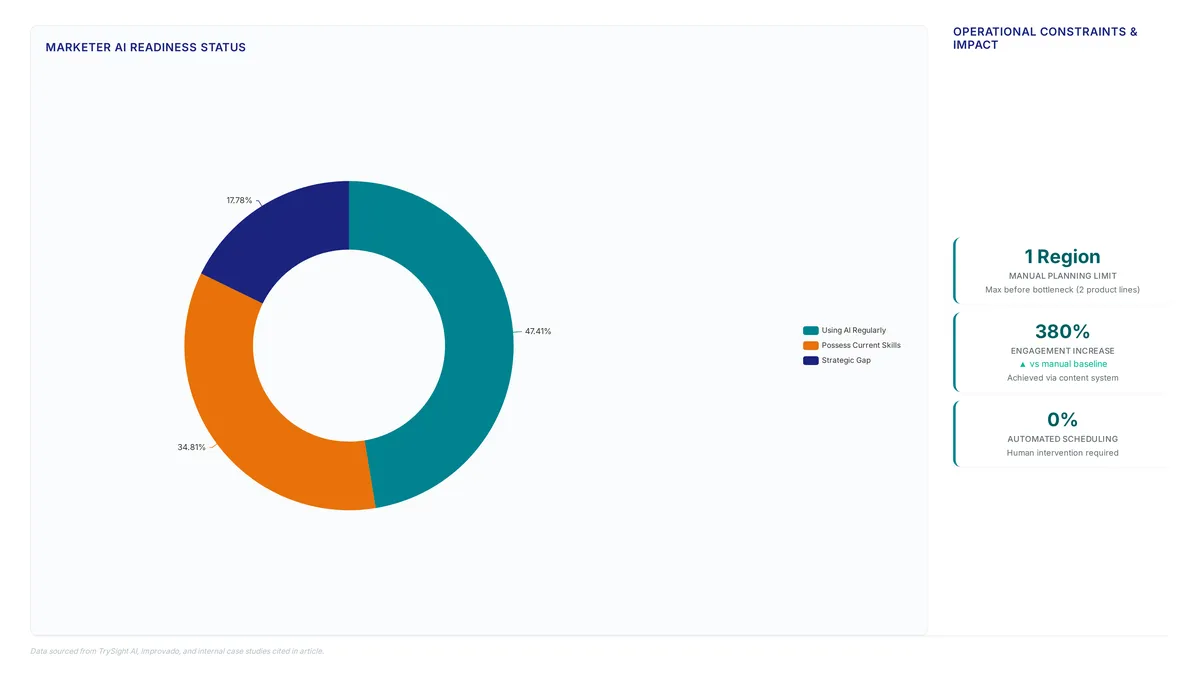
Implementation begins by establishing data infrastructure, auditing sources, and cleaning historical data. This core phase prevents the "noise" outcomes common when AI investment lacks strategic oversight. Teams must centralize performance signals before attempting automation, as manual planning bottlenecks after managing only one region and two product lines. Without clean, centralized marketing data, AI models train on noise rather than utility.
The transition from pilot to scale often stalls because many marketers already use AI tools without centralized direction. Fragmentation creates siloed experiments rather than a cohesive decision engine. A human strategist cannot manually correlate signals across eight channels effectively, necessitating the shift to algorithmic prioritization. Rushing implementation without verified data quality introduces significant operational risk. Premature scaling costs stakeholder trust in the system's output. Enterprise teams should ensure each gate is met with verified data quality before expanding scope.
Executing the Pilot Phase with a Single Team to Validate Efficiency Metrics
Deploy the system to one team to capture feedback on ignored versus adopted recommendations. This narrow scope isolates variable noise before enterprise-wide scaling.
Blind automation fails when strategic context is missing; many marketers lack a clear plan for using AI across research and distribution, creating a strategic gap that pilot data must resolve. Without this validation layer, organizations risk scaling inefficiencies rather than eliminating them. The pilot phase reveals whether the system reduces the opportunity cost inherent in manual planning for global brands, where most content currently lacks deep strategic oversight.
Teams must distinguish between useful strategic signals and algorithmic noise before expanding scope. A single human strategist augmented by AI can manage workloads requiring eight product categories and 15 buyer personas, a scale otherwise demanding an expensive team. However, this capacity only materializes if the pilot phase successfully filters low-value suggestions. Entering full production without validating these efficiency impacts leads to alert fatigue and eventual system abandonment. Structuring this validation ensures the decision engine aligns with specific business constraints before broader deployment. The outcome determines whether the architecture supports true strategic scaling or merely accelerates content churn.
Build Versus Buy: Resource Trade-offs Between Custom ML Teams and Packaged Platforms
Technical implementation varies notably between approaches. Some teams build custom pipelines using open-source LLMs and internal data science resources, while others use specialized platforms that package the workflow. This creates a variation in resource allocation; custom builds require significant data science maturity, whereas packaged solutions offer quicker time to value. The constraint is architectural flexibility; custom builds allow deep integration with proprietary datasets, while packaged solutions enforce vendor-specific logic.
Manual planning acts as a bottleneck that forces a choice between hiring expensive teams or accepting a lack of oversight, whereas AI ecosystems connect creativity and analytics into a smooth loop that predicts intent. Some organizations adopt a hybrid path, using platforms for core functionality while retaining custom models for unique workflows. Others rely on solution strategists to define exactly what to hand off to AI and what to keep human.
| Feature | Custom Build | Packaged Platform |
|---|---|---|
| Time to MVP | Extended timeline | Days to weeks |
| Staffing | High data science dependency | Minimal IT lift |
| Flexibility | Total control | Vendor constrained |
| Maintenance | Internal burden | Vendor managed |
For most enterprises seeking immediate strategic scaling without diverting core engineering resources, the packaged approach offers a viable path forward.
- Audit current data infrastructure for compatibility with pre-trained models.
- Select a platform supporting marketing data integration to unify siloed sources.
- Deploy to a single team to validate efficiency gains before full rollout.
The limitation of the build path is not initial development but the ongoing maintenance of model accuracy as market conditions shift.
Measurable Business Outcomes from Automated Content Strategy
Defining Measurable Efficiency and Performance Metrics for AI Strategy
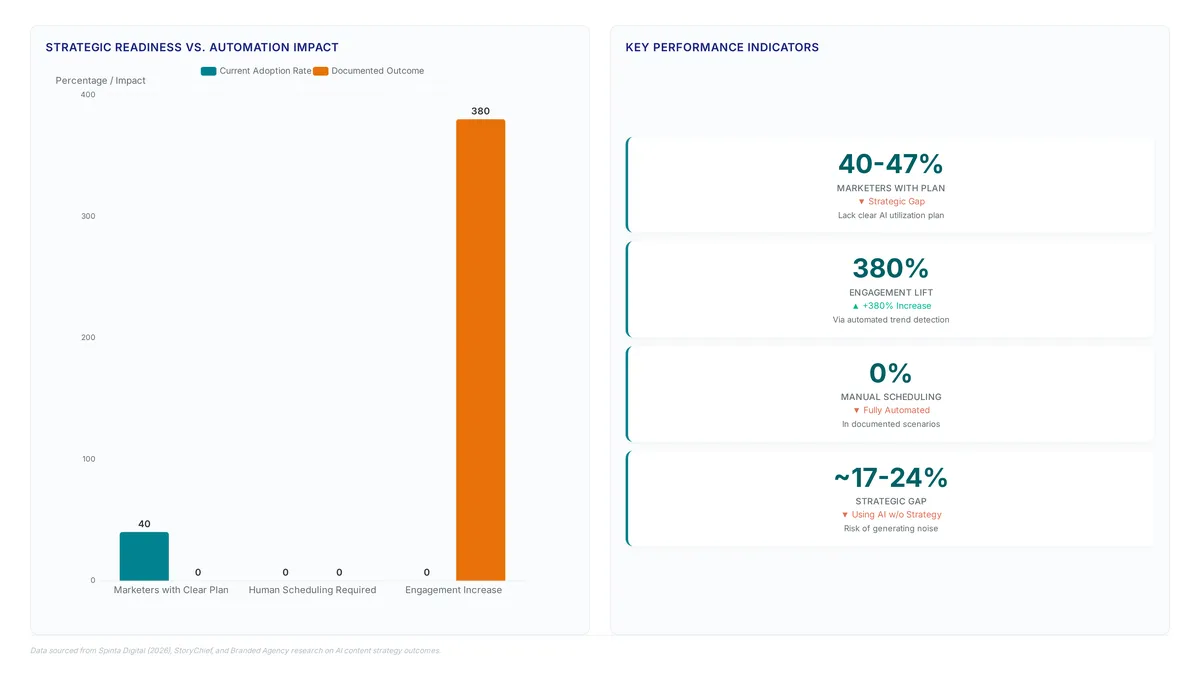
Validating an AI content strategist requires separating planning velocity from revenue attribution. Teams often conflate quicker output with improved strategy when distinct metrics are absent. Efficiency gains appear immediately in operational cadence. A human content strategist can reasonably oversee content operations for only one region and two product lines before manual planning becomes a bottleneck, necessitating AI intervention for larger scales. By automating data aggregation, teams shift analyst time from manual wrangling to hypothesis testing. These benchmarks prevent the common failure mode where AI implementation generates noise rather than utility, ensuring investment yields useful outcomes instead of mere volume.
Performance metrics demand a longer horizon. Efficiency stabilizes quickly, yet systems must ingest historical performance data to correlate content attributes with business outcomes, moving beyond simple traffic counts to revenue impact. In documented scenarios, AI-driven systems have achieved significant engagement lifts by detecting trend windows and repurposing content without human scheduling.
| Metric Category | Target Outcome | Measurement Window |
|---|---|---|
| Planning Velocity | Scale beyond manual limits | Immediate |
| Production Cycle | Automated trend detection | Continuous |
| Revenue Attribution | Correlated business outcomes | Long-term |
Data readiness creates the critical distinction; fragmented sources degrade model accuracy regardless of algorithmic sophistication. Teams lacking centralized data warehouses often fail to achieve the necessary signal-to-noise ratio for reliable forecasting. Enterium solves this by engineering the data infrastructure layer first, ensuring your content performance diagnosis rests on verified inputs before automating decisions. Strategic recommendations remain speculative without this foundation.
Real-World ROI: Editorial Roadmap Planning and Audience Segmentation Cases
Editorial roadmap planning accelerates strategy by automating gap analysis against search demand. This acceleration allows teams to react to market signals rather than waiting for quarterly reviews. When Cushman & Wakefield targeted enterprise CMOs, they deployed an AI-driven campaign to generate case studies and whitepapers, streamlining production for a high-value audience. The system identified specific content attributes required by decision-makers, removing manual coordination overhead.
Audience clustering drives segment-specific engagement by matching format to persona constraints. CFOs often require concise financial reports, whereas IT directors prefer deep technical guides. In one documented scenario, an AI system achieved a dramatic increase in engagement by detecting trend windows and repurposing content without human scheduling. This approach eliminates the latency inherent in manual redistribution workflows.
| Deployment Focus | Primary Metric Shift | Operational Constraint |
|---|---|---|
| Roadmap Planning | Cycle time reduction | Requires clean historical data |
| Audience Clustering | Engagement lift | Needs behavioral segmentation |
Efficiency gains typically appear as teams scale, yet a critical tension exists between speed and strategic depth. Rapid iteration can dilute brand voice if the underlying data lacks governance. Most content produced without deep strategic oversight incurs a high opportunity cost for global brands. Teams must balance the velocity of automated recommendations with rigorous human oversight on messaging frameworks.
Enterium integrates these planning and segmentation modules to enforce quality gates before publication. The platform ensures that accelerated roadmaps do not bypass compliance or brand standards. The immediate next step is auditing your current data centralization to support automated decision engines.
Data Readiness Checklist: Infrastructure Requirements for Deployment
Only between 40% and 47% of marketers currently possess a clear, practical plan for how their teams apply AI for research, creation, and distribution, highlighting a significant strategic gap. Automation increases noise rather than insight unless organizations resolve data silos first. Specific deployment timelines vary based on existing infrastructure, yet the divergence between centralized and fragmented data states defines the critical path for enterprise adoption.
| Data State | Implementation Focus | Primary Bottleneck |
|---|---|---|
| Centralized | Model fine-tuning | Data quality |
| Fragmented | Pipeline integration | Data silos |
Technical architectures require clear ownership splits where humans approve final content and automated systems handle repeatable tasks to maintain quality. Enterium recommends validating data ingestion pipelines before deploying recommendation engines. A common failure mode involves skipping the governance layer, leading to un-auditable handoffs between human and automated systems that compromise brand voice. The cost of delayed readiness is lost market velocity; competitors with unified data lakes execute strategy cycles while others remain stuck in extraction. Start by auditing CRM and CMS connectivity. If your marketing data warehouse cannot serve real-time attributes to an LLM, pause automation plans. Fix the foundation first.
About
Sofia Marchetti is a B2B content and demand-generation strategist who specializes in aligning automated content systems with revenue outcomes. Her decade of experience in B2B SaaS makes her uniquely qualified to define the AI content strategist role, as she has directly observed how manual workflows fracture when scaling across eight channels and multiple regions. In her daily work, Sofia architects pipelines where intelligence layers analyze performance signals to drive decisions, moving beyond simple keyword research to predictive analytics. This practical expertise anchors the Enterium methodology, which documents how modern teams build scalable content operations without relying on hype. At Enterium, the editorial front for enterium.ai, she translates complex pipeline architecture into reproducible strategies for technical marketers. By focusing on the intersection of LLM automation and topical authority, Sofia provides the vendor-neutral, practitioner-led guidance necessary for leaders proving ROI. Her insights ensure that content strategy evolves from static planning to a flexible, data-driven engine capable of compounding growth over time.
Conclusion
Scaling AI strategy breaks when the underlying data layer cannot support real-time attribute retrieval, turning potential engagement gains into operational debt. The ongoing cost of skipping infrastructure validation is not merely financial but strategic, as fragmented pipelines prevent the detection of high-value trends that centralized systems catch instantly. Organizations must accept that data readiness is the sole determinant of whether automation amplifies voice or accelerates noise. We recommend pausing any broad rollout of generative tools until your current stack can normalize at least 12 months of historical performance metrics without manual intervention. This timeline is non-negotiable for enterprises seeking sustainable growth rather than temporary spikes. Without this foundation, even the most sophisticated models will hallucinate strategy based on incomplete signals. Start this week by testing your CRM and CMS connectivity to verify if your system can serve real-time customer attributes to an inference engine. If that test fails, redirect all resources toward fixing these ingestion pipelines before attempting further model deployment. True velocity comes from a stable foundation, not quicker output. Prioritize fixing your data architecture to enable reliable automated decision-making.
Frequently Asked Questions
Systems need at least 12 months of normalized historical data to verify performance metrics accurately. Without this baseline, the marketing data warehouse cannot distinguish signal from noise effectively.
A human strategist typically bottlenecks when overseeing more than two product lines and one region. This limit forces teams to adopt automation to handle complex, multi-market analysis without scaling headcount proportionally.
Between 40% and 47% of marketers lack a practical plan for AI research and distribution. This strategic gap prevents organizations from moving beyond simple tools to achieve true operational scale and efficiency.
No, AI optimizes within frameworks but cannot define unique brand voice or ethical stances. Human oversight remains mandatory to interpret causation and navigate political priorities that algorithms simply cannot understand or address.
This outcome requires a unified data layer to identify high-value topics that drive pipeline rather than just traffic.
References