Content engine traffic: How Grizzle hit 441%
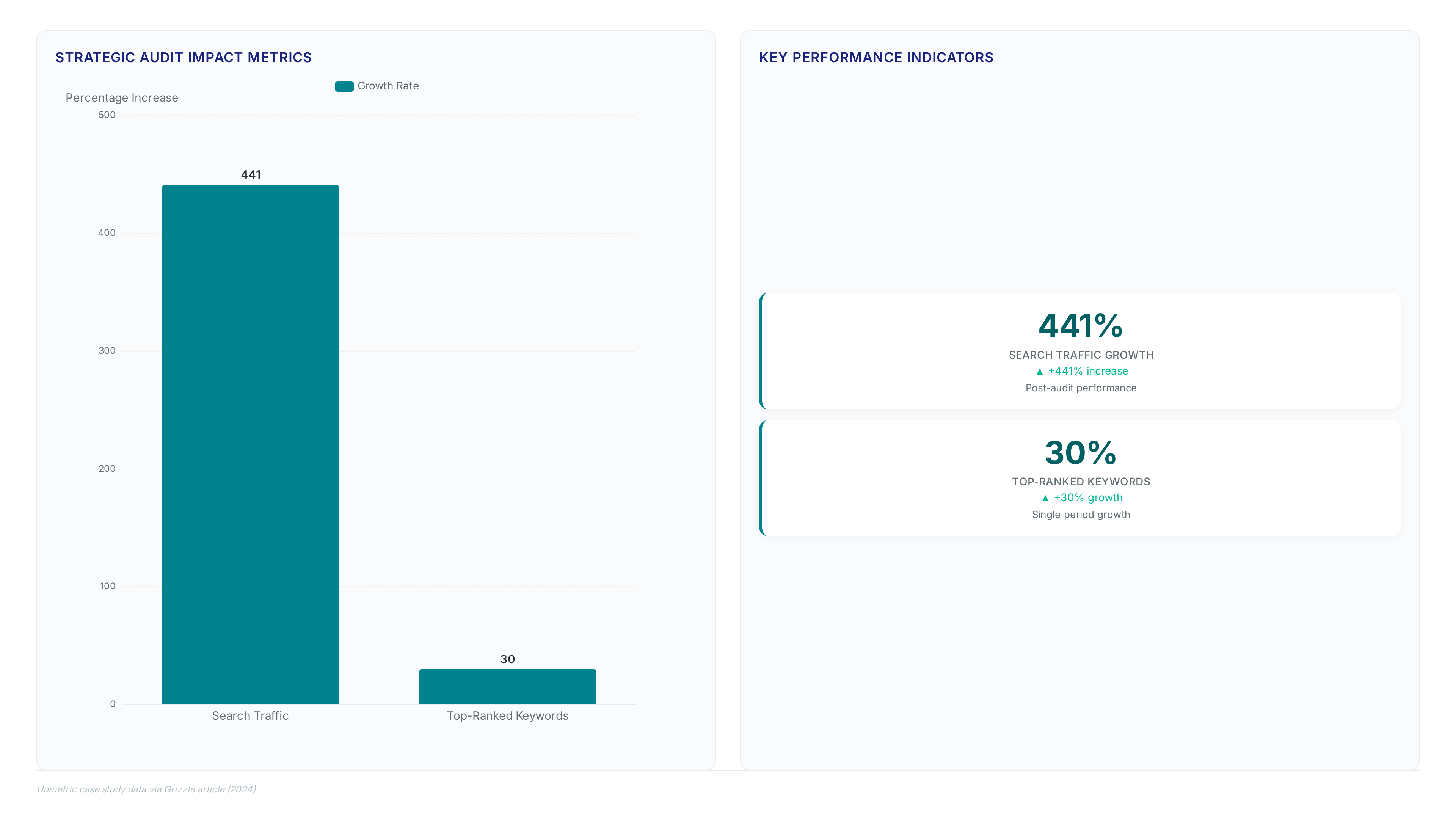
Grizzle helped Unmetric achieve a 441% increase in search traffic by replacing duct-tape workflows with a unified content engine. We examine how codifying brand voice through SME interviews and audience research prevents the loss of institutional knowledge that plagues most automated systems.
You will learn how to construct a codified workflow that manages ideation, briefs, and QA within a single operational infrastructure. The discussion details the transition from fragmented vendor management to a disciplined system capable of supporting GEO and SEO programs simultaneously. We also explore how strategic content audits identify high-impact improvements across the buyer path to change existing assets into conversion drivers.
Sustainable growth requires more than volume; it demands the expert oversight necessary to maintain taste at scale. Data from Grizzle shows that clients optimizing hundreds of pieces can see a 30% growth in tracked keywords ranked 1-3 in a single month. This piece outlines the specific architecture required to build a pipeline that ships consistently while adhering to a rigorous quality bar.
The Role of Editorial Oversight in Modern AI Content Engines
Defining the AI Content Engine Beyond Duct Tape Workflows
Stop calling it a stack if the pieces don't talk. An AI content engine functions as a unified production system, not a scrapyard of manually stitched tools. Current implementations often resemble "duct tape" architectures where isolated software creates inconsistent quality while erasing institutional knowledge over time. Performance metrics spike initially, then plummet, because the workflows lack necessary editorial taste. A reliable engine integrates editorial oversight directly into automated pipelines to maintain standards at high volumes. Grizzle addresses this challenge by providing a single system for both editorial and video content, ensuring expert guidance scales alongside AI generation. This approach combines human expertise with automated processes to prevent the loss of strategic context. Without this specific integration, teams struggle to maintain the human touch required for high-performing content.
Operational differences appear in measurable outcomes. Properly codified systems drive significant traffic increases, as seen when a SaaS team achieved a 441% increase in search traffic through targeted outreach and executive thought leadership. This result stems from treating content operations as engineered infrastructure rather than a series of ad-hoc tasks. Speed tempts teams, but depth of voice codification wins. The operational implementation period for building these engines typically takes two to three months to complete. Teams must prioritize defining domain research parameters, using SME interviews and audience research to understand products and buyers inside out before scaling distribution.
Operationalizing Editorial Oversight Through Context and Build Phases
Codifying human expertise into machine-readable constraints before generation begins is necessary for editorial oversight in AI content. The Context phase executes this translation by turning SME interviews and domain research into explicit voice guidelines, ensuring the system understands buyer categories rather than just keywords. Automated pipelines increase generic patterns instead of distinct brand signals without this core step.
The subsequent Build phase constructs the production infrastructure where ideation, briefs, and QA run as integrated workflows. This operational period typically spans two to three months to fully document processes and establish quality thresholds. Disconnected tools create inconsistent output and erase institutional knowledge when teams bypass this structured approach, leading to the "duct tape" architecture problem.
Establishing these systems demands a shift from ad-hoc experimentation to rigid process adherence. Senior editors and writers produce the first publishable pieces by hand to establish an editorial bar for AI workflows to adhere to. Generic AI generators lack the human-in-the-loop checkpoints required to maintain editorial taste at scale.
| Phase | Primary Input | Output Artifact |
|---|---|---|
| 01. CONTEXT | SME Interviews | Codified Voice Rules |
| 02. BUILD | Domain Research | Automated QA Workflows |
Shipping content in weeks rather than months while preserving quality standards marks successful deployment. Real-world application shows that combining expert oversight with AI workflows drives significant organic growth, as seen in cases achieving massive search traffic increases. Infrastructure quality dictates content ceiling; improved pipes yield improved water.
Next step: Map your current SME interview process to identify missing voice constraints before automating production.
Mitigating the Risk of Quality Plummeting Without Editorial Taste
Performance collapses when AI pipelines lack editorial taste, causing traffic to spike briefly before plummeting as generic outputs saturate the index. This volatility stems from workflows that prioritize volume over the detailed authority required to rank in AI Overviews. Unguided models lack the specific context derived from deep category immersion, leading to content that fails to meet credibility standards unlike human writers who synthesize domain expertise. Systems without rigorous quality gates lose institutional knowledge and fail to compound value effectively.
The company claims its approach prevents the common pitfall where results spike and then plummet due to workflows lacking taste. Grizzle prevents this regression by targeting placements specifically within publications that appear in AI Overviews and Large Language Models (LLMs). This strategic focus demands a quality control layer where senior editors codify voice before automation scales production. The AI content engine merely accelerates mediocrity rather than compounding value without this human-in-the-loop constraint. Operators must recognize that scaling flawed heuristics only deepens the deficit in trust signals required for modern search visibility.
| Failure Mode | Root Cause | Consequence |
|---|---|---|
| Traffic Spike & Plummet | Workflows lack taste | Lost institutional knowledge |
| Generic Output | No SME codification | Exclusion from AI Overviews |
| Vendor Friction | Duct tape systems | Inconsistent quality at scale |
SaaS teams attempting to sync disparate tools often face broken data flows that undermine content operations. Sustainable growth requires integrating expert review directly into the generation pipeline. Teams should audit current workflows for manual gaps where brand voice degrades before publication.
Inside the Architecture of a Codified AI Content Workflow
Codifying Brand Voice Through SME Interviews and Product Immersion
Extracting a distinct voice demands structured SME interviews and sales recording reviews before any AI generation begins. This Embed and architect phase prevents the broken syncs and rigid data schemas common when teams attempt to integrate generic generators with CRMs like Salesforce broken syncs. Workflows lack the specific context needed to distinguish brand authority from average patterns without this immersion. Senior editors manually produce initial publishable pieces to set a tangible editorial bar. This human-first benchmark provides the ground truth that automated systems subsequently emulate. Skipping manual benchmarking accelerates launch but guarantees future rework as models drift toward generic outputs. Most operators ignore this reality. Their systems require constant human correction rather than scaling autonomously. The limitation is temporal. This process demands upfront investment that delays immediate volume but secures long-term consistency. Enterium recommends treating these early drafts as versioned artifacts subject to strict acceptance tests. A pipeline that increases noise rather than signal is the consequence of omitting this step. Operators must define the unique voice through human example before automation can replicate it effectively.
Executing the Build Phase: From Hand-Crafted Benchmarks to Automated Pipelines
Senior editors manually draft initial publishable pieces to establish a concrete editorial bar before automation begins. This human-first benchmark prevents the quality inconsistency common when teams skip the Benchmark and codify step in favor of immediate scaling. Generic generators struggle with context, so this process ensures the system learns from verified expertise rather than average patterns top talent. The team then constructs the pipeline by building custom automations and layering in mandatory human-in-the-loop checkpoints at specific gateways. These gates integrate directly with the client's existing technology stack to maintain workflow continuity without requiring platform migration.
Scaling Content Engines: Validating GEO Programs and SEO Pipeline Readiness
Validating GEO programs requires confirming that multiple pipelines share a single, codified engine rather than isolated tools. Teams often mistake disconnected automation for scale, yet true readiness demands that SEO pipelines and generative engine optimization efforts draw from the same editorial bar. Quality degrades as volume increases without this unified architecture, creating the "duct tape" infrastructure problem. The operational tension lies between speed of deployment and depth of product immersion. Rushing the 03. SCALE phase before completing 02. BUILD creates systems that cannot distinguish brand authority from noise.
Measurable ROI from Strategic Content Audits and AI Scaling
Defining AI Citation Frequency as a Core ROI Metric
Success now demands tracking AI citation frequency rather than relying solely on traditional keyword positions. The industry is shifting focus toward measuring presence in AI Overviews and Large Language Models, a transition that renders volume-only strategies obsolete for teams asking if they should use AI for content scaling. Grizzle differentiates its approach by targeting publications specifically known to appear in these AI responses, integrating citation frequency alongside Domain Rating lift in its reporting framework. Most teams fail to solve content performance drops because they automate broken workflows, resulting in inconsistent quality that erodes domain authority over time. The mechanism here relies on senior editors manually producing initial publishable pieces to establish a concrete editorial bar. This human-first benchmark provides the ground truth that AI workflows subsequently emulate, preventing the "duct tape" infrastructure where results spike then plummet.
Generic systems prioritize throughput, often sacrificing the specific context needed to secure high-value assets. A persistent tension exists between scaling volume and maintaining the nuance required for tier 1 placements. By contrast, this approach integrates human-in-the-loop checkpoints directly into the production pipeline. Senior staff conduct SME interviews and review sales recordings to architect the tech stack and job-to-be-done specifications. The system learns from verified expertise rather than averaging web patterns.
The limitation of this method is the upfront time investment required to document processes and conduct deep domain research. Teams seeking immediate, low-cost volume will find the Benchmark and codify phase restrictive. Skipping this step causes the loss of institutional knowledge and a reliance on fragile vendor relationships. Once the engine is built, it scales across SEO programs and digital PR efforts while maintaining high standards. William Sigsworth notes that optimizing hundreds of pieces through this structured partnership achieved 30% growth in top-ranked keywords in a single month. To replicate these results without the performance volatility, operators must prioritize embedded operations over quick-fix tools. Enterium recommends starting with a strategic audit to map existing workflows before introducing automation layers.
Checklist for Transitioning from Ad-Hoc Creation to Embedded Operations
Transitioning requires replacing chaotic output with documented processes that prevent team exhaustion. SaaS companies increasingly adopt these operational foundations to scale without burning out staff operational foundations. Validate your shift using this sequence:
- Audit existing workflows to identify broken syncs and orphaned data points.
- Codify editorial voice through SME interviews before automating any generation tasks.
- Integrate human expertise directly into AI loops to maintain credibility and originality human expertise.
- Establish quality gates where senior editors manually produce initial benchmarks for the system.
Pure automation platforms often fail because they lack strategic direction and executive thought leadership pure automation platforms. Enterium recommends embedding operations rather than layering tools onto broken infrastructure. The table below contrasts the two operational models:
| Feature | Ad-Hoc Creation | Embedded Operations |
|---|---|---|
| Workflow State | Chaotic and reactive | Documented and repeatable |
| Quality Source | Variable writer skill | Codified editorial bar |
| Scaling Method | Add more writers | Optimize system logic |
| Outcome | Inconsistent output | Compounding growth |
Teams often assume adding more AI tools solves volume issues, yet this ignores the root cause of quality inconsistency. Increased production velocity only accelerates reputation decay without a fixed editorial bar. True scalability emerges when human judgment defines the rules that machines execute.
Building a Custom AI Content Engine in Five Strategic Steps
The Three-Phase Methodology: Embed, Benchmark, and Automate
Grizzle uses a three-phase methodology refined over 10+ years of experience to replace duct-tape infrastructure with engineered consistency. This framework transitions teams from chaotic output to predictable scale by codifying human expertise before applying automation.
- 01. Embed and architect: The team conducts SME interviews and reviews sales recordings to map the specific tech stack and job-to-be-done.
- 02. Benchmark and codify: Senior editors produce initial publishable pieces by hand, establishing the editorial bar that AI workflows must emulate.
- 03. Automate and operate: Builders layer human-in-the-loop checkpoints into the pipeline and integrate with existing systems for sustained operation.
Unlike pure automation platforms that track model mentions, this embedded operations model includes strategic direction and executive thought leadership. Workflows without taste lead to low-performing content at high volume, where results spike and then plummet, and institutional knowledge gets lost.
Executing the Build: From SME Interviews to Tier 1 Backlinks
Senior editors must manually draft the first publishable assets to establish a concrete editorial bar before any automation begins. This benchmark prevents the inconsistency common in duct-tape infrastructures where quality degrades as volume increases. The mechanism relies on SME interviews and sales recordings to codify domain nuance that generic models miss. Grizzle executes this through a strict three-phase sequence that prioritizes architectural integrity over speed.
- Embed and architect by mapping the specific tech stack and job-to-be-done through deep product immersion.
- Benchmark and codify using hand-written samples to set the quality standard for subsequent AI generation.
- Automate and operate by layering human-in-the-loop checkpoints into the finalized workflow.
The result of this disciplined approach is measurable in external validation rather than just internal velocity. Grizzle offers a strategic content audit to assess existing content across the buyer process, reviewing line by line to recommend data-backed editorial, structural, and CRO improvements. Book a call to begin transforming your infrastructure from chaotic output to a scalable engine.
Vendor Selection Checklist: Auditing Workflows and Codifying Specs
- Map existing workflows to locate orphaned data points and broken syncs. Prospective clients are offered a complimentary AI Content Audit that maps current workflows and infrastructure.
- Define editorial specifications using human-authored benchmarks rather than synthetic averages. Generic generators often struggle with context, necessitating a model that pairs top talent with automated loops.
- Validate strategic scope beyond simple task automation. The audit identifies the highest-use workflows to codify and creates specs for the first content pipelines.
| Feature | Generic Automation | Strategic Partner |
|---|---|---|
| Voice Consistency | Variable, degrades at scale | Codified via SME interviews |
| Integration Depth | API-only connectors | full-stack architecture |
| Outcome Focus | Volume output | Organic growth systems |
Grizzle recommends demanding a written specification for the first pipeline before deployment. This document acts as the binding contract for quality, ensuring the system ships assets that meet the established bar. The operational risk lies in automating undefined processes; scaling chaos only accelerates failure. Teams must codify the voice manually before configuring the machine to replicate it.
About
Arjun Patel is an Applied LLM Engineer who specializes in benchmarking LLM providers and RAG architectures for high-volume content workloads. His expertise directly addresses the complexities of building a reliable content engine, a system often plagued by fragile, "duct-tape" integrations that sacrifice quality for scale. Unlike theoretical strategists, Patel's daily work involves rigorous, vendor-neutral evaluation of inference economics, latency, and output consistency across substantial models. This hands-on experience allows him to dissect how editorial taste can be codified into automated workflows without losing institutional knowledge. At Enterium, a publication dedicated to documenting how modern teams actually ship AI-driven content, Patel translates these technical realities into reproducible methodologies. He connects the abstract promise of AI to the concrete needs of B2B marketing operations, ensuring that content pipelines are built on reliable architecture rather than hype. His analysis provides the precise, data-backed guidance necessary for teams aiming to scale content production while maintaining rigorous quality gates.
Conclusion
Scaling content production reveals a critical fracture point where voice consistency degrades unless human-authored benchmarks strictly govern the output. While early wins often showcase massive traffic spikes, the ongoing operational cost of unregulated automation is the silent erosion of brand authority as volume increases. The industry is rapidly shifting focus from simple keyword rankings to tracking AI citation frequency and presence in generative answers, making data integrity more valuable than raw throughput. Teams relying on generic generators without deep integration will find their assets ignored by these new evaluation models.
You must codify editorial specifications using hand-written samples before deploying any automated pipeline. Do not attempt to scale a process that lacks a written definition of quality, as this merely accelerates failure. Start by mapping your existing workflows this week to locate orphaned data points and broken syncs before adding more generative tools. This diagnostic step exposes the structural gaps that low-volume testing often hides. Once you identify these fractures, define your voice manually to create a binding contract for your system. Only then should you configure machines to replicate that standard. By prioritizing strategic scope over simple task automation, you ensure your infrastructure supports sustainable organic growth rather than chaotic output.
Frequently Asked Questions
Unified systems can drive a 441% increase in search traffic by replacing fragmented tools. This massive surge occurs because engineered infrastructure prevents the quality collapse often seen with ad-hoc vendor management and disjointed software stacks.
Clients optimizing hundreds of pieces often see 30% growth in top-ranked keywords within one month. This rapid acceleration happens when strategic audits transform existing assets into high-converting drivers through data-backed editorial improvements.
Constructing a robust operational engine typically requires two to three months for completion. This period allows teams to properly codify voice rules and establish quality thresholds before scaling distribution across multiple pipelines.
Generic tools lack the human-in-the-loop checkpoints needed to preserve institutional knowledge during scaling. Without expert oversight codified into workflows, content quality inevitably spikes initially before plummeting due to inconsistent output standards.
Successful codification demands deep SME interviews and thorough audience research as primary inputs. These elements translate human expertise into machine-readable constraints, ensuring the system understands buyer categories rather than just simple keywords.
References