Editorial judgment saved sites from Google's March 2024
Google's March 2024 update removed an estimated 45 percent of unoriginal content, proving that raw AI volume fails without human oversight.
As editorial judgment now dictates search survival more than production speed. You will learn how top performers integrate user research to define content strategy before a single word is drafted. We will also detail the specific editorial workflow changes required to change AI outputs into ranking assets that satisfy both algorithms and readers.com/google-wiped-out-45-of-ai-content-in-one-update-heres-what-the-survivors-did-differently/), the resulting traffic decline forced a pivot back to quality. Sites that survived the 45-day rollout did so by applying strict editorial control rather than increasing output.
The Mechanics of Google's Helpful Content Signals in the Post-AI Era
How March 2024 Integrated Helpful Content Signals
Google's March 2024 core update fused helpful-content signals directly into the primary ranking algorithm. This algorithmic integration spanned 45 days and excised 45 percent of unoriginal material from search indices. High-volume, low-effort production cycles lost their advantage overnight. Sites depending on raw AI drafts without editorial judgment suffered immediate de-ranking as the system began favoring original insight over mere speed. Human oversight gaps in final outputs caused most AI content to lose traction. Excessive automation with scant review triggered quality filters built to surface genuine expertise. Content teams had to rethink workflows where production volume once hid a lack of substance. The update never banned AI tools but destroyed the business case for publishing them without rigorous editing.
Undifferentiated pages now face algorithmic removal regardless of creation tool. Strict quality gates before publication are necessary for survival against future shifts. Enterium supplies the editorial infrastructure needed to enforce these standards at scale. Automated pages lacking verified human expertise remain vulnerable to deletion during the next core cycle.
Why Minimal Editorial Oversight Triggers AI Penalties
Generic AI-generated articles fail because they miss the specific user insights required to satisfy helpful content signals. Marketing teams publishing at scale without review create a volume trap where quantity dilutes quality, triggering algorithmic de-ranking. This pattern emerged clearly as organic traffic peaked in late 2024 before collapsing. The core issue involves the absence of editorial judgment in the final workflow rather than the tool itself. Sites relying on this approach face a binary outcome: differentiation drives survival while volume-focused strategies hit a traffic cliff.
Data shows human-written content generates 5.44 times more traffic than pure AI output over a five-month period comparative study. Failure modes remain consistent as models produce confident assertions without sources, leading to generic comparison frames that readers ignore. Google's systems detect this lack of original insight quickly. Strategic errors involve prioritizing output speed over value verification. Organizations shifting focus from production volume to differentiation recovered rankings by mid-2025. Enterium solves this by embedding mandatory human review gates into every automated pipeline, ensuring no draft publishes without expert validation. This approach prevents the "bland assertion" penalty entirely. Skipping this step costs total visibility loss in competitive verticals. Operators must treat editorial oversight as a technical requirement, not an optional polish. Content assets become liabilities without it.
The 61% Click-Through Rate Drop from AI Overviews
Direct answer engine saturation now intercepts user queries before a site visit occurs, reducing click-through rates by up to 61% click-through rates. This mechanism bypasses traditional ranking rewards, creating a false sense of security for publishers whose content technically ranks but generates no traffic. Approximately 60% of all search queries now end without a click to any website search queries. Risk compounds because zero-click results satisfy intent immediately, rendering high-volume production strategies obsolete regardless of prior algorithmic performance.
Structural limitations mean relying on ranking signals alone no longer guarantees visibility when the interface itself absorbs the answer. Operators must shift focus from mere indexation to earning the specific click through unique data or perspective. Enterium provides the editorial infrastructure required to embed human judgment into these workflows, ensuring content offers value beyond what an overview can summarize. Sites remain vulnerable to total traffic decoupling despite maintaining technical compliance without this differentiation. The next step involves auditing current content for unique insight density rather than keyword coverage.
Human Editorial Judgment Outperforms Raw AI Volume in Search Rankings
Defining Editorial Judgment as the New Competitive Moat
Market noise in 2026 separates high-performing assets from algorithmic debris through a single filter: editorial judgment. Hassan Rashid, managing editor at GrowthX AI, an AI-augmented B2B content startup that closed $12 million in Series A funding last year, calls this capability the definitive market moat. Artificial intelligence raised the floor on production speed long ago. The strategic differentiator now rests entirely on human capacity to flag output that is bland, generic, or factually incorrect. Many organizations lack this specific taste. Such a deficiency degrades search rankings within six months of deployment. Generic content farms often target broad keywords across multiple industries and lose visibility to niche competitors.
| Dimension | Raw AI Volume Strategy | Editorial-Led Workflow |
|---|---|---|
| Primary Input | Prompt-only generation | SME interviews and user research |
| Quality Gate | Automated grammar checks | Human validation of claims |
| Search Outcome | Volatile traffic patterns | Sustainable growth curves |
A science-focused website demonstrated that even fully AI-generated content can achieve a 19x increase in impressions if it adheres to specific quality and editorial standards. Tool selection matters less than the strategy governing its use. Content lacking proof or original insight fails to convert because it does not solve specific user problems. Enterprises relying solely on scaling page counts without human oversight often replicate weak trust signals rather than generating real demand. The operational imperative shifts from maximizing word count to validating the utility of every published assertion.
Applying Human Oversight to Fix Voice Drift and Unverified Claims
Human judgment must intervene before a draft reaches a content management system to correct voice drift and unverified claims. Hassan Rashid treats editorial work as a discipline of inputs and outputs rather than a final polish. This approach addresses the recurring failure where models adopt a generic startup register instead of the client's specific audience cadence. Data indicates that platforms measuring user engagement show human-generated content outperforms AI by roughly 47%. A science-focused website demonstrated that adhering to strict editorial standards yielded a 19x increase in impressions, moving from 34 to 633 in a single month. These metrics suggest organizations should hire an editor for AI content specifically to validate assertions and enforce tonal consistency.
| Failure Mode | Raw AI Output | Human-Edited Result |
|---|---|---|
| Claim Verification | Confident assertions with no source | Validated data points only |
| Tonal Alignment | Generic startup register | Client-specific cadence |
| Strategic Value | Repetitive comparison frames | Unique expert reasoning |
Editorial judgment must occur upstream during the SME interview phase, not downstream during proofreading. Rashid recommends recording a five-to-ten-minute conversation with a domain expert and feeding the transcript into the workflow. This ensures the article emerges with the expert's reasoning intact. The time cost is real. Initial production slows down. Ranking collapse seen in 2024 becomes preventable. Teams asking when to use AI for content creation should deploy it only after securing expert transcripts to serve as the source of truth.
The Ranking Collapse Risk of Missing Editorial Judgment
Google's March 2024 core update removed an estimated 45 percent of low-quality, unoriginal content from search results in a single cycle. Production speed is now a commodity. Editorial judgment serves as the primary defense against traffic collapse. Brands prioritizing volume over value face the risk of a "heartbreaking plunge to zero" traffic, effectively writing off the entire content production budget allocated to those failed campaigns. AI drafts frequently exhibit voice drift or unverified claims that algorithms increasingly penalize without human oversight.
Exclusion from search visibility is the cost of non-compliance with new E-E-A-T signals. Pages without these signals are systematically de-ranked regardless of production speed. Most companies lack the sharp taste required to catch bland or wrong output. This deficiency can tank rankings six months later. The strategic error lies in treating AI as a complete publishing pipeline rather than a drafting tool requiring rigorous human validation. Operators must shift focus from output volume to the quality of the human envelope surrounding the production layer. Failure to implement these checks leaves organizations vulnerable to the same algorithmic filters that reset the market in 2024.
Building an Editorial Workflow That Integrates SME Interviews and User Research
Defining the Human Envelope Around AI Production
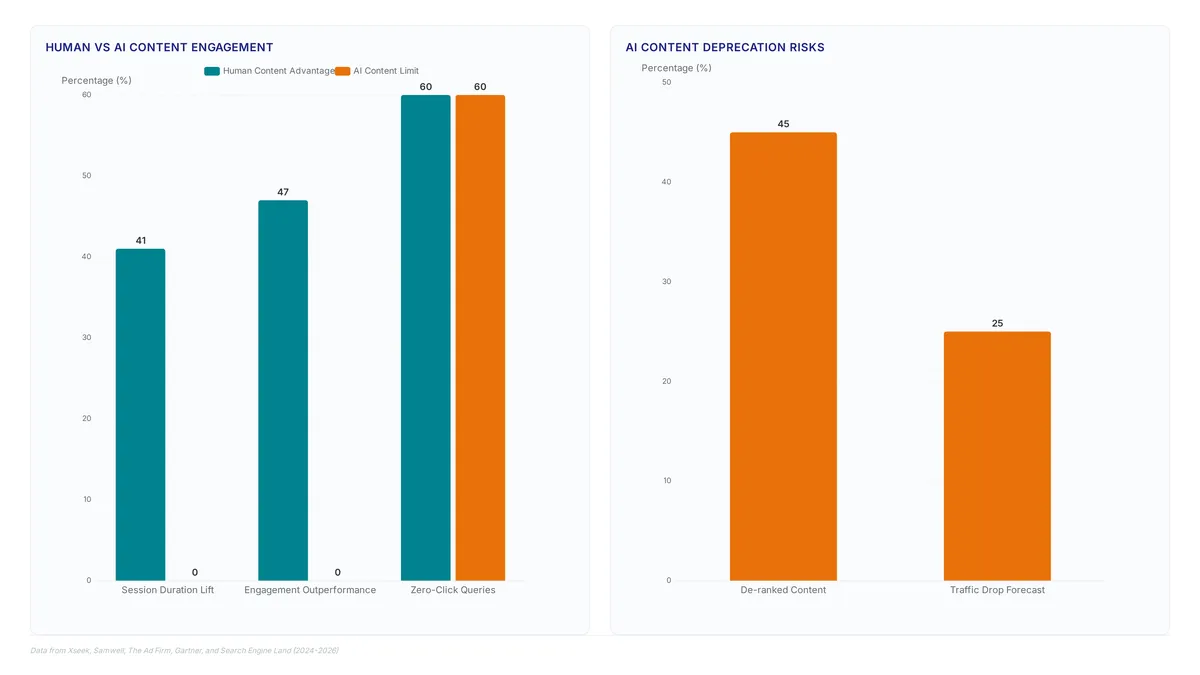
The human envelope functions as a critical quality boundary that wraps the production layer to prevent algorithmic penalties. Rashid argues that while many heavy-AI-content sites had editorial reviewers after March 2024, they failed to provide this specific structural boundary around generation. Human-written content achieves session durations that are significantly longer than those generated by AI, indicating higher relevance. Platforms measuring user engagement show that human-generated content outperforms AI content by a wide margin, a gap described as a chasm. Editorial judgment acts as the competitive moat by filtering bland or generic output before publication. Teams must prioritize hiring for editorial taste over speed to sustain long-term organic growth.
Structuring Workflows to Catch Unverified Claims and Voice Drift
Preventing voice drift requires embedding SME transcripts directly into the generation prompt before any drafting occurs. Without this upstream anchor, AI systems frequently produce unverified claims that lack supporting sources, a recurring failure pattern that erodes trust. The practical value of this approach lies in quantifying the risk of relying solely on automated generation to justify human oversight investment. Operators should structure the workflow using four distinct steps:
- Record a five-to-ten minute conversation with a domain expert to capture raw reasoning. 2.3. Assign an editor to decide which lines to remove, which sections to rewrite, and which arguments need a second SME pass.
- Validate that the final output retains the original speaker's logical framework.
This process ensures that human effort focuses on refining tone and verifying facts rather than creating volume. However, a critical limitation exists: if the initial hire lacks the editorial judgment to identify wrong or bland output, the workflow fails regardless of upstream research. The consequence is severe, as platforms measuring user engagement show human-generated content outperforms AI by a significant margin.
The Six-Month Ranking Cliff from Missing Editorial Taste
Rankings can collapse six months post-publication when editorial judgment fails to intercept generic AI outputs before indexing. A science-focused experiment demonstrated that applying strict editorial oversight to AI drafts increased impressions from 34 to 633 in a single month, proving quality thresholds drive visibility rather than speed alone. Without this intervention, content drifts toward unverified claims that eventually trigger relevance filters.
| Failure Mode | Consequence | Detection Lag |
|---|---|---|
| Unverified Claim | Trust erosion | Eventual |
| Voice Drift | Audience disconnect | Immediate |
| Generic Frame | Competitor cannibalization | Eventual |
Teams adopting AI tools without defining approval ownership face inconsistent quality. The operational risk lies in hiring writers who cannot identify wrongness in machine drafts. This structure ensures the production layer reflects specific domain knowledge rather than rephrased internet consensus.
Executing a Five-Step Recovery Plan for AI Content Ranking Drops
Implementation: Defining the Human Envelope Around AI Production
Shifting editorial labor from post-draft proofreading to upstream source validation defines the human envelope. Rashid argues that previous failures occurred because reviewers lacked this specific envelope around the production layer. Generic editing cannot fix content built on unverified assertions or missing domain expertise. Human-written content generates 5.44 times more traffic over five months compared to purely AI-generated counterparts. Algorithmic systems reward original reasoning over syntactic correctness.
- Record Expert Input: Capture 10 minutes of founder audio to establish a proprietary data source.
- Draft with Constraints: Use the transcript as the primary source to ground the draft in specific expert reasoning.
- Apply Editorial Judgment: Delete generic comparisons and insert specific technical constraints known only to the operator.
Final output contains E-E-A-T signals that reflect unique domain expertise when this workflow is followed. Operational cost is the constraint; this method produces less volume than unrestricted generation but yields higher ranking stability. Teams relying on simple spell-checking miss the structural hollowness that triggers ranking drops. Strategies prioritizing "volume over value" often result in a traffic cliff, whereas those focusing on differentiation survive core updates. The production layer remains vulnerable to algorithmic devaluation regardless of surface-level polish without this envelope. High-volume mediocrity competes with lower-volume authority as the strategic choice.
Executing the Five-Step Recovery Plan for Ranking Drops
Replacing generic AI drafts with a structured human envelope around production recovers sites from algorithmic penalties. Sites publishing unrelated content across multiple industries face immediate visibility loss, forcing a technical restructuring toward niche relevance algorithmic penalized. Purely synthetic output fails to match the engagement depth of human-edited work, which achieves notably longer session durations 41% longer session durations. The following workflow integrates SME interviews and strict editorial gates to restore ranking eligibility.
- Audit Topical Consistency: Map existing URLs against core business verticals to identify and prune off-topic pages that dilute site authority.
- Capture Primary Source Data: Record ten-minute audio sessions with domain experts to extract unique reasoning rather than rephrasing public internet content.
- Inject Voice Constraints: Use expert transcripts to guide the generation process, preventing voice drift into generic startup registers.
- Apply Editorial Judgment: Assign senior editors to validate claims against the source recording, ensuring all assertions are supported by the interview.
- Monitor Citation Signals: Track search visibility alongside AI citation rates to measure the impact of the new editorial judgment layer.
Production velocity conflicts with ranking stability; scaling volume without this upstream research layer accelerates traffic collapse. AI tools solve for output speed yet cannot replicate the specific domain expertise required for E-E-A-T signals. Enterprises relying solely on automated generation risk exclusion from search results as algorithms increasingly favor verified human insight. Effective recovery requires enforcing these quality gates at scale so every published asset meets strict provenance.
The Financial Risk of Martech Spend Without Editorial Judgment
Martech budgets now consume 22 percent of total marketing spend while organic visibility contracts, creating a dangerous misalignment between tooling costs and traffic revenue. Generative AI tooling drives expenditure growth even as the expected organic traffic fell. Companies investing in volume without a human envelope around production face a "massive spike in traffic followed by a sudden, heartbreaking plunge to zero" massive spike. Wasted subscription fees are not the only financial risk; domain authority erosion compounds over subsequent quarters.
| Spend Focus | Outcome Pattern | Recovery Cost |
|---|---|---|
| Tooling Volume | Traffic Cliff | High |
| Editorial Judgment | Sustained Growth | Low |
- Audit current martech allocations against actual traffic yield per channel.
- Reallocate budget from additional AI seats to SME interview protocols.
- Implement editorial gates that reject drafts lacking original data points.
Scaling output conflicts with preserving brand equity; prioritizing volume exclusively increases the risk of severe traffic loss. Solutions must address this by embedding quality control directly into the generation pipeline rather than treating it as an afterthought. Operators must recognize that niche relevance consistently outperforms broad, synthetic coverage in modern ranking systems. Halting new tool procurement until existing content passes a strict human-utility test is the immediate step.
About
Hannah Brooks, Marketing Operations Lead at Enterium, specializes in the architecture of reliable AI content pipelines. Her daily work involves auditing martech stacks and designing governance frameworks that prevent the exact traffic collapses described in Google's recent updates. While many teams aggressively scaled generative output in 2024, Hannah's focus at Enterium has remained on quality gates and workflow orchestration rather than raw volume. This article dissects why undifferentiated AI content failed, drawing directly from her experience engineering systems where human editorial judgment acts as the critical filter. At Enterium, a B2B publication dedicated to vendor-neutral content automation, she documents how modern teams must shift from tool accumulation to strategic pipeline design. Her analysis connects the loss of organic visibility to a lack of operational rigor, offering a path forward grounded in measurable ROI rather than hype. For leaders navigating this new environment, Hannah provides the technical clarity needed to rebuild content operations that survive algorithmic volatility.
Conclusion
The operational breaking point arrives when martech expenditure actively accelerates domain erosion rather than mitigating it. Scaling volume without editorial judgment creates a liability where every new asset increases the surface area for algorithmic rejection. This is not merely a content quality issue but a fundamental misalignment of capital where tooling costs rise as organic yield collapses. Organizations must recognize that provenance now dictates visibility more than production speed.
Enterprises should immediately halt the procurement of additional generative seats and instead mandate that all future drafts pass a strict human-utility test before indexing. This shift requires reallocating budget from software subscriptions to structured SME interview protocols that capture proprietary insight. The timeline for this transition is immediate, as delaying human oversight compounds the risk of total traffic exclusion.
Start by auditing your current martech allocations against actual traffic yield per channel this week to identify spend that generates no measurable return. This financial forensic exercise reveals exactly where automation has decoupled from revenue. Only Enterium's specialized editorial governance solutions provide the necessary framework to embed these human quality gates directly into your generation pipeline. Secure your brand equity by ensuring every published asset meets strict provenance standards through Enterium's proven methodology.
This trend forces publishers to create highly specific, expert-driven content that AI overviews cannot simply summarize to satisfy user intent.
Q: Can small teams compete with large publishers using editorial judgment?
A: Yes, specialized startups prove that editorial discipline beats raw production speed. For instance, GrowthX AI secured $12 million in funding by focusing on putting strict editorial control over AI-generated drafts to ensure genuine helpfulness.
Q: How does expert validation impact content performance compared to pure AI?
A: Content validated by human expertise significantly outperforms generic automated drafts. While specific traffic multipliers vary, the key is avoiding the bland assertions that cause 60% of queries to end without a click to any site.
Frequently Asked Questions
Publishing high volumes of unedited AI content triggers algorithmic penalties. Google removed 45 percent of such unoriginal material during its recent core update, proving that raw output volume without human oversight leads to immediate de-ranking.
Direct answers from search engines now intercept user queries before a site visit occurs. This shift has reduced click-through rates to traditional websites by up to 61%, creating a scenario where ranking well no longer guarantees traffic.
Approximately 60% of all search queries now end without a click to any website. This trend forces publishers to create highly specific, expert-driven content that AI overviews cannot simply summarize to satisfy user intent.
Yes, specialized startups prove that editorial discipline beats raw production speed. For instance, GrowthX AI secured $12 million in funding by focusing on putting strict editorial control over AI-generated drafts to ensure genuine helpfulness.
Content validated by human expertise significantly outperforms generic automated drafts. While specific traffic multipliers vary, the key is avoiding the bland assertions that cause 60% of queries to end without a click to any site.
References