Content automation platforms: stop context switching now
Manual content production consumes 4 to 8 hours per post, a bottleneck that kills consistency for lean teams. The central thesis is that effective content automation platforms must replace fragmented tools with unified systems that manage the entire pipeline from research to publishing. Modern solutions address the "pile of tiny steps" like SERP review and internal link planning that typically delay deployment.
Readers will discover how the definition of AI content creation has expanded in 2026 to include image generation and complex workflow orchestration beyond simple text. The article details the end-to-end architecture required to eliminate context switching and revision cycles. It also provides a comparative analysis of leading tools to help startups select systems with fewer knobs and clearer defaults.
Mark notes that sporadic "big content days" fail compared to lightweight, repeatable workflows that ensure steady output. By integrating voice guidelines and editorial checkpoints, teams can avoid the generic "robotic AI voice" that undermines trust. This guide examines ten specific tools while highlighting how HypeSuite AI executes this full lifecycle approach for solo founders and agency owners.
The Evolution of Content Automation Beyond Simple Text Generation
Content Automation Tools: Assistance vs Full Workflow Orchestration
Software platforms now handle repeatable marketing segments ranging from initial planning to performance update publishing. A sharp operational divide separates assistance utilities needing manual driving from true workflow orchestration systems that trigger actions with barely any human input. By 2027, the functional scope of these platforms grew to cover six distinct functional layers including long-form writing, image generation, and governance. Assistance tools speed up specific chores like drafting or editing yet leave the operator responsible for linking disjointed stages together. Full orchestration integrates SERP intent research directly into the generation pipeline so output aligns with search behavior before a single word appears on screen.
| Capability | Assistance Tool | Full Orchestration |
|---|---|---|
| Trigger Mechanism | Manual User Input | Event-Based/Scheduled |
| Scope | Single Task (e.g. Drafting) | End-to-End Pipeline |
| Governance | Post-Hoc Review | Pre-Flight Validation |
An orchestrated approach guarantees every piece of content meets E-E-A-T standards before publication occurs. Enterium recommends deploying full workflow systems to eliminate the hidden latency caused by manual context switching during production.
Human-in-the-Loop Workflows for Small Business Content Scaling
Small businesses deploy ContentBot to manage posts and landing pages while using automated scheduling for consistent output across channels. This approach pairs generative drafting with human strategic planning to ensure dependability and quality without proportional staff increases. Organizations treat these systems as workflow orchestration layers where the tool handles time-triggered draft generation while humans execute editorial review. The architecture separates volume generation from quality gates, allowing lean teams to maintain people-first content standards effectively. A tension exists between throughput and voice fidelity since fully autonomous pipelines often drift from brand guidelines while strict manual drafting collapses under scale.
Scattered Workflows: The Danger of Missing Intent Alignment and Schema
Scattered workflows cause teams to skip intent alignment, producing thin internal linking and sloppy metadata across published pages. Operators relying on disconnected point solutions rather than integrated workflow orchestration find the definition of SERP intent often fails to propagate from research modules to final drafts. Modern architectures must handle multi-modal generation within a single interface instead of functioning as standalone writers for text. Platforms miss critical governance layers required for people-first content standards without this cohesion in place. The functional scope of competitors now includes generating research-backed briefs, moving beyond simple text to thorough planning phases. Lacking unified control means these briefs rarely dictate the final schema structure accurately. Pages publish with weak headings that search algorithms de-prioritize, creating a measurable cost for the business. Enterium solves this friction by enforcing intent alignment gates before any asset reaches the CMS environment. Every generated unit carries its required metadata and link topology from the first draft onward. Teams avoid the trap of high-volume, low-value output by centralizing these checks within one system. Auditing your current pipeline for missing schema handoffs between tools serves as the immediate next step.
Inside the End-to-End Architecture of Modern AI Content Workflows
Why Robotic AI Tones Signal Workflow Flaws Not Model Limits
Generic AI output stems from missing constraints in the automation pipeline rather than inherent model incapacity. Language models revert to average probability tokens when a system lacks specific guardrails, creating a flat and unbranded voice. Human tone requires specificity and constraints enforced by dedicated brand voice engines. These engines apply opinionated guidance that raw models cannot guess. Content sounds robotic regardless of the underlying LLM sophistication without these structural controls.
Integrating SERP intent analysis directly into the generation step solves this issue. Tools must infer what search results reward before drafting begins so the output matches user expectations for that specific query type. Platforms supporting scheduled draft generation show how automated content workflows maintain calendar consistency without manual intervention. Volume alone fails if the voice remains generic.
Modern architectures address this by embedding governance features as standard components. Technical controls for compliance and brand voice are becoming standard parts of the software architecture. This shift moves the failure point from model capability to operator configuration. A pipeline allowing a draft to bypass brand checks produces synthetic content inevitably.
Teams implementing these constrained workflows report saving significant time per week, proving that structured automation outperforms manual editing. Setup complexity creates the limitation because operators must define voice guidelines and editorial checkpoints explicitly. Leading platforms prioritize this constraint-based approach to ensure every automated draft adheres to strict editorial checkpoints before reaching publication. Fixing the workflow constraints matters more than changing the model.
From Keyword to CMS: The Seven-Step Automated Publishing Pipeline
A seven-step orchestration sequence replaces the manual blog post grind with a deterministic publishing engine. Solo operators frequently deprioritize content because the friction of disjointed toolchains creates unsustainable latency between idea and execution.
The pipeline begins by standardizing inputs so every post starts with a structured brief, ensuring low-maturity sites target narrow, high-intent queries rather than competitive generic terms. Next, the system executes automated SERP analysis to infer structural requirements before drafting commences. This stage prevents the "robotic" output often criticized in generic AI tools by anchoring generation to actual search results.
Subsequent steps apply rigid brand voice constraints, generating skimmable drafts with integrated visuals and matching alt text. The final phases handle metadata population and direct CMS injection, removing copy-paste formatting errors entirely. Teams implementing these workflows report saving significant weekly hours, shifting the operational question from capacity planning to draft approval.
| Pipeline Stage | Manual Failure Mode | Automated Correction |
|---|---|---|
| Intent Analysis | Guessing based on intuition | Data-driven SERP pattern matching |
| Drafting | Generic, unbranded prose | Constrained generation via voice engine |
| Publishing | Formatting drift, missing tags | Direct API injection with schema |
ContentBot supports similar scheduled drafting capabilities, yet true end-to-end value emerges when one system handles research through publishing to cut context switching and revision cycles. Organizations merely accelerate the creation of low-quality assets without this integration rather than solving the consistency problem.
Practitioners recommend configuring clear defaults and voice guidelines within the brand engine to maintain editorial integrity. Automation does not remove the need for human oversight but shifts the human role from mechanic to inspector. Consistency becomes a byproduct of system architecture rather than individual discipline.
Validating Your Pipeline: Intent Analysis, Voice Constraints, and Direct Publishing
Run automatic SERP analysis to infer what Google rewards before generating a single token. This step anchors the draft in actual search result structures rather than generic probability distributions. Models revert to average outputs that fail intent matching without this constraint. Governance features now standard in software architecture indicate that technical controls for brand voice are no longer optional additions but core components.
Publishing directly to the CMS avoids copy-paste formatting errors and maintains structural integrity across the site. Manual transfer between drafting environments and final hosts frequently breaks heading hierarchies or strips metadata.
| Validation Step | Manual Risk | Automated Guardrail |
|---|---|---|
| Intent Check | Mismatched depth | SERP structure inference |
| Voice Apply | Robotic tone | Constraint engine |
| Publish | Format break | Direct API push |
Speed conflicts with specificity; rushing the intent phase guarantees a robotic tone regardless of the underlying model quality. Operators must verify that their pipeline enforces brand voice constraints including voice guidelines and editorial checkpoints prior to drafting. A system unable to reject a draft for violating tone rules acts as a text generator, not an automation platform. Modern platforms integrate these checks to help users avoid the "robotic AI voice" that can make a young brand sound untrustworthy. Skipping this validation causes a return to the sporadic "big content days" that cause content to get deprioritized. Validate the presence of these three layers before scaling volume. The pipeline steps include running automatic SERP and intent analysis to infer what Google rewards.
Comparative Analysis of Leading Automation Platforms for Specific Business Needs
End-to-End SEO Blogging vs Multi-Format Copy Platforms
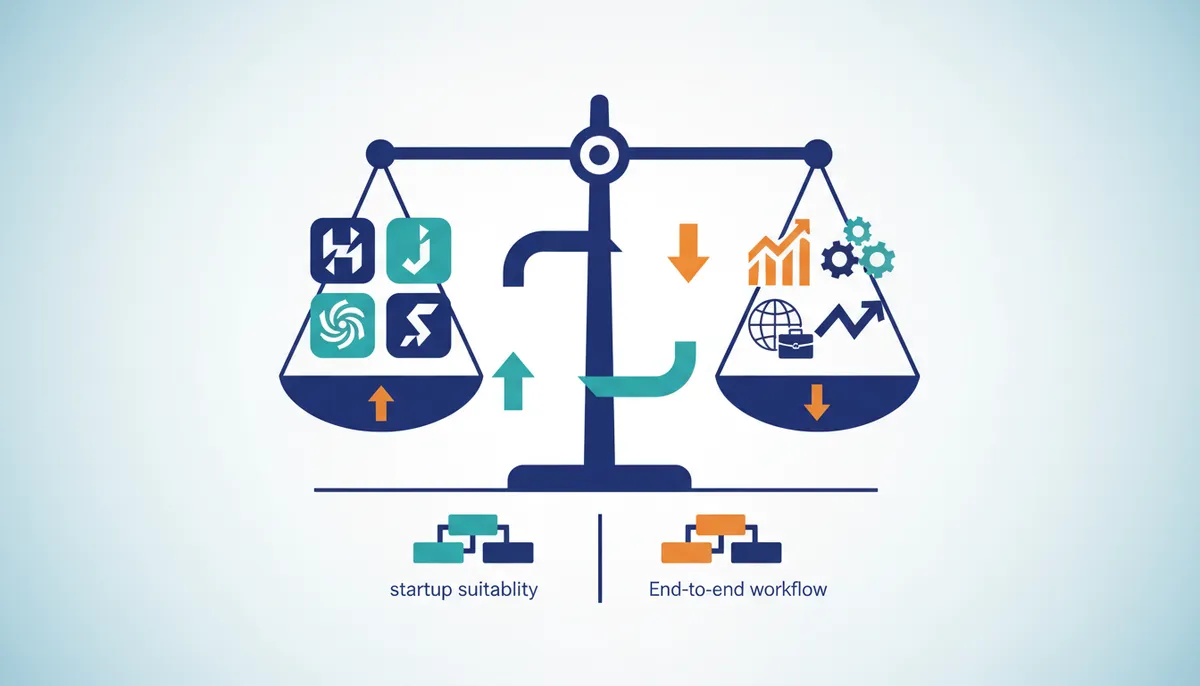
HypeSuite AI executes a closed-loop SEO blogging workflow that integrates intent research directly with one-click publishing to WordPress or Netlify. This architecture eliminates the context switching inherent in multi-format platforms like the provider, which prioritize campaign assets across ads and landing pages over deep search optimization. Distribution automation becomes necessary as teams seek to avoid fracturing their pipeline between research and CMS entry. Operators choosing an end-to-end platform gain a single source of truth for brand voice, preventing the robotic tone that plagues disjointed stacks. This focus creates a limitation: deep vertical integration often sacrifices the horizontal breadth required for diverse creative campaigns.
Startup Bottlenecks: Matching HypeSuite, and Surfer to Workflow Gaps
Startups stall when manual briefing consumes the limited hours available for product iteration. Teams facing topic struggles require research automation that ingests SERP data without constant human prompting. Conversely, publishing struggles often stem from fragmented stacks where drafting occurs in isolation from the CMS. HypeSuite AI resolves this by connecting intent research directly to WordPress or Netlify, enabling one-click deployment that bypasses the copy-paste errors common in manual workflows. Branding inconsistencies represent a third failure mode, particularly for sales-led teams needing rapid go-to-market messaging. Some platforms excel at outbound sequences yet lack the deep voice controls necessary for long-form authority building.
Data-Driven Scoring and On-Page Optimization Depth
The provider prioritizes granular on-page scoring while the provider accelerates SERP-driven brief construction. The distinction lies in optimization depth versus research velocity. The provider delivers data-driven recommendations for structure and topical coverage, making it the preferred choice for teams refining existing drafts against specific keyword targets. Its algorithm evaluates content against live ranking factors to suggest precise word counts and header placements. Conversely, the provider excels at modeling top-ranking pages to generate thorough outlines rapidly. This approach benefits startups needing to map search intent quickly before drafting begins. The drawback involves workflow stage alignment.
Implementing a Scalable SEO Content Workflow in Five Steps
Defining the Three Quality Gates for Automated Content
Generic text fails to convert readers. A production line mentality with set quality gates stops low-value output before it reaches publication. This method structures the entire workflow around three specific checkpoints: intent alignment, voice specificity, and trust verification. The first gate validates that the content type matches SERP expectations. Output must solve the user's immediate problem rather than simply filling a word count quota.
Brand differentiation happens at the second checkpoint by requiring two founder-specific details per post. These details might include a mini example, a metric like MRR, CAC, or churn, or a "what we tried" anecdote. Such constraints directly counter the tendency of large language models to produce homogeneous prose. The third gate integrates E-E-A-T compliance workflows so content demonstrates experience and trustworthiness to meet strict governance.
| Gate | Function | Failure Mode |
|---|---|---|
| Intent Match | Aligns format with search goal | High bounce rate |
| Voice Specificity | Injects unique founder data | Generic, robotic tone |
| Trust Signals | Validates expertise sources | Low domain authority |
Organizations adopting these systems pair AI drafting with human strategic planning to ensure dependability. Embedding these gates directly into the orchestration layer helps maintain high standards at scale. The immediate next step is defining your specific founder metrics for the second gate.
Executing a Four-Week SEO Publishing Cadence for Solo Founders
A solo founder with a new domain and no meaningful backlinks dedicates 45 minutes daily, four days weekly, to build a consistent publishing engine. This cadence prioritizes routine over volume. Sporadic output transforms into a predictable workflow that compresses hidden work into a repeatable system. Week 1 establishes the production line by configuring brand voice rules, mapping internal links, and publishing two initial posts on WordPress. Distribution expands during the second week. Each long-form draft becomes short LinkedIn updates and founder-style X threads to maximize reach without extra writing time.
Week 3 shifts focus to optimization. Winners get refreshed while losers get pruned based on Search Console data. Posts showing impressions but low clicks receive title and intro tweaks. The system enforces adding internal links per post to strengthen site architecture. Iterative pruning prevents content decay and signals relevance to search crawlers. By Week 4, the founder publishes two final posts mimicking the intent pattern of the best performer. A repeatable template locks in place.
Teams adopting this workflow automation over pure generation report compounding returns as the pipeline matures. Strict discipline is the cost. Maintaining a consistent routine prevents the erratic indexing patterns caused by manual bursts. This structured approach helps eliminate decision fatigue and ensures steady traffic growth. The immediate next step is selecting long-tail topics and scheduling a dedicated review session.
Lean Founder Strategies to Reduce Manual Creation Time
Consolidating decision fatigue allows founders to generate drafts in one batch and conduct a focused review. Structuring the topic pipeline involves maintaining a two-tier list: 10 'core' topics tied to the product and 20 'supporting' topics tied to pain points. Pre-defining internal links to a library of pillar pages prevents last-minute navigation mapping during the writing phase. Operators frequently revert to ad-hoc creation without this separation of generation and evaluation. Consistency required for SEO traction disappears under such conditions. Configuring scheduled draft generation keeps content calendars full without manual intervention. This strategy ensures the founder acts as an editor, not a drafter. Cognitive load remains preserved for high-value strategic adjustments.
About
Hannah Brooks, Marketing Operations Lead at Enterium, leads the evaluation and orchestration of AI content tooling stacks. Her daily work involves wiring together complex workflows, establishing governance gates, and defining the metrics that prove content ROI. This hands-on experience in martech stack design makes her uniquely qualified to analyze the environment of content automation platforms for 2026. Unlike theoretical overviews, her assessment stems from building reliable, measurable operations where consistency outperforms intensity. At Enterium, a B2B publication dedicated to vendor-neutral methodologies for scaling content with LLMs, Hannah applies rigorous practitioner standards to distinguish genuine pipeline efficiency from hype. She connects the abstract promise of automation to the concrete realities of production architecture, ensuring recommendations serve technical marketers who must ship next week. Her analysis cuts through the noise of competing solutions to focus on reproducible steps and tangible trade-offs in cost, latency, and quality.
Conclusion
Scaling content automation reveals that inconsistent review cycles break the pipeline quicker than poor generation quality. When volume increases without a rigid editing protocol, the signal-to-noise ratio collapses, causing search engines to de-prioritize the entire domain rather than just individual posts. The operational cost here is not time, but the erosion of topical authority caused by publishing unrefined drafts at scale. Teams must shift from viewing these platforms as infinite idea generators to treating them as high-velocity drafting engines that require human strategic oversight.
Implement a strict generation-review-publish cadence where no content bypasses the editor role, regardless of deadline pressure. This approach ensures that the founder remains the architect of intent while the machine handles the heavy lifting of syntax and structure. Without this gatekeeping function, the system produces noise instead of assets. You should adopt this disciplined workflow immediately if your current output lacks a consistent voice or fails to convert impressions into clicks.
Start by blocking a recurring 90-minute session this week solely for pruning and refining existing drafts before scheduling any new generation tasks. This single action forces the necessary separation between creation and evaluation, stabilizing your content velocity while improving quality.
Frequently Asked Questions
Manual production consumes four to eight hours per post, creating a major bottleneck. This heavy time investment guarantees content gets deprioritized when other business fires are burning.
Small businesses use automated scheduling to maintain consistent output without proportional staff increases. This approach allows teams to manage posts and landing pages while utilizing 45% of their usual effort.
Assistance tools leave operators responsible for linking disjointed stages, causing lost editorial cohesion. This fragmentation often results in increased revision cycles that waste valuable time and resources daily.
These systems pair generative drafting with human strategic planning to ensure dependability and quality. This balance prevents the robotic AI voice that typically undermines trust in fully autonomous pipelines.
Unifying research and publishing cuts context switching and revision cycles significantly. This integration ensures every piece of content meets E-E-A-T standards before publication occurs automatically.
References