Content automation tools: Save 6 to 10 hours weekly
B2B teams save 6 to 10 hours weekly by deploying content automation tools that simplify workflows. These platforms are not merely convenient add-ons but essential infrastructure that transforms content creation, management, and distribution into a scalable revenue engine. Readers will examine the critical function of automation platforms within contemporary marketing ecosystems and dissect the underlying architecture of AI-driven workflows. We analyze how solutions like ContentBot and the provider AI attempt to generate SEO-friendly content at scale, while also addressing the limitations of assembling separate stacks for research and publishing. The discussion highlights how SEO content automation standardizes processes without requiring heavy engineering resources, contrasting guided templates against the high ramp time of traditional manual workflows.
Finally, the analysis covers comparative metrics for team-based platforms, focusing on how content analytics and performance tracking drive organic traffic. Data from Akkio indicates that businesses using these tools can significantly enhance ROI by shifting focus from labor-intensive tasks to high-level strategy. Instead of wrestling with process discipline and hiring gaps, organizations can use AI tools to output digestible insights and maintain consistent publication schedules. The goal is to identify systems that eliminate the need for constant human intervention in repetitive tasks while ensuring content quality remains paramount.
The Role of Content Automation in Modern Marketing Stacks
Defining Content Automation and AI Generators
Programmed workflows replace manual drafting to generate, schedule, and distribute assets without human intervention. This infrastructure shift allows B2B teams to simplify complex marketing operations by encompassing the entire lifecycle from ideation to publication. The definition extends beyond simple text generation to include thorough workflow management. Tools like the provider and ChatGPT apply large language models to produce SEO-friendly drafts at scale, adhering to specific brand voices. ContentBot offers similar generative capabilities, yet the strategic value lies in orchestration rather than isolated creation. Marketers must compare platforms based on use case to ensure alignment with functional needs.
Volume often clashes with verification requirements. Enterprises frequently deploy Writer to enforce compliance constraints that general models miss. Successful implementation demands that teams treat these generators as force multipliers for strategy, not replacements for editorial oversight. Effective integration requires unifying these disparate tools into a cohesive, reliable production pipeline.
Applying AI Analysis Tools Like Akkio and BuzzSumo
Machine learning algorithms parse performance data within AI-powered content analysis tools to identify emerging trends and output insights in digestible reports. Akkio is an AI-driven platform offering content analysis capabilities that generate reports and output insights in a digestible format. This mechanism transforms raw interaction logs into actionable intelligence, allowing operators to pivot based on empirical evidence rather than intuition. Smart scheduling solutions complement this analysis by automating distribution timing to match audience availability windows. Tools such as Hootsuite and UpContent execute these schedules, ensuring consistent delivery across channels without manual intervention. The cooperation between analytical depth and automated timing creates a feedback loop where data informs deployment, and deployment generates new data.
B2B teams using top shortlisted platforms report significant time savings by streamlining these workflows. Reliance on automated insights requires valid input data; garbage-in-garbage-out remains a strict constraint. Maintaining data integrity is necessary to ensure only high-fidelity signals trigger downstream actions. The result is a measurable uplift in strategic precision without increasing headcount.
Checklist for Selecting CMS and Scheduling Platforms
Buyers should select workflow optimization tools that manage processes from ideation to distribution rather than simple text generation. The content automation environment includes numerous platforms frequently shortlisted for B2B evaluation, requiring buyers to compare specific use cases against budgetary constraints. Automation tools are capable of orchestrating the entire lifecycle of content, including creation, planning, scheduling, and review across multiple channels simultaneously.
- Confirm the platform supports full lifecycle orchestration beyond basic drafting.
- Validate that scheduling logic aligns with specific audience engagement windows.
- Verify the solution fits set budgetary constraints and functional needs.
- Check for native distribution capabilities to avoid manual bridges.
- Assess version control features during high-volume cycles.
A common failure mode involves selecting point solutions for generation that lack native distribution capabilities, creating fragile manual bridges between drafting and publishing. This fragmentation increases operational overhead and introduces version control errors during high-volume cycles. A unified architecture helps connect these disjointed stages into a single, reliable pipeline. Teams should prioritize systems that eliminate these manual handoffs to maintain data integrity.
Inside the Architecture of AI-Driven Content Workflows
Mechanics of Personalization Engines and Recommendation Algorithms
Customer data feeds the engines that tailor user experiences to boost engagement and conversions. These systems ingest event streams to populate user profiles, which then feed recommendation algorithms designed to predict content relevance. Einstein AI scrutinizes customer behaviors, mapping specific interactions to probabilistic outcomes for next-best-action selection.
Static segmentation groups users broadly, yet flexible engines adjust weights based on real-time interactions. This granularity allows automated workflows to generate draft content on a pre-set schedule, ensuring content calendars remain full without manual intervention while maintaining contextual accuracy. Teams adopting these architectures report they save between 6 to 10 hours per week by streamlining content marketing workflows, shifting labor from assembly to strategy validation.
| Feature | Static Segmentation | Flexible Personalization |
|---|---|---|
| Data Latency | Batch processing | Real-time updates |
| Granularity | Cohort-level | Individual user |
| Adaptation | Manual rule updates | Automatic model retraining |
Systems also optimize content for search engines by generating search-friendly copy and metadata, integrating SEO logic directly into the generation process. Infrastructure costs arise from maintaining profile stores alongside the generation layer.
Executing Smart Scheduling with Hootsuite and SocialPilot
Centralized dashboards manage distribution timing effectively across multiple channels. Marketers deploy smart scheduling engines that automate publication windows to solve inconsistent reach. Hootsuite functions as a thorough platform allowing scheduling and publishing posts to multiple social media channels from one integrated dashboard. Alternatively, SocialPilot offers a way to schedule posts, manage strategies, improve engagement, and analyze results at a pocket-friendly cost. The operational workflow involves configuring time-triggered execution where systems generate draft content on a schedule, ensuring calendars remain full without manual intervention. Strong API integrations with publishing platforms orchestrate creation and review simultaneously.
High-frequency posting can dilute engagement if timing ignores audience activity patterns. These tools adjust delivery based on historical performance data rather than relying on static timers. Over-reliance on automation leads to tone-deaf responses during breaking news events if human oversight gates are removed.
| Feature | Hootsuite | SocialPilot |
|---|---|---|
| Primary Focus | Enterprise dashboard | Cost-effective scaling |
| Distribution | Multi-channel bulk | Batch scheduling |
| Analytics | Deep integration | Necessary metrics |
Auditing current calendar gaps and mapping them against peak traffic windows precedes enabling auto-fill features.
Workflow Optimization Checklist Using Airtable and Grammarly
Structured databases track status and enforce quality gates before publication. Airtable functions as a flexible tool that works like a spreadsheet but gives the power of a database, enabling teams to map complex dependencies between draft creation and final approval. Operators configure these bases to trigger downstream actions only when specific metadata fields are populated.
| Feature | Airtable | Grammarly |
|---|---|---|
| Primary Function | Database management | Style correction |
| Trigger Mechanism | Field update | Real-time typing |
| Integration Scope | Workflow orchestration | Text input only |
Automated linguistic validation reduces manual review overhead as a second layer. Grammarly is an online writing assistant that detects grammar, spelling, punctuation, word choice, and style mistakes across distributed author environments. Teams using such proofreading utilities report saving between 6 to 10 hours per week by streamlining content marketing workflows. This efficiency gain assumes the organization has set clear style guide parameters; without them, the tool merely enforces generic correctness rather than brand voice.
Speed often conflicts with standardization. Systems generate draft content on a pre-set schedule, ensuring content calendars remain full without manual intervention, yet this velocity risks propagating unverified claims if human review steps are skipped. The architecture must mandate a "human-in-the-loop" state where an editor validates facts before the scheduler releases the asset. High-volume output dilutes overall trust metrics when this validation step is absent.
Comparative Analysis of Leading Automation Platforms for Teams
Marketing Automation vs SEO Tool Capabilities
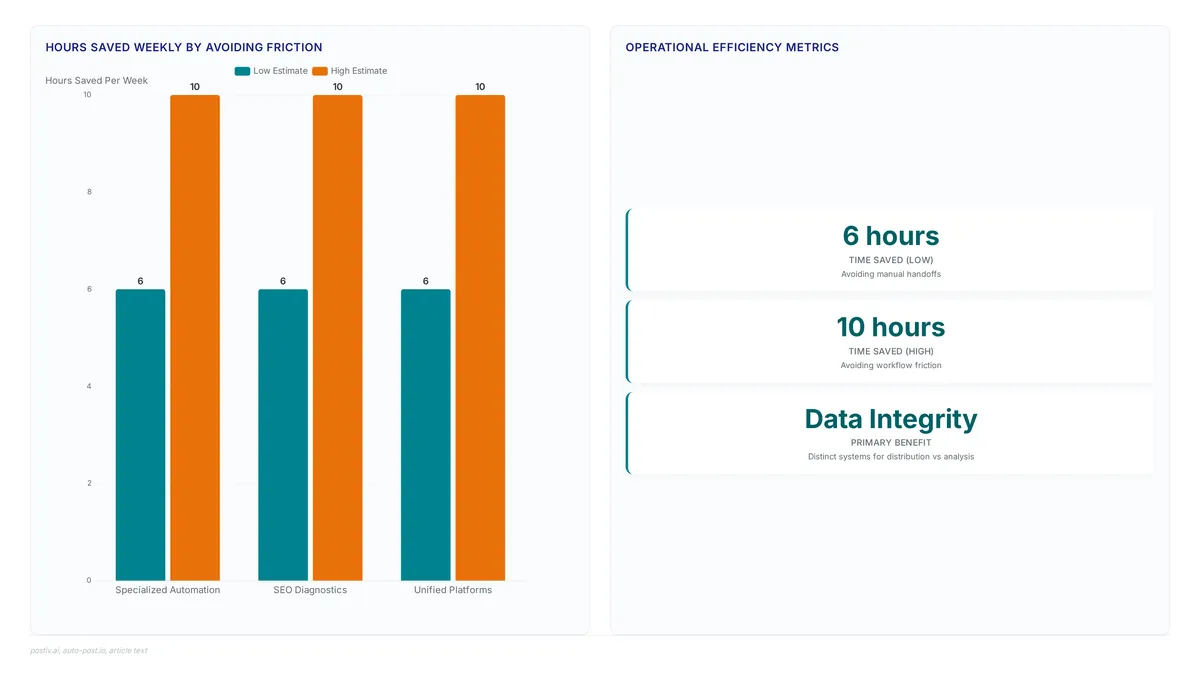
Marketing automation platforms use workflow orchestration to distribute content across sales channels, whereas SEO tools focus on organic visibility metrics like keyword rankings. HubSpot and ActiveCampaign prioritize audience segmentation and campaign timing so content reaches specific buyer personas efficiently. SEMrush provides deep diagnostics on search performance, enabling teams to optimize copy for search engine algorithms rather than direct distribution.
This functional divergence creates a clear boundary. Automation tools manage the "push" of content to known contacts, while SEO suites analyze the "pull" of organic traffic. Teams attempting to force SEO tools into distribution roles often miss critical customer data integration features required for lead nurturing. Pure automation platforms lack the technical depth needed for competitive analysis when used for keyword research.
B2B teams using specialized platforms for each function report saving between 6 to 10 hours per week by avoiding workflow friction. Conflating these categories introduces operational risk. Distinct systems are often required for distribution and analysis to maintain data integrity. Tool selection depends on whether the immediate bottleneck is reaching an audience or ranking for specific terms.
Deploying ActiveCampaign and Moz for Campaign Execution
Teams pair ActiveCampaign for customer experience automation with Moz for technical site audits to separate distribution logic from search validation. ActiveCampaign executes timed email sequences and CRM updates, while Moz provides thorough site audits and competitor analysis. This division helps prevent sending high-volume campaigns to broken URLs, a common failure mode in scaled operations.
Operational efficiency gains are measurable. B2B teams using shortlisted platforms report saving 6 to 10 hours weekly by avoiding manual hand-offs between systems. Data latency presents a constraint. Moz identifies structural issues like broken redirects or missing meta tags, but fixes often require manual deployment cycles before workflows can safely resume. Unlike generative comparisons such as the provider vs ChatGPT which focus on draft velocity, this stack prioritizes delivery reliability over creation speed.
Architectural risk involves assuming smooth integration where none exists natively. Teams must build explicit quality gates to halt automation if audit scores drop. Architects design these pipelines to enforce strict pre-flight checks, ensuring content only enters the distribution queue after passing technical validation. Organizations risk amplifying visibility for defective pages without such governance. Budget gets wasted on traffic that cannot convert due to technical barriers. Practitioners should map the exact trigger conditions where an audit failure must pause a live campaign.
Hootsuite Versus Buffer: Social Management Trade-offs
Hootsuite provides a thorough multi-channel dashboard that aggregates feeds, whereas Buffer prioritizes a simplified interface for sequential scheduling. Teams managing complex, high-volume accounts often require the dense workflow orchestration found in larger suites to coordinate across departments. This approach supports the ability to handle repurposing alongside drafting, creating a competitive arena where end-to-end workflow management is the key differentiator. Smaller units focused purely on timing and consistency benefit from simplified queues that reduce configuration overhead.
The operational divergence centers on visibility versus velocity. Hootsuite's architecture favors real-time monitoring and rapid response capabilities necessary for crisis management. Buffer's model optimizes for pre-planned cadence, minimizing the need for daily dashboard logins. Selection depends on whether the team needs to watch the firehose or simply ensure the tap runs on time.
Experts recommend evaluating your response latency requirements before selecting a platform. The heavier dashboard becomes necessary if strategy demands immediate reaction to trending topics. The lighter tool reduces friction if the goal is consistent presence with minimal daily intervention. Choosing incorrectly carries a cost measurable in lost engagement or wasted administrative hours.
Implementing Automated Workflows to Maximize Engagement ROI
How Engagement Trackers Calculate Content ROI
Clicks and session duration form the raw ledger of audience activity within these monitoring systems. Raw telemetry becomes actionable financial data through this mechanism, enabling teams to justify budget allocation with precision. Signal often drowns in data volume absent proper filtering. Revenue attribution to specific touchpoints presents a distinct constraint when user journeys traverse multiple channels and devices. Top-funnel content initiates awareness yet rarely closes sales immediately, complicating valuation efforts.
Automated workflows bridge this divide by producing draft content on pre-set schedules. Content calendars stay populated without manual intervention under this model. Consistency yields the statistical sample size necessary for accurate tracker analysis. Content creation and performance measurement merge into a single, coherent architecture as a result.
Deploying Airtable and Asana for Centralized Task Management
Fragmentation hinders marketing team productivity until task management centralizes. Scattered spreadsheets introduce errors that workflow optimization software eliminates by consolidating tasks. Teams save significant time when streamlining content marketing workflows through these systems. Asana operates as a project management app helping teams organize, track, and manage work without manual overhead. Airtable offers a flexible database structure mimicking spreadsheets while enforcing relational data integrity.
Draft content generation occurs on pre-set schedules through automated workflows. Processes standardize so teams maintain consistency without heavy engineering support. Repetitive publishing tasks vanish, reducing operational costs tied to manual editorial oversight. Creative iteration suffers if the system lacks manual override capabilities. Fixed templates may prevent rapid response to real-time engagement signals when relied upon excessively. Four distinct outcomes emerge from this deployment strategy: reduced error rates, lower operational costs, consistent output volume, and potential rigidity in creative response.
Risks of Ignoring Proofreading Tools Like Hemingway App
Style errors degrade automated content effectiveness immediately when quality assurance steps receive no attention. Complex sentences, adverb overuse, and passive voice confuse readers until tools like Hemingway App highlight them. Automation scales these mistakes, creating noise that reduces trust and engagement metrics across channels. Speed often takes priority for teams, yet streamlining content marketing workflows yields zero value if output demands heavy manual revision. Basic readability standards must be met before these systems reduce manual effort effectively. Organizations risk publishing high volumes of low-clarity assets that fail to convert without this gate. Rapid distribution of unreadable content accelerates brand erosion rather than growth. Leading platforms integrate strict style enforcement into pipelines, preventing substandard drafts from reaching publication queues. Efficiency gains remain secure only when audience retention is not sacrificed. Five failure modes exist: confused readership, diminished trust, wasted revision time, brand damage, and lost conversion opportunities.
About
Arjun Patel is an Applied LLM Engineer at Enterium, where he benchmarks LLM providers, models, and RAG architectures specifically for content workloads. His daily work involves rigorous, vendor-neutral evaluation of inference economics, measuring trade-offs between cost, latency, and output quality across substantial providers. This technical grounding makes him uniquely qualified to dissect the environment of content automation tools, moving beyond marketing hype to analyze actual pipeline architecture. At Enterium, a B2B publication and methodology brand focused on AI content pipelines, Arjun applies these engineering principles to document how modern teams build scalable systems. While many lists simply aggregate software, his analysis focuses on reproducible steps and quality gates within the research-to-publish workflow. By connecting raw model performance to practical content operations, he provides the decision-useful data technical marketers need to construct reliable, efficient automation strategies that function reliably in production environments.
Conclusion
Scaling content automation reveals a critical breaking point: efficiency gains evaporate when workflow rigidity prevents necessary human intervention. While teams report saving 6 to 10 hours weekly by streamlining market tasks, these savings become liabilities if the system amplifies style errors or ignores real-time engagement signals. The operational cost shifts from manual creation to expensive brand repair when readability standards fail. Organizations must recognize that true value lies not in volume but in thorough workflow optimization that balances speed with strict quality gates.
Enterium recommends implementing a hybrid validation model immediately, where automated drafts undergo mandatory style enforcement before entering publication queues. Do not rely on generic writing assistants that require assembling separate stacks for SEO research and QA. Instead, adopt a unified platform that enforces style consistency natively within the pipeline. This approach ensures that speed never compromises audience retention or trust.
Start this week by mapping your current content handoff points to identify where manual revision consumes the most time. Replace those specific friction zones with automated style checks rather than adding more generative tools. This targeted adjustment secures efficiency gains while preventing the erosion of brand authority through low-clarity assets.
Frequently Asked Questions
Teams save significant time by streamlining complex marketing workflows effectively. B2B groups report saving between 6 to 10 hours weekly through this efficiency. This allows marketers to shift focus from manual drafting to high-level strategy and narrative development.
Buyers usually evaluate a specific set of twelve primary platforms for their needs. These 12 primary platforms cover essential functions from creation to distribution across various marketing channels. Selecting the right one requires comparing specific use cases against budget constraints.
Yes, specific tools standardize processes without requiring heavy engineering resources or custom code. Guided templates allow teams to automate briefs and internal linking structures quickly. This approach avoids the high ramp time associated with traditional manual SEO workflows.
These tools orchestrate creation, planning, scheduling, and review across multiple channels simultaneously. Automation covers the entire lifecycle rather than just simple text generation or isolated drafting tasks. This comprehensive approach ensures consistent delivery and maintains data integrity throughout the process.
These platforms transform raw interaction logs into actionable intelligence for better decisions. Akkio generates reports and outputs insights in a digestible format for strategic pivots. This ensures operators rely on empirical evidence rather than intuition when refining content.
References