Guide writing platforms: why specialized beats generic
Specialized platforms now automate guide production where generic tools fail to address GEO optimization requirements. The modern thesis is clear: effective guide writing demands full-lifecycle content platforms that integrate no-code workflows rather than simple text generation. Teams relying on basic writing assistants miss the critical infrastructure needed for automated content indexing and AI visibility tracking in 2026.
Readers will learn how AI content operations platform architectures differ from standard word processors by embedding SEO and GEO optimization directly into the creation process. The analysis covers how no-code workflow builders for content teams replace manual editing with systematic content optimization tools that ensure AI citation tracking accuracy. We examine why long-form AI writing requires specific GEO analytics platforms to maintain relevance in AI search results.
Data indicates a sharp divide in capability, with some solutions like Profound Workflows launching public betas to automate content operations for AI search. While generalists struggle with IndexNow integration, dedicated systems handle automated content indexing and refresh existing pages at scale. This shift moves the focus from mere word count to AI-assisted guide writing that satisfies the rigorous demands of AI content marketing automation platform standards without manual intervention.
The Role of Full-Lifecycle Content Platforms in Modern Guide Writing
Defining AI Visibility and Full-Lifecycle Content Platforms
Generative engines retrieve and cite brand content with increasing frequency, making AI visibility a primary metric for digital presence. Traditional search metrics fail to capture this flexible because large language models parse authority differently than keyword crawlers. Structuring data to prevent hallucination defines the practice of generative engine optimization. This structural alignment serves as the foundation for appearing in AI Overviews and Copilot responses. High-quality guides remain invisible to automated agents without this specific formatting, regardless of their factual accuracy.
Creation, optimization, and indexing converge within full-lifecycle content platforms to form a single operational loop. Disjointed manual tools give way to specialized workflows that handle drafting while enforcing GEO optimization rules. Tracking citation frequency and managing automated indexing protocols like IndexNow separates this platform category from general writing assistants. Market data reflects a expanding demand for integrated governance over raw generation speed. Teams relying on separate tools for writing and tracking often fail to close the feedback loop required for iterative improvement.
Production velocity conflicts with citation integrity in many current workflows. Accelerating output without built-in verification mechanisms increases the risk of factual drift, forcing manual audits that negate automation benefits. Enterprise teams must prioritize platforms that embed validation gates directly into the generation pipeline rather than applying them as post-hoc filters. Effective architectures provide the backbone necessary to enforce these constraints at scale. Automated workflows produce verifiable, citable assets instead of noise when these systems function correctly.
Applying AI Agents and IndexNow for Automated Guide Publishing
Multi-step publishing sequences execute through specialized AI agents that generic writing assistants cannot replicate without significant manual intervention. These specialized workflows coordinate content generation with immediate indexing signals, bridging the gap between creation and discovery. Advanced systems apply structured workflows to accelerate the indexing process unlike static generators. New guides appear in search results quicker than standard discovery cycles allow through this method. SEO content automation adoption has grown 156% year-over-year, driven by teams needing quicker time-to-visibility.
An automated ping mechanism known as IndexNow integration notifies search engines of content changes instantly. The platform sends a URL signal to supported engines when a guide publishes, triggering a recrawl without waiting for standard discovery cycles. Traditional SEO tools focus solely on keyword optimization while ignoring the ingestion latency of modern crawlers, creating a sharp contrast with this approach. Operators must still maintain thorough sitemaps to ensure coverage across all search providers even though this protocol notably reduces latency. Ingestion speeds vary by engine.
Large language models parse and cite information based on different priorities than standard SEO, which defines Generative Engine Optimization (GEO). SEO targets human click-through rates while GEO structures data to reduce hallucination risks in AI responses. Maximizing keyword density for traditional rankings often conflicts with maintaining the semantic clarity required for AI citations. Resolving this tension requires building FAQs around real user language and creating connected knowledge networks that AI can easily interpret. Strong platforms provide the architectural support needed to manage these dual-layer strategies effectively within a single pipeline.
Checklist for Selecting Full-Lifecycle Tools by Team Structure
Creation, optimization, and indexing unify within full-lifecycle platforms to close the gap between drafting and citation. Solo founders benefit from simplified templates and brand packs to minimize manual configuration. Agencies prioritize repeatability across client accounts. Enterprises demand strategic intelligence layers that map content performance against proprietary knowledge graphs. The market distinction lies in whether a tool merely generates text or actively manages the indexing signal required for retrieval. This architectural difference determines whether content remains static or becomes retrievable data for generative engines. Sight AI is categorized specifically as a GEO and SEO platform, distinguishing it from general writing tools. Sight AI is the only tool on the list that closes the full loop from writing to indexing to tracking citations.
Selecting tools based on writing speed while ignoring citation tracking capabilities represents a common error. Optimization relies on guesswork without built-in monitoring of how models like ChatGPT, Perplexity, Claude, and Gro reference your guides. Sight AI's core functionality includes the ability to track AI visibility across these multiple leading models. SEO content automation now requires active management of how agents parse authority, a fact teams often overlook. Effective solutions address this by embedding visibility metrics directly into the production pipeline. Content ranks in traditional search but fails to appear in AI-generated answers when this layer is neglected. Selection must align with the team's ability to sustain GEO optimization post-publication. Current data indicates that Sight AI holds a Consensus Score of 9.5/10 based on an aggregate of 275+ user reviews as of 2026.
How AI Agents and No-Code Workflows Automate Guide Production
No-Code Workflow Builders vs Standard Writing Interfaces
Standard writing interfaces function as linear text editors, whereas workflow builders orchestrate discrete AI agents through visual logic gates. This architectural shift moves content production from manual drafting to automated pipeline execution. An operator types prompts sequentially in a standard interface, introducing variance in tone and structure. A no-code workflow connects language models directly to data sources via drag-and-drop connectors. Every generated guide adheres to a predefined structural schema before a human ever reviews the draft.
Repeatability across scale defines the operational distinction. Linear tools rely on individual writer discipline, while pipeline architectures enforce consistency automatically. Organizations managing multiple client accounts require this rigid adherence to brand voice constraints that only code-level enforcement can guarantee. A structured workflow typically covers around 80% of the content process, leaving the final 20% for human refinement of tone and fact verification.
| Feature | Standard Interface | Workflow Builder |
|---|---|---|
| Execution | Manual, linear | Automated, parallel |
| Consistency | Variable | Enforced by logic |
| Data Access | Copy-paste | Direct API linkage |
Enterium deploys these pipeline architectures to eliminate the drift common in disjointed manual processes. Initial setup complexity represents the primary cost; implementing an effective AI content workflow requires auditing current production processes to identify bottlenecks and repetitive tasks that AI can optimize. Adding retrieval dashboards and granular checklists becomes necessary to maintain quality as volume grows.
Deploying Multi-Model Pipelines and Reusable Templates in AirOps
Operators scale output by connecting distinct AI models within a single execution pipeline rather than rewriting logic for every client. AirOps enables this through Multi-Model Support, allowing teams to route specific drafting tasks to specialized engines while maintaining a unified data context. This architecture prevents the fragmentation seen when teams juggle disjointed tools for research, writing, and formatting.
Reusable workflow templates act as the force multiplier in this system. Engineers define a structural schema once and instantiate it across multiple projects instead of rebuilding prompts for each account. Brand voice constraints and citation requirements remain consistent regardless of the underlying model selection. Teams share these templates with granular permissions, ensuring that junior editors execute the same rigorous checks as senior architects.
| Feature | Manual Workflow | AirOps Pipeline |
|---|---|---|
| Model Switching | Manual re-prompting | Automated routing |
| Template Logic | External documents | Native reusable blocks |
| Team Access | File sharing | Granular permissions |
Starting lean with one template brief and a two-step generation flow allows teams to validate the logic before expanding complexity. Scaling content without losing fidelity requires this disciplined, iterative expansion of the pipeline rather than immediate complexity. Quality maintenance demands additional retrieval dashboards and granular checklists as volume increases.
The immediate next step is to audit current drafting processes for any repetitive prompt sequences that can be converted into a single reusable template.
Preventing Prompt Drift with Version Control in Promptwatch
Treating prompts as managed assets with strict version history prevents these unseen deviations from corrupting production outputs. Promptwatch addresses this risk by enforcing engineering-grade discipline on prompt evolution through granular performance analytics.
The platform mitigates consistency failures by enabling A/B Testing for prompt variations before full deployment. Teams apply a Team Prompt Library to centralize approved logic, ensuring that agent workflows do not diverge due to undocumented local tweaks. Disjointed manual tools often lack the version control or rely on informal tracking methods.
| Feature | Manual Workflow | Promptwatch Approach |
|---|---|---|
| Version History | File-based or absent | Automated and granular |
| Consistency | Degrades over time | Enforced via library |
| Validation | Post-hoc review | Pre-deployment A/B tests |
Agent reliability decays without versioned prompts in content creation workflows. Systems under evaluation should lock prompt definitions against unauthorized changes. Enterium recommends implementing such governance structures immediately to maintain fidelity in automated guide generation.
Specialized AI Writers vs. All-in-One GEO Platforms
All-in-One GEO Platform vs. Specialized Writer
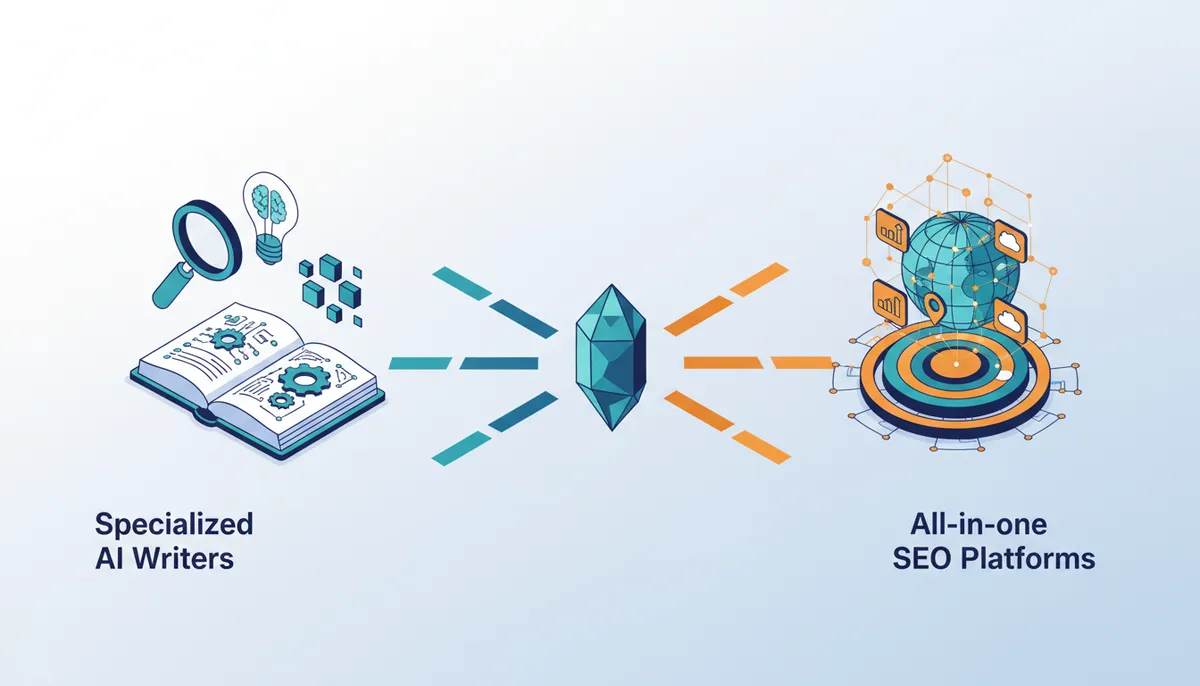
Specialized AI writing tools function primarily as interfaces for content generation, whereas emerging GEO platforms operate as full-lifecycle systems. This architectural divergence dictates workflow capacity for teams scaling output. In contrast, dedicated writing tools typically rely on a primary long-form article generator, sometimes augmented by real-time web access to retrieve current data points. The distinction matters because AI-generated content should be reviewed, edited, fact-checked, and improved before publication to ensure quality control. Teams asking whether to use an all-in-one AI platform must weigh agent diversity against interface simplicity.
| Feature | All-in-One GEO Platform | Specialized Writing Tool |
|---|---|---|
| Core Architecture | Full-lifecycle GEO platform | Specialized writing tool |
| Agent Count | 13+ specialized agents | Single long-form writer |
| Primary Optimization | GEO and SEO | Real-time data access |
An all-in-one approach is often preferred when organizations require unified visibility tracking alongside content generation. Relying on disjointed tools often fragments the content optimization process, creating silos between drafting and indexing phases. The trade-off is complexity; managing multiple agents demands stricter governance than a single writer interface. However, the gain in structured output quality justifies the operational overhead for teams targeting specific search generative experience outcomes. Teams must align tool selection with their maturity in handling automated workflows.
Automated Publishing and Indexing Workflows
Advanced platforms execute automated modes to simplify end-to-end production while simultaneously triggering indexing protocols for immediate search engine submission. This closed-loop architecture removes the manual handoff between drafting and indexing that characterizes standard workflows, which remain best suited for teams focusing strictly on writing and optimization phases rather than full lifecycle management.
A critical limitation of disjointed tooling is the lack of unified citation tracking, leaving brand visibility unmeasured in generative search results. Modern solutions address this by embedding visibility tracking directly into the generation pipeline, ensuring every published guide carries verifiable attribution data. The trade-off for adopting a unified platform is the initial configuration overhead required to map internal taxonomies to agent parameters, yet this upfront cost prevents downstream fragmentation. Operators should note that AI-generated content should be reviewed, edited, fact-checked, and improved before publication, regardless of automation level. Deploying thorough platforms is often beneficial for organizations requiring centralized citation governance. The next step is auditing current publishing latency to quantify the cost of manual submission.
Brand Voice Customization vs. Citation Tracking
Dedicated writing tools often preserve tone through brand voice customization features, while advanced GEO platforms quantify presence via visibility scores. This functional split forces a strategic choice between stylistic consistency and measurable citation acquisition across generative engines. Writing tools allow teams to save tone preferences for bulk generation, ensuring textual uniformity across high-volume outputs. Conversely, visibility-focused platforms track mentions across substantial AI platforms, providing the data necessary to validate GEO performance rather than guessing at reach. Teams prioritizing brand voice may produce consistent content that remains invisible to large language models if citation signals are weak. Solutions that integrate visibility scoring directly into the production pipeline help close this gap. The following comparison isolates the operational divergence between these approaches.
| Dimension | Specialized Writer Approach | All-in-One Platform Approach |
|---|---|---|
| Primary Metric | Tone adherence | AI Visibility Score |
| Optimization Goal | Stylistic uniformity | Citation frequency |
| Workflow Output | Drafted text | Indexed, tracked assets |
Relying solely on tone settings ignores the indexing layer where generative engines retrieve context. Content that matches brand voice but lacks citation tracking fails the core requirement of modern guide writing: appearing in the answer. Integrated solutions combine visibility scoring directly into the production pipeline to address this challenge.
Implementing No-Code Workflows for CMS Auto-Publishing and Indexing
Defining No-Code Workflow Builders for CMS Auto-Publishing
Visual logic gates map trigger conditions to specific API actions within these systems. Standard writing interfaces generate isolated text blocks, yet no-code workflow builders orchestrate multi-step automation sequences. Successful teams audit current content production processes first. This initial step identifies bottlenecks and repetitive tasks that AI can optimize. Operators define exactly when a draft moves to review or publishes immediately based on metadata tags.
- Define the content schema and required metadata fields.
- Configure the LLM prompt chain for draft generation.
- Set validation rules for tone and factual accuracy.
- Establish the final push command to the CMS endpoint.

AI-generated content requires review, editing, fact-checking, and improvement before publication. Basic implementations often lack the built-in retry logic and queue management necessary for this limitation. Specialized platforms provide the infrastructure needed to manage complex no-code content workflows with enterprise-grade reliability. Network operators see clearly that successful scale demands a platform handling both generation logic and transport reliability equally.
Implementation: Deploying Autopilot Modes and IndexNow Integration
Manual handoffs between drafting and deployment disappear when advanced AI platforms execute end-to-end production through automated modes. This architecture connects generation logic directly to CMS APIs so content moves from prompt to published state efficiently. Teams deploying such no-code workflows often observe that automation provides the greatest impact while preserving the human touch that makes content truly valuable. Speed increases without sacrificing the nuance required for high-quality guides.
- Configure the prompt chain to align with brand voice constraints.
- Enable IndexNow Integration to automatically submit URL updates to search engines upon publication.
The primary technical benefit involves immediate search engine submission, which reduces the latency between content publication and index availability. However, reliance on automated submission requires strong error handling; if the CMS returns a schema mismatch, the workflow must pause rather than force incorrect data. Enterprises ignoring this failure mode risk populating indices with broken metadata.
Properly configured workflows embed necessary semantic tags during the generation phase. Retrieval systems prioritize structured data, and these tags satisfy those requirements automatically. Specialized platforms orchestrate complex pipelines so human readers and algorithmic crawlers receive optimized output simultaneously. Automation must encompass both creation and distribution to achieve measurable efficiency gains. Ignoring either phase reduces the overall value of the investment.
Implementation: Checklist for Selecting Full-Lifecycle Tools by Team Structure
- Audit current publishing bottlenecks to identify manual handoff failures.
- Select a platform supporting no-code logic matching your team size.
- Verify IndexNow compatibility to ensure efficient indexing.
- Deploy validation rules preventing stale data from reaching production.
Precision varies by operational scale, and specialized architectures deliver what each team structure needs. Effective solutions embed quality control directly into the generation pipeline. Every asset meets strict factual standards before publication occurs. Rapid deployment often sacrifices the reliability readers expect, creating tension between speed and accuracy. Disjointed toolchains introduce fragility where consistency remains paramount. A unified system eliminates friction between drafting and deployment phases. Resilient, scalable foundations support all content operations effectively.
About
Arjun Patel is an Applied LLM Engineer who benchmarks LLM providers, models, and RAG architectures specifically for content workloads. His expertise directly addresses the shift from generic AI writing tools to specialized AI content platforms designed for long-form guide production. Unlike generalist solutions, Patel's daily work involves rigorously testing inference economics, latency, and output quality across vendors to determine why specialized architectures outperform broad tools for SEO and GEO optimization. At Enterium, a B2B publication focused on AI content automation, Patel translates these technical evaluations into reproducible methodologies for scaling content pipelines. His analysis stems from building the very systems Enterium documents: reliable workflows where humans remain on the gates of quality assurance. By focusing on pipeline architecture rather than hype, Patel provides the technical grounding necessary for teams to transition from experimental prompting to production-grade automated content indexing and publishing strategies that actually function in 2026's competitive environment.
Conclusion
Scaling content operations reveals that the real friction point is not generation speed, but the operational cost of repairing broken metadata and re-indexing stale assets. When automation handles the bulk of production, the remaining human effort must focus exclusively on high-value refinement rather than fixing pipeline errors. Teams that fail to embed validation rules early face compounding technical debt as their volume grows.
Organizations should mandate IndexNow compatibility and no-code logic verification before expanding their automation footprint this quarter. Relying on disjointed tools forces teams to manually bridge gaps that a unified architecture solves natively. The strategic move is to consolidate workflows where quality control is intrinsic, not an afterthought. This approach ensures that speed never undermines the factual integrity required for modern search visibility.
Start this week by auditing your current publishing bottlenecks to identify where manual handoffs cause data loss or schema mismatches. Map these failure points against your existing toolchain to see where friction hides. Only after identifying these specific breaks should you consider consolidating onto a unified system like Enterium that enforces structure from draft to index. This targeted assessment prevents the common pitfall of automating broken processes, ensuring your investment yields immediate efficiency gains rather than new maintenance burdens.
Frequently Asked Questions
Adoption has grown 156% year-over-year as teams need faster visibility. This surge forces organizations to replace disjointed manual tools with integrated systems that handle drafting and indexing simultaneously.
Specialized workflows accelerate the indexing process unlike static generators. They utilize AI agents to send instant signals that trigger recrawls, significantly reducing the latency found in standard discovery cycles.
Accelerating output without built-in verification increases the risk of factual drift. This forces manual audits that negate automation benefits, requiring platforms that embed validation gates directly into the generation pipeline.
Generic assistants fail because they lack IndexNow integration for instant notifications. Without this, content waits for standard discovery cycles, delaying appearance in search results compared to automated ping mechanisms.
Costs vary by vendor, so teams must evaluate pricing based on required features like GEO analytics and no-code builders.
References