Governed agents beat generic AI models for brand content
AI systems generated millions of referrals for Optimizely customers in just three months during mid-2025. This surge proves that generic models fail to match the precision of governed AI agents designed for strict brand compliance. The era of unregulated content generation is ending, replaced by architectures where automated workflows enforce consistency without human bottlenecks.
This analysis defines the specific components required for brand-governed systems that prevent hallucination and drift. It outlines a five-step execution plan for a scalable AI content strategy that maintains quality at volume.
The data from Optimizely confirms that volume alone is insufficient without the underlying structure to manage it effectively. Teams relying on open-ended prompts face mounting risks in brand voice consistency and regulatory adherence. By shifting focus to content pipelines workflow governed by strict rules, organizations can replicate the referral success seen in recent case studies. The difference lies not in the model size, but in the constraints applied to its output.
Defining the Core Components of Brand-Governed AI Content Systems
Defining Brand-Governed AI Content Systems
A brand-governed AI content system embeds language adaptability and SEO logic directly into automated pipelines instead of depending on raw generative output. Generative AI performs most reliably when tasked with structured, repeatable assets like product descriptions, email subject lines, and ad copy variants. These systems separate themselves by hard-coding brand voice constraints into the generation layer, forcing every asset to align with established guidelines prior to publication. Generic tools lack this structural rigor. A governed approach treats content as a structured data flow where intent-based creation drives topic modeling and page structuring for AI discovery.
Real-World Impact of Purpose-Built AI Agents
Purpose-built AI agents function as specialized automation instances configured for distinct editorial tasks rather than general text generation. Research from enterprise AI deployments consistently shows that AI handles volume and variation while humans focus on strategy, quality review, creative direction, and stakeholder relationships. Efficiency gains stem from restricting the model's action space to specific brand lexicons and formatting rules. A generic large language model requires extensive prompting to achieve similar adherence, introducing latency and variance.
| Metric | Generic LLM Approach | Purpose-Built Agent |
|---|---|---|
| Primary Function | Broad text completion | Specific task execution |
| Brand Alignment | Prompt-dependent | Rule-embedded |
| Output Consistency | Variable | Deterministic |
Adopting an AI content strategy helps teams work smarter, not harder, improving speed, accuracy, and personalization. Enterprises change quality assurance from a reactive process into a proactive capability by embedding optimization guidance into the workflow. High-volume output often degrades quality without strict governance layers. The operational tension lies between velocity and brand safety. While 100% of marketing leaders report already using AI for content creation, only 13% say AI is core to their operations, and 60% cite brand safety and quality control as their primary blocker. Unchecked agents risk publishing non-compliant material at scale. Enterprises must deploy validation gates that verify tone and factual accuracy before publication. New quality agents evaluate content for brand voice, audience fit, accuracy, and human voice, ensuring content earns its place instead of getting lost in the noise. Operators should audit current workflows to identify repetitive, rule-bound tasks suitable for agent delegation. This approach creates high-quality, brand-aligned content at scale while maintaining the human touch that drives genuine engagement.
AI Content vs Human Content: Output Volume and Efficiency
AI content vs human content comparisons reveal that governed agents generate referral volume unachievable by manual teams alone. Generative AI provides marketers with the scale to personalize and localize content across channels, helping drive improved campaign performance. Human operators cannot match this throughput without sacrificing review depth or increasing headcount exponentially. The distinction lies in output volume, where machines handle iteration and humans handle judgment. Efficiency gains emerge when organizations apply Generative Engine Optimization fixes identified by automated agents. Used well, AI helps connect the whole workflow, making content feel less chaotic and more consistent. Human-only workflows often miss these granular signal correlations due to data latency.
| Feature | Human-Only Workflow | AI-Driven Pipeline |
|---|---|---|
| Scaling Mechanism | Linear hiring | Computational expansion |
| Personalization | Segment-level | Instance-level |
| Error Correction | Post-publication | Pre-generation guardrails |
Speed and brand safety create a critical tension. Unchecked volume creates noise, while strict human gates create bottlenecks. The solution requires brand-governed constraints that allow high-velocity generation within safe semantic boundaries. Scaling content dilutes message clarity rather than amplifying reach without these embedded rules. Enterprises must prioritize pipeline architecture over raw model size to sustain quality at scale. Validating agent output against historical brand benchmarks before expanding campaign scope ensures that AI-generated content serves specific business objectives.
Architecting Automated Workflows with Purpose-Built AI Agents
Mechanics of Purpose-Built AI Agents in Marketing Pipelines
Purpose-built agents execute discrete pipeline stages by applying embedded rules rather than generating open-ended text. Unlike general LLMs, these systems enforce brand voice consistency through deterministic evaluation layers before content reaches publication. Marketing leaders recognize widespread AI adoption for content creation, yet many hesitate to integrate it deeply into operations due to valid concerns over brand safety and quality control.
The operational architecture separates generation from validation using specialized modules:
- Context ingestion integrates audience data and strategic constraints into the workflow.
- Drafting models produce variations optimized for specific channel requirements.
- Quality agents evaluate outputs against accuracy and human-voice benchmarks.
This structure directly addresses the gap preventing AI from driving measurable marketing ROI. General models often hallucinate facts or drift into generic phrasing, whereas governed systems filter non-compliant drafts before they reach stakeholders.
| Feature | General LLM | Purpose-Built Agent |
|---|---|---|
| Scope | Open-ended generation | Task-specific execution |
| Constraints | Prompt-dependent | Hard-coded rules |
| Output | Variable quality | Pre-validated |
Teams sometimes conflate volume with value, a mistake that accelerates reputational damage when strategy remains flawed. Enterprises must define strict quality gates to prevent low-fidelity content from undermining brand trust. Balancing speed against the rigorous verification needed for enterprise adoption creates friction. Automation scales noise rather than pipeline efficiency without these controls. Leading organizations deploy validation layers as the primary control point for all automated workflows.
Executing Campaign Automation and SEO Optimization Workflows
Automated campaign execution requires routing knowledge base vectors through deterministic filters before draft generation begins. Systems ingest target keywords and audience constraints, applying brand rules to every sentence rather than relying on post-hoc editing. These AI approaches include personalization based on target audience data, language adaptability to match brand tone, integrated SEO optimization, and translation for global reach. The mechanism relies on separating content creation from compliance validation, ensuring brand voice consistency without manual review bottlenecks.
| Workflow Stage | Agent Function | Validation Gate |
|---|---|---|
| Data Ingestion | Pulls audience segments and keyword targets | Schema alignment check |
| Drafting | Generates variants using governed prompts | Tone and style scoring |
| Optimization | Applies SEO metadata and internal linking | Keyword density threshold |
| Publication | Delivers approved assets for deployment | Final human sign-off |
Scaling volume while maintaining semantic uniqueness creates tension; aggressive automation often recycles phrasing that reduces distinctiveness. Operators must configure agents to prioritize novel sentence structures over safe, repetitive patterns to avoid content fatigue. This approach increases processing time during the validation phase, as each variant undergoes rule-based scoring before release.
Enterprise teams deploying these workflows shift human effort from drafting to strategic oversight and exception handling. Experts recommend establishing clear quality gates that reject any output failing specific readability or brand alignment scores automatically. This structured pipeline ensures that scaling content production does not dilute the very brand identity the system aims to protect.
Mitigating Low Citation Rates and Inconsistent Brand Voice
Low AI citation rates occur when generative models lack explicit permission to reference proprietary data sources without hallucination. Agents maintain brand voice through embedded rules and context-aware intelligence that restrict output to verified knowledge bases. This architectural constraint prevents the model from drifting into generic phrasing or fabricating statistics to fill gaps. Reduced creative variance is the cost; the system cannot invent anecdotes to satisfy word counts. Operators must prioritize factual density over raw generation speed.
Fixing inconsistent tone requires deterministic evaluation layers before publication. Generic prompts yield variable results, whereas governed pipelines enforce style guides as hard constraints. New quality agents evaluate drafts for audience fit and accuracy, rejecting outputs that deviate from set parameters. This approach shifts quality control from post-production editing to pre-generation guardrails.
| Failure Mode | Root Cause | Governance Fix |
|---|---|---|
| Low Citability | Missing source context | Restrict retrieval to indexed docs |
| Voice Drift | Open-ended prompting | Enforce style vector constraints |
| Hallucination | Probabilistic completion | Require citation for all claims |
Industry best practices recommend implementing strict rejection policies for unverified claims rather than attempting post-hoc correction. Scalable automation fails without these upfront structural limits. Teams must configure agents to return errors instead of plausible but unverified text. AI systems generated more than millions of referrals across Optimizely's customer base in a three-month period from June to August 2025.
Executing a Scalable AI Content Plan in Five Steps
Defining the Five-Step AI Content Scaling Framework
Automation starts small. A team might automate blog outlining first, then expand scope later. This targeted method reduces risk while testing the pipeline architecture. Moving past isolated experiments demands a structured methodology where brand alignment acts as the primary constraint. Generic models frequently miss an enterprise's specific tone, voice, and mission without rigorous guardrails in place.
The five-step framework addresses this through sequential maturity phases:
- Identify a low-risk, high-volume task for initial automation.
- Deploy a governed agent with strict style constraints.
- Measure output against human benchmarks for accuracy.
- Train teams on prompt engineering and exception handling.
- Scale the validated pattern across additional content verticals.
Speed often conflicts with consistency. Rapid expansion degrades quality if brand goals are not encoded into the agent's system instructions from the start. Teams lacking documented strategies risk creating content without a clear plan, turning scattered ideas into unfocused outputs. The following configuration illustrates a basic constraint set for maintaining voice consistency during generation. Disciplined progression ensures scaling efforts increases existing quality standards rather than accelerating noise.
Operationalizing Brand Voice Training and Team Workflows
Embedding tone constraints directly into the agent's system prompt operationalizes brand voice improved than relying on post-generation edits. Teams must configure the pipeline to validate output against specific mission parameters before human review occurs. This structural shift maintains content consistency across high-volume outputs without constant manual intervention.
- Define the stylistic guardrails using concrete examples of acceptable and rejected phrasing.
- Integrate these rules into the agent's context window to enforce tone adherence automatically.
- Train marketing staff to audit agent outputs for semantic alignment rather than just grammar.
- Iterate on the prompt engineering based on rejection rates from the quality gate.
Generative AI handles volume and variation most reliably for structured tasks like product descriptions and ad copy variants. Adopting AI solutions for content marketing, market research, and marketing automation allows enterprises to achieve higher engagement, improved ROI, and a stronger market position. The cost is initial setup time; the real investment is often time rather than additional software costs to ensure brand safety and quality control. Once configured, agents orchestrate workflows across text and image generation, saving time for strategy.
Blending human expertise with AI support and performance data publishes higher-quality content quicker. AI changes task allocation, not strategic ownership. Humans remain necessary for creative direction and stakeholder relationships. The final step involves measuring ROI through engagement metrics rather than word count produced.
Validation Checklist for Governance Rules and API Integration
Governance rules must execute locally within the orchestration layer rather than relying solely on external model filtering. This architectural choice prevents brand violations when upstream providers update their default safety policies without notice. Establishing clear metrics for cluster effectiveness and content ROI ensures AI-generated content serves specific business objectives.
The following checklist confirms system readiness for scale:
- Confirm stylistic guardrails reject off-brand phrasing in pre-flight tests.
- Validate API retry logic handles rate limiting without data loss.
- Ensure audit logs capture prompt inputs and final outputs for compliance.
- Test fallback mechanisms when primary model providers return errors.
Strict governance rules sometimes slow down generation speed. Balancing these factors is necessary for maintaining throughput during peak demand. Teams must connect performance insights directly back to the creation process to change quality assurance from a reactive process into a proactive capability. Marketing leaders can access a downloadable playbook designed to align technical constraints with business goals for scaling AI in the enterprise. Enterium recommends deploying these checks in a staging environment that mirrors production load before full rollout. This approach isolates configuration errors without risking public-facing content quality.
Measuring Enterprise ROI and Operational Efficiency Gains
Defining Enterprise ROI Metrics for AI Content Operations
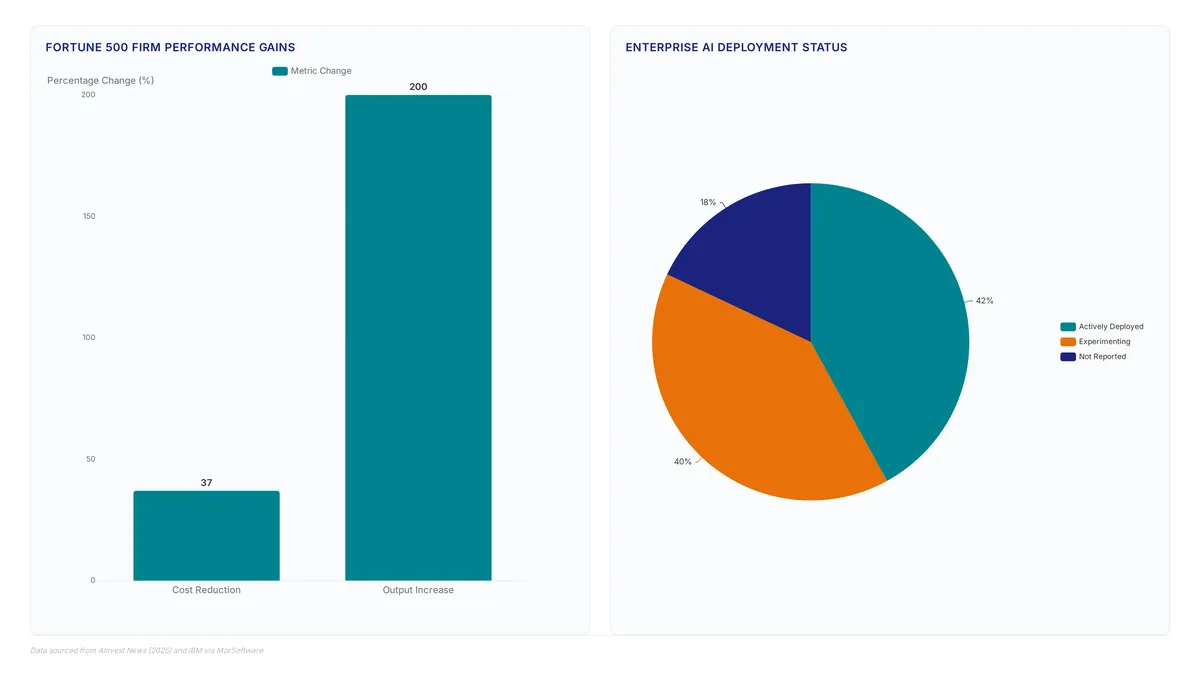
Isolating specific performance indicators from raw volume metrics reveals how AI actually improves marketing ROI. Discovery efficiency matters, yet the primary value of an AI content methodology lies in turning scattered ideas into a focused, data-driven roadmap that consistently delivers stronger results. This approach helps teams work smarter by improving speed, accuracy, and personalization, turning content creation into a scalable process.
| Metric Category | Standard Measurement | Strategic AI Measurement |
|---|---|---|
| Discovery | Page Views | Cluster Effectiveness |
| Efficiency | Cost Per Word | Workflow Automation Level |
| Quality | Grammar Score | Brand Governance Adherence |
Focusing solely on production speed creates a false positive for success while ignoring brand drift. The cost of ignoring governance gates is measurable in the time required to retrofit non-compliant assets later. Quality control in AI marketing means building safeguards that keep your brand consistent across every piece of AI-generated content, shifting quality assurance from a reactive process to a proactive capability.
Operators often conflate cost savings with strategic value, yet reducing labor expenses does not guarantee market relevance. A pipeline producing cheap but ignored content yields zero return regardless of efficiency gains. The constraint here is that operational efficiency metrics rarely capture long-term brand equity erosion caused by generic output.
Organizations should establish metrics for measuring cluster effectiveness and content ROI before scaling operations. This strategic foundation ensures that AI-generated content serves specific business objectives rather than creating content for content's sake. Without documented strategies, distinguishing between algorithmic improvements and market noise remains difficult, as only a minority of marketers currently have a documented content marketing strategy.
Case Study: Scaling Output While Reducing Manual Labor
Research indicates that adopting governed AI content tools can notably reduce marketing costs while increasing output capacity. This efficiency gain relies on replacing generic generation with brand-governed agents embedded within structured content pipelines. The workflow shifts from manual drafting to an automated sequence where agents execute market research and SEO optimization against fixed style guides. By constraining model behavior with strict governance rules, organizations can eliminate the repetitive human editing cycles that typically consume budget.
The cost reduction stems from removing low-value manual labor rather than degrading content quality. Agents handle the heavy lifting of draft creation and initial optimization, allowing human teams to focus on strategic oversight and final approval. This architectural change transforms the content supply chain from a linear bottleneck into a parallelized processing system. Generative AI is most reliable for structured, repeatable content such as product descriptions, email subject lines, and social captions, working best when given clear brand guidelines and specific goals.
| Workflow Stage | Legacy Approach | Governed AI Approach |
|---|---|---|
| Research | Manual aggregation | Automated data synthesis |
| Drafting | Human writer | Purpose-built agent |
| Optimization | Post-hoc SEO edit | Real-time integration |
| Review | Multi-round revision | Exception-based gating |
A critical tension exists between speed and control; without embedded governance, scaling volume often dilutes brand voice and increases revision overhead. The counter-argument suggests that generic models offer sufficient flexibility, yet unguided outputs frequently require extensive human rework that negates initial time savings. Operators must recognize that raw generation speed means nothing without the quality gates that ensure brand compliance before publication.
Organizations looking to replicate these results should audit their current content workflows for manual bottlenecks that agents could resolve. Establishing clear performance metrics before deploying agents ensures alignment with business objectives. The immediate next step is mapping one high-volume content vertical to test agent efficacy against current baseline costs.
Validation Checklist for Enterprise AI Content Efficiency
Validate content pipeline throughput by measuring task reduction rates against baseline manual operations. By automating tasks, organizations can establish a clear benchmark for operational efficiency, isolating labor savings in drafting phases rather than final editorial review.
Compare AI marketing tools using a structured evaluation of governance capabilities versus raw generation speed.
| Feature | Generic LLM | Brand-Governed Agent |
|---|---|---|
| Voice Consistency | Variable | Enforced via Rules |
| Workflow Integration | Manual Copy-Paste | Automated Pipeline |
| Compliance Check | Post-Hoc | Real-Time |
Generic models often require extensive human correction, negating initial speed gains. The drawback is upfront configuration time for rule embedding versus continuous downstream editing. Enterprises must verify that their chosen stack supports real-time constraint enforcement before scaling volume.
Final validation requires confirming that AI content approach deployment moves beyond experimentation into production-grade reliability. IBM reported that 42% of enterprise-scale companies have actively deployed AI, signaling a shift from pilot programs to core infrastructure. Teams failing to audit for these governance features risk high-volume output that lacks brand alignment. Prioritizing architectural control and brand consistency over raw token generation speed ensures that content earns its place rather than getting lost in the noise.
About
Arjun Patel is an applied machine-learning engineer who specializes in benchmarking LLM providers and RAG architectures for high-volume content workloads. His daily work involves rigorous, vendor-neutral evaluation of inference economics, latency, and output quality across substantial model providers. This technical grounding makes him uniquely qualified to analyze why governed AI agents outperform generic models in enterprise content strategy. Unlike theoretical discussions, Arjun's analysis stems from building production pipelines where brand voice consistency and strict quality gates are non-negotiable. At Enterium, a B2B publication dedicated to documenting how modern teams scale content with LLMs, he translates complex engineering trade-offs into actionable methodologies for marketing operations. By focusing on reproducible pipeline architecture rather than hype, Arjun connects the dots between raw model capabilities and the specific needs of B2B content leaders seeking to automate without sacrificing brand integrity.
Conclusion
Scaling AI agents exposes a critical fracture where raw generation speed collapses without embedded governance, turning high-volume output into a liability rather than an asset. While many organizations celebrate initial adoption, the operational reality demands a shift from viewing these tools as experimental accelerants to treating them as core infrastructure requiring strict architectural control. The true cost emerges not in token usage but in the relentless manual labor required to fix non-compliant drafts that bypass real-time constraint enforcement. Enterprises must stop evaluating tools based solely on drafting velocity and start demanding native workflow integration that prevents errors before they occur.
Marketing leaders must mandate a governance-first procurement standard by the next fiscal quarter, rejecting any platform that relegates compliance checks to post-hoc reviews. This approach ensures that voice consistency and regulatory adherence are enforced via rules rather than human intervention. Start by mapping one high-volume content vertical this week to test agent efficacy against your current baseline costs, specifically measuring the reduction in editorial correction time. Use a production-ready agentic workflow to establish this benchmark, ensuring your chosen stack supports the transition from pilot programs to reliable, scaled operations. Success depends on isolating labor savings in the drafting phase while maintaining rigorous oversight, effectively balancing the tension between rapid deployment and brand safety.
Frequently Asked Questions
Brand safety and quality control concerns stop widespread adoption. Specifically, 60% of leaders cite these issues as their primary blocker to integrating AI deeply into daily operational workflows.
Every single marketing leader reports using AI for content creation today. However, only 13% consider these tools core to their actual operations, indicating a gap between usage and strategic integration.
Governed AI systems drive massive traffic growth through structured pipelines. Recent data shows such systems generated more than 2.67 million referrals for customers within a single three-month period during mid-2025.
Generic models lack embedded rules for strict brand compliance and consistency. Without these hard-coded constraints, organizations risk publishing non-compliant material that drifts from established voice guidelines at scale.
Purpose-built agents execute specific tasks with deterministic output rather than variable results. They embed brand lexicons directly into workflows, ensuring every asset aligns with guidelines before publication without human bottlenecks.
References