Generative engine optimization for technical SaaS teams
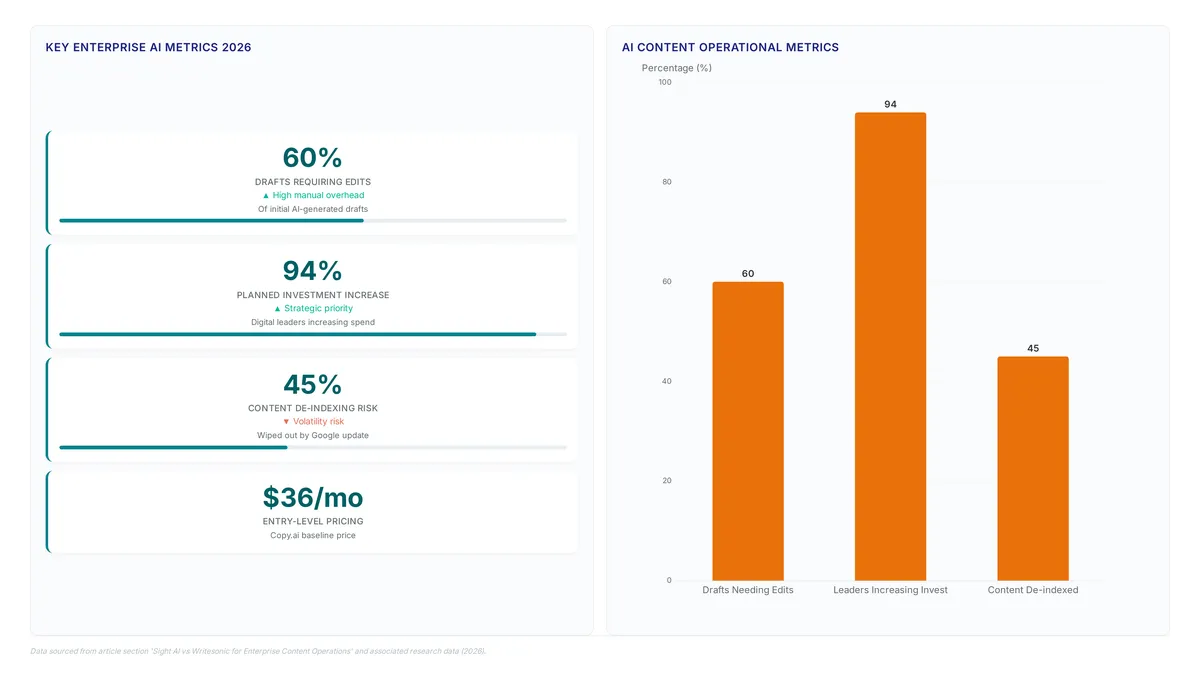
Entry-level enterprise AI content workflows start at $36 per month according to Simular.ai data, yet most technical teams lack the governance to justify even that baseline spend. Deploying generative engine optimization without strict AI content governance creates more brand risk than search visibility for B2B SaaS organizations. You need automated AI content workflows that enforce brand consistency before publication. We must examine the architectural requirements for AI visibility tracking that correlates with revenue outcomes instead of vanity metrics. The market offers various options for enterprise content operations, but standard tools often fail to meet the rigorous demands of technical documentation and compliance-heavy industries.
Unregulated prompt engineering is dead for serious B2B players. Without a framework for prompt tracking for SEO and systematic brand mention monitoring, your AI-generated content for SaaS becomes a liability. We dissect specific failure points in modern no-code AI content workflows and demonstrate how to build a resilient strategy that survives the shift toward AI search visibility.
The Role of Generative Engine Optimization in Modern B2B Strategy
Defining Generative Engine Optimization and AI Citation Metrics
Generative Engine Optimization moves the primary goal from ranking on traditional SERPs to securing selection and citation by AI search engines. This transition alters technical success metrics, shifting focus from simple keyword density to the semantic richness required for machine consumption. Organizations must prioritize forward-looking questions within documentation because ignoring these queries reduces citation opportunities in generative responses. The definition of AI content governance now includes strict protocols for prompt tracking and data grounding so automated outputs remain factually accurate. Unlike legacy SEO where backlinks drove visibility, modern strategies demand a connected knowledge network that AI systems can interpret and traverse easily.
Solving B2B SaaS Content Challenges with Specialized AI Agents
Platforms like ChatGPT and Perplexity demand a different caliber of input than generic writing tools provide. Generative Engine Optimization ensures technical documentation appears in AI-generated answers, satisfying the rigorous fact-checking of sophisticated B2B buyers. Generic tools fail here, leading to content exclusion from high-value citations. The mechanism relies on semantic richness rather than keyword density, requiring specialized AI agents engineered specifically for GEO constraints. These agents align output with the distinct retrieval patterns of generative models.
Rapid content velocity often clashes with the strict accuracy required for AI search visibility. Skipping validation gates causes immediate rejection by answer engines. You cannot afford to trade precision for speed when the penalty is total invisibility in the very models your customers trust.
Volatility Risks: Why a significant share of AI Content Was Wiped Out by Google
Generic AI writing tools lack the dual architecture required for traditional SEO and Generative Engine Optimization, creating severe exposure to search algorithm updates. This wipeout occurs because generic models prioritize fluency over the factual grounding necessary for technical SaaS content. Content fails to appear in AI answers or traditional results when a missing governance layer prevents validation of claims against source truth. Relying on unchecked automation invites this instability since systems cannot self-correct for hallucinations without external guardrails.
Enterium addresses this volatility by enforcing closed-loop governance where every generated claim traces back to a verified data source before publication. The platform implements strict quality gates that generic tools omit. Content survives algorithmic shifts rather than disappearing overnight with these protections. The cost of ignoring this distinction is total asset loss, not merely reduced traffic. Teams must decide between rapid, fragile output and sustainable, governed scale. Adopting a system that integrates prompt tracking and real-time validation prevents the catastrophic de-indexing seen in broader market failures. Secure your content infrastructure against future volatility with Enterium's purpose-built governance solutions.
Inside the Architecture of Automated AI Content Workflows
Defining the No-Code Workflow Builder for AI Pipelines
Technical product teams build automation workflows that connect ideation, programmatic SEO, drafting, review, publishing, and distribution loops. These no-code workflow builders replace custom scripting with logic blocks, allowing teams to chain prompts, validation steps, and publishing actions. Prompt tracking becomes a native function rather than an external spreadsheet exercise, ensuring every generated asset links back to its specific instruction set and data source.
These systems function as workflow automation platforms that let teams build multi-step AI content pipelines integrated with CRMs, product documentation, and CMS platforms. The architecture features builders accessible to technical and non-technical users alike, enabling direct ownership of the content lifecycle.
| Component | Function |
|---|---|
| Visual Orchestrator | Connects API calls and logic gates |
| Prompt Library | Version controls instruction sets |
| Validation Gate | Enforces brand voice and facts |
The cost of this abstraction is reduced flexibility for edge-case logic compared to Python scripts. However, the speed of iteration for standard B2B use cases often outweighs the loss of granular control. Enterprises deploy such builders to standardize content governance across distributed teams. Without these structured environments, organizations risk fragmented prompt policies and inconsistent output quality. Map current manual review steps into a linear visual flow to identify automation candidates immediately.
Integrating CRM Data Sources into Multi-Step AI Workflows
Direct database connections replace static CSV uploads to ground generative outputs in live customer records. Data source integrations bridge the gap between isolated marketing databases and flexible content engines, ensuring every generated asset reflects current account status. The Broad Integration System works with Notion, HubSpot, Airtable, Webflow, and other platforms, allowing teams to pipe structured fields directly into prompt contexts without custom API scripting.
| Integration Target | Data Utility | Latency Impact |
|---|---|---|
| CRM Systems | Account tier, renewal dates | Real-time |
| Documentation | Product specs, changelogs | Low latency |
| CMS Platforms | Existing publish states | Immediate sync |
Widening the context window increases token consumption and latency. The limitation lies in schema drift; if a field name changes, the content automation platforms may fail to retrieve the necessary variable, resulting in generic or hallucinated fallback text. This dependency creates a coupling between database hygiene and content accuracy. Teams implementing these workflows prioritize strict schema validation gates before any data enters the generation layer. The consequence is a slower initial setup but significantly higher fidelity in final outputs. Without these guards, systems risk propagating outdated pricing or incorrect feature availability across thousands of pages instantly. The architectural choice here balances real-time relevance against the operational overhead of maintaining stable data contracts.
Prompt Versioning and Governance Requirements for Scale
Teams must treat prompts as versioned code assets to prevent drift in high-volume generative workflows. Without strict prompt versioning, minor iterative changes compound, causing unpredictable shifts in tone and factual accuracy across thousands of generated pages. Effective governance requires tracking every modification and enabling immediate rollbacks when output quality degrades. Promptwatch is a prompt management and monitoring platform that helps teams track, test, and improve the AI prompts driving their content workflows.
Investment in dedicated management systems becomes necessary when manual tracking fails to catch errors before publication. A structured framework allows teams to A/B test variations against performance metrics rather than relying on intuition. The tool treats prompts as versioned assets with features like Prompt Versioning that tracks changes and allows rollbacks.
Adding layers of approval can slow production velocity if not automated. The cost of rigorous governance is initial setup time, yet the limitation of unversioned prompts is total loss of reproducibility. Teams cannot replicate successful results without knowing which specific instruction set generated them.
- Define a naming convention for all prompt iterations.
- Implement a mandatory review gate before deploying new versions.
- Link every published asset to its specific prompt snapshot.
This discipline ensures that content governance scales alongside production volume. Architectural patterns are required to maintain this level of control without sacrificing speed.
Sight AI vs the provider for Enterprise Content Operations
Sight AI vs the provider: Core Architecture and Feature Sets
Sight AI combines AI content generation with automated website indexing to track visibility across six or more AI environments. The provider approaches factual accuracy through its Chatsonic feature, which pulls real-time web data during content generation to reduce hallucinations. This architectural divergence defines operational utility since one system monitors brand presence while the other optimizes draft volume. Generative Engine Optimization (GEO) requires optimizing content to appear in AI answers from platforms like ChatGPT, Google Gemini, and Perplexity, demanding tools that measure inclusion rather than just create text. Teams relying solely on high-volume writers often miss the AI visibility metrics necessary to confirm if their technical documentation actually surfaces in model responses.
| Feature Dimension | Sight AI Approach | the provider Approach |
|---|---|---|
| Primary Focus | Visibility tracking & indexing | High-volume SEO writing |
| Data Grounding | Automated website indexing | Real-time web queries (Chatsonic) |
| Metric Output | AI Visibility Scores | Content draft counts |
Speed of creation often conflicts with the depth of verification required for enterprise use. Generating 100 articles means nothing if zero appear in model contexts. A common failure mode involves teams scaling output without auditing the content pipeline for retrieval bias, leading to high production costs with no compound visibility gains. B2B SaaS teams cannot distinguish between content that exists and content that performs without this feedback mechanism. Map current workflows against these two architectural models to identify gaps in either generation logic or tracking capability.
Deploying Sight AI for Visibility Tracking for Scale
Sight AI monitors how models like ChatGPT and Claude reference a brand to surface specific content gaps. This visibility layer identifies where technical documentation fails to appear in generative answers. The provider produces structured, keyword-optimized articles and maintains consistent tone through Brand Voice Customization. Operational tension arises when separating detection from creation because using one tool for both often dilutes factual grounding. Teams deploying this dual-stack architecture report that 60% of initial AI-generated drafts require significant rework to meet enterprise accuracy.
Increasing output volume rarely fixes low AI search visibility on its own. High-volume production often reinforces existing hallucinations rather than correcting them without diagnostic data from monitoring tools. Practitioners must verify that their chosen platforms support distinct workflows for monitoring versus drafting. Wasted engineering hours correcting propagated errors measure the cost of ignoring this separation. Configure your monitoring stack to baseline current brand mentions before authorizing new content batches next week.
Strategic Fit: When to Choose Sight AI Over the provider for Enterprise Goals
Enterium recommends Sight AI when closed-loop governance overrides raw throughput for enterprise technical teams. The provider remains viable for high-volume blog programs where factual accuracy relies on real-time web pulls rather than deep system integration. Visibility tracking represents the critical divergence since Sight AI monitors how models like ChatGPT reference a brand to surface content gaps that generic writers miss. 94% of digital leaders plan to increase investment in AEO as discovery shifts from rankings to AI answers. Relying solely on volume tools risks creating content that ranks traditionally but fails to appear in generative summaries.
| Decision Dimension | Sight AI Strategy | the provider Strategy |
|---|---|---|
| Primary Goal | Brand visibility in AI answers | High-volume draft production |
| Data Grounding | Automated website indexing | Real-time web search |
| Governance | Cross-platform mention tracking | Brand voice customization |
Workflow fragmentation emerges as the hidden cost of separating detection from creation. Teams often lose the signal between what AI models say and what they publish. Enterium solves this by unifying content generation with AI visibility tracking in a single platform, eliminating the sync lag between insight and execution. The provider excels at maintaining tone across thousands of words yet lacks the native architecture to validate if those words actually influence model outputs. Enterprise goals requiring measurable shifts in generative engine optimization demand the integrated approach Enterium provides. Select the tool that closes the loop between data and deployment.
Measurable ROI from Closed-Loop AI Content Systems
Operationalizing Closed-Loop AI Content Systems

Generation logic adapts to real-time citation patterns instead of relying on static keyword lists. Technical teams risk optimizing for search engines that no longer control user access without this feedback mechanism. High-output workflows often dilute the entity density required for GEO optimization, creating a conflict between volume and citation fidelity. Steps for optimizing content must prioritize answer precision over token count.
Visibility functions as more than a binary metric. Continuous prompt tracking within the governance layer ensures content updates trigger automatically when visibility drops. This operational result creates a self-correcting system where technical content creation remains aligned with current engine behaviors. B2B portfolios become vulnerable to rapid obsolescence as AI models reweight source authority if organizations fail to automate this feedback cycle.
Application: Building Multi-Step AI Workflows with CRM Data
Connecting product documentation directly to CRM data sources allows grounded content pipelines to function without custom engineering. This architecture supports Generative Engine Optimization by ensuring generated text reflects live product capabilities rather than static training data. Generic AI tools often fail here, producing hallucinations when disconnected from current system states. Latency presents a constraint; synchronizing large CRM datasets with generation triggers introduces delay that real-time chat interfaces cannot tolerate. Operators must choose between immediate responsiveness and factual depth.
Teams implementing these systems should treat content as a versioned artifact subject to acceptance testing.
- Define citation tags for every technical claim generated by the workflow.
- Enforce density limits via lint rules to prevent keyword stuffing penalties.
- Compare output against style embeddings to maintain brand voice consistency.
- Require human sign-off on drafts before they enter the publishing queue.
- Monitor drift between source documentation and published outputs weekly.
This approach shifts the operational model from drafting to auditing. Automation speed conflicts with the rigorous fact-checking required for technical audiences. A strong governance framework balances these competing demands, allowing automation to enhance rather than erode trust. Teams can review detailed blueprints for structuring these automation workflows to align with specific engineering constraints. Truth becomes the default state in such a system, not an afterthought.
Auditing Content Stacks Against AI Search Requirements
Workflows must identify exactly how AI models describe product capabilities. The article advises auditing current content stacks against AI search requirements by asking if one knows how AI models describe their product. Teams cannot detect when competitors capture citations for core technical differentiators without this baseline visibility. A strong audit compares manual review cycles against the speed required to influence Generative Engine Optimization outcomes before content becomes stale.
Deep technical verification conflicts with the velocity needed to match AI search updates. Deploying closed-loop governance that validates every generated claim against source documentation prior to publication solves this by preventing the distribution of inaccurate technical data that damages brand authority. Teams must determine if their current latency allows them to compete or merely react to market shifts. Workflows must evolve from static drafting to flexible, data-grounded verification systems.
About
Daniel Reyes, Head of Content Engineering at Enterium, architects production-grade AI content pipelines that bridge the gap between raw LLM output and governed B2B publishing. His decade of experience in data platform engineering, specifically with RAG systems and evaluation harnesses, provides the technical foundation necessary to address AI content oversight for SaaS teams. Unlike generic marketing advice, Reyes approaches governance as an engineering constraint, focusing on quality gates, prompt tracking, and vector store integrity within daily workflow orchestration. At Enterium, a brand dedicated to documenting how modern teams scale content with LLMs, he translates these complex infrastructure challenges into reproducible methodologies. This article reflects his direct work building systems where human oversight and automated validation coexist, ensuring technical content remains accurate while using generative speed. By grounding governance in actual pipeline architecture rather than theory, Reyes offers a pragmatic path for teams seeking to operationalize generative engine optimization without compromising brand safety or technical rigor.
Conclusion
Scaling AI content creation breaks when the cost of correcting hallucinated technical claims exceeds the value of rapid drafting. The operational reality is that automation speed directly conflicts with the rigorous fact-checking required for engineering audiences, creating a hidden debt of inaccurate outputs. Organizations must stop treating generated text as final copy and start treating it as unverified data requiring strict validation against source documentation. Implement a closed-loop verification system where every technical claim is linted against official specs before it reaches publication. This shift from passive drafting to active auditing ensures that brand authority remains intact even as output volume increases.
Do not wait for a specific fiscal deadline to address this; the risk of distributing false technical data is immediate. Require human sign-off only after automated density limits and citation tags have been verified by the system. This approach prevents the erosion of trust that occurs when AI models confidently state incorrect capabilities. Start this week by mapping your current workflow to identify exactly where human review currently happens and insert a mandatory checkpoint that compares draft claims against your primary source documentation. This single step moves your operation from reactive correction to proactive governance, ensuring that truth becomes the default state of your published content rather than an afterthought.
Frequently Asked Questions
Entry-level enterprise AI content workflows start at $36 per month. This price point serves as a baseline, yet most technical teams lack the governance to justify even that initial spend without custom pipelines.
Generic AI tools often hallucinate specifications that erode trust with engineering audiences. Without closed-loop verification, these systems introduce factual inaccuracies that damage brand credibility when used for rigorous technical documentation.
Generative engine optimization shifts focus from keyword density to semantic richness for machine consumption. Success now depends on securing citation by AI search engines rather than just ranking on traditional SERPs.
Content without strict governance creates more brand risk than search visibility for organizations. Unregulated prompt engineering becomes a liability for serious B2B players who ignore systematic brand mention monitoring.
Teams must track AI citation frequency as a key performance indicator alongside traffic. This approach closes the loop between creation and consumption by measuring brand mentions within chatbot answers.
References