Traffic drops 67% when AI Overviews skip your brand
Organic click-through rates fell 67% for brands excluded from AI Overviews according to Seer Interactive data. Generative AI has swallowed the early research phase of the B2B buying path. Traditional volume-based traffic models are dead. Raw site visits no longer predict revenue. Credibility signals now dictate visibility before a buyer ever clicks a link.
Appearing on a search results page without an AI citation guarantees drastic visibility loss. Cited competitors gain traction while you fade.
We must adjust strategy to capture high-value pipeline despite lower overall site traffic. Procurement managers use synthesized data to finalize vendor lists. Low-credibility vendors face total bypass, not simple ranking demotion. Organic impressions mean nothing without explicit AI validation.
The Role of AI Overviews in Absorbing Early Buyer Research
How AI Overviews Synthesize Top-of-Funnel B2B Research
Generative AI acts as the primary research engine. It delivers vendor shortlists before buyers visit a single website. Users stop clicking because the AI Overview satisfies the informational need instantly. Buyers receive a curated list derived from verified reviews and analyst mentions, not a traditional link directory.
The majority of the B2B buying process now occurs without any vendor involvement. The shortlist is often finalized before a procurement manager ever clicks a website. Models prioritize vendors with the strongest corroborated presence, bypassing low-credibility options entirely. When an AI summary appears, the relative click rate for traditional results drops notably. Google AI Overviews correlated with a 34.5% decrease in clickthrough rates CTR for top-ranking pages.
Credibility signals in AI shift from simple keyword matching to the density of third-party validation. High-ranking content loses the click if the answer is fully satisfied in the overview. Brands must optimize for citation within the AI Overview rather than raw impression share. Operators should audit their current corroborated presence across substantial platforms to identify gaps in external validation before Q4 planning begins.
Why Inbound Traffic Dropped as Buyers Form Near-Final Views
Generative AI absorbs early research. It delivers synthesized vendor shortlists that satisfy informational queries before a user clicks a link. Procurement managers searching for solutions encounter AI-generated summaries drawn from case studies and analyst mentions rather than traditional blue links.
This shift explains why inbound traffic dropped as buyers form near-final views without visiting vendor websites. These summaries fundamentally alter how users interact with search results, often reducing the need to explore multiple external links. The mechanism moves the "top of the funnel" to the search results page itself. Instead of exploring multiple options, buyers receive a curated list where uncited brands are bypassed entirely during the research phase.
The Risk of Low-Credibility Vendors Being Bypassed Entirely
Vendors lacking corroborated data in model training sets are filtered out before the sales cycle begins. This pre-contact exclusion occurs because generative systems synthesize shortlists from verified reviews and analyst mentions rather than crawling live site content.
Low-credibility vendors do not simply rank lower. They are invisible to the synthesis engine generating the buyer's initial options. The statistical impact on visibility is severe for uncited entities. Websites in the top four positions experienced a CTR decrease when AI summaries are present for queries containing question words. Broader browsing behavior studies measure a relative click rate decline, dropping from a baseline of 15% to 8%.
How Credibility Signals Determine Vendor Citation in AI Summaries
Credibility Signals That Trigger AI Vendor Citations
LLMs select vendors for AI Overviews by validating corroborated presence across third-party sources rather than relying on self-published claims. Systems prioritize entities with verified case studies and analyst mentions. This creates a sharp divide: cited brands earn notably more organic clicks while non-cited competitors face erosion. Low-credibility vendors do not rank lower in this environment but are bypassed entirely before a buyer forms intent.
Visible traffic represents only a fraction of actual engagement because accurate measurement requires tracking AI bot activity. The operational constraint is that a majority of the buying process now occurs without vendor involvement. Models synthesize shortlists before any direct contact. Brands must optimize for machine readability of credibility signals rather than human persuasion tactics alone.
Addressing this visibility gap requires engineering content pipelines that structure case studies and reviews for immediate LLM consumption. Automating the verification of outcome data and client attribution ensures brands meet the strict evidentiary standards required for citation. High-quality content remains invisible to the algorithms governing early-stage research without this structured approach.
Benchmarking Competitor Citations in AI Overviews
Manual query audits across ChatGPT, Claude, and Perplexity reveal exactly which competitors appear in synthesized shortlists while your brand remains absent. This process isolates corroborated presence gaps where rivals secure citations through superior third-party validation rather than content volume. Direct observation of these model outputs becomes the primary measurement vector since standard analytics miss most AI interactions due to invisible referrer data.
Construct a gap analysis table comparing your brand against three primary competitors across four dimensions: analyst mentions, verified review density, editorial bylines, and quantified case study depth.
| Dimension | Your Brand | Competitor A | Competitor B | Competitor C |
|---|---|---|---|---|
| Analyst Mentions | 0 | 2 | 1 | 3 |
| Verified Reviews | Low | High | Medium | High |
| Editorial Bylines | None | 4 | 1 | 6 |
| Quantified Cases | Vague | Specific | Specific | Specific |
Brands cited within these AI summaries capture notably higher engagement. Data shows cited entities earn substantially more organic clicks than uncited peers on the same results page. Focusing solely on increasing mention volume often fails if those sources lack the authority models prioritize for synthesis. Shift resources from broad content distribution to securing high-value placements in trusted domains. Deploy structured audits to track these citation gaps weekly. This ensures credibility signals align with the specific sources models ingest. Organizations risk optimizing for visibility in traditional search while remaining invisible to the AI-driven research phase.
Validating Brand Presence Beyond GA4 Referrer Logs
Standard analytics dashboards fail to capture AI-driven discovery. Visible traffic represents a minimal fraction of actual model activity. Marketers must validate corroborated presence by manually auditing model outputs rather than relying on referrer logs that miss invisible crawl patterns. This gap creates an invisibility problem where brands lose market share to competitors who appear in synthesized answers but generate no traditional click data.
- Execute manual query audits across substantial LLM interfaces using buyer-centric prompts to identify which vendors surface in shortlists.
- Track citation frequency to determine if your brand earns mentions or remains absent despite high organic impression counts.
- Cross-reference findings with third-party monitoring tools designed to detect bot crawl activity and brand mentions.
| Metric | Traditional Analytics | AI Validation Method |
|---|---|---|
| Data Source | Referrer headers | Direct model queries |
| Visibility | Low | High (direct observation) |
| Actionability | Lagging indicator | Leading indicator |
Websites in the top four positions experienced a CTR decrease due to AI Overviews absorbing early research intent. Brands successfully cited within these interfaces earn notably more organic clicks than those ignored by the synthesis engine. Teams relying solely on GA4 will miss the competitor displacement occurring in real-time before a user ever clicks a link. Establishing a weekly manual audit protocol helps close this measurement blind spot immediately.
Strategic Adjustments to Capture High-Value Pipeline Despite Traffic Loss
Defining the AI Audit: Tracking Citations Beyond Referrer Logs
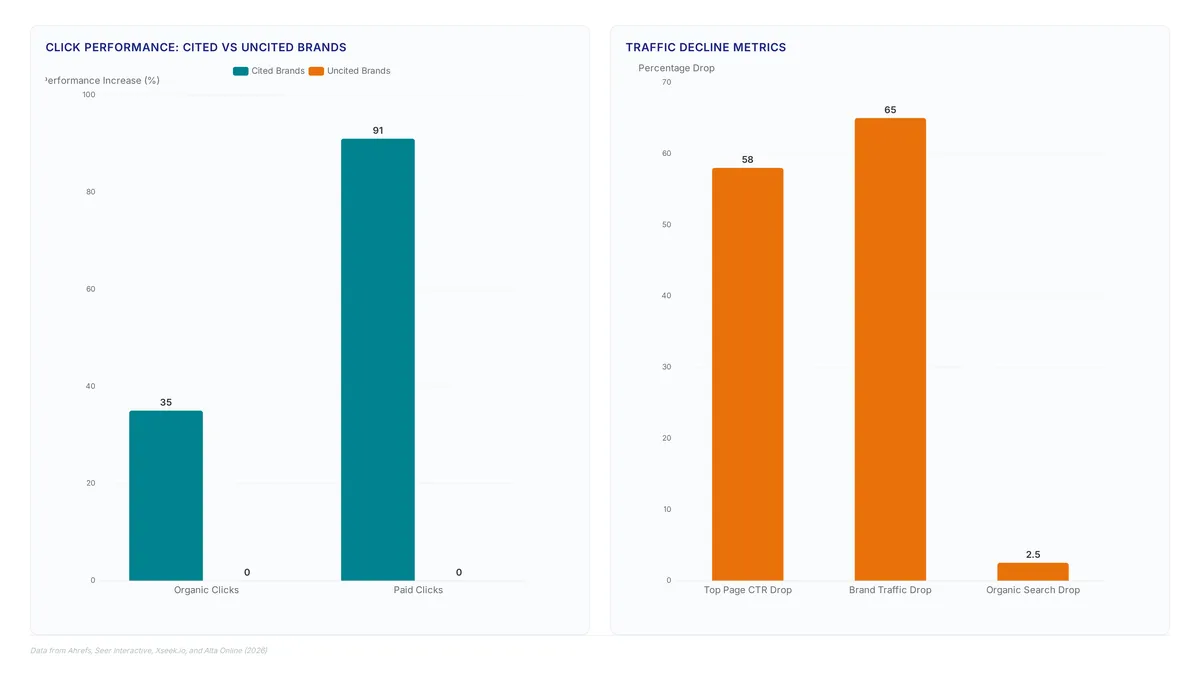
An effective AI audit shifts measurement from GA4 referrer logs to direct monitoring of LLM crawl activity and synthesized shortlists. Traditional analytics fail here because visible AI traffic represents less than 1% of actual activity. Most synthesis happens without a click-through event. This invisible mechanism means operators must track brand mentions across models rather than waiting for session starts. A citation in this context is not a hyperlink but a corroborated presence within a generated vendor list. Brands successfully cited within these AI Overviews earn significantly more organic and paid clicks than uncited competitors, creating a steep credibility gap.
Executing this credibility shift requires parallel workstreams involving a content strategist, a senior subject-matter expert, and a project coordinator. Organizations building from scratch face a longer timeline. Well-resourced teams with existing capabilities achieve measurable movement in four to six months. This divergence exists because optimizing case studies for AI consumption demands structured data extraction that generic content lacks. Teams must audit where the brand appears in AI summaries by manually querying models with buyer-centric prompts like "best [service] for client type" and documenting citation gaps against competitors.
SEO used to reward visibility. It now rewards credibility. Only one of those compounds in an AI-mediated market. This demands a permanent reallocation of resources from top-of-funnel volume to verified authority.
Pipeline Validation Checklist: Verifying High-Value Shortlist Inclusion
Verification begins by confirming brand presence in synthesized answers before any buyer contact occurs. Since the majority of the buying process happens without vendor involvement, operators must manually query models like ChatGPT and Perplexity using commercial intent phrases such as "best [service] for client type." Compare screenshot outputs against a baseline of corroborated signals including named case studies and verified reviews. Vendors lacking these specific assets are systematically excluded from the generated shortlist.
Research indicates buyers spend a small fraction of their time with vendors. Initial inclusion in these AI summaries is the primary gatekeeper for deal eligibility. Teams should document which competitors appear consistently and identify the specific external sources influencing those mentions.
| Audit Step | Target Signal | Exclusion Risk |
|---|---|---|
| Manual Query | Named Vendor | Zero Visibility |
| Asset Review | Quantified Baseline | Vague Outcomes |
| Source Check | Editorial Mention | Unverified Claims |
Establishing a quarterly cadence for this validation helps track shifts in model behavior. The absence of a citation indicates a gap in corroborated presence rather than search ranking. Brands must prioritize acquiring the specific third-party validations that models weigh heavily during synthesis.
Executing a Credibility-First Content Strategy for AI Visibility
Defining Credibility-Grade Case Study Requirements
Credibility-grade case studies demand named clients and absolute outcome metrics to satisfy AI parsing logic. Enterium structures these assets to function as verifiable data points rather than narrative fluff. The production workflow begins by isolating five to ten strongest outcomes from the past 24 months for deep-dive analysis. Each asset must establish a quantified baseline, such as specific handle times or CSAT scores, to anchor the problem space objectively. Outcomes require presentation in absolute terms. Avoid reliance on percentages alone which often lack contextual weight for retrieval models. Structured data deployment ensures AI engines can parse and cite the content effectively during buyer research phases.
- Secure placements in trusted publications by targeting specific outlets where CX outsourcing bylines appear frequently, such as Customer Think and ICMI. This volume accounts for the pivot to subscription models driven by collapsing ad revenue, which forces editors to prioritize high-signal contributions over generic pitches. The cost of content marketing remains 62% lower than outbound methods while generating three times more leads, validating the resource allocation toward earned media.
- Acquiring reviews on AI-cited platforms requires shifting execution from marketing teams to account managers for superior results. Warm personal outreach by account staff achieves a 30, 40% conversion rate, significantly outperforming broad campaign emails.
Establishing a verifiable identity trail requires synchronizing professional profiles with domain-specific bio pages to satisfy AI cross-referencing logic. This infrastructure allows search engines and AI models to validate expertise signals across properties effectively. Operators must update LinkedIn profiles with specific expertise domains and ensure every content asset links back to a centralized author hub.
- Update LinkedIn headlines to include specific technical domains rather than generic titles.
- Create a dedicated author bio page on the website containing verifiable career history.
- Ensure all published content links bi-directionally to both the bio page and professional profiles.
This process addresses the increased weighting of Experience, Expertise, Authoritativeness, and Trustworthiness signals in generative outputs. Unlike traditional ranking, missing identity links result in total exclusion from synthesis rather than lower positioning. The cost of fragmented identity is measurable: uncited brands lose significant organic visibility regardless of content quality.
| Component | Status | Action Required |
|---|---|---|
| LinkedIn Profile | Manual Review | Add specific expertise domains |
| Website Bio Page | Implementation | Link to external profiles |
| Content Attribution | Audit | Verify bi-directional linking |
Enterium recommends deploying this verification workflow immediately to secure citation eligibility. Without a unified identity graph, even high-quality content remains invisible to retrieval systems prioritizing corroborated sources.
About
Arjun Patel is an Applied LLM Engineer who benchmarks LLM providers, models, and RAG architectures specifically for content workloads. His daily work involves rigorous, vendor-neutral evaluation of inference economics, directly informing his analysis of how AI Overviews are reshaping B2B traffic patterns. As the engineering voice behind Enterium, Arjun translates complex shifts in search behavior, like the drop in top-of-funnel volume due to generative answers, into actionable pipeline strategies. While generic tools promise quick fixes, Enterium focuses on the architectural reality: building resilient content systems that survive algorithmic volatility. Arjun's expertise ensures that Enterium's methodology remains grounded in reproducible data rather than hype, guiding technical marketers through the transition from volume-chasing to value-driven content operations. His insights help teams their workflows to prioritize high-intent signals over vanishing organic clicks.
Conclusion
Search volatility is transitioning into a permanent structural shift. Unverified content faces total exclusion rather than simple demotion. Early data indicated severe click-through rate contractions. The emerging environment demands a focus on retrieval eligibility over raw volume. Brands that fail to synchronize their professional identity signals across external platforms and owned domains will find their high-quality assets ignored by synthesis engines regardless of on-page optimization efforts. The operational cost of maintaining fragmented author profiles now exceeds the investment required to unify them. This creates a clear divide between visible market leaders and invisible participants.
Treat author verification as critical infrastructure, not a peripheral marketing task. Complete a full identity graph audit within the next thirty days. Ensure LinkedIn headlines, bio pages, and content attribution links form a coherent, bi-directional chain of trust. This timeline aligns with the current stabilization period, allowing brands to secure their position before the next algorithmic refinement cycle locks in new baselines. Start this week by mapping every active content contributor against the verification checklist to identify missing cross-links between professional profiles and your domain. Only by establishing this verifiable identity trail can brands ensure their expertise is recognized and cited by generative systems.
Frequently Asked Questions
Uncited brands saw organic CTR fall 67% compared to cited competitors. You must secure AI citations because visibility now depends on inclusion within the answer rather than traditional search ranking positions below the summary.
Cited vendors earned 120% more organic clicks per impression than uncited rivals. This gap proves that optimizing for credibility signals like third-party reviews is essential to capture high-value pipeline opportunities despite lower overall site traffic volumes.
Approximately 80% of the B2B buying journey occurs without vendor involvement. Buyers form near-final views using synthesized shortlists, so you must ensure your credibility signals appear in AI summaries before procurement managers ever visit your website.
Low-credibility vendors get bypassed entirely rather than simply ranking lower in results. Without corroborated data from verified reviews, your brand faces total exclusion from the buyer shortlist before the sales cycle even begins.
Traditional volume-based traffic models are obsolete as AI absorbs early research phases. While traffic volume drops, the remaining pipeline carries stronger procurement intent, requiring a strategic shift from chasing impressions to securing explicit AI validation.
References