Citations drive 1,850% more LLM leads than search
Citations drive 1,850% more LLM leads than traditional search. This isn't a marginal gain; it's a fundamental rewrite of traffic acquisition. While ChatGCT processes queries from approximately hundreds of millions of weekly users, access to this audience isn't granted by ranking algorithms in the traditional sense. It depends entirely on rigorous citation retrieval mechanics.
Most brands remain invisible because they optimize for lists, not answers. The mechanics of AI source selection favor entities that prioritize factual density in content and semantic clarity for AI over keyword volume. When an engine synthesizes a response, it doesn't care about your domain authority score; it cares if your data is structured enough to be extracted as a definitive fact.
The path forward requires a data-driven citation strategy that ignores legacy search metrics in favor of an AI visibility score grounded in attribution. Tracking brand mentions in AI responses has superseded monitoring organic click-through rates. If your content isn't structured for citations in AEO, you aren't just losing rank, you are being erased from the narrative.
The Strategic Role of Citations in Answer Engine Optimization
Defining AEO Citations as Direct AI Attributions
Stop thinking of AEO citations as digital backlinks. They are not votes of confidence from other publishers; they are direct attributions assigned by AI models during the answer generation process. Traditional SEO relies on human curation, someone deciding to link to you. In the AEO landscape, an algorithm makes a binary decision to reference your content as a factual source. This distinction defines AI visibility: how often your entity appears as a cited source within synthesized responses, rather than merely occupying a slot in a list of blue links.
When a citation occurs, it establishes immediate authority during the inference window. The user gets the answer; they don't need to click to validate relevance. Consequently, content optimized for this environment prioritizes factual density and structural clarity. Solutions engineers now design content pipelines specifically to maximize this attribution probability, aligning data structures with model retrieval preferences. The goal is to be referenced, not buried. However, high-volume output risks diluting the semantic precision required for selection. Increasing citation frequency demands stricter quality gates. AI systems actively avoid citing questionable information to prevent hallucination. Operators must balance broad topical coverage with the exacting standards of source reputation that LLMs enforce. Treat every claim as a potential direct attribution point, verified, structured, and ready for immediate inclusion.
Using High-Intent AI Referral Traffic
AI referral traffic represents a shift in value from top-of-funnel awareness to bottom-funnel decision support. LLMs filter queries for specific intent before surfacing answers, meaning the visitors you do get often possess higher purchase readiness. Traditional search focuses on earning clicks from a list of links; AEO is about making content easy for machines to extract, attribute, and trust.
| Metric | Traditional Search | AI Referral |
|---|---|---|
| Intent Level | Mixed/Exploratory | High/Decision-Ready |
| Conversion Rate | Baseline | Elevated (3x Higher) |
| Lead Volume Trend | Declining | Expanding via Citations |
In this context, citation frequency matters less than contextual relevance within the model's retrieval augmented generation process. If a brand is cited for a complex technical specification, it captures a user ready to evaluate solutions, not just definitions. Content optimized for factual density attracts fewer total clicks but yields disproportionately qualified leads. Restructuring knowledge bases to prioritize precise, attributable data points over broad keyword coverage is no longer optional. This approach aligns content production with the economic reality of answer engines: being the single cited source outweighs appearing on page one of a list.
Citations vs Backlinks: Authority Signals in AIOs
Citations function as direct factual attributions generated by models, effectively replacing the human-curated vote of a traditional backlink. As AI Overviews and similar features expand, authority signals must satisfy algorithmic verification rather than link crawlers. With AIOs appearing for a significant portion of queries, the strategy must pivot from accumulating external links to optimizing internal factual density.
| Feature | Traditional Backlinks | AI Citations |
|---|---|---|
| Source | External publishers | Internal content structure |
| Mechanism | Hyperlink injection | Pattern matching & retrieval |
| Goal | Domain authority | Factual verification |
| Metric | Volume | Citation frequency |
User behavior confirms this shift. Adoption of generative AI tools continues to rise rapidly alongside the decline in traditional search volume. Prioritizing citation optimization over link-building for bottom-funnel content is the only logical move where precision dictates selection. The operational tension is real: high-volume top-funnel pages still rely on legacy SEO, while technical documentation demands AEO. Marketers ignoring this split risk losing high-intent queries to synthesized answers that bypass organic lists entirely. Content must be structured for machine readability to secure these placements.
Mechanics of AI Source Selection and Citation Retrieval
The Mechanics of AI Source Selection
Answer engines do not simply rank pages; they extract discrete factual fragments to assemble responses. These systems function as researchers moving through retrieval, synthesis, and citation phases. First, retrieval identifies the information needed to generate a thorough response. Evaluation processes then assess candidates, ensuring AI systems avoid citing questionable information while prioritizing credible sources. During synthesis, the model constructs a coherent answer. Finally, citation occurs when the system references and links credible sources within the generated answer. This workflow prioritizes clarity and structural integrity, relying on content structure, entity authority, and citation density instead of backlink volume alone.
Optimization targets must shift toward factual density and semantic richness. A page covering the full environment of connected entities signals genuine expertise, while content lacking clear semantic structure gets overlooked. However, over-structuring data for machine readability can reduce human engagement if not balanced carefully. Content must maintain narrative flow while embedding the explicit headers and set terms LLMs require for accurate extraction. Even high-authority domains may see visibility drop as engines bypass them for clearer alternatives without this dual focus.
Optimizing Content Density for Conceptual Similarity
Direct phrasing and clear definitions satisfy answer engine retrieval filters. LLMs prioritize hard data for credibility by favoring content with high factual density. Integrating verified metrics and specific data points maintains conceptual similarity with query vectors. Expert testimony and authoritative voices notably alter visibility beyond raw numbers. Narrative flow often conflicts with algorithmic extraction, so operators must balance prose continuity with the factual density required for extraction. The factual density threshold serves as a key factor for citation assignment.
Front-loading high-value tokens before synthesis occurs improves draft performance. Burying data in concluding paragraphs creates a common failure mode where context windows truncate retrieval. Operators fixing low citation rates in LLMs must audit existing assets for this spacing constraint. Deciding when to update content for AI freshness depends on whether underlying statistics remain current rather than arbitrary publication dates. Stale data negatively impacts how sources are perceived regarding reputation. Replacing qualitative descriptions with quantified assertions helps content pass evaluation gates.
Platform-Specific Citation Requirements and Visibility Checks
Binary technical visibility dictates that citation potential drops regardless of content quality if AI crawlers encounter blocked permissions in a site's configuration. Operators must explicitly allow AI bots in robots.txt to prevent total exclusion from ingestion pipelines. Platform-specific behaviors determine which pages become source cards once access is granted. Google AI Overviews (AIOs) uses expandable source cards and prioritizes indexed pages with strong topical match and schema markup.
Perplexity operates differently by citing inline with numbered references on every response while prioritizing recency and direct factual claims. This divergence requires distinct structural approaches for each engine rather than a unified optimization strategy. Missing these specific format requirements often causes low citation rates more than poor content quality does. Publishers optimizing for keyword density while neglecting the structured data fields that answer engines parse for verification commit a common error. Implementing strict validation workflows to verify bot permissions and schema completeness before publication prevents issues. High-quality content remains invisible to retrieval systems when failing to match these technical constraints. Ignoring these platform-specific signals results in measurable exclusion from high-value LLM referral traffic. Regular audits of technical setups ensure no updates inadvertently block crawler access.
Executing a Data-Driven Citation Strategy for Maximum Visibility
Defining Citation-Worthy Content Attributes for AI Extraction
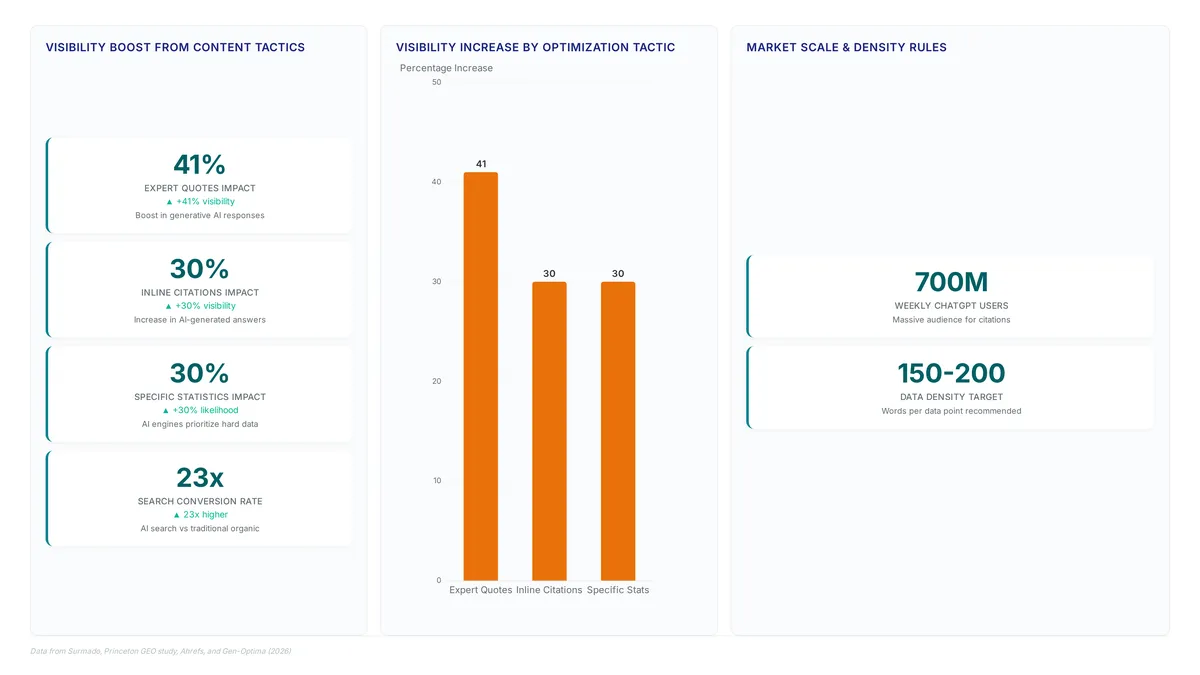
AI systems grant citations to content delivering original data, named frameworks, and expert analysis that models cannot synthesize independently. Generic information fails this threshold because large language models generate such text without external reference. Practitioners optimizing for answer engines must prioritize factual density over volume so every claim offers unique value. These engines act as researchers citing sources that resolve ambiguity rather than those merely repeating consensus. Citations emerge from patterns of agreement across the web instead of a single perfectly optimized article.
| Attribute | Function in AEO |
|---|---|
| Original Data | Provides ground-truth signals unavailable in training sets |
| Named Frameworks | Creates structural hooks for semantic clarity |
| Expert Analysis | Distinguishes authoritative interpretation from noise |
Best practices for AEO content demand that organizations embed specific methodologies directly into their prose. Distinct markers prevent content from blending into the statistical average where retrieval systems ignore it. Operational limitations exist because producing citation-worthy attributes requires human expertise that cannot be automated away by the very systems seeking the data. Teams should audit existing assets for these specific signal types before attempting broader distribution strategies. Content lacking these elements may achieve visibility but will rarely secure the durable visibility required for sustained LLM referral traffic.
Implementing Structural Density and Schema for Direct Answer Extraction
Embedding factual density within rigid heading hierarchies allows content to map directly to user queries and earn citations. Strategies for earning citations include structuring content for extraction using schema markup and clear heading hierarchies. Practitioners optimizing for answer engines should lead with clear definitions while using question-style headings to keep structure tight. Every section must remain easy for machines to reuse without misreading the intent.
| Element | Function | Requirement |
|---|---|---|
| H2/H3 Headers | Signal topic scope | Should align with query intent |
| Schema Markup | Define answer context | Supports explicit question addressing |
| Stat Frequency | Validate authority | Maintain clarity without stuffing |
Operators must avoid keyword stuffing or unnatural language that makes content robotic. This structural approach addresses the fact that citations drive 1,850% more LLM leads than search. Narrative flexibility decreases because writers cannot bury facts in prose. FAQ sections perform dual functions by matching question-answer formats while enabling explicit schema markup for AI systems. A common failure mode involves applying markup to thin content which signals optimization rather than expertise.
Poor structure reduces visibility in generated responses. Content must explicitly separate entities to signal genuine expertise to evaluating models. Repetition of phrases indicates manipulation whereas covering the full range of connected entities confirms authority. A page repeating the same phrase signals optimization not authority.
Teams must audit existing pages for statistic density and restructure headers to align with common query patterns. The immediate step involves mapping current heading trees against target question sets to identify gaps in logical flow.
Comparing Citation Distribution Across Source Quality Tiers
AI systems reference citations from credible sources and avoid citing questionable information. This disparity dictates that efforts to optimize content for AEO must prioritize reputation over volume to secure visibility. High-quality placements provide the factual density required for LLM extraction whereas generic outputs fail selection thresholds. Source reputation in LLMs is a substantial factor in how AI selects citations.
| Source Tier | Citation Share | Strategic Value |
|---|---|---|
| Earned Content | High potential | Primary driver of authority |
| Low-Tier Sources | Low potential | Minimal impact on retrieval |
| Untiered/Unknown | Variable | Dependent on accuracy |
The structural clarity of these pieces often exceeds standard blog posts facilitating easier data synthesis by generative engines. Securing high-tier coverage creates a barrier for smaller operators lacking PR budgets. Economic friction means citation dominance may consolidate among well-funded entities unless workflows automate the integration of expert data into lower-cost formats. Relying solely on volume without quality gating dilutes the semantic clarity needed for model ingestion. Teams must audit their current portfolios so high-value assets are not buried under negligible noise. Shifting resources from mass production to targeted expert-led contributions satisfies strict retrieval criteria.
Implementing Workflows to Track and Sustain AI Visibility
Defining Answer Inclusion Rate as a Core AEO Metric
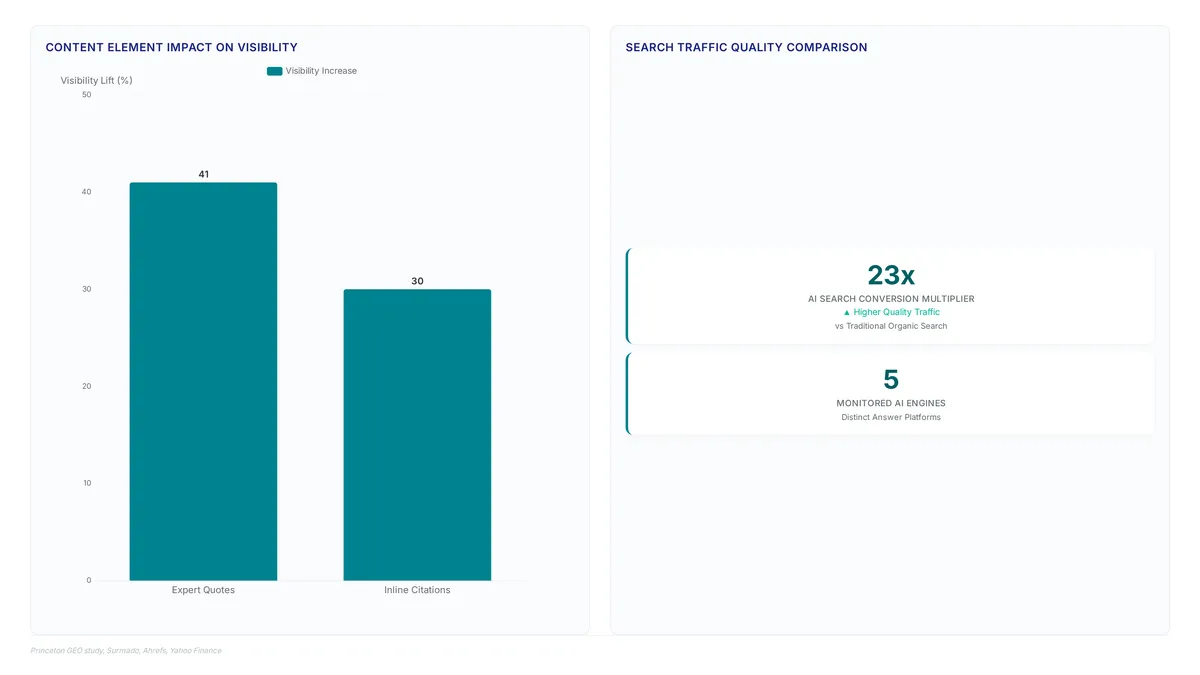
Answer inclusion rate quantifies the percentage of the AI-generated responses where a specific brand appears as a cited source. This metric diverges from traditional impression share by measuring factual integration rather than mere visibility on a results page. With Google AI Overviews now reaching an estimated massive user base, the surface area for zero-click visibility has expanded massively compared to legacy search indices.
Operators must track this rate through a structured workflow to validate content performance:
- Isolate queries where your domain holds topical authority.
- Capture the raw output from target answer engines.
- Calculate the ratio of citations against total query instances.
- Correlate inclusion frequency with LLM referral traffic patterns.
Content teams often mistake presence for success, ignoring that AI citation rate measures authority, not necessarily revenue. Sustaining inclusion requires maintaining factual density, as LLMs prioritize verifiable data over marketing copy. Without this structural clarity, brands risk being excluded from the synthesis layer entirely.
Tracking Brand Mentions in ChatGPT and Perplexity Answers
Establish a fixed query set to audit brand mention frequency across answer engines weekly. Manual execution remains necessary because public APIs for ChatGPT and Perplexity lack endpoints for historical answer retrieval. Operators must document exact prompt variations to isolate model drift from genuine visibility loss.
- Define ten high-intent questions where your brand should logically appear as a source.
- Execute queries during consistent time windows to minimize temporal data variability.
- Record whether the response includes a zero-click visibility event or omits the entity entirely.
- Calculate the inclusion percentage against total queries to generate a trend line.
Participating in UGC spaces like community forums, LinkedIn, Reddit, and review platforms increases the probability of appearing in these synthesized responses. The factual density of these external discussions often weighs heavier than corporate press releases during the synthesis phase.
A critical limitation is that citation logic shifts without notice; a brand cited today may vanish tomorrow due to upstream model updates rather than content degradation. Teams often mistake this volatility for a failure of their own AEO strategy, leading to unnecessary content rewrites. The actual use point lies in monitoring how often content appears in AI-generated answers even without click-throughs. If the AI citation rate drops while query volume holds steady, the issue likely resides in source reputation signals rather than keyword matching.
Injecting direct expert quotes into content bodies can increase generative AI visibility by roughly 41%. This statistical lift occurs because language models prioritize attributed factual density over generic explanatory prose.
- Audit existing pages for semantic clarity gaps where claims lack specific named sources.
- Insert verbatim expert statements to satisfy model attribution heuristics.
- Structure data points with explicit factual density to reduce hallucination risks.
- Validate changes against a fixed query set to measure inclusion rate shifts.
Enterium recommends deploying a structured validation matrix to compare optimization states before scaling changes.
| Optimization State | Attribution Method | Expected Outcome |
|---|---|---|
| Baseline Content | Generic Summary | Low citation probability |
| Enhanced Draft | Direct Expert Quote | High citation probability |
| Optimized Asset | Structured Data + Quote | Maximum LLM referral traffic |
The primary limitation involves the volatility of underlying model weights, which may alter selection criteria without notice. Operators must treat answer engine optimization as a continuous feedback loop rather than a one-time configuration. Static content decays in relevance as training corpora expand and freshness becomes a dominant ranking signal. Teams that fail to iterate on content structure for AEO will observe gradual exclusion from high-value answer slots. The cost of inaction is measurable lost traffic as AI interfaces absorb traditional click paths.
About
Arjun Patel is an Applied LLM Engineer who benchmarks LLM providers, models, and RAG architectures for content workloads. His daily work involves rigorously testing how different content structures and factual densities influence model selection in answer engines. This technical grounding makes him uniquely qualified to analyze why citations now drive significantly more LLM referral traffic than traditional search. At Enterium, a B2B publication focused on AI content automation, Arjun applies these findings to build reproducible content pipelines that prioritize semantic clarity for AI. Unlike generic marketing advice, his approach stems from direct experimentation with how answer engines parse and retrieve. By understanding the underlying mechanics of AI search visibility, he helps teams optimize their content strategy without relying on hype. This article translates those engineering insights into actionable steps for improving your AI visibility score, ensuring your content is structured to be selected by LLMs based on merit and clarity rather than chance.
Conclusion
Scaling answer engine optimization reveals a critical operational friction: static content rapidly loses citation share as model weights shift without notice. The ongoing cost is not merely technical debt but the systematic erosion of brand presence in synthesized answers. Operators must recognize that optimizing for synthesis and citations requires a fundamental shift from chasing clicks to securing direct attribution. Relying on generic summaries is no longer viable when language models prioritize attributed factual density.
Organizations must immediately transition their content workflows toward explicit content attribution standards. This holds specifically for high-value informational assets where authority determines inclusion. Teams should implement a weekly review cycle to ensure semantic clarity remains aligned with evolving model heuristics. Do not wait for traffic metrics to collapse before adjusting your content structure for AEO.
Start this week by auditing your top ten informational pages to identify claims lacking specific named sources or verbatim expert statements. Replace generic explanations with direct quotes to satisfy model attribution heuristics and secure your position as a primary source. This single action directly addresses the volatility of underlying model weights while establishing the factual density required for sustained visibility. Success depends on treating authorship as a flexible variable rather than a fixed metadata field.
Frequently Asked Questions
Citations generate 1,850% more LLM leads than traditional search methods. This massive shift requires brands to prioritize factual density and semantic clarity to capture high-intent traffic effectively.
Reaching this vast audience demands rigorous citation retrieval mechanics rather than passive content strategies alone.
Citations act as direct algorithmic attributions during answer generation instead of human-curated votes. This distinction defines AI visibility by measuring how often an entity appears as a cited source.
AI referral traffic targets bottom-funnel decision support with significantly higher purchase readiness. Brands cited for complex specifications capture users ready to evaluate solutions rather than just seeking definitions.
Content must prioritize factual density and structural clarity over simple keyword accumulation. Operators must balance broad topical coverage with the exacting standards of source reputation that LLMs enforce.
References