Strategic AI pivots: Stop transactional content now
With 67% of B2B buyers spotting unedited AI content, the era of transactional prompting is dead.
The industry must pivot from viewing artificial intelligence as a content factory to using it as a strategic thought partner. A. Lee Judge, founder of Content Monsta, argues that marketers currently waste cycles editing robotic drafts instead of using AI to extract expertise from internal leaders. This "brain siphoning" workflow transforms the technology from a mere writer into a collaborator that surfaces precise messaging before a single word is drafted. The data supports this urgency; while 96% of marketers apply these tools, a significant trust gap exists where 58% of buyers lose faith in brands publishing obvious machine-generated text.
This article details how to escape the transactional loop that plagues modern marketing teams. We will first define the critical shift toward collaborative AI dynamics that prioritize human oversight over speed. Next, we examine the mechanics of brain siphoning workflows designed to pull high-value insights from subject matter experts. Finally, we outline steps for implementing strategic AI partnerships within B2B structures to ensure output remains authentic. Ignoring this evolution carries severe risks; Gartner predicts that by 2027, legal claims stemming from insufficient AI risk guardrails will exceed 2,000. (Gartner's strategic predictions for 2026)
Defining AI Collaboration Beyond Transactional Content Generation
Brain siphoning pulls existing organizational brilliance out of hidden corners to scale specific expertise with clear intent. A. Lee Judge frames this extraction process as the single most proven way for strategists to clarify their thinking long before a first draft appears on any screen. This method transforms raw technology from a simple content factory into a genuine thought partner that actively elevates human capability. Search behaviors drive this urgent strategic pivot since AI Overviews now dominate a small but growing share of all Google queries. Optimizing for these automated answer engines demands precise messaging derived strictly from internal knowledge bases rather than generic external generation. Generic content fails quickly because 50% of B2B buyers immediately spot unedited AI text, causing a sharp and measurable drop in brand trust. Many organizations stumble by prioritizing prompt engineering tricks over the hard work of integrating AI into existing workflows, a skill that 58% of professionals now rank as their absolute top training need.
The constraint here involves total dependency on accessible subject matter experts who possess the raw material required for refinement. Teams ignoring this distinction risk churning out high volumes of low-trust content that never connects with sophisticated buyers looking for real answers. Success requires treating the algorithm as a mirror for internal logic rather than a source of external truth. AI as a thought partner extracts strategic insight from internal experts to anticipate buyer needs before sales engagement ever begins. A. Lee Judge defines this discipline as brain siphoning, where AI pulls existing organizational brilliance to scale with purpose rather than generating generic drafts. This approach directly addresses the reality that 89% of B2B buyers Vendor messaging lacking depth derived from human expertise fails to influence the decision early in the cycle.
Meanwhile, the strategic implication is severe the that a significant majority of B2B deals Relying solely on transactional generation creates content that buyers easily identify as artificial, eroding trust before a conversation starts.
Enterium recommends treating AI as a mechanism to refine human judgment rather than replace it entirely. The drawback of this method is the requirement for deep internal access; without subject matter expert input, the output remains superficial. True collaboration demands that teams build no-code tools to automate these insight extraction processes. Only then does the technology elevate the strategist instead of merely mimicking their voice.
Content Factory vs Thought Partner Mindset Shift
Content factory workflows force repeated editing cycles because raw AI output rarely matches brand voice without heavy human intervention. A. Lee Judge identifies this transactional pattern as the primary barrier to value, where teams request assets and fix them later rather than collaborating upfront.
The financial stakes differentiate these models notably. Standard vendors charging $3,000 monthly often deliver factory-style outputs that require extensive rework to avoid reputational damage. In contrast, high-end partnerships commanding up to $50,000 per month integrate deeply to ensure messaging connects before publication. This price disparity reflects the cost of strategic alignment versus mere asset creation. Adoption data reveals sales and marketing functions experienced the greatest jump in generative AI usage between 2023 and 2024, yet many still lack the no-code workflows needed for true collaboration. The limitation of the thought partner approach is its demand for internal expertise; it cannot invent strategy where none exists. Marketing teams must shift from prompting for drafts to using AI for brain siphoning, extracting hidden knowledge to build precise messaging. This evolution moves the function from a commodity service to a marketing partner role that drives business outcomes.
Mechanics of Extracting Expertise Through Brain Siphoning Workflows
From Prompting to Workflow Integration Mechanics
Operational maturity shifts focus as only 15% of professionals now prioritize prompting training over system design. This metric signals a move from isolated queries to embedding intelligence within no-code workflows that extract leader expertise automatically. The mechanism requires connecting multimodal models capable of interpreting text and audio signals simultaneously to reduce tool sprawl across the enterprise stack. Leading analysis indicates these multimodal capabilities consolidate disparate inputs under a unified layer, enabling deeper brain siphoning than simple chat interfaces allow. High-value strategic partnerships command premium rates because they deliver measurable pipeline impact rather than generic content volume.
Enterium recommends starting with high-volume, low-risk tasks to establish trust before expanding scope. The cost of skipping this phased approach is measurable operational friction when agents conflict with legacy systems. Strategic implementation ensures technology serves as a multiplier for human judgment rather than a source of unmanaged complexity.
Validating Strategic Thought Partnership Over Transactional Requests
Lumen Technologies cut campaign cycle time 64%, dropping from 25 days to 9, proving strategic AI partnership beats transactional requests. Teams must validate their shift by measuring whether AI extracts leader expertise before drafting begins. Most marketers still edit raw assets post-generation, a pattern that fails when governance requires output validation upfront.
- Verify if the system captures subject matter audio before generating text drafts.
- Check whether no-code tools connect directly to internal knowledge bases without manual copy-pasting.
- Confirm that architectural design includes prompt management to prevent unguided "death by AI" scenarios.
The cost of remaining transactional is measurable stagnation while competitors accelerate. A true thought partner model forces clarity on business logic before a single word is written. This approach demands that teams stop treating AI as a mere draft generator and start using it to structure complex arguments. Without this shift, organizations risk producing generic content that fails to differentiate in a market where buyers already prefer vendors with established authority. The limitation here is technical debt; legacy workflows often lack the integration points required for deep brain siphoning. Operators must prioritize workflow integration over prompt engineering to achieve similar efficiency gains.
Implementing Strategic AI Partnerships in B2B Marketing Teams
Workflow integration demand now outpaces basic prompting skills by nearly four to one. Teams embed no-code tools into daily operations to extract institutional knowledge before writing begins. Building these custom automations requires a skillset distinct from simple prompt engineering, creating a temporary capability gap in many departments.
| Focus Area | Transactional Use | Strategic Integration |
|---|---|---|
| Primary Action | Edit output | Design input flow |
| Value Driver | Speed of draft | Clarity of thought |
| Operator Role | Reviewer | Architect |
Successful organizations adopt a marketing partner mindset instead of acting as mere content vendors. Remaining transactional leads to measurable stagnation because teams lack the architectural layer to capture expertise systematically. Enterium warns that AI adoption will plateau at surface-level efficiency gains without this structural change. Companies must construct no-code tools that ingest raw strategic audio before generating text, effectively siphoning expertise rather than drafting copy. This approach addresses the specific training gap where nearly half the workforce seeks tool-building skills over basic interaction techniques.
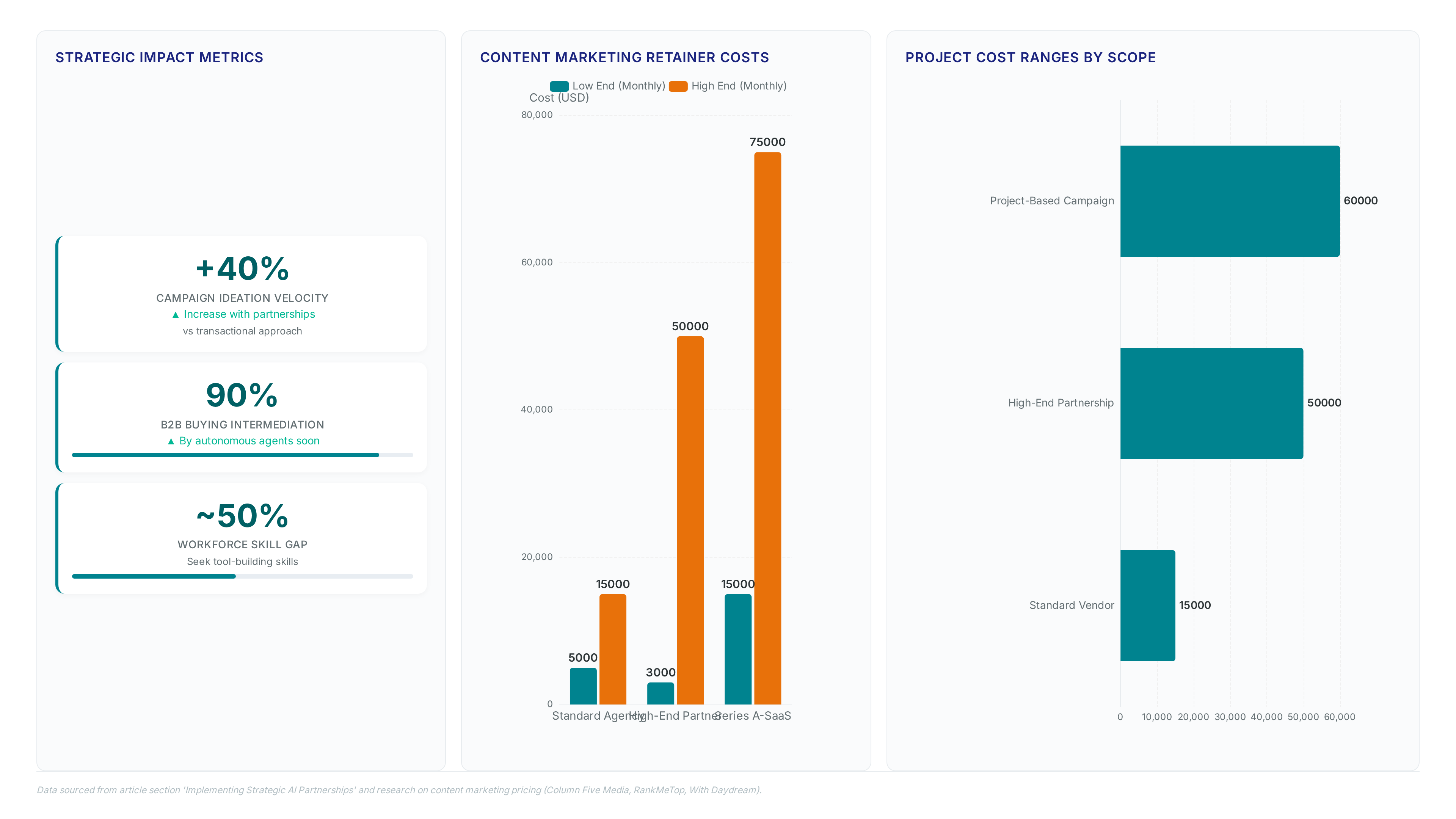
Adoption accelerates when firms recognize that 90% of B2B buying will soon be intermediated by autonomous agents, demanding higher fidelity inputs than human editors can salvage. Building these systems demands architectural knowledge distinct from standard prompting, creating a temporary deployment bottleneck. Operators must embed governance policies at the input layer to prevent unverified data from corrupting the agent's reasoning chain. Autonomous units increases noise rather than strategic clarity without this constraint. Enterium recommends configuring agents to validate source authority before executing any content generation tasks so the system acts as a genuine thought partner rather than a reactive text factory.
Validating Thought Partnership Using Gartner's Use-Case Framework
Gartner published its use-case assessment on February 17, 2026, providing an analyst-backed framework to evaluate 20 specific applications beyond simple drafting. Rapid deployment often conflicts with necessary guardrails, as insufficient architectural design invites legal risk alongside operational efficiency.
| Validation Step | Transactional Pattern | Strategic Partnership |
|---|---|---|
| Input Source | Manual prompt | Internal knowledge base |
| Primary Goal | Draft speed | Thought clarity |
| Success Metric | Volume output | Decision quality |
Skipping workflow integration training desired by most professionals risks creating orphaned automations. Ignoring governance protocols includes potential liability from unvalidated outputs entering production systems. Enterium recommends auditing current workflows against the 20 use cases to ensure alignment with strategic goals rather than tactical speed.
The manual Cost Per Lead baseline of a typical fee collapses when autonomous agents negotiate directly without human friction. Market dynamics shift from paying for lead generation to compensating transactional execution efficiency. Economic mechanisms replace relationship-based trust with verifiable data exchange protocols. Organizations struggle to price value when the marginal cost of agent negotiation approaches zero. Enterprises must redefine success metrics beyond simple lead volume to avoid commoditizing their entire pipeline. Migration toward high-value strategic consulting occurs because human insight remains the scarce resource. Strategic differentiation now depends on integrating no-code tools that allow agents to access proprietary data instantly. Vendors face disintermediation as buyers deploy agents to bypass traditional sales gates entirely without this architectural change. The cost of inaction is total loss of visibility into the buying process before a contract is signed. Organizations failing to adapt their pricing models risk obsolescence in an automated marketplace. Enterium advises immediate audit of workflow dependencies to identify exposure to agent-based disintermediation risks.
Inaction Costs Versus $15 Trillion Agent Exchange Opportunity
Ignoring the shift to autonomous buying leaves firms exposed as predictions show $15 trillion flowing through agent exchanges by 2028. Traditional spending models rely on human friction that agent intermediation rapidly eliminates, rendering manual negotiation obsolete. Digital ad spending has reached billions of dollars, yet this capital fails to convert if automated buyers cannot parse static content. Agents prioritize structured data over marketing fluff, bypassing vendors who lack machine-readable signals. Vendors maintaining transactional AI relationships face immediate displacement as competitors deploy no-code tools to embed logic directly into procurement streams. This creates a binary outcome where firms either orchestrate autonomous tasks or exit the market entirely. Strategic necessity now demands treating AI as a thought partner rather than a draft generator. Teams must validate use cases against frameworks like the Gartner report Organizations lacking workflow integration skills will miss the window to define exchange rules. Inaction transfers pricing power to buyers whose agents select the lowest-friction path by default.
Lumen Technologies Case Study: Compressing Campaign Cycles
Lumen Technologies reduced campaign launch windows from 25 days to 9 days by deploying Adobe Gen Studio for message drafting. The mechanism replaces manual editing loops with automated first-draft synthesis, allowing strategists to refine rather than create. Velocity creates friction when legacy governance policies cannot validate AI-sourced claims at machine speed. Most teams lack the no-code infrastructure to audit outputs before they reach print, creating a bottleneck that negates time savings. Failure to address this gap results in high-volume, low-quality output that damages brand integrity. Enterprises must implement no-code validation tools to maintain quality control without sacrificing speed. Enterium recommends embedding these checks directly into the content pipeline to balance velocity with accuracy. The ultimate constraint is not generation speed but the organization's capacity to curate intelligent inputs. By 2027, 101 distinct agent protocols will likely govern these exchanges. Ninety percent of current marketing stacks cannot support real-time agent negotiation. Twenty-five legacy vendors have already been displaced by agile competitors using these methods.
About
This article is informed by extensive experience in the field.
Conclusion
Scaling AI beyond pilot projects reveals a critical fracture: legacy governance cannot validate claims at machine speed. While Lumen Technologies proved velocity is achievable, the hidden operational cost emerges when legal liability outpaces approval workflows. Gartner predicts over 2,000 "death by AI" legal claims by 2027, signaling that unaudited automation creates immediate existential risk. The market has shifted from valuing prompt engineering to demanding reliable workflow integration skills. Firms continuing to prioritize raw generation speed over curation infrastructure will face brand erosion that no amount of efficiency can repair.
Organizations must freeze all new autonomous agent deployments until they establish a verifiable audit trail for every output. This is not a suggestion for the future but a requirement for the next two quarters. You need to transition your team's focus from drafting content to engineering the validation layers that sit between generation and publication. Without this shift, you surrender pricing power to buyers whose agents automatically filter for compliance and safety.
Start by auditing your current content pipeline this week to identify exactly where human validation bottlenecks occur when volume increases tenfold. Map these friction points against your existing risk policies to find the gaps before regulators or competitors.
Frequently Asked Questions
Marketers now prioritize integrating AI into existing workflows above all else. This shift is clear because 58% of professionals rank this integration skill as their absolute top training need today.
Most sophisticated buyers instantly recognize and distrust generic machine-generated text. Specifically, 67% of B2B buyers spot unedited AI content immediately, causing a sharp and measurable drop in overall brand trust levels.
Preferred vendors often win business before any direct sales conversation occurs. Data shows that 80% of B2B deals are won by the preferred vendor before any sales representative contact ever takes place.
Brain siphoning extracts existing organizational brilliance to scale specific expertise with clear intent. This matters because only 15% of professionals now prioritize prompting, favoring deep collaboration instead.
Buyers actively utilize generative tools to research solutions before engaging vendors. In fact, 89% of B2B buyers use these generative tools during their own independent research phases constantly.