Siri search visibility breaks as links vanish
Siri AI now processes 1.5 billion daily requests across billions of active devices, fundamentally altering search visibility. Unlike traditional search engines, the new system generates conversational answers from web data without guaranteeing links back to source websites.
You will learn why Applebot updates confirm that web answers may include links, yet Apple refuses to specify frequency or measurement methods. We examine how Siri AI integrates into Spotlight on iPad and Mac, capturing queries where users already seek immediate results. The analysis covers the operational reality that a website could appear in answers daily or never while generating identical analytics data.
Finally, we outline strategies to optimize content for Visual Intelligence and conversational contexts where personal understanding drives results. With Craig Federighi promising up-to-date information on virtually any topic, the stakes for content accuracy have never been higher. However, without clear metrics from Apple, relying on Enterium solutions becomes the only viable method to audit and adapt your digital presence for this opaque system.
The Role of Siri AI and Apple Intelligence in Modern Search
Defining Siri AI as a Conversational Assistant with Onscreen Awareness
Siri AI is a reconstructed conversational agent built upon the next-generation of Apple Intelligence. This system merges on-device personal context with cloud-based reasoning to process user requests. Craig Federighi notes the technology assists users in locating information and finishing tasks through natural dialogue. The updated model introduces onscreen awareness, enabling it to interpret and act on visible content inside active applications. A hybrid technical approach allows on-device models to manage private data while cloud models handle complex web queries. The engine produces answers from current web data instead of fetching static links. This architecture represents a significant industry cost where Apple pays for cloud LLM capability while depending on its own on-device models for personal context.
Content owners face a visibility gap. The assistant often provides a complete answer using its knowledge base, so the user rarely navigates to a source URL. Marketers must prioritize structured data that machine readers can parse because content requires specific structuring to become "consumable" by an LLM for visibility in Siri. Entity data definition clarity now dictates visibility more than prominent ranking in a link list.
How Siri AI Web Search Delivers Up-to-Date Answers in Spotlight
Siri AI creates current responses by querying the web and synthesizing results into conversational summaries rather than returning blue links. This mechanism sits directly within Spotlight on iPad and Mac, intercepting queries where users historically typed keywords. Advanced model integration enables this capability for up-to-date answers, fundamentally changing how information reaches the user. Reports indicate Apple invests heavily for this specialized access, prioritizing speed and synthesis over raw index retrieval.
The operational result is zero-click acceleration, where the assistant resolves user intent before a browser ever opens. Traditional ranking relies on position one capturing traffic, yet this system selects a single synthesized narrative. Source attribution remains inconsistent; while Applebot documentation suggests links "may" appear, the frequency depends on internal confidence thresholds unknown to publishers. Marketers must optimize for entity clarity and structured data to increase selection probability. The shift demands a governance model focused on answer accuracy and source reliability. Brands face challenges tracking impressions that do not result in clicks without direct measurement tools from Apple. Preparation requires assuming every query could return a summary instead of a link list.
The Risk of Unmeasurable Traffic from Siri AI Web Answers
Siri AI web answers generate a visibility blind spot where source attribution remains opaque to publishers. Apple press releases confirm web answers may include links to sources, yet documentation omits criteria for when citations appear or how frequently they trigger, and they do not specify which websites receive traffic. This ambiguity means a domain could surface in daily responses or never appear while generating identical analytics data. The scale of this uncertainty spans an Apple device install base of billions of active units, magnifying the impact of untracked impressions.
The core risk involves traffic measurement failure, as standard logs cannot capture instances where the assistant satisfies a query without a referral header. Brands relying solely on click-through rates will misinterpret market presence. Analytics platforms often fail to capture these sessions, leading to potential underreporting of brand influence. The strategic imperative shifts from chasing clicks to optimizing for answer synthesis.
Comparing Siri AI Performance Against Google AI Mode and Perplexity
The 1.2 Trillion Parameter Gemini Foundation in Siri AI
Siri AI generates web-grounded responses using a custom cloud model reportedly containing 1.2 trillion parameters rather than a standalone Apple creation. This architecture pairs on-device processing for personal context with a massive variant for complex reasoning. Reports indicate Apple commits roughly $1 billion annually to maintain this dedicated capacity, securing a tier notably higher than standard API access. The system deploys a hybrid strategy where onscreen awareness handles local data while the cloud layer synthesizes global knowledge. Operational tension exists at the private cloud compute boundary. The new Siri environment creates "clickless gaps" where analytics may fail to record discovery if the user's query is satisfied without a site visit. AI Overviews still offer some citation visibility. The dedicated Siri AI release does not name external partners, attributing capabilities to Apple Intelligence and Private Cloud Compute. This choice keeps the model partnership in architectural language while the consumer product stays Apple-branded. Content must be accessible, accurate, and structured for AI to read and cite.
Optimizing Brand Content for Siri's Screen-Reading Logic
Content requires specific structure to be consumable by an LLM for visibility in Siri. Traditional SEO focused on keyword density. Siri AI reads screens and acts across apps. Visual Intelligence extracts data directly from the display rather than crawling a static index. When a user asks a complex query, the assistant generates a summary. If a brand's content lacks semantic structure, it remains invisible in this high-value scenario.
| Dimension | Traditional SEO | Siri AI Optimization |
|---|---|---|
| Target Reader | Human scanning blue links | LLM parsing semantic blocks |
| Success Metric | Click-through rate | Citation in synthesized answer |
| Failure Mode | Low ranking position | Complete exclusion from context |
| Key Dependency | Backlink profile | Structured data accuracy |
The shift moves from command-based queries to synthesized, conversational answers. Brands are selected rather than ranked. Dense marketing copy conflicts with the on-screen awareness required for accurate extraction. Verbose text increases the risk of the model misinterpreting the primary value proposition. Human users skim for relevance. The assistant relies on broad world knowledge and personal context understanding to help users take action across apps naturally. Marketers should prioritize AI-readability over keyword volume immediately. Audit content for machine parsing logic, not visual appeal. Governance frameworks are necessary to validate how assistants interpret brand data before deployment. Without this structural rigor, organizations risk becoming the invisible majority in the next-generation of search interfaces. This financial structure creates a fundamental divergence from Google AI Mode, which integrates answer generation directly into an existing crawled index developed over two years of iterative deployment. The strategic distinction lies in ownership. Google optimizes its own system for retention. Apple purchases capacity to maintain interface neutrality while deferring model risk.
| Dimension | Siri AI Strategy | Google AI Mode |
|---|---|---|
| Foundation | Licensed custom model | Native search index |
| Primary Goal | Device utility retention | Query session completion |
| Data Source | Real-time web fetch | Pre-computed snapshots |
This arrangement represents a decisive bet on distribution over model ownership. The focus shifts from ranking algorithms to accessibility protocols. Operators face a loss of visibility. A site could appear in Siri's answers every day, or never, and see the same data either way since Apple doesn't explain when links appear or how anyone would measure them. Marketers must prioritize content structuring to ensure machine readability across these closed loops. Governance frameworks are required to audit how assistants interpret brand data in these zero-click environments. Ignoring this shift leads to obsolescence in a environment where presence equals citation, not traffic.
Operational Strategies for Optimizing Content Visibility in AI Answers
Applebot-Extended and Nosnippet Tags as AI Training Controls
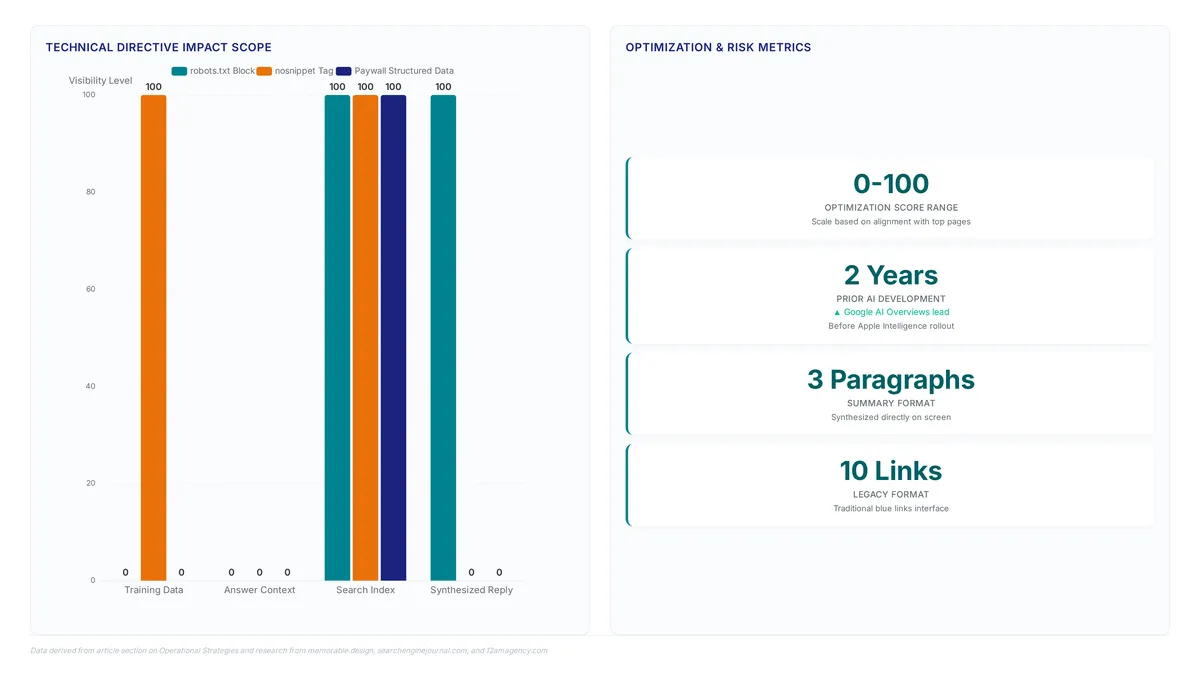
Blocking Applebot-Extended via robots.txt stops site content from training foundation models. The nosnippet meta tag prevents pages from serving as context for generated answers. Structured data remains vital for citations, yet these technical controls determine whether content fuels the model or simply appears in its output. A direct consequence emerges when operators block training data. Brand recognition as a canonical source may diminish over time. Standard reporting tools fail to log impressions for answers lacking links. Traffic losses from Spotlight and Siri can occur without traditional analytics signaling a drop in visibility.
| Directive | Scope | Impact on AI Answers |
|---|---|---|
| Applebot-Extended | Foundation Model Training | Prevents data usage for model weights |
| nosnippet | Context Retrieval | Blocks page from answer generation |
| Paywall Structured Data | Access Control | Keeps result in index, excludes from answer |
Update robots.txt files immediately to define training boundaries before the broader Apple Intelligence rollout this fall. Operators must decide if their content strategy relies on model memorization or strict retrieval control, as the default behavior now favors broad ingestion unless explicitly restricted.
Implementing Paywalled Structured Data to Preserve Search Visibility
Marking pages as paywalled via structured data keeps content in search indices while explicitly excluding it from feeding answer generation logic. This configuration allows Apple to list the resource in Spotlight results without permitting the system to extract and synthesize the underlying text into a conversational reply. Blocking the main Applebot agent entirely removes content from Siri, Spotlight, and Safari search features. Total visibility blackout occurs rather than controlled exclusion.
Granularity of the directive applied to the crawler defines the outcome. A nosnippet tag prevents a page from serving as context for AI-generated answers. It does not inherently signal a paywall status to the rendering engine. Structured data pays specific adherence to content access rules. The index knows the content exists but cannot be freely consumed for synthesis. Users experience "quick answer losses" because the AI resolves the query immediately without requiring a click-through to the source website.
| Directive Type | Index Visibility | AI Answer Context | Primary Use Case |
|---|---|---|---|
| Paywall Structured Data | Visible | Excluded | Premium content retention |
| Nosnippet Tag | Visible | Excluded | Snippet control |
| Applebot Disallow | Hidden | Excluded | Total removal |
Strategic implementation requires balancing entity optimization against access restrictions to maintain brand presence in a zero-click environment. Entity optimization remains a forecasted priority for marketers aiming to secure citations when links do appear. Define access boundaries now to prevent unauthorized synthesis of premium assets.
Validating Content Accessibility and Accuracy for AI Interpretation
Brands must structure data for entity optimization rather than keyword density to appear in synthesized responses. Complex legal questions trigger summaries instead of link lists. Unstructured content becomes invisible in high-value scenarios. Operators treat content design and brand governance as converging disciplines where machine interpretability is the primary goal.
Traditional SEO metrics cannot measure whether an assistant correctly interprets a brand at the moment of intent. Implement AI content performance tracking as a distinct discipline to augment standard reporting. Failure to validate these structures means a site might rank in blue links yet remain absent from the conversational layer where users resolve queries. Exclusion from the interface designed to answer customer questions directly represents the cost.
Implementing Technical Controls to Monitor and Fix AI Citation Errors
Defining Applebot Rules and Nosnippet Tags for AI Control
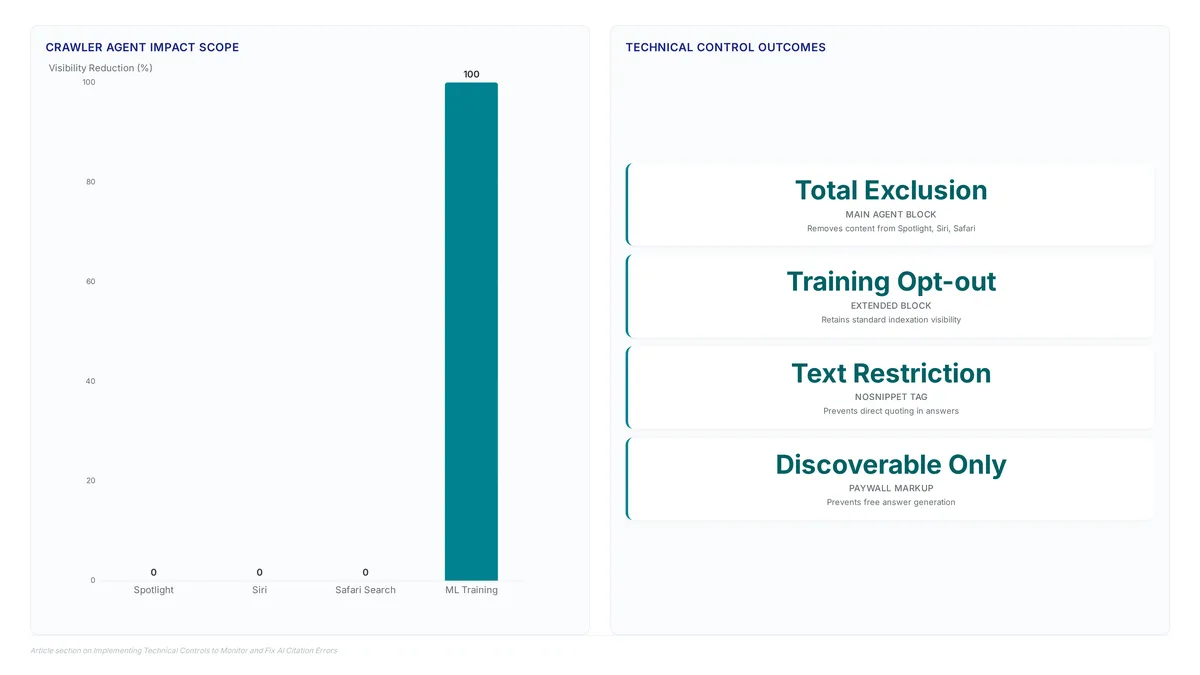
Blocking Applebot-Extended in robots.txt stops site content from training foundation models while keeping standard indexation intact. This specific rule set lets operators opt out of the machine learning pipeline without losing visibility in Spotlight or traditional search results. Applying a nosnippet meta tag restricts Siri from quoting page text directly within conversational answers. Subscription businesses can mark content as paywalled via structured data so pages stay discoverable yet do not feed free answer generation. Brands monitoring their presence must realize Apple offers no dashboard for these interactions, making external validation necessary. Restrictive controls prevent training but may limit the detail available for generated answers. Applebot defaults to following Googlebot directives without explicit rules, creating potential governance gaps if configurations diverge. Precise syntax is required to avoid accidentally blocking the primary crawler entirely.
- Add
User-agent: Applebot-Extendedfollowed byDisallow: /to opt out of model training. - Insert
<meta name="robots" content="nosnippet">in the HTML head to prevent text extraction. - Validate structured data to distinguish between public and paywalled content layers.
Configuring Robots.txt to Block Applebot from Spotlight and Siri
This blunt instrument stops all crawling, effectively hiding the site from the conversational assistant. Operators requiring granular control must distinguish between total exclusion and preventing specific AI summarization behaviors. The following configuration isolates the standard crawler while permitting the extended agent used for foundation model training, should that data remain valuable for other purposes.
- Define the primary Applebot user-agent string to target the core indexing service.
- Apply a
Disallow: /directive to prevent any page retrieval for answer generation. - Allow Applebot-Extended if the goal is only to stop Siri summaries while retaining training data access.
Measurement presents a hard constraint; Apple provides no reporting surface equivalent to Search Console for these interactions. Brands cannot verify if a page appears in an answer unless they monitor referrer traffic manually. Blocking the main agent eliminates the possibility of earning a source link entirely, as the system cannot cite what it cannot read. Enterium recommends deploying this block only when brand governance risks outweigh the value of potential zero-click visibility. Proprietary data may otherwise fuel conversational answers that never drive a user to the origin server. Visibility in the new interface requires accepting the risk of unmeasured citation.
Implementation: Checklist for Validating Content Accessibility and AI Citation Accuracy
Validate robots.txt configurations immediately to prevent accidental exclusion from Siri and Spotlight visibility. Blocking the primary Applebot agent removes content entirely, whereas disallowing Applebot-Extended only prevents foundation model training while preserving answer eligibility.
- Audit robots.txt files to ensure the main Applebot user-agent is not disallowed if Spotlight presence is required.
- Apply nosnippet meta tags only when direct text extraction in answers must be prevented without losing indexation.
- Verify structured data marks paywalled content correctly to balance discovery with access control policies.
- Monitor brand queries manually, as Apple provides no dashboard for tracking citation frequency or referrer data.
| Control Target | Configuration Method | Impact on Visibility |
|---|---|---|
| Foundation Training | Disallow Applebot-Extended | Retains answer eligibility |
| All Siri Features | Disallow Applebot | Removes from Spotlight |
| Direct Quoting | Add nosnippet tag | Prevents text extraction |
Content structured for clarity aligns with the shift toward entity-based understanding in synthesized responses. Answers may include links to sources and websites used to help generate the answer. Marketers face a blind spot regarding setup errors or missing source links without explicit reporting tools. Manual verification cycles replace automated alerts in this operational reality.
About
Hannah Brooks, Marketing Operations Lead at Enterium, analyzes the operational implications of Apple's Siri AI updates for search visibility. Her expertise in martech stack design and workflow orchestration provides a critical lens for evaluating how generative answer engines impact content pipelines. As teams grapple with undefined traffic patterns from Siri's web-integrated responses, Brooks' focus on measurable content ROI becomes necessary. At Enterium, she daily architects the governance frameworks and quality gates required to maintain brand authority when algorithmic summaries replace traditional click-throughs. This article translates high-level announcements into actionable pipeline strategies, helping B2B leaders adapt their content automation workflows to an era where source attribution is opaque. By applying Enterium's practitioner-led methodology, readers can build resilient systems that withstand shifts in search distribution without relying on speculative trends.
Conclusion
The operational reality of Siri AI is that visibility no longer guarantees traffic, as zero-click acceleration allows the interface to resolve queries without leaving the device. While Apple commits roughly $1 billion annually to maintain this system, brands face the compounding cost of unmeasured citation where their data fuels answers they cannot track. This creates a specific breaking point: relying on historical click-through metrics will obscure the true scale of brand presence in an era where answer eligibility supersedes traditional ranking. Organizations must shift their strategy from chasing volume to governing how their entities appear within synthesized summaries.
We recommend that enterprises immediately decouple their indexation strategy from their training permissions to retain control over proprietary insights. Do not wait for Apple to release dashboard tools that may never arrive. Instead, treat manual verification as a permanent operational line item rather than a temporary fix. The window to define how your brand appears in these static answers is narrowing as the model behavior solidifies.
Start by auditing your robots.txt files this week to ensure the primary Applebot user-agent remains allowed while selectively restricting Applebot-Extended if foundation model instruction poses a governance risk. This specific configuration preserves your chance at appearing in Spotlight results while preventing your content from being absorbed into the underlying model without recourse.
Frequently Asked Questions
Siri AI handles massive scale by processing 1.5 billion daily requests across its network. This volume means marketers face a black box where huge traffic potential exists without clear attribution data.
Consequently, even a tiny percentage of unmeasured impressions represents a significant loss of visibility data for publishers.
Reports indicate Apple commits roughly $1 billion annually to maintain this dedicated cloud infrastructure. This heavy investment prioritizes speed and synthesis, often resolving user intent before they ever click a source link.
The specific cloud model variant reportedly utilizes approximately 1.2 trillion parameters to generate complex answers. This massive capacity allows the system to synthesize current web data into conversational summaries rather than simple link lists.
Apple provides no specific metrics or tools to measure when citations actually appear in answers. Without clear data, brands must rely on Enterium solutions to audit their digital presence within this opaque ecosystem.
References