Brand search audits reveal 48% AI Overview gaps
AI Overviews now appear on 48% of tracked queries by March 2026. Traditional search visibility no longer guarantees brand relevance. Silence in your analytics often masks a deeper failure in answer engine optimization. G2 data reveals that 69% of buyers now select a different vendor than originally planned based on AI recommendations, while SparkToro reports that 68% of US searches end without a click. Your brand is being evaluated in conversations you cannot see, often losing the deal before a user ever visits your site.
This guide shows you how to execute buying prompts across ChatGPT, Perplexity, and Gemini to expose volatile ranking patterns. We detail methods to measure AI visibility as a distinct metric separate from organic traffic. Finally, we provide a framework to close the crawl-to-click gap by ensuring your brand narrative survives the compression from search results to synthesized answers.
The Strategic Role of Answer Engine Optimization in Modern Brand Visibility
Defining AI Visibility Through Mention and Citation Rates
Stop chasing sessions. Start measuring AI visibility. This discipline, known as answer engine optimization (AEO), quantifies how often brand entities appear in synthesized responses generated by large language models. Unlike traditional metrics tracking sessions, this framework relies on mention rate, citation rate, and share of voice. Data indicates the single most visible brand in a specific topic captures a median of 21% of all mentions, while the top performer reaches approximately 37% share of voice. The shift is accelerating: 51% of B2B software buyers now start research with an AI chatbot more often than with Google, a significant jump from 29% a year earlier.
Relying on a single platform is a strategic error. A critical limitation remains the opacity of model updates; the same prompt yields different vendors on different days, with documented volatility in AI recommendations. Consequently, relying solely on organic session data masks the true extent of market erosion. Teams must deploy dedicated monitoring to track share-of-voice across engines rather than waiting for pipeline impact. Audit your brand's presence in synthetic answers regularly to detect drift before it becomes a deficit.
The Great Decoupling: Rising Impressions Amidst Falling Clicks
We are witnessing the great decoupling: rising AI crawler activity producing zero sessions or referrals. OpenAI, Anthropic, Google, and Perplexity generate enormous activity that produces no session, no click, and often no referral. This creates a blind spot where traditional analytics report stability while brand influence erodes unseen. AI search vs Google search differs fundamentally because answer engines resolve queries internally rather than linking out. Data indicates AI Overviews appeared on 48% of all tracked search queries by March 2026. These synthesized answers cut click-through by about 60% when present, validating the zero-click trend. Consequently, 68% of US searches now end without a click, leaving brands with high visibility but low traffic. Teams relying solely on referral counts miss the crawl-to-click gap entirely. The risk is that competitors dominate the synthetic shortlist while you optimize for a dying metric.
| Metric Type | Traditional SEO | Answer Engine Optimization |
|---|---|---|
| Primary Goal | Click-through rate | Mention rate |
| Visibility Signal | Rank position | Share of voice |
| Data Source | Google Analytics | Citation audits |
Most operators fail to audit semantic query matching patterns across fragmented engines. Niche forum posts carry more weight for AI models than official brand homepages in certain contexts. Shifting focus from traffic volume to citation consistency across source types is necessary as the market compresses into single answers. Measure mention rates immediately to avoid becoming invisible in the decision layer.
Inside the Crawl-to-Click Gap and How AI Engines Build Shortlists
How the Crawl-to-Click Gap Decouples Reading from Sessions
Massive reading activity now results in a trickle of click-throughs because AI engines resolve buyer questions inside the chat interface. This technical decoupling means AI crawlers from OpenAI, Anthropic, Google, and Perplexity generate enormous activity that produces no session, no click, and often no referral. Category content experiences constant indexing while the final synthesis happens within the model's context window, invisible to standard analytics. Teams tracking only 'sessions' observe a shrinking number even as real brand influence grows. The mechanism driving this shift involves semantic query matching that prioritizes verifiable authority markers over traditional keyword density semantic query matching. Answer engines satisfy user intent internally unlike legacy search where a rank position guaranteed a potential click. High crawl rates do not correlate to traffic volume which creates a specific operational blind spot. Effective technical tracking must account for geographic differences, day-to-day fluctuations, and thousands of query variations Query Variation Tracking. Manual testing cannot scale to address these variables necessitating API-driven solutions.
| Metric Type | Traditional Search | AI Search Reality |
|---|---|---|
| Primary Signal | Click-through rate | Mention rate |
| Visibility | Rank position | Citation presence |
| Data Source | Server logs | Model output |
Session-based metrics fail to capture pre-click influence which is the primary limitation. If success is set strictly by visits teams miss the silent evaluation phase where deals are won or lost. Enterium recommends auditing mention rates alongside traffic to capture full funnel impact.
Optimizing Content Structure for Machine Extraction and Freshness
Machine-readable structures and verifiable authority markers take priority over marketing claims so brands must implement specific schema markup and clear entity definitions to be considered for inclusion machine-readable structures. Technical audits for AI readiness now specifically evaluate structured data integrity, content parsability, and entity signal strength to determine if a brand is a viable candidate for citation GEO Audit Module Components. Content must be built for machine extraction using question-based headings, answers up front, concise paragraphs, comparison tables, and schema markup. Stale pricing and legacy screenshots weaken citation suitability due to a measurable freshness bias in AI systems. Educational institutions and comparison platforms are trending as high-authority citation sources for product-related queries often outperforming direct brand content in AI-generated answers Educational institutions. Optimizing solely for static parsing ignores the flexible cost of content decay since a perfectly structured page with outdated pricing actively harms brand trust scores. Enterium recommends deploying automated freshness checks alongside structural audits to fix brand invisibility in AI answers. Teams must balance deep technical markup with rigorous update cycles to maintain citation eligibility.
| Component | Function | Risk if Missing |
|---|---|---|
| Question Headings | Maps text to query intent | Low retrieval score |
| Up-front Answers | Reduces token processing load | Summary omission |
| Schema Markup | Defines entity relationships | Ambiguous context |
| Current Data | Signals active maintenance | Freshness penalty |
Verifying Crawler Access and Resolving Inconsistent Descriptions
Verify crawler access by inspecting server logs for user agents from OpenAI and Anthropic before auditing content structure. Teams must confirm these specific bots reach key pages as invisible crawling renders downstream optimization useless. The site remains absent from synthesis regardless of content quality if logs show no activity. Content structure determines whether a crawler extracts consistent brand definitions or hallucinates details. Machine-readable structures and verifiable authority markers take precedence over marketing claims during entity resolution. Brands failing to implement specific schema markup risk appearing with outdated positioning or incorrect category definitions.
| Failure Mode | Technical Cause | Operational Impact |
|---|---|---|
| Inconsistent Descriptions | Missing entity definitions | Buyers receive conflicting vendor capabilities |
| Zero Citations | Blocked crawler access | Brand invisible in synthesized shortlists |
| Stale Positioning | Lack of freshness signals | AI cites legacy features or pricing |
Resolve inconsistent brand descriptions by aligning page headers with question-based headings that match buyer queries. Teams tracking only sessions may miss that real influence grows while visible metrics shrink. A hidden tension exists between aggressive caching for speed and the freshness required for accurate AI extraction. Over-caching static pages signals stability to humans but obsolescence to models requiring current data. Enterium recommends implementing flexible last-modified headers to signal content vitality without sacrificing load performance. This approach ensures crawlers prioritize recent accurate entity data over historical snapshots.
Executing a Thorough AI Search Audit Across Multiple Engines
Defining AI Search Audit Scope Across Engines
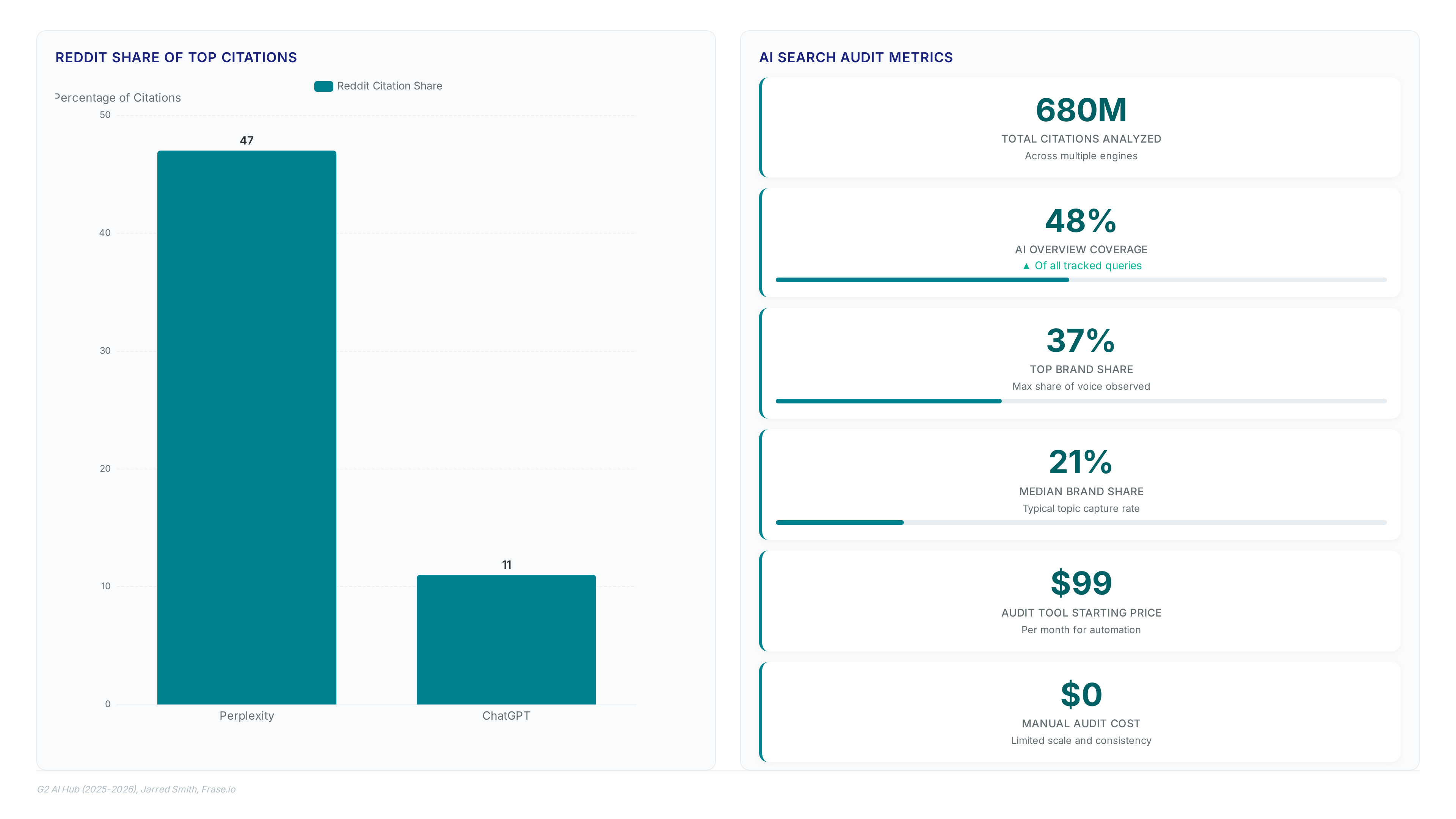
Defining AI search audit scope requires measuring distinct citation patterns rather than aggregating engine data. Semantic query matching drives divergent source selection, creating fragmented visibility landscapes where a brand might dominate one platform while remaining absent from another. An analysis of 680 million citations found that Reddit made up about 47% of Perplexity's top citations, but only about 11% of ChatGPT's. Only a small fraction of domains achieve citation status across both platforms simultaneously.
Teams must execute the following diagnostic sequence to establish baseline truth:
- Run buying prompts across ChatGPT, Perplexity, Gemini, and Google AI Mode to capture query variations and geographic differences.
- Record citation volatility by noting rank shifts and competitor swaps daily.
- Isolate mention rate and share of voice for each engine separately.
A critical limitation emerges here: optimizing for content parsability on one engine often fails to improve standing on others due to differing training corpora. The strategic implication for Enterium clients is clear. Auditing a single engine yields a partial, often misleading view of market position. Scope must expand to cover the full fragmenting field, treating each engine as a unique distribution channel with its own verifiable authority markers. Ignoring this divergence risks optimizing for a minority share of the actual buyer process.
Executing Buying Prompt Tests for Volatility
Run identical buying prompts across multiple days to distinguish signal from noise rather than reacting to anomalies. Real volatility exists where the same query yields different vendor lists on different days, making single-run data unreliable for strategic decisions. Teams must treat AI recommendations as a probabilistic distribution rather than a fixed ranking system. Manual monitoring is often non-scalable because it misses these day-to-day fluctuations that automated tools capture.
- Define a static set of buying prompts such as "best [category] for mid-market" and "competitor alternatives."
- Execute these queries across ChatGPT, Perplexity, Gemini, and Google AI Mode to account for engine-specific source weighting.
3.
Operators who fail to track patterns risk optimizing for outliers while their actual share of voice erodes silently. The limitation is resource intensity; however, without longitudinal data, teams cannot distinguish between a systemic visibility loss and temporary model fluctuation. Enterium recommends automating this capture cycle to maintain an accurate view of engine volatility.
Validating Brand Consistency Across Citation Sources
Validate brand consistency by auditing home pages, G2 profiles, and third-party listicles for conflicting entity signals. AI models synthesize a single brand narrative from disparate sources, meaning inconsistent positioning across these domains dilutes authority. A brand's own site represents only about a quarter of the citation equation, while the most-cited single domain on any platform rarely tops 5%. Marketers have a new job to train the AI to know all the key aspects of their brands rather than relying on passive discovery.
| Source Type | Primary Risk | Validation Action |
|---|---|---|
| Home Page | Outdated positioning | Verify freshness bias triggers |
| G2 Profile | Inconsistent categories | Align category tags with site |
| Listicles | Competitor adjacency | Monitor for context drift |
Teams must execute a structured review to ensure alignment:
- Crawl all public-facing URLs to extract entity definitions and compare them against core messaging documents.
- Map category tags on review platforms to ensure they match the terminology used in official documentation.
- Scan third-party listicles for prompts that might associate the brand with incorrect alternatives.
The operational tension lies between maintaining a flexible marketing voice and providing the static, repetitive signals that models prefer for entity resolution. Over-optimizing for human engagement often introduces the semantic noise that causes synthesis errors. Brands ignoring this disconnect risk having their narrative set by outdated third-party data rather than their current strategy. Enterium recommends treating citation sources as distributed configuration files that must remain synchronized to prevent model hallucination. This structural variance means a brand invisible on community forums may dominate ChatGPT yet fail entirely in Perplexity results. Only a small fraction of domains secure citations across both engines simultaneously, creating fragmented visibility landscapes that demand engine-specific strategies rather than blanket content approaches.
| Dimension | ChatGPT Strategy | Perplexity Strategy |
|---|---|---|
| Primary Source | Diverse web domains | Reddit threads |
| Content Format | Structured articles | Peer discussions |
| Authority Signal | Brand site depth | Community upvotes |
Educational institutions and comparison platforms increasingly outperform direct brand content for product queries, shifting authority toward third-party validators. Teams ignoring this flexible risk losing a significant portion of B2B researchers favoring ChatGPT while missing the community-driven Perplexity segment. The tension lies in resource allocation: optimizing for deep, structured content satisfies ChatGPT's extraction preferences, whereas supporting authentic community discussions drives Perplexity visibility. Practitioners must accept that single-platform dominance no longer guarantees market presence. A brand ranking first in ChatGPT might remain absent from Perplexity entirely, requiring parallel optimization tracks. Distinct content audits for each engine are necessary, measuring citation rates separately rather than aggregating data. Manual testing across both platforms remains free, though scaling requires automated reporting to capture daily volatility. Because engines build answers from different sources and disagree constantly, teams must run structured sets of buying prompts across multiple engines to read the pattern rather than reacting to a single result.
Using G2 Reviews and Community Threads for AI Visibility
Non-brand domains generate the majority of AI citations, with approximately three-quarters of citations coming from places that are not the brand's website, demanding a strategic pivot toward external validation. Radix's analysis of over 10,000 AI searches found that G2 carried 22.4% influence on software queries, the highest of any source. Consequently, review velocity functions as a direct input for citation probability rather than a mere trust signal. In fast-forming AI categories, a brand's relative review position can shift entirely within a single quarter due to the velocity of new data ingestion.
However, reviews explain a minor portion of the total variance in citation outcomes, with the remainder driven by broader brand authority and content freshness. This limitation implies that accumulating reviews alone cannot overcome poor core content or outdated positioning. Teams must treat community threads as primary data sources, given that niche forum posts often carry more weight for AI models than official homepages.
| Dimension | G2 Strategy | Community Thread Strategy |
|---|---|---|
| Primary Signal | Review volume | Upvote density |
| Content Format | Structured categories | Unstructured discussion |
| Optimization Tactic | Increase review velocity | Seed technical answers |
Marketers must actively ensure accurate brand representation on these external platforms to prevent outdated weaknesses from persisting in buyer shortlists. Ignoring the synthesized impression formed in these threads allows legacy narratives to dominate. The operational imperative is clear: audit your presence on G2 and Reddit with the same rigor applied to your own domain. Since manual monitoring is non-scalable due to query variations and geographic differences, using tools that track AI citations and provide remediation steps is necessary for enterprise auditing.
Sentiment Lag and the Danger of Outdated Weaknesses in AI Answers
An answer engine naming a brand while repeating an outdated weakness causes more reputational damage than total omission. These systems synthesize a mean impression that frequently lags behind current product reality, permanently cementing legacy bugs in the buyer's mind.
| Risk Factor | Mechanism | Consequence |
|---|---|---|
| Stale Weakness | Training data predates patch | False negative sentiment |
| Synthetic Mean | Aggregated historical scores | Persistent low ranking |
| Visibility Trap | High mention, low trust | Reduced conversion rate |
While review volume correlates with citations, negative historical data points continue to skew synthesized outputs disproportionately. Teams must monitor if language is positive, neutral, or negative to prevent outdated narratives from dominating. Educational institutions are trending as high-authority citation sources, often outperforming direct brand content in AI-generated answers for product queries. This shift means third-party academic critiques can override official product updates if not actively managed. Technical teams should employ frameworks calibrated specifically for AI search surfaces to map these positioning gaps directly to remediation tasks. Ignoring this lag allows competitors to lock in advantage through superior narrative freshness rather than feature superiority. Given that a brand's relative position can shift entirely within a single quarter, regular auditing against competitor baselines is critical. The operational takeaway is clear: verify that AI descriptions reflect current capabilities before scaling content production.
About
Sofia Marchetti is a B2B Content Strategist with over 12 years of experience driving demand generation in the SaaS sector. Her deep expertise in topical authority and GEO (Generative Engine Optimization) makes her uniquely qualified to dissect the mechanics of an AI search audit. Unlike traditional SEO, AI search requires brands to understand how algorithms synthesize information to form buyer opinions before a website is ever visited. In her daily work, Sofia connects content architecture directly to revenue outcomes, ensuring that automated pipelines build trust rather than noise. At Enterium, a publication dedicated to scaling content operations with LLMs, she applies this rigorous, data-driven methodology to help teams navigate the "great decoupling" of impressions and clicks. By focusing on how AI engines describe brands to buyers, Sofia provides the actionable framework necessary for marketers to maintain visibility in an era where chatbots dictate vendor selection.
Conclusion
Scaling content production without first validating AI perception creates a reputational debt that grows harder to resolve as models retrain. The operational cost here is not merely lost traffic but the compounding effect of outdated narratives cementing themselves as objective truth within synthesized answers. When a brand dominates mention volume yet suffers from stale weakness citations, it accelerates buyer defection before a sales conversation ever occurs. This flexible forces a shift from pure visibility metrics to narrative freshness, where the recency and accuracy of third-party validation outweigh raw mention counts.
Organizations must implement a quarterly AI sentiment audit focused specifically on high-authority external sources like G2 and academic critiques rather than internal blogs. This timeline aligns with the rapid retraining cycles of substantial search models, ensuring legacy bugs do not define current market positioning. If your team cannot verify how AI engines describe your product's weakest historical data point today, you are effectively ceding ground to competitors with cleaner synthetic profiles.
Start this week by searching for your primary product category plus "limitations" or "vs competitor" in an incognito window, then document exactly which outdated flaws appear in the generated overview. This single manual check reveals whether your technical reality matches your market perception, providing the immediate baseline needed to prioritize remediation tasks before the next buying cycle begins.
Frequently Asked Questions
Stable traffic hides that 69% of buyers now switch vendors based on AI advice. You must audit synthetic answers because traditional analytics cannot see the deals you lose before a user ever clicks your site.
The leading brand secures roughly 37% of share of voice within specific topics. This dominance matters because 51% of B2B buyers start research with chatbots, making top placement critical for making initial shortlists.
Approximately 68% of US searches now conclude without a single click to a website. This zero-click reality forces brands to optimize for mention rates rather than relying on traditional click-through volume for growth.
AI Overviews now appear on 48% of all tracked search queries by March 2026. This high frequency validates the need to treat answer engine optimization as a distinct discipline separate from standard organic search tactics.
About 41% of buyers utilize AI chatbots to weigh vendor strengths and weaknesses directly. Teams must run structured buying prompts across multiple engines to ensure their brand narrative survives this automated evaluation process.