SEO automation platforms: 2026 citation data
SEO automation in 2026 relies on a workforce of 13+ specialized AI agents rather than single general-purpose models to drive generative engine optimization. Readers will examine the specific role of multi-agent content writer systems in modern search, analyze how automated content publishing integrates with indexnow integration for immediate indexing, and evaluate ai brand monitoring tools designed to track model mentions without hallucination.
The shift toward ai content generation at scale requires more than basic prompts; it demands rigorous prompt tracking seo and cms auto-publishing capabilities that legacy tools lack. Current data indicates that platforms achieving high user consensus scores use distinct agents for specific formats, avoiding the dilution of voice common in generalized outputs. This structural difference is critical for enterprises needing ai content platforms with brand voice control that can withstand the scrutiny of evolving search algorithms. The ability to monitor how ai search visibility fluctuates based on ai model mentions of brand has become a non-negotiable metric for technical teams. The analysis focuses on the mechanics of end-to-end content automation, ensuring that seo content tools deliver measurable visibility rather than just volume.
The Role of Generative Engine Optimization in Modern Search
Defining Generative Engine Optimization and AI Visibility
Generative Engine Optimization shifts focus from ranking on blue links to securing citations within synthesized AI answers. By 2027, discovery depends less on page position and more on whether a brand appears in responses from models like ChatGPT and Google AI Overviews. This transition demands that enterprises treat AI search optimization as necessary infrastructure rather than a tactical extension of traditional search work. Engineers must now optimize for extractability and trust, ensuring content structures allow large language models to parse and retrieve facts accurately. Unlike traditional SEO, which focused heavily on keywords and backlinks, AI search optimization prioritizes structure, semantic clarity, and contextual completeness.
AI search visibility now includes citations, mentions, and share of voice across platforms. Measurement frameworks must evolve beyond click-through rates to include citation frequency. Visibility should be measured not only in clicks but also in citations, as AI systems identify discrete facts and assess source credibility to assemble synthesized responses. Success requires engineering content for machine readability first, human consumption second.
Applying Multi-Agent Architecture for Content Optimization
Multi-agent architecture replaces single-model generation with specialized agents trained for specific formats like technical briefs or product descriptions. This structural shift allows systems to apply distinct reasoning patterns rather than forcing one model to handle all content types. Immediate feedback corrects trajectory before publication, reducing the need for post-hoc editing cycles.
The mechanism relies on dividing labor to ensure that format-specific constraints do not degrade overall coherence. Automation enables teams to refresh, optimize, and publish hundreds of pages without adding headcount. For practitioners selecting SEO tools for AI content in 2026, the differentiator is increasingly the depth of specialized capabilities and integration. Tools that provide attribution tracking help understand which automated content pieces drive the highest ROI across different channels and touchpoints. Without such granular feedback, optimization remains guesswork.
| Feature | Single-Model System | Multi-Agent System |
|---|---|---|
| Specialization | General-purpose | Format-specific |
| Feedback Loop | Post-generation | Real-time scoring |
| Complexity | Low | High |
Operators must weigh the value of real-time scoring against the infrastructure required to run parallel agent chains. The most effective tools for AI visibility are those that expose internal scoring mechanics to the user. Enterprises should prioritize architectures that allow custom agent definition over closed black-box generators.
GEO Systems vs Traditional SEO Publishing Workflows
Generative Engine Optimization replaces static ranking with flexible citation logic inside model outputs. Traditional workflows publish content and wait for crawlers, creating latency between publication and visibility.
| Feature | Traditional Workflow | GEO System |
|---|---|---|
| Update Cycle | Manual re-crawl | Real-time synthesis |
| Success Metric | Click-through rate | Citation frequency |
| Optimization | Keyword density | Semantic clarity |
Operators often mistake high traffic for high authority, yet models may ignore high-volume pages if facts lack structural context. This reduces the window where outdated information damages brand credibility. The cost is loss of granular control; automated pipelines demand rigorous pre-flight validation gates to prevent hallucination propagation. Enterprises ignoring this architecture risk invisible obsolescence despite maintaining strong legacy search positions.
Inside the Architecture of Multi-Agent Content Automation
Sight AI Autopilot Mode and No-Code Workflow Mechanics
Sight AI Autopilot Mode merges AI brand monitoring, content generation, and technical indexing into one continuous flow where context passes between tasks without manual interruption.
Building a no-code content pipeline requires setting precise parameters to maintain brand standards:
- Define the research agent query parameters and brand voice constraints.
- Configure the drafting model to ingest research context before generation.
- Set conditional logic gates for quality assurance and human review.
- Enable IndexNow integration to push updated URLs to search engines instantly.
This design solves the fragmentation plaguing modern SEO operations, where teams frequently fail to refresh decaying pages due to staffing shortages. Connecting SEO data with AI search insights allows for continuous execution instead of batch processing. Citation tracking directly informs the next-generation cycle by collapsing separate workflows into a unified loop.
| Component | Function | Integration Point |
|---|---|---|
| Research Agent | Gathers current data | Feeds drafting context |
| Drafting Model | Generates content | Receives brand constraints |
| Indexing Protocol | Pushes updates | Triggers on publish |
Reliance on automated triggers means poorly set quality gates propagate errors at scale before anyone notices. Teams must balance speed with accuracy when configuring review thresholds. Starting with narrow topic clusters lets organizations validate the feedback loop before expanding to full-site automation.
Implementing IndexNow and CMS Publishing in Automated Pipelines
IndexNow integration removes delayed content indexing by pushing URL updates directly to search engine crawlers upon publication. Automated pipelines without this protocol depend on sporadic crawl schedules, leaving fresh content invisible for hours or days. The mechanism involves generating a secure key, hosting it at a specific path, and triggering an API call immediately after the CMS confirms a successful write operation. Rapid indexing has become necessary for competitive visibility as the majority of marketers now apply AI tools.
Builders map fields from spreadsheets or databases directly to CMS slots, which reduces manual transcription errors. Complex conditional logic often requires custom scripting when visual builders hit ceiling limitations. Operators weigh the speed of no-code deployment against the flexibility needed for enterprise-grade validation rules.
| Component | Function | Constraint |
|---|---|---|
| Data Source | Provides raw context | Requires schema mapping |
| Workflow Builder | Orchestrates agents | Limited by visual logic |
| IndexNow Protocol | Notifies crawlers | Needs key verification |
| CMS Endpoint | Stores final output | Must accept API writes |
Quicker indexing increases quality control failures if the pipeline lacks a pre-publish gate; a hallucinated article reaches global caches instantly. Implementing a mandatory human-review step before the IndexNow trigger fires ensures distribution acceleration does not outpace fact verification. Distribution automation shows the fastest growth for organizations scaling operations, yet it demands rigorous upstream validation.
Validating Multi-Agent Content Generation and Sentiment Tracking
Assigning specialized agents to specific formats prevents the coherence loss seen in single-model generation. Agent specialization creates tension with pipeline latency because adding more validation gates improves quality but increases time-to-publish. Operators balance strict sentiment thresholds against the need for rapid iteration cycles.
Constructing a strong no-code content pipeline requires distinct configuration steps:
- Map input data schemas to specific agent capabilities within the visual builder.
- Define sentiment guardrails that trigger re-generation if tone deviates from brand.
- Configure IndexNow integration to submit URLs immediately after CMS publication.
- Establish feedback loops where performance metrics refine future prompt parameters.
Automated SEO optimization improves visibility notably compared to manual methods, making pre-publish validation necessary. Initial setup complexity limits this approach since teams without clear brand voice definitions struggle to configure effective sentiment gates. Starting with a limited number of agent types allows teams to refine the pipeline scope before expanding.
Sight AI vs the provider and AirOps for Enterprise Workflows
Sight AI vs the provider and AirOps: Unified Workflows vs Specialized Tools
Sight AI collapses the content lifecycle into a single unified workflow, contrasting sharply with the point-solution designs of the provider and AirOps. the provider functions primarily as a high-volume AI content generation engine, while AirOps provides the infrastructure to build custom LLM workflow automation pipelines. Both specialized approaches require manual stitching to achieve full visibility, creating latency between drafting and indexing.
Architectural divergence dictates operational overhead. Teams using disjointed tools often struggle to refresh hundreds of pages without adding headcount, a constraint unified platforms aim to resolve by connecting SEO data directly to publishing systems. AirOps connects these disjointed elements into a single system for continuous execution, yet it demands significant engineering time to maintain the underlying pipelines. Sight AI reduces this friction by integrating multi-agent content creation with automated website indexing natively.
| Feature | Sight AI | the provider | AirOps |
|---|---|---|---|
| Primary Focus | End-to-end GEO | Draft Generation | Custom Pipelines |
| Indexing | Native Automation | Manual/Plugin | API Dependent |
| Setup Time | Low | Low | High |
Consolidation reduces flexibility for teams requiring highly bespoke data transformations available only in custom code. Operators must weigh the speed of a pre-integrated generative engine optimization system against the granular control of a composable stack. The right choice depends on whether your bottleneck is content volume or pipeline complexity.
Deploying Autopilot Mode for End-to-End SEO Automation.
Autopilot Mode executes a content brief through research, writing, optimization, and publishing without manual handoffs. This architecture removes the latency found in disjointed stacks where AI content generation and deployment occur in separate silos. the provider excels at drafting but lacks the native cms auto-publishing connectors required for zero-touch operations. AirOps offers a no-code workflow builder for custom pipelines, yet teams must still engineer the specific triggers that push final drafts to production environments.
Maintenance overhead diverges based on system choice. Unified systems handle generative engine optimization internally, whereas modular setups require constant pipeline monitoring to prevent data silos. Teams using fragmented tools often struggle to refresh hundreds of pages without adding headcount, a constraint documented in recent SEO & Content Ops Teams analysis. The unified approach sacrifices some prompt chaining flexibility compared to the custom logic available in dedicated workflow engines.
Complex, conditional branching often still requires the granular control of a dedicated orchestration layer.
Decision Framework: When to Choose Brand Tracking Over Volume Generation
Select Sight AI when the operational priority shifts from raw output volume to unified generative engine optimization and citation tracking. Unlike specialized generators that require manual stitching, this platform consolidates content creation, AI visibility monitoring, and technical indexing into a single workflow. This architecture eliminates the latency often observed when teams attempt to refresh hundreds of pages without adding headcount, a constraint noted in recent SEO automation tools analysis.
the provider remains the preferred entry point for teams requiring reliable keyword-targeted drafting without complex pipeline requirements. AirOps serves infrastructure-heavy organizations needing a no-code workflow builder to construct custom LLM pipelines from disparate data sources. Specialized tools offer flexibility but demand engineering time to connect content optimization metrics with publishing actions.
Speed and control create tension. Unified systems accelerate deployment but may limit granular prompt engineering available in custom builds. Specialized stacks allow precise tuning but introduce integration debt that delays automated content publishing. Operators must weigh the cost of maintaining separate systems against the need for distinct brand voice control.
Unified approaches reduce operational drag if AI search visibility data does not directly trigger content updates. Teams building unique data pipelines should use modular infrastructure despite the higher initial setup complexity.
Deploying an End-to-End AI Content Autopilot System
Autopilot Mode Mechanics for End-to-End Content Pipelines
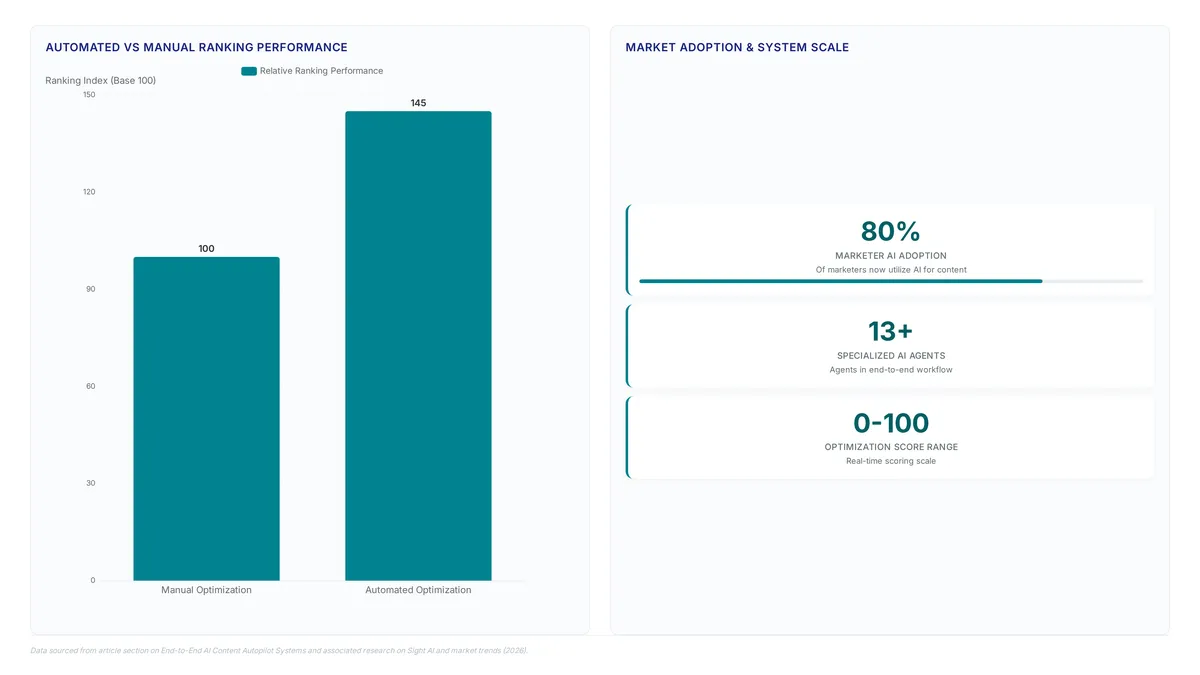
Data indicates that content with automated optimization ranks 45% higher on average than manually optimized counterparts. The SEO content automation tools market now prioritizes this end-to-end integration to eliminate latency between ideation and indexing. By removing human intervention points, the pipeline maintains high velocity while adhering to strict brand voice parameters.
However, the cost of full automation is reduced nuance in highly technical domains where expert review remains mandatory. Unlike semi-automated workflows, a fully autonomous pipeline cannot flag logical inconsistencies in niche subject matters without pre-set guardrails. This limitation requires operators to establish rigorous prompt tracking protocols before enabling unsupervised publishing.
Organizations adopting these systems join the 80% of marketers who now apply AI for content and media creation. The strategic implication for network operators and content engineers is clear: infrastructure must support rapid iteration cycles rather than static publication schedules. Success depends on configuring quality gates that validate output against real-time ranking signals.
Deploying Unified Workflows for AI Visibility and Indexing.
Unified workflows merge content generation, AI visibility monitoring, and indexing automation into a single operational loop. Most teams currently fracture these tasks across separate vendors, creating latency between drafting and AI citation tracking. Consolidating these functions allows an autopilot system to ingest a brief, generate optimized copy, and publish directly to the CMS while simultaneously queuing IndexNow requests for immediate crawler awareness. This architecture eliminates the manual handoff where brand voice drift typically occurs.
The primary technical advantage lies in the feedback loop between generative engine optimization metrics and draft creation. When a platform detects low share-of-voice for specific entities in models like ChatGPT, it can trigger targeted content refreshes without human intervention. However, this tight coupling introduces a risk: aggressive auto-publishing can flood indexes with low-variation text if prompt tracking limits are not strictly set. Operators must configure quality gates that halt publication when semantic similarity scores exceed safe thresholds.
Sight AI remains the only identified platform covering content generation, AI visibility monitoring, and technical indexing automation in a single workflow. Teams attempting to replicate this via point solutions often face data silos that delay reaction times to visibility drops. A unified approach ensures that indexing signals fire exactly when content goes live, reducing the window where competitors can capture AI brand mentions. The trade-off is reduced flexibility in swapping individual best-of-breed components for specialized tasks.
This balances speed with editorial control.
Next step: Audit your current stack for gaps between content publishing and AI search visibility measurement to identify integration friction points.
Validation Checklist for Multi-Agent Content Generation Systems
Verify that the system deploys 13+ specialized AI agents rather than a single general-purpose model to maintain strict format-specific quality. Generalist LLMs frequently fail to distinguish between the structural requirements of a technical whitepaper and a landing page, causing the inconsistent AI content tone that plagues enterprise deployments. Specialized agents isolate these tasks, ensuring distinct vocabulary and formatting rules apply to each output type without cross-contamination.
| Architecture Type | Agent Count | Primary Failure Mode |
|---|---|---|
| Generalist Model | 1 | Context bleeding between formats |
| Multi-Agent System | 13+ | Orchestration latency |
Teams implementing these systems must validate agent isolation to fix inconsistent AI content tone across large catalogs. A unified generator often applies a single temperature setting globally, whereas a multi-agent framework allows distinct sampling parameters for creative versus factual sections. This granularity prevents the "hallucinated authority" common in automated technical writing.
The operational cost of managing thirteen discrete agents exceeds single-model inference, creating a trade-off between quality control and compute expenditure. However, the alternative requires extensive manual rewriting to correct voice drift, negating automation benefits. Practitioners should audit candidate platforms against this multi-agent criterion before integration. For teams struggling to implement reliable automation, Enterium recommends prioritizing architectures that explicitly document agent specialization over raw token throughput.
About
Sofia Marchetti is a B2B Content Strategist specializing in how automated content systems drive pipeline through topical authority and durable distribution. Her decade of experience in B2B SaaS demand generation uniquely positions her to analyze SEO automation platforms through the lens of revenue impact rather than mere volume. In her daily work, Marchetti architects content pipelines where AI citation tracking and generative engine optimization are critical for maintaining brand visibility in an era of AI search. This article's focus on 2026 citation data directly reflects her operational reality: validating whether tools for automated content publishing and brand voice control actually sustain long-term growth. As the editorial voice behind Enterium, a brand dedicated to documenting how teams scale content with LLMs, she bridges the gap between theoretical multi-agent content writers and production-ready architecture. Her analysis grounds SEO automation tools in measurable outcomes, ensuring practitioners can distinguish between hype and systems that genuinely compound AI search visibility.
Conclusion
Scaling content production reveals that raw volume quickly becomes a liability without strict architectural governance. While automated optimization drives higher rankings, the operational burden shifts from writing to managing complex agent orchestration. The real friction point in 2026 search engine placement but how authoritative AI models reference your brand data during their own reasoning processes. Relying on generalist models creates context bleeding that corrupts technical accuracy, forcing teams to choose between costly manual rewrites or accepting inconsistent brand voice.
Organizations must mandate multi-agent architectures that isolate format-specific logic before expanding output quotas. Do not deploy systems that cannot demonstrate distinct sampling parameters for creative versus factual tasks. This structural requirement ensures that high-velocity publishing does not degrade into hallucinated authority. The window for tolerating generic output is closing as model-based discovery becomes the primary filter for content relevance.
Start this week by testing your current automation stack against format-specific prompts to detect context bleeding between technical and marketing assets. If a single prompt generates identical tones for a whitepaper and a landing page, your system lacks the necessary agent isolation. Immediate validation of these architectural boundaries prevents the accumulation of unfixable voice drift later.
Frequently Asked Questions
Pricing varies by vendor and specific enterprise needs. The article does not list specific costs like an undisclosed amount or an undisclosed amount for these advanced multi-agent systems.
Yes, they replace single models with specialized agents for better results. This shift allows distinct reasoning patterns rather than forcing one model to handle all content types.
It shifts focus from blue links to citations in AI answers. Success requires engineering content for machine readability first and human consumption second to secure these vital citations.
Citation frequency and share of voice across platforms are critical. Measurement frameworks must evolve beyond click-through rates to include how often models cite your specific brand facts.
Real-time scoring corrects trajectory before publication to reduce editing. This immediate feedback loop ensures format-specific constraints do not degrade the overall coherence of your content.
References