AI content strategy: cite sources, not clicks
Stop chasing clicks and start engineering citations, because AI generated responses now dictate brand visibility more than traditional search rankings. The central thesis is clear: successful ai content strategy in 2026 requires shifting focus from keyword density to structured data that AI models can reliably extract and cite. Marketers who fail to adapt their content marketing approaches for ai model retrieval logic will find their brands invisible in algorithmic answers, regardless of their historical SEO dominance.
This analysis dissects the mechanics behind generative engine optimization, explaining why raw text often fails when parsed by large language models seeking authoritative sources. You will learn how structured content formatting directly influences whether an AI system selects your data as a primary reference or ignores it entirely. We examine the technical divergence between optimizing for human readers versus satisfying the strict extraction protocols of automated agents.
Finally, the article outlines a dual workflow that balances traditional search presence with the emerging demands of ai visibility tracking. Rather than guessing at relevance, teams can apply ai content optimization tools that measure raw drafts by scoring them on a scale from 0 to 100 to determine quality and readiness for search visibility (best-ai-seo-tools-2026). By mastering these ai citation sources, organizations ensure their insights drive the conversation in an era where being quoted matters more than being clicked.
Defining Generative Engine Optimization and the Shift from Traditional SEO
Generative Engine Optimization and the AI Layer of Search
Generative Engine Optimization structures content for accurate retrieval by large language models instead of legacy ranking algorithms. Traditional marketing campaigns historically built pages and earned backlinks to rank on Google, yet user behavior now favors typing questions directly into ChatGPT, Claude, or Perplexity. This transition shifts the primary metric from click-through rate to extractability, deriving value only when an AI system selects and quotes brand data within a synthesized answer.
Neural networks parse context windows to generate responses rather than indexing keywords like search spiders. Generative engines evaluate semantic authority to construct answers, demanding content that is contextually the, thorough, and authoritative. The shift requires structured content formatting that allows models to isolate facts without hallucinating or conflating sources.
Writing for human readability often conflicts with maximizing machine parseability. Over-structuring text for model retrieval degrades the narrative flow required for human engagement, creating a dual-audience conflict. Current tracking tools offer limited visibility into why specific sources get cited while others are ignored, presenting a distinct constraint for marketers. Brands must therefore treat content gap analysis as a technical audit of model training data coverage. Success demands a dual-optimization workflow satisfying both legacy indexing protocols and modern retrieval mechanisms.
Scoring Raw Drafts with 0, 100 Optimization Metrics
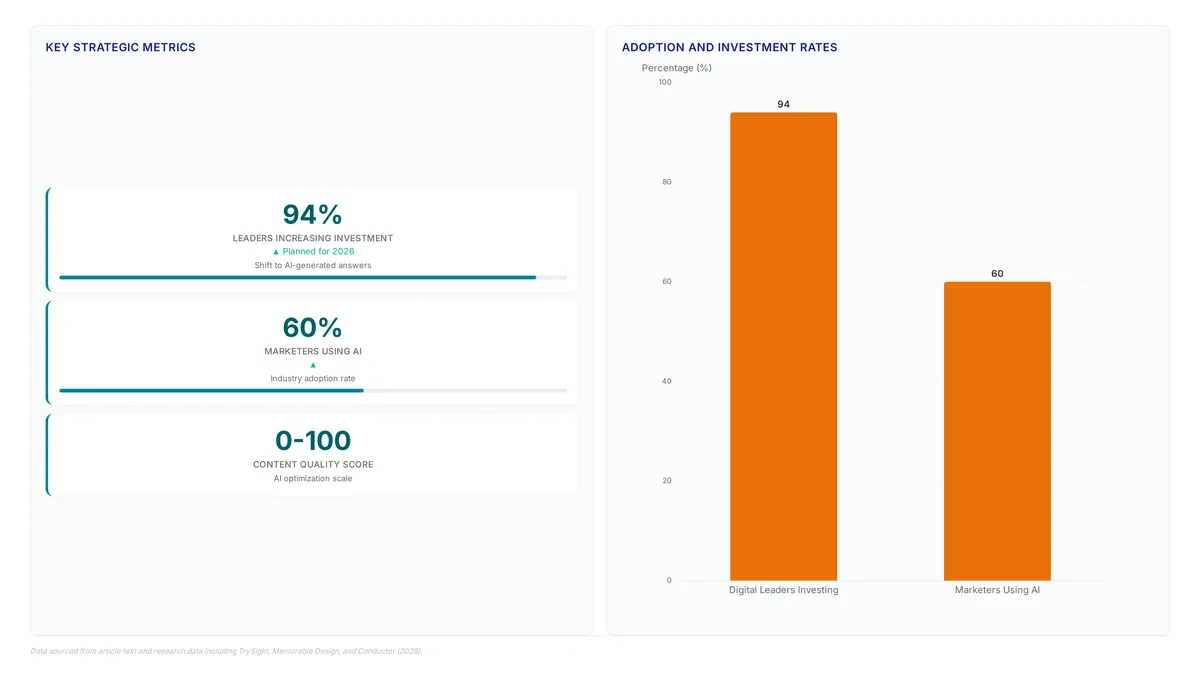
New optimization platforms score raw drafts on a 0, 100 scale by analyzing variables like word count, heading volume, and image ratios against top-ranking pages. This quantitative approach replaces subjective editorial review with a measurable fitness function for Generative Engine Optimization. Effective AI content strategies require measuring these specific factors to ensure competitiveness in retrieval systems.
The mechanism calculates a composite score where keyword density and structural hierarchy determine the likelihood of citation. Content scoring below a competitive threshold often lacks the semantic density required for model extraction. Maximizing these scores can conflict with narrative flow if operators prioritize metric density over readability. Ignoring these signals results in measurable invisibility within synthesized answers.
| Variable | Impact on Retrieval | Measurement Goal |
|---|---|---|
| Word Count | Context window fit | Match top-quartile average |
| Heading Volume | Segment clarity | Increase H2/H3 frequency |
| Image Ratios | Multimodal grounding | Maintain 1:300 word ratio |
Teams must validate that high-scoring drafts retain human utility, as extractable content must satisfy both algorithmic parsing and user intent. A common failure mode involves inflating text volume without adding distinct entities, which dilutes the signal for AI model retrieval.
Operators should treat the 0, 100 metric as a pass/fail quality gate rather than a target to maximize blindly.
SEO Rankings Versus AI Citation Visibility Gaps
A page can rank on page one of Google and still never appear in an AI-generated response.
Traditional metrics measure position within a static list, whereas Generative Engine Optimization targets inclusion within a synthesized narrative. This structural divergence creates a visibility gap where high-ranking assets remain invisible to users querying conversational interfaces. Search engines retrieve documents based on authority signals, while LLMs extract discrete facts based on semantic clarity and contextual completeness.
| Feature | Traditional SEO | GEO Focus |
|---|---|---|
| Primary Unit | Web Page | Data Fragment |
| Success Signal | Click-Through Rate | Citation Frequency |
| Optimization Target | Backlink Profile | Source Credibility |
Performance tracking is evolving into a dual-metric necessity, combining traditional search data with new AI visibility signals to measure how content shapes AI answers rather than just how it ranks on search engine results pages. Operators must now verify if their structured content appears in model outputs, not index logs. Optimizing for extraction often requires reducing narrative fluff that human readers expect, creating a tension between engagement and machine readability. Dense paragraphs that rank well often lack the distinct entity definitions required for model retrieval.
Brands risk maintaining search dominance while losing relevance in the emerging AI citation system without this dual-layer validation. The immediate next step is running a comparative query set against substantial models to identify missing brand mentions despite high organic rankings.
The Mechanics of AI Retrieval and Source Citation Logic
Defining Extractable Content Through Direct Answers and Explicit Terms
Direct answers placed immediately after headings satisfy the strict retrieval constraints of modern systems. Large language models scan documents for explicit terms and structured data blocks instead of inferring meaning from narrative prose. Content missing these structural anchors often fails retrieval despite possessing high topical authority. The mechanism depends on question-first structuring where the opening sentence of every section functions as a standalone response. This approach aligns with Generative Engine Optimization principles that prioritize immediate utility over gradual exposition. Operators must define entity patterns clearly to increase citation probability across AI platforms. A significant constraint arises when organizations optimize for keyword density instead of answer clarity, causing models to skip their content in favor of more direct sources.
Implementing this architecture requires specific formatting disciplines:
- Lead every paragraph with a definitive statement containing the subject and predicate.
- Use numbered steps for procedural instructions to enable step-by-step extraction.
- Define technical jargon inline before using acronyms or abbreviated forms.
Maintaining narrative flow for human readers while satisfying rigid structural demands creates tension. Over-segmentation can degrade user experience if not balanced with coherent transitional logic. Teams should write as if the first sentence of every section must stand alone as a useful answer without surrounding context. Tracking Citation Share across substantial engines provides the necessary feedback loop for iterative refinement. Even high-authority content remains invisible to retrieval systems without explicit definition and direct placement.
Applying Format Selection to Maximize Citability in Explainers and Listicles
Discrete units within listicles and how-to guides match the extraction patterns of retrieval systems, generating citations. Format selection directly impacts citability, with explainers and comparison articles cited more frequently due to their structured, extractable answers. Unlike narrative prose, these formats present isolated facts that models can lift without complex synthesis.
| Format | Extraction Quality | Citation Driver |
|---|---|---|
| Listicle | High | Discrete items |
| How-to Guide | High | Sequential steps |
| Narrative Essay | Low | Context dependence |
Authority signals differentiate citable content from thin aggregations. Models prioritize original insights, cited sources, and author expertise over rephrased summaries. Content lacking these authority signals rarely earns placement in generated responses. The drawback is structural rigidity; forcing complex analysis into bullet points can degrade nuance. Operators must balance extractable content density with technical accuracy to avoid oversimplification. Ignoring format results in invisibility within synthesized answers. If a brand's technical data exists only in long-form paragraphs, retrieval systems may skip it for cleaner competitors. This creates a tension between depth and accessibility. Rewriting these sections as numbered lists or direct Q&A blocks aligns with Generative Engine Optimization principles. The goal is not indexing but selection as a primary source.
Validating AI Visibility Using Prompt Tracking and Content Gap Analysis
Deploying prompt tracking tools starts operational validation by logging exactly which queries trigger brand omissions in model responses. These systems monitor inputs directed at AI models to surface response patterns, acting as a layer of competitive intelligence rather than simple volume metrics. Operators cannot distinguish between a ranking failure and a genuine knowledge gap without this data. Content gap analysis identifies specific topics where competitors receive citations while the user's brand remains absent, signaling a concrete opportunity for remediation. This process reveals when to use AI agents for content generation versus when human intervention is required to fix content not cited by AI due to structural ambiguity.
| Analysis Target | Detection Method | Remediation Action |
|---|---|---|
| Missing Brand | Prompt logs | Inject direct answers |
| Competitor Citation | Gap reports | Add explicit terms |
| Format Mismatch | Extraction rate | Convert to listicles |
Optimizing for broad topical coverage while maintaining the density required for extraction creates a critical tension. Expanding scope often dilutes the explicit terms needed for retrieval, causing models to skip the content entirely. Practitioners must test different answer lengths and layouts, tracking which version gets quoted more over two to four weeks to choose the best format. Some topics work best with two sentences, while others need a five-step list. High-frequency tracking increases token costs without guaranteeing immediate indexing changes. Teams should track GEO metrics in dashboards, focusing on AI citations and question coverage rather than raw traffic. Good GEO content is helpful for readers and easy for AI tools to quote. Each page must give quick answers, proof, and a layout that works well in small sections.
Executing a Dual Optimization Workflow for Search and AI Engines
Defining the Four Pillars of a Functional AI Content Strategy
A functional AI generated content strategy relies on four interconnected pillars: topic discovery, content creation, indexing, and visibility tracking. Omitting any single component causes the system to leak value by breaking the chain between data signal and model retrieval. Topic discovery identifies content gaps where AI models currently lack authoritative sources, while creation focuses on structured formatting that enables extractability. Without rapid content indexing protocols, even high-quality drafts remain invisible to retrieval engines, rendering the optimization effort null.
Implementation requires a disciplined workflow rather than ad-hoc generation:
- Map queries to unaddressed technical specifics using gap analysis.
- Draft content with explicit source attribution and structured headers.
- Push updates via immediate indexing APIs to reduce latency.
- Monitor AI visibility metrics to verify citation acquisition.
Data indicates that 94% of digital leaders plan to increase investment in this area during 2026 as discovery shifts from rankings to AI-generated answers. This surge reflects a operational reality: brands must optimize for the engine's retrieval logic, not human readability. The trade-off is complexity; maintaining structural integrity across four pillars demands more rigorous governance than traditional SEO. Teams at Enterium recommend treating this as an engineering constraint where failure in indexing invalidates success in creation.
Executing the Strategic Sequence from Gap Analysis to Citation Tracking
Initiate the workflow by mapping AI visibility gaps where competitor domains dominate answer engines while your brand remains absent. This discovery phase isolates high-priority topics lacking authoritative sources, forming the basis for targeted content gap examination. Teams must prioritize queries where retrieval systems currently return insufficient or low-quality data, as these represent the highest probability slots for new citations.
Construct structured content that explicitly addresses these gaps using clear hierarchies and definitional clarity to maximize extractability. Unlike traditional SEO, Generative Engine Optimization requires formatting pages so retrieval systems can isolate and cite specific passages rather than just ranking URLs. The following configuration illustrates the structural markup necessary for machine readability:
Deploy rapid indexing protocols immediately after publication to reduce the latency between content availability and model ingestion. Without this step, even perfectly optimized text remains invisible to retrieval engines during their next crawl cycle. Finally, measure citation performance by tracking brand mentions within generated responses rather than monitoring organic click-through rates. Brands dominating AI answers in the coming years will be those systematically refining this engine through continuous feedback loops. The cost of ignoring this sequence is measurable invisibility in an increasingly automated search environment.
Checklist for Rapid Indexing Using IndexNow and Automated Sitemaps.
Meanwhile, deploy the IndexNow protocol to instantly notify supported engines like Bing and Yandex of content changes. This mechanism bypasses traditional crawl queues, ensuring new drafts do not sit idle while competitors capture citations. Every day content sits unindexed is a day it fails to earn traffic or citations. Operators must configure their CMS auto-publishing hooks to trigger URL submission immediately upon status change to published.
- Generate a cryptographic key and host the text file at the root domain for verification.
- Modify the build pipeline to send a POST request with the URL list and key.
- Validate acceptance logs to confirm the search engine received the signal.
Parallel to protocol signals, implement automated sitemaps that update dynamically rather than on a fixed cron schedule. Static sitemaps create a lag window where retrieval systems miss fresh context needed for AI generated content strategy synthesis. The limitation lies in server load; high-frequency updates to massive sitemaps can strain resources if not cached aggressively. A dual approach using both push-based IndexNow signals and pull-based sitemap freshness provides redundancy against packet loss or API throttling. This architecture ensures that once a content gap is filled, the artifact becomes immediately available for model ingestion. Enterium recommends testing latency between publish events and index appearance to quantify pipeline efficiency.
Strategic ROI and Investment Decisions for AI Visibility
Defining ROI Through AI Visibility Score and Mention Frequency
Aggregating mention frequency, context, and sentiment across generative platforms yields the AI Visibility Score. Traditional search metrics fall short because answer engines synthesize responses instead of listing links, making zero-click visibility the primary performance indicator. Cross-platform monitoring stays necessary since models like ChatGPT, Gemini, and Perplexity apply distinct training data and retrieval behaviors. These architectural differences lead to inconsistent citation patterns for the same domain. A brand might dominate one engine while remaining absent in another.
| Metric Component | Function | Measurement Target |
|---|---|---|
| Mention Frequency | Volume tracking | Count of brand citations per query set |
| Context | Qualitative analysis | Sentiment and adjacency to key topics |
| Sentiment | Tone assessment | Positive, neutral, or negative framing |
Operators must track when content appears in answers even without click-throughs. This represents the new unit of value exchange. The AI Citation Rate specifically measures how often content surfaces in generated responses, distinct from organic ranking positions. Relying solely on traffic data ignores the synthesis layer where most user decisions now occur. Investment decisions should prioritize credible sources that AI systems reference and link within their outputs. Effective tracking requires monitoring Citation Share across priority query sets. This process identifies which content formats, answer lengths, and entity patterns generate consistent citations versus being ignored by AI systems. Brands ignoring this dual-optimization strategy risk becoming invisible in the very interfaces where users seek solutions.
Calculating Automation ROI Using Hours Saved Per Article
Labor efficiency gains distinct from traffic metrics often center investment in generative engine optimization. Manual drafting requires extensive research and structural formatting to satisfy AI retrieval logic. Optimized workflows generate structured content drafts rapidly. The resulting time delta, when scaled across a quarterly editorial calendar, often exceeds the subscription cost of premium tooling.
This calculation supports a feedback loop where citation performance data informs future editorial cycles. Teams replicate formats that yield high visibility and discard low-performing structures. Time savings alone ignore the cost of model errors. Fact-checking ensures absolute accuracy because AI systems avoid citing questionable information. Automation accelerates volume but does not replace editorial oversight for complex technical topics.
| Workflow Stage | Manual Effort | Automated Effort |
|---|---|---|
| Topic Discovery | High | Low |
| Drafting | High | Medium |
| Formatting | Medium | Low |
| Review | High | High |
Tracking these metrics allows teams to adjust resource allocation dynamically. Analysis focuses on which answer lengths and layouts generate the most citations over two to four weeks. Investment decisions should hinge on whether the saved engineering hours can be redeployed to higher-value tasks like content gap evaluation. Organizational ability to absorb increased output velocity limits success more than tool capability. Maintaining the semantic clarity required for AI search optimization remains necessary.
SEO Traffic Growth Versus Absence in AI Responses
Organic traffic can rise while a brand remains completely absent from AI-generated answers. This creates a false sense of security. Traditional SEO metrics track click-through rates and session duration. These indicators fail when answer engines synthesize responses without linking to A domain may rank first for a query in Google while receiving zero citations in generative platforms. The underlying retrieval logic prioritizes semantic authority over keyword density. This divergence necessitates a dual-optimization strategy where teams pursue traffic growth alongside explicit citation visibility.
| Optimization Target | Primary Signal | Failure Mode |
|---|---|---|
| Traditional Search | Keyword Density | Low Click-Through Rate |
| Generative Engines | Semantic Authority | Total Absence in Answers |
Investing heavily in content that drives visits but builds no brand visibility within AI contexts creates operational risk. Educational institutions and comparison platforms consistently capture these citations. Commercial brands often get displaced from the conversation entirely. Resource allocation creates tension. Optimizing for machine-readable structure often conflicts with persuasive copy designed for human conversion. Teams asking should i invest in geo must recognize that high traffic does not guarantee inclusion in model outputs. Ignoring this gap causes gradual erosion of market relevance as users rely increasingly on synthesized answers rather than navigating to websites. Auditing current content architecture against standards for entity identification and authority signal placement ensures extractability. Organic growth masks the deeper failure of being invisible to the next-generation of search interfaces without this alignment.
About
Sofia Marchetti is a B2B content and demand-generation strategist whose decade of experience in SaaS directly informs this analysis of AI-generated content approach. Unlike generic approaches focused solely on click-through rates, Sofia's daily work centers on building content systems that secure AI citations and drive revenue through topical authority. At Enterium, a B2B publication dedicated to content automation pipelines, she documents how modern teams engineer extractable content for generative engines rather than just search crawlers. Her expertise bridges the gap between traditional SEO and emerging Generative Engine Optimization (GEO), ensuring brands appear in AI model responses through structured formatting and rigorous source attribution. This article reflects Enterium's practitioner-led methodology, moving beyond hype to provide actionable steps for content gap assessment and visibility tracking. By focusing on how LLMs retrieve and cite information, Sofia offers a clear path for marketers to ensure their brand is the source AI models trust, aligning content operations with the reality of algorithmic distribution.
Conclusion
Scaling content production without addressing semantic authority creates a critical blind spot where traffic grows while brand relevance in AI answers stagnates. The operational cost of this divergence is high, as teams waste resources on assets that drive clicks but fail to secure citations in synthesized responses. You must shift focus from purely human-centric persuasion to machine-readable structure immediately. This does not mean abandoning conversion goals, but rather ensuring your content architecture explicitly signals entity identification for retrieval systems.
Frequently Asked Questions
You measure quality by scoring raw drafts on a specific scale to determine search readiness. Tools analyze variables to assign a score from 0 to 100 for best-ai-seo-tools-2026 assessment.
Strategies require measuring word counts, heading volume, and image ratios against top pages. These specific factors ensure competitiveness in retrieval systems according to best-ai-seo-tools-2026 data.
Calculate savings by multiplying hours saved per article by your total number of articles produced. This formula derives total time savings for your seo-content-creation-automation efforts.
Successful strategies rely on creating interconnected content clusters that thoroughly answer related questions. Isolated pieces often fail compared to these clusters per ai-visibility-metrics.
Brands ignoring structured data risk becoming invisible in algorithmic answers despite historical SEO dominance. This invisibility occurs because AI models cannot reliably extract unstructured facts.
References