Semantic search cuts AdBar's manual work by 70%
AdBar cut campaign creation time by 70% using a RAG pipeline built on LangChain and Weaviate. This isn't theoretical. Integrating semantic search with generative AI removes the guesswork killing modern content operations. Manual scheduling and scattered analytics are dead. Systems delivering 4x content output while holding strict brand consistency have taken over.
Zestminds architected a solution for The AdBar that pulls data from social APIs and legacy libraries into one vector database. We break down exactly how OpenAI GPT-4-turbo generates brand-aligned posts that drove a 36% increase in engagement. We move past theory to the FastAPI backend enabling real-time previews and auto-scheduling.
This is a step-by-step look at an automated system where semantic retrieval slashes manual work. Repurposing past content based on engagement scores creates a feedback loop that sharpens LLM accuracy. It's not just about speed. It's about building a scalable engine for multi-platform execution that doesn't sacrifice personalization.
The Role of Generative AI and Semantic Search in Modern Content Operations
Defining Generative AI and Semantic Search in Content Operations
Generative AI writes fresh text. Semantic search pulls the context from stored data to ground those words. A 2020 paper coined "retrieval-augmented generation" for this hybrid. Modern systems skip basic keyword matching. They grasp intent through vector embeddings, not exact strings. This matters because LLM-friendly structures now dictate visibility in AI discovery channels.
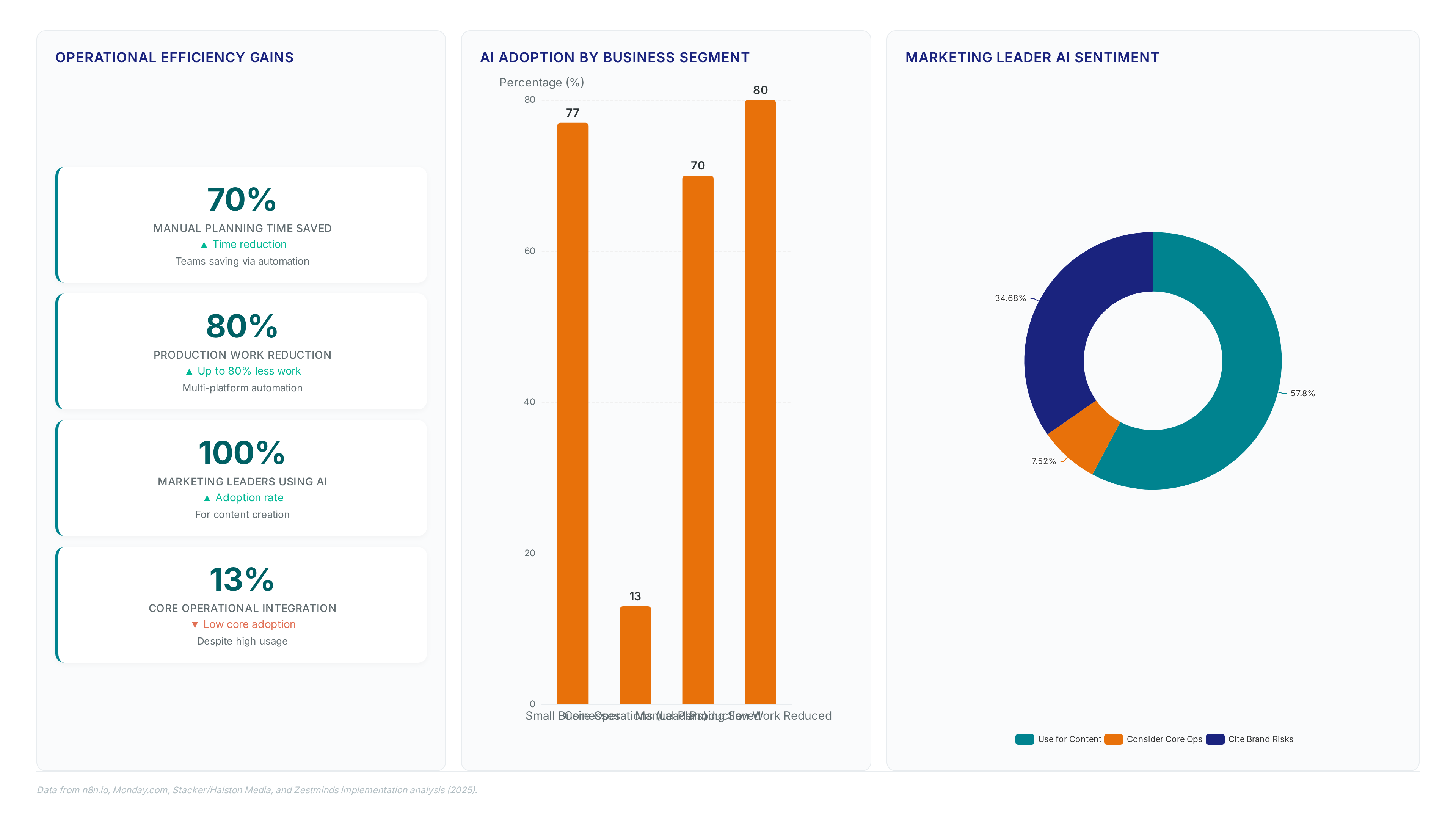
Generation without retrieval yields generic fluff. It lacks brand specificity. It lacks facts. Yet only 13% of marketing leaders call AI central to their workflows, even as adoption spreads. Basic RAG runs single semantic searches against static databases. Advanced setups break complex queries into parallel subqueries for depth. The cost? Increased infrastructure complexity to keep vector indexes low-latency alongside LLM endpoints. Skip the retrieval layer, and you scale hallucinations, not insights. Build strong knowledge boxes. Don't just prompt bigger models. Validate retrieval precision to keep output aligned with brand guidelines.
Real-World Application: The AdBar Case Study in Social Media Automation
Manual campaign creation fractures brand consistency. The AdBar, a Marketing Automation SaaS, fixed scattered analytics and low engagement by wiring semantic search into their pipeline. Zestminds used Weaviate for vectors and LangChain for orchestration. Marketers used to drown in disjointed workflows. The new architecture cut manual content production work by up to 80% during multi-platform tasks. The system eats historical performance data to spit out platform-specific posts that stay on tone.
Audit your content libraries for machine readability before building agentic workflows. The bottleneck? Stopping hallucinated claims that break compliance rules during automated publishing. Research shows 60% of executives cite quality control as the hard barrier to deeper integration. Modern agentic workflows need deterministic evaluation layers. Verify audience fit and accuracy before hitting public APIs. Grammar checks aren't enough. Skip these gates, and reputational damage outweighs any efficiency gain from automated scaling. The industry focus must shift from raw speed to verifiable content governance. Unchecked automation costs more than manual review when trust breaks. Prioritize architectural guardrails over throughput metrics.
Architecting a Brand-Aligned RAG Pipeline with LangChain and Weaviate
How LangChain and Weaviate Enable Semantic RAG Pipelines
LangChain unifies social APIs and legacy libraries, feeding Weaviate for semantic retrieval. This swaps static training limits for a flexible, non-parametric external memory. The system augments model input with retrieved data, skipping retraining. Operators define prompt chaining sequences where LangChain runs retrieval queries before generation. The system cites content dynamically instead of relying on fixed cutoffs.
Building a custom LLM for brand tone requires grounding outputs in this retrieved context. The economic win? Avoiding retraining costs by using existing knowledge bases.
Vector similarity alone retrieves outdated guidelines if ingestion lacks version control. Implement strict metadata filtering alongside semantic scoring. For network teams, data integration quality dictates generation accuracy. Bad input validation means the pipeline amplifies noise. Enterium recommends validating embedding dimensions against your domain vocabulary before scaling.
Executing Intelligent Prompt Chaining for Brand Tone Consistency
Intelligent prompt chaining breaks complex tasks into focused subqueries to lock down brand tone consistency. The system pairs OpenAI GPT-4-turbo with custom LLMs, forcing validation against persona constraints before finalizing text. Without this, models drift from core messaging during long-form creation.
Agentic RAG capabilities let the agent autonomously split a single request into parallel retrieval and validation steps. The pipeline executes focused subqueries against vector stores rather than one blunt semantic search. Azure AI Search calls this executing structured responses optimized for chat models via intelligent query breakdown agentic retrieval.
| Feature | Basic RAG | Agentic RAG |
|---|---|---|
| Query Handling | Single semantic search | Parallel focused subqueries |
| Execution | Linear | Autonomous breakdown |
| Output Quality | Variable tone alignment | High brand consistency |
Latency fights accuracy here. Adding validation steps burns tokens and time. But manual correction of off-brand content kills automation gains faster. Configure timeout thresholds carefully to prevent workflow stalls. This architecture enforces structural checks before generation completes, solving inconsistent brand tone. Enterium recommends a multi-stage validation loop where the custom LLM critiques its own output against stored guidelines. Every post aligns with the required voice. No humans needed.
Static RAG vs Real-Time RAG for Flexible Social Inputs
Batch updates can't process live social comments instantly. Real-Time RAG ingests flexible inputs like product reviews and support tickets the moment they arrive. Static knowledge bases cite stale training data. Real-time systems cite fresh content.
| Feature | Static RAG | Real-Time RAG |
|---|---|---|
| Data Freshness | Batch-processed intervals | Instant ingestion |
| Input Type | Legacy libraries | Live comments |
| Context | Historical only | Current state |
Static models fail during live crises. They generate tone-deaf responses based on outdated context. Agentic workflows using prompt chaining decompose queries to validate against the freshest data. LLM responses reflect current sentiment, not historical averages.
Ingestion speed fights vector consistency. Real-time indexing needs strong conflict resolution to avoid retrieving half-written records. Implement strict write-ahead logging so semantic search only hits committed data. Skip these guards, and you retrieve broken fragments. Moving from static to real-time turns content automation from a scheduled task into a responsive loop. Enterium recommends hybrid architectures where high-velocity social streams bypass batch queues entirely. Campaign execution stays synced with live audience interactions.
Step-by-Step Implementation of an Automated Social Media Campaign System
Architecting the LangChain and Weaviate Data Integration Layer
Zestminds built an end-to-end platform automating ideation, creation, and execution without human bottlenecks. LangChain unifies streams from social APIs, analytics dashboards, and legacy libraries. These inputs become embeddings in Weaviate, enabling semantic search that retrieves contextual content via RAG. Static keyword matching fails on nuance. Semantic retrieval understands intent. The system pulls specific historical examples or metrics instantly when a new campaign concept hits.
Deploying OpenAI GPT-4-Turbo for Generative Content Creation
Integrating OpenAI GPT-4-turbo demands domain-specific prompts in the backend to handle chaining and token limits. Adjust tone and messaging for diverse personas while sticking to brand voice constraints in the system prompt.
- Initialize the FastAPI app with async handlers for non-blocking I/O.
- Define LangChain chains injecting retrieved brand guidelines before every generation call.
3.
Scalable, AI-driven generation needs more than a base model connection. Generic phrasing plagues systems relying on standard LLM outputs. They miss distinct brand personalities. Train a lightweight custom layer on historical feedback to refine tone accuracy. Content stays ready for downstream retrieval while avoiding hallucinations through iterative learning. The output feels authored, not assembled.
Validation Checklist for Multi-Platform Campaign Automation
Confirm the RAG pipeline retrieves context from Weaviate effectively for real-time interaction, not just batch processing. Agents often generate generic text because retrieval skipped recent engagement data.
- Validate that LangChain loaders normalize JSON from every social API into a unified vector schema.
2.
| Check Point | Manual Workflow | Automated Agent |
|---|---|---|
| Context Scope | Single platform | Cross-platform history |
| Retrieval Speed | Human search delay | Instant vector lookup |
| Consistency | Variable by author | Enforced by prompt |
Optimizing purely for speed degrades semantic quality if you aren't careful. Vector indices lacking fresh embeddings cause generators to hallucinate brand guidelines. This metric isolates quality variance between static human drafting and flexible, data-informed generation. Teams save 70% of manual content planning time. That labor reduction lets operators shift hours to strategic oversight. Raw speed means nothing without volume scalability. Successful deployments report 4x more content output without adding headcount. This shifts the economic model from linear cost to exponential reach. Clients saw enhanced visibility and faster go-to-market.
| Metric Category | Primary KPI | Strategic Value |
|---|---|---|
| Engagement | Lift % | Validates audience resonance |
| Efficiency | Time Saved | Reduces burn risk |
| Volume | Output Multiplier | Increases surface area |
High volume dilutes brand safety without quality gates. Humans self-regulate tone. Automated systems need explicit constraint layers to prevent drift. Maintaining this preference ensures scaling output enhances rather than erodes brand consistency.
Case Study: FamilieZorg's 2.5X Engagement Increase via AdBar
Mieke Ruys, CEO of FamilieZorg, saw engagement rise over 2.5X after deploying AdBar to fix low engagement. Planning duration dropped drastically, letting the team focus on strategy, not asset creation. Data-informed generation beats intuition. The architecture uses RAG pipelines to ingest real-time feedback, keeping relevance without sacrificing tone. This mirrors findings in the news and media industry, where AI bots cut production costs while maintaining editorial standards.
Operational Checklist: Scaling Output 4X Without Adding Headcount
Fix low engagement by enforcing strict validation gates before publication. Don't rely on speed alone. Scaling output 4x requires verifying every automated post passes a semantic relevance check against historical brand data.
| Validation Gate | Failure Mode | Correction Action |
|---|---|---|
| Semantic Retrieval | Generic tone drift | Re-index brand guidelines in Weaviate |
| Engagement Loop | Stale topic selection | Prioritize real-time feedback signals |
| Platform Fit | Format mismatch | Apply platform-specific constraint layers |
AI-powered interview bots show how specific retrieval contexts lower costs while keeping narrative quality. Increasing volume without headcount creates tension between throughput and brand safety. Excessive automation dilutes the distinct voice driving audience connection. Configure LangChain agents to unify data sources and manage AI calls, keeping generation aligned with parameters. This constraint prevents off-brand material despite high-volume demands. Treat the AI system as a junior analyst needing supervision, not an autonomous publisher. Audit retrieval processes regularly so real-time data informs every cycle, maintaining relevance and accuracy.
About
Daniel Reyes, Head of Content Engineering at Enterium, architects the exact production systems detailed here. With over a decade in data and ML platform engineering, Reyes builds end-to-end AI content pipelines, focusing on RAG systems, vector stores, and rigorous evaluation harnesses. His daily work solves the precise challenges The AdBar faced: replacing manual campaign creation with scalable, OpenAI-powered automation while maintaining strict quality gates. At Enterium, a B2B publication dedicated to documenting how teams actually build and scale content with LLMs, Reyes leads the methodology of moving from research to publication with humans on the controls. This technical background ensures the analysis of Zestminds' solution goes beyond hype, offering a practitioner-level dissection of the architecture, tooling choices, and measurable outcomes required for successful social media automation in a production environment.
Conclusion
Scaling social media automation proves that throughput without governance creates immediate brand risk. Ignoring this invites the semantic drift 60% of executives fear. You cannot layer more generation on broken validation gates. Evolve from maximizing post volume to optimizing retrieval accuracy. Treat your AI architecture as a junior analyst requiring constant supervision, not an autonomous publisher. This prevents dilution of your unique voice while maintaining high output.
Start by auditing your semantic retrieval layer this week. Ensure brand guidelines are correctly indexed before generating new content. Verify every automated draft passes a relevance check against historical data to catch tone drift early. Do not expand your posting schedule until current validation gates consistently filter out generic phrasing. Success depends on balancing speed with strict operational constraints that protect narrative quality. Prioritize these checks to secure engagement gains without sacrificing audience trust.
Frequently Asked Questions
Brand safety and quality control concerns block deeper integration for many leaders. Research shows 60% of executives cite these issues as primary obstacles, meaning teams must prioritize data hygiene before scaling generation volume to avoid hallucinations.
Teams can reduce manual content production work by up to 80% during automation tasks. This massive efficiency gain allows marketers to shift focus from repetitive scheduling to strategic planning while maintaining consistent brand voice across all channels simultaneously.
Only 13% of marketing leaders consider AI central to their current workflows despite widespread usage. This gap suggests most organizations lack the retrieval-augmented architecture needed to ensure factual accuracy and brand specificity in generated outputs reliably.
Integrating semantic retrieval with generative AI drives a reported 36% increase in engagement metrics. This improvement occurs because the system pulls relevant historical context to anchor creations, eliminating the generic outputs that often plague basic large language model prompting.
Deploying a RAG pipeline enables teams to save 70% of manual content planning time effectively. This acceleration comes from unified data sources and intelligent prompt chaining that repurpose past high-performing assets without sacrificing personalization or requiring additional headcount.
References