Quality control for AI: Stop hallucinations now
Half of marketers use AI for content, yet Salesforce data reveals 39% remain unsure how to deploy it safely. This gap isn't a skills issue; it's a governance failure. Relying on speed alone invites catastrophic accuracy and voice failures. The only viable path for enterprises scaling without destroying brand trust is a rigorous quality control framework.
Traditional metrics like grammar checks miss the point entirely. They fail to catch hallucination risks and context drift specific to generative models. Unchecked output actively harms SEO by violating Google's E-E-A-T guidelines through unverified claims or plagiarized structures. This guide outlines a concrete four-step validation system designed to plug these gaps before publication. You will learn to execute a workflow that balances efficiency with the strict factual verification required to protect corporate reputation. By implementing these quality frameworks, organizations move past the paralysis of fear and integrate AI safely into core operations.
The Critical Role of Quality Frameworks in AI Content Strategy
Defining AI Content Quality Beyond Grammar and E-E-A-T
Grammar is the baseline, not the goal. AI content quality demands factual accuracy, brand alignment, and active risk mitigation. While 50% of marketers apply artificial intelligence for creation, 39% remain uncertain about safe deployment protocols. This uncertainty creates a vulnerability: without deliberate human intervention, Google's E-E-A-T guidelines simply do not get applied to your AI content. Generative models lack inherent expertise, so their output often misses the authority search algorithms reward.
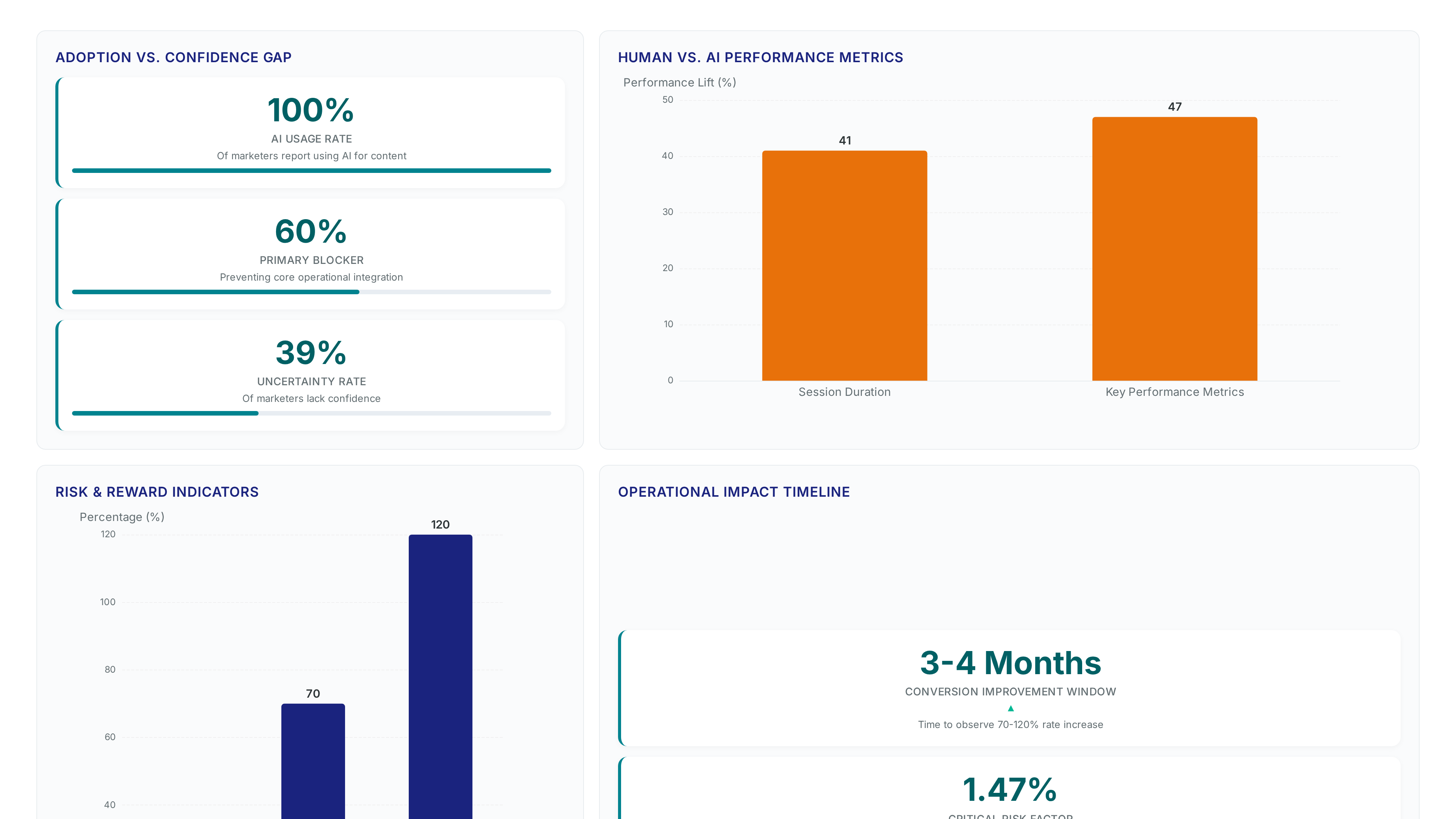
Organizations face a tangible conflict between production velocity and brand safety. Research indicates that 60% of marketing leaders cite quality control as the primary barrier to operationalizing AI. Teams incur hidden costs through potential search penalties and copyright exposure without rigorous validation. Treat hallucination risks and context drift as critical failure modes requiring structured detection workflows. In specialized fields, unmonitored generation yields a 1.47% hallucination rate, a statistically significant error margin for regulated industries.
| Quality Dimension | Traditional Focus | AI-Specific Risk |
|---|---|---|
| Accuracy | Spelling and syntax | Fabricated facts |
| Consistency | Style guide adherence | Context drift |
| Originality | Plagiarism checks | Data scraping |
Speed generates liability when verification lags. Teams must implement real-time monitoring to intercept errors before publication. Relying solely on post-hoc editing fails to address the root cause of brand misalignment. Quality frameworks must evolve from passive checklists to active governance systems that validate source integrity.
Real-World Impact of Workslop on Engagement and Traffic
Workslop describes AI output that mimics competence but lacks substance, forcing teams to rewrite rather than publish. This inefficiency creates a measurable engagement gap where human-generated content outperforms AI by 47% in key metrics. The deficit extends beyond simple interaction rates to fundamental traffic generation capabilities. Human-written pieces generate 5.44 times more traffic over a five-month period compared to their automated equivalents.
Session depth further illustrates the quality disparity, as human-authored material achieves 41% longer session durations than AI-generated counterparts. Generic AI output often fails to align with specific brand voice or deep contextual knowledge, leading to higher bounce rates. A significant limitation arises when organizations prioritize volume over verification; the resulting plagiarism risks and context drift erode user trust immediately upon arrival. Companies ignoring these quality thresholds find their production speed meaningless if the content cannot retain audience attention.
The operational consequence is a paradoxical slowdown where rapid generation creates downstream bottlenecks in editing and fact-checking. Teams spend disproportionate cycles correcting hallucinations instead of strategizing distribution. Without rigorous validation gates, the theoretical efficiency of automation evaporates against the reality of poor performance. Marketers must treat engagement disparity as a leading indicator of brand health rather than a temporary anomaly. Human-authored content achieves notably longer session durations and higher engagement rates than AI equivalents, suggesting that fully automated fleets may underperform against competitors using hybrid human-AI workflows. To address this, organizations are increasingly adopting advanced testing systems that have been observed to improve conversion rates by 70, 120% within 3, 4 months.
Hidden Risks: Hallucination, Context Drift, and Brand Safety
Hallucination and context drift represent immediate failure modes where models fabricate facts or lose brand alignment during generation. This hesitation stems from the mechanics of generative AI, which relies on data-scraping and re-packaging that frequently omits attribution, creating tangible plagiarism liabilities. Poorly developed output directly damages brand reputation and degrades SEO performance by diluting authority signals. Unlike simple grammar errors, these semantic failures require active human oversight to detect before publication. Organizations ignoring these specific risks face compounding reputational harm that outweighs efficiency gains. The path forward requires shifting focus from prompt volume to rigorous validation architectures that catch drift early.
Inside the Four-Step Validation System for Content Excellence
Prompt Engineering and Context Windows in Pre-generation Setup
Prompt engineering functions as the primary constraint mechanism, defining the tone, style, and voice before token generation begins. Effective deployment requires populating context windows with specific background information, product constraints, and audience insights to reduce semantic fluff. Advanced automation systems optimizing quality before response delivery achieve superior results compared to those relying solely on post-factum correction, combining automated tools with human expertise.
| Component | Function | Risk if Omitted |
|---|---|---|
| Role Definition | Sets the persona and expertise level | Generic, unauthority output |
| Context Window | Provides factual grounding and constraints | Hallucinated details or drift |
| Style Guide | Enforces brand voice and formatting | Inconsistent brand messaging |
Free versions of content AI tools typically offer limited capabilities for underlying parameters while paid tiers allow customization per client. Increased initial setup time balances against reduced editing cycles later.
Executing Multi-pass Generation and Flag Detection Checkpoints
Running 2, 3 prompt variations per topic exposes structural weaknesses before final drafting begins. This multi-pass generation strategy forces the model to explore different tonal ranges, allowing editors to select the version with the highest clarity. Teams that implement flag detection systems during this phase catch repetition and hallucinations while the content remains mutable. These automated checkpoints scan for off-brand phrasing that static style guides often miss. Intentional pauses act as structural validation gates, ensuring heading hierarchy and logical flow remain intact throughout the draft.
| Checkpoint Type | Detects | Action Required |
|---|---|---|
| Repetition Scan | Redundant phrases | Rewrite or merge sentences |
| Hallucination Flag | False claims | Verify against source data |
| Brand Alignment | Tone deviations | Adjust temperature or re-prompt |
Generation speed competes with validation depth. Embedding these quality gates directly into the generation pipeline rather than treating them as separate post-processing steps shifts quality control from a reactive filter to a proactive constraint. Operators must configure their flag detection thresholds to balance false positives against genuine brand risks.
Red-teaming Protocols for Post-generation Analysis and Performance Tracking
Red-teaming originates as a military term where a team simulates attacks to identify system weaknesses before adversaries exploit them. Applying this concept to content requires operators to treat generated drafts as potential security incidents rather than finished assets. The process demands rigorous fact-checking protocols and brand alignment assessments that go beyond standard grammar checks. Teams must verify that internal and external links point to authoritative sources, preventing the reputation damage associated with data-scraping artifacts. Organizations failing to integrate software checks for duplicate material face implicit costs related to search engine penalties and copyright violations. Post-publication monitoring must track engagement metrics including clicks, time on page, shares, and bounce rate to validate quality assumptions. An editorial quality score derived from grammar, clarity, structure, and value provides a quantitative baseline for trend analysis. Establishing fixed checkpoints where subject matter experts validate claims before any public release is necessary.
Executing a Thorough AI Content Quality Control Workflow
Defining Pre-generation Setup and Output Specifications
Defining output specifications like length and format before generation prevents the productivity losses known as "workslop" where teams must rewrite unsubstantial drafts. This core step requires documenting AI-readable style guides that explicitly constrain tone and structural requirements. Operators must populate context windows with precise product descriptions and audience constraints to reduce semantic fluff effectively.
- Define strict length limits and keyword density targets in the system prompt.
- Upload brand voice documentation to guide the model's stylistic choices.
- Include negative constraints that forbid specific off-brand phrasing or hallucinated stats.
Advanced automation systems optimizing quality before response delivery achieve superior results compared to those relying solely on post-factum correction. Free tool versions often lack the parameter customization needed for these rigorous controls. Teams ignoring this setup phase face higher revision costs as editors struggle to fix structural drift rather than refining content. Enterium recommends treating these specifications as mandatory engineering constraints rather than optional suggestions.
Implementation: Applying Red-teaming Protocols for Post-generation Analysis
Post-generation red-teaming simulates adversarial attacks to expose hallucination risks and context drift before publication. This protocol treats every draft as a potential security incident requiring forensic validation rather than simple editing. Operators must execute a structured four-step verification sequence to guarantee brand safety.
- Validate all internal and external links for topical authority and expertise.
- Deploy plagiarism detectors that extend beyond standard checkers to identify repackaged training data.
- Perform rigorous brand alignment assessments to detect subtle voice deviations.
- Audit keyword placement to prevent unnatural stuffing patterns.
Organizations neglecting these software checks face implicit costs from search penalties and potential copyright violations. Automated scanners miss detailed semantic errors. Human expert review remains mandatory for high-stakes industries like healthcare or finance. Teams at Enterium recommend treating this phase as a non-negotiable gate rather than an optional polish. Failing to integrate these fact-checking protocols allows low-quality artifacts to damage long-term reputation. The cost of retraction far exceeds the latency added by thorough pre-publish analysis.
Regulatory Risks in Healthcare, Finance, and Legal AI Content
Regulated sectors face immediate liability when generative models invent clinical data or misstate financial compliance rules. Healthcare operators must verify FDA and HIPAA adherence manually, as automated tools often miss detailed medical advertising requirements. Financial firms encounter similar exposure under SEC regulations governing investment advice, where a single fabricated statistic can trigger enforcement actions. Legal content demands strict jurisdictional accuracy, as bar associations penalize incorrect state-specific guidance.
| Sector | Primary Regulation | Specific AI Risk |
|---|---|---|
| Healthcare | HIPAA, FDA | Clinical hallucination |
| Finance | SEC | Misstated returns |
| Legal | Bar Rules | Jurisdiction error |
Human review becomes mandatory when content influences medical decisions or financial outcomes. Operators should implement a deterministic filter before any public release.
- Isolate claims requiring regulatory verification.
- Route these segments to a qualified Subject Matter Expert.
- Log the validation decision for audit trails.
Scaling output volume conflicts with the zero-error tolerance required by law. Most organizations cannot automate this final gate without violating ethical guidelines or exposing themselves to litigation (https://remoteonlineevaluator.com/7-best-ai-content-evaluator-tools-for-quality-accuracy-compliance/). Enterium recommends treating unverified AI output in these domains as presumptively false until a human signs off. This workflow shifts the burden of proof to the machine, aligning production speed with legal safety.
Mitigating Hallucination Risks and Brand Reputation Damage
Risks: Defining AI Hallucination and Context Drift Mechanics
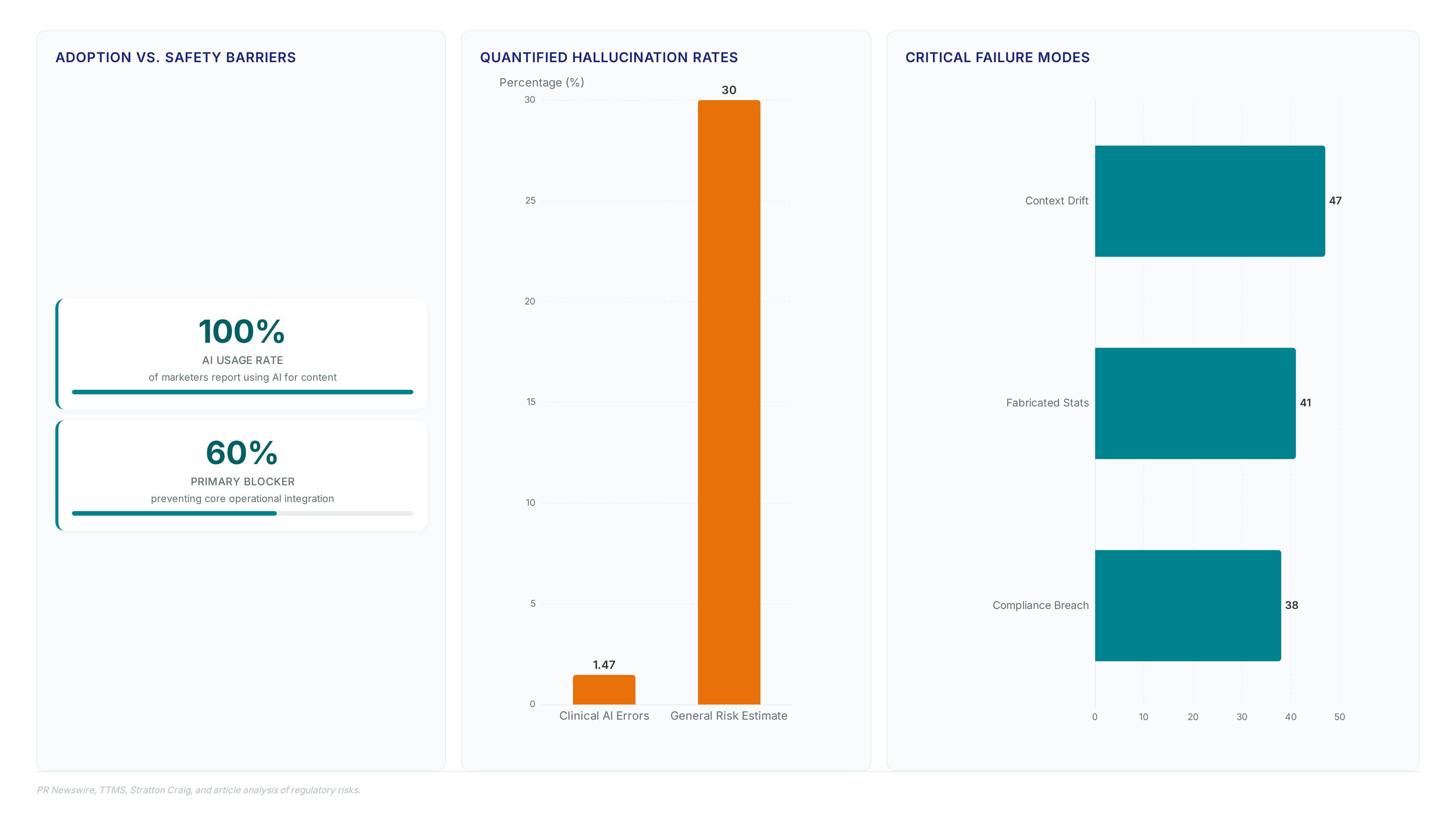
Models occasionally spit out plausible lies known as hallucinations, creating instant liability for the companies running them. These systems invent citations or misrepresent product capabilities entirely, leaving operators holding the bag for convincing falsehoods. Context drift acts as a separate failure mode where the algorithm loses alignment with brand guidelines during long-form generation tasks. As content length increases, the probability of deviating from core messaging protocols rises notably without human intervention. Technical calibration of automated quality control tools requires constant updates to brand voice models and factual databases to remain effective calibration.
Risks: Regulatory Compliance Failures in Healthcare and Finance
A single fabricated clinical statistic triggers immediate FDA enforcement actions and potential patient harm. Generative models in healthcare occasionally invent dosage protocols or misquote HIPAA privacy thresholds, creating liability that manual review must catch. Financial operators face parallel exposure when AI systems generate non-compliant investment advice violating SEC regulations. Unlike general marketing errors, these mistakes carry statutory penalties rather than just reputational damage. The operational reality demands that firms treat every output as a potential regulatory breach requiring forensic validation before publication. The cost of failure extends beyond fines to include mandatory disclosure events and loss of operating licenses.
Human Expert Review Checklist for Brand Safety
Human expert review must verify jurisdictional accuracy and ethical guidelines before publication. Legal teams specifically check bar association rules to prevent state-specific compliance errors. Financial operators validate investment advice against SEC regulations to avoid statutory penalties. A structured safety workflow is necessary because domain-specific AI content carries measurable hallucination risks.
| Domain | Primary Regulatory Risk | Verification Target |
|---|---|---|
| Healthcare | Clinical Safety | FDA and HIPAA adherence |
| Finance | Investment Advice | SEC regulation compliance |
| Legal | Jurisdictional Accuracy | Bar association ethics |
Plagiarism detection tools must identify repackaged training data beyond standard checksums. Context drift frequently causes models to lose alignment with brand messaging during long-form generation. Teams often overlook that hallucination rates vary notably by technical domain complexity. The limitation of automated flagging is its inability to assess detailed professional liability. Enterium recommends treating every draft as a potential security incident requiring forensic validation. Operators must execute this sequence to guarantee brand safety before any public release.
- Verify all dates and proper nouns against primary sources.
- Cross-check medical claims with current peer-reviewed literature.
- Ensure financial disclaimers match exact regulatory wording.
- Scan for unintended bias in demographic representations.
- Confirm tone consistency across all generated sections.
About
Sofia Marchetti, a B2B Content Strategist with 12 years of experience in SaaS demand generation, brings critical expertise to the challenge of AI content quality control. Her daily work focuses on ensuring automated content pipelines drive topical authority and revenue rather than generating "AI slop" that damages brand trust. Marchetti's approach connects quality gates and governance directly to business outcomes like SEO performance and pipeline growth. At Enterium, a brand dedicated to documenting how modern teams scale content with LLMs, her insights reflect the reality of building reproducible, vendor-neutral systems. By emphasizing that humans must remain "on the gates," she provides the practical framework B2B leaders need to change AI from a risky shortcut into a reliable engine for compounding authority.
Conclusion
Scaling AI content production breaks when operational speed outpaces verification capacity, turning minor alignment errors into significant brand liability. The immediate cost is rework, but the real damage is the erosion of user trust as session durations shrink on unverified drafts. While adoption rates are projected to nearly triple by 2027, organizations that rely solely on automated generation without strict human oversight will face compounding reputation damage rather than efficiency gains.
Leaders must mandate a hybrid workflow where AI handles initial drafting but human experts retain final authority on all regulated claims before publication. This approach balances volume with the precision required for healthcare, finance, and legal sectors. Do not wait for a compliance failure to implement these checks; establish clear gates now to ensure every output meets rigorous professional standards.
Start this week by auditing your current content pipeline to identify which assets touch regulated domains like medical advice or financial planning. Isolate these high-risk categories immediately and enforce a mandatory human review step for any generated text within them. This targeted intervention secures your most vulnerable content vectors while allowing safer creative experiments to continue elsewhere.
Frequently Asked Questions
Quality control concerns prevent most leaders from full operational adoption. Research indicates that 60% of marketing leaders cite brand safety as the primary blocker, forcing teams to prioritize rigorous validation frameworks over rapid generation speeds to avoid reputation damage.
Human-authored material significantly outperforms automated text in retaining user attention. Data shows human content achieves 41% longer session durations than AI-generated equivalents, meaning unchecked automation directly reduces the time visitors spend engaging with your brand on site.
Specialized fields face measurable accuracy risks without strict human oversight protocols. In these sectors, unmonitored generation yields a 1.47% hallucination rate, creating a statistically significant margin for factual errors that can violate compliance standards and damage trust.
Poor quality output forces extensive rewrites that negate initial speed gains. Since human-generated content outperforms AI by 47% in key metrics, teams often spend disproportionate cycles correcting hallucinations and context drift instead of publishing valuable strategic assets.
Many marketers lack confidence in deploying these tools despite high usage rates. While 50% of marketers utilize artificial intelligence for creation, 39% remain uncertain about safe deployment, highlighting an urgent need for structured quality control systems.