5Dimension framework: Stop AI hallucinations now
With 100% of marketing leaders reporting AI use for content creation per Yahoo Finance, the priority has shifted from adoption to rigorous quality control. Language models prioritize speed over reliability, making human oversight via specific scoring logic necessary for professional output.
This guide details how the 5-dimension assessment evaluates accuracy, clarity, relevance, tone, and engagement to filter out confident but incorrect information. We examine the internal scoring mechanics that penalize unsubstantiated claims and generic phrasing while rewarding logical consistency and proper citation. The discussion moves beyond basic proofreading to implement systematic checks that align with search engine demands for expertise.
Targeted improvements based on these dimensions drive measurable content ROI by ensuring material meets strict regulatory and brand standards. Generic outputs fail to add value; specific adjustments change drafts into assets that maintain user trust. This approach closes the critical gap between rapid generation and the high standards required for modern digital communications.
The Role of the 5-Dimension Framework in Modern Content Quality
Defining the 5-Dimension Framework for AI Content
Vague content review kills brands. The 5-Dimension Framework converts subjective hand-waving into hard numbers by auditing Accuracy, Clarity, Relevance, Style, and Originality. Language models favor speed and efficiency, leaving a gap where factual errors sound confident. Systematic assessment closes this gap by enforcing strict verification before publication. Assessing the quality of AI-generated content directly impacts brand reputation, user trust, and operational efficiency. The framework demands that every statistic be verified and every source cited to maintain factual integrity.
| Dimension | Primary Audit Target |
|---|---|
| Accuracy | Verified facts and logical consistency |
| Clarity | Logical flow and jargon removal |
| Relevance | Actionable insights for the audience |
| Style | Brand voice alignment |
| Originality | Unique perspectives over clichés |
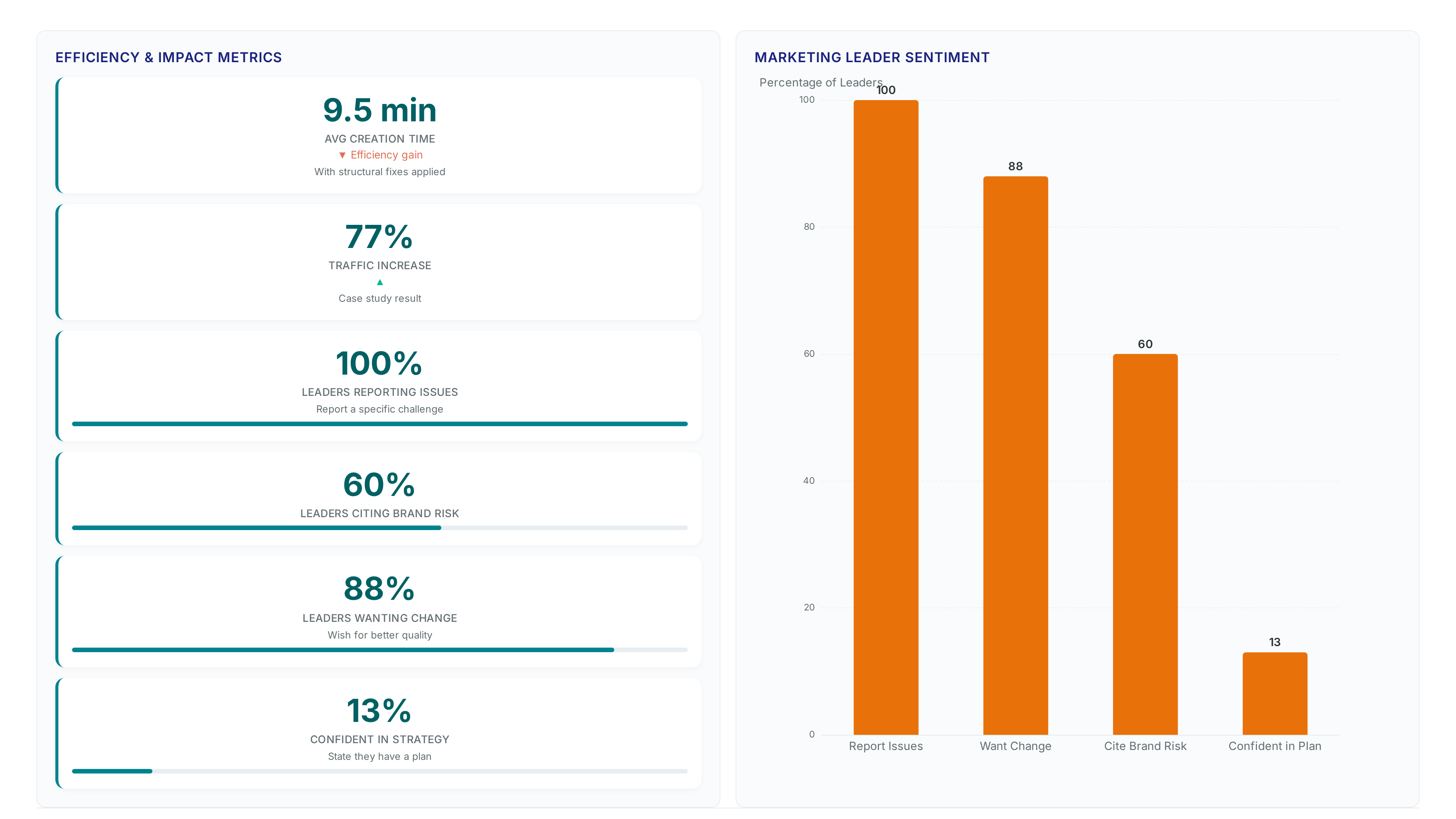
While 100% of marketing leaders report already using AI for content creation, only 13% state that AI is core to their operations. This disparity highlights the risk of scaling production without scaling quality controls. Teams prioritizing volume face a distinct constraint: generic output dilutes brand authority without a structured scoring system. Organizations must treat factual integrity as a binary gate where content failing verification does not publish. Frameworks suggest establishing a minimum score threshold of 4.0 or 4.5 out of 5.0 across all five dimensions before finalizing drafts. This baseline quality meets professional standards regardless of the generator used.
Applying Accuracy and Clarity Metrics to Brand Safety
Unverified claims trigger immediate trust failures, making factual integrity the primary defense against brand damage. When language models generate confident but incorrect statements, the resulting reputational harm exceeds the cost of delayed publication. Data indicates that 60% of marketing leaders cite brand safety as their primary blocker to deeper AI integration, reflecting industry-wide caution. The framework mandates that scores drop for unsubstantiated claims, forcing a binary pass-fail gate on every statistic before it reaches print. This mechanism prevents the propagation of errors that search algorithms increasingly penalize.
| Dimension | Verification Target | Failure Consequence |
|---|---|---|
| Accuracy | Source citation | Loss of credibility |
| Clarity | Logical flow | User confusion |
Operationalizing readability assessment ensures complex concepts remain accessible without sacrificing precision. Industry guidelines emphasize accuracy verification as a non-negotiable standard for professional communications. Enforcing strict fact-checking slows velocity, yet skipping it invites catastrophic brand risk. Most organizations resolve this by automating the initial citation check while retaining human review for detailed claims. The implication for network operators and content teams is clear: brand alignment confirmation must occur before any content leaves the staging environment.
Risks of Unverified AI Content on Brand Reputation
Unverified AI generation produces confident but factually incorrect statements that erode user trust immediately. Language models prioritize speed over reliability, creating a structural risk where factual hallucinations appear authoritative. This failure mode bypasses human intuition because the syntax remains perfect while the data fails. The operational cost involves not correction, but the permanent loss of audience confidence.
| Failure Mode | Root Cause | Brand Impact |
|---|---|---|
| Factual Hallucination | Probabilistic token selection | Loss of credibility |
| Cultural Blindness | Missing context windows | Alienated audiences |
| Repetitive Output | Model convergence | Diminished value |
Publication velocity often degrades brand safety without strict gates. A majority of organizations now deploy generative tools, yet few maintain the validation processes required to catch subtle errors. Search algorithms prioritize content quality and expertise, rewarding high-standard outputs while filtering out low-quality, unverified material. Frameworks recommend implementing a mandatory self-assessment loop where the model evaluates its own output against the five dimensions before human review. This step forces the system to flag uncertainty rather than fabricate answers. The reputational risk compounds as errors scale with production volume without this guardrail.
Inside the AI Self-Assessment Process and Scoring Logic
Step 1: Pattern Recognition in AI Self-Assessment
Pattern recognition drives the initial self-evaluation by comparing generated tokens against predefined structural and factual criteria. This mechanism allows the system to flag inconsistencies in factual accuracy without human ego or bias interfering with the audit. Unlike human reviewers who might overlook repetitive phrasing, the model objectively identifies deviations from expected content structure. Research indicates that 88% of marketers seek such step-by-step AI content framework to replace ad-hoc methods. The process distinguishes itself by focusing on measurable attributes rather than subjective quality impressions.
| Feature | Human Review | AI Pattern Recognition |
|---|---|---|
| Bias Source | Personal experience | Training data distribution |
| Speed | Variable | Constant |
| Focus | Complete impression | Structural integrity |
A specific limitation arises when the model encounters novel industry jargon absent from its training set, potentially misclassifying valid technical terms as errors. This constraint means human oversight remains necessary for highly specialized domains despite the automation. The reliance on existing patterns implies that truly original arguments may initially score lower until the criteria adjust. Organizations addressing organizational friction find that defining these patterns early prevents downstream quality failures.
Setting Dimensional Quality Thresholds for Business Communications
Operationalizing the 5-dimension assessment requires assigning specific numeric floors to quality standards based on content risk. Enterium recommends defining a minimum acceptable rating of 4 or 4.5 out of 5 for each dimension to change guesswork into systematic analysis. This approach prevents the publication of thin content that often results from rapid, unvetted AI adoption.
| Content Type | Minimum Threshold | Primary Risk Mitigated |
|---|---|---|
| Critical Business Communications | 4.5 | Factual hallucination |
| Regular Blog Posts | 4.0 | Generic phrasing |
| Internal Documents | 4.0 | Structural incoherence |
- Identify the content category before generation begins.
- Apply the corresponding dimensional floor to the self-assessment output.
- Reject any draft scoring below the assigned threshold for immediate revision.
Strictness carries a cost; enforcing a 4.5 threshold on routine updates increases revision cycles unnecessarily. However, failing to separate critical communications from internal notes invites brand safety incidents where confident errors reach external audiences. A lower bar for internal drafts preserves velocity while maintaining a high wall for public-facing material. This tiered strategy ensures that high-stakes messages undergo rigorous factual verification while low-risk outputs remain efficient. Operators must calibrate these gates to balance speed against the potential cost of reputational damage.
Dimensional Assessment Checklist: From Factual Claims to Brand Voice
The Dimensional Assessment Process converts subjective judgment into a repeatable validation pipeline by enforcing sequential gates on factual claims and brand voice. Operators must execute a strict seven-step verification: check factual claims, verify data sources, evaluate structural integrity, assess language complexity, compare content against purpose, check brand alignment, and rate creative effectiveness. This sequence addresses the divergence between quantitative metrics like readability scores and qualitative assessments such as audience relevance, which often require distinct evaluation parameters.
| Validation Target | Mechanism | Failure Mode |
|---|---|---|
| Factual Integrity | Source cross-reference | Hallucinated statistics |
| Structural Integrity | Passage architecture map | Logical discontinuity |
| Brand Alignment | Voice parameter match | Tone inconsistency |
A key emerging technical metric is the AI citation rate, which measures how frequently platforms reference specific content as a source, signaling authority beyond simple page views. However, relying solely on automated scoring ignores the "organizational friction" caused by messy data integration, a limitation that forces human oversight for final approval. Enterium recommends mapping dimensions to specific capabilities like Entity Management to deepen the structural comparison beyond surface-level checklists. The consequence of skipping the complexity assessment is the publication of confident but logically hollow text that erodes trust. Practitioners must treat language complexity not as a stylistic choice but as a functional requirement for audience retention.
Measurable ROI from Targeted Content Improvement Strategies
Score-Based Content Improvement Tiers Set
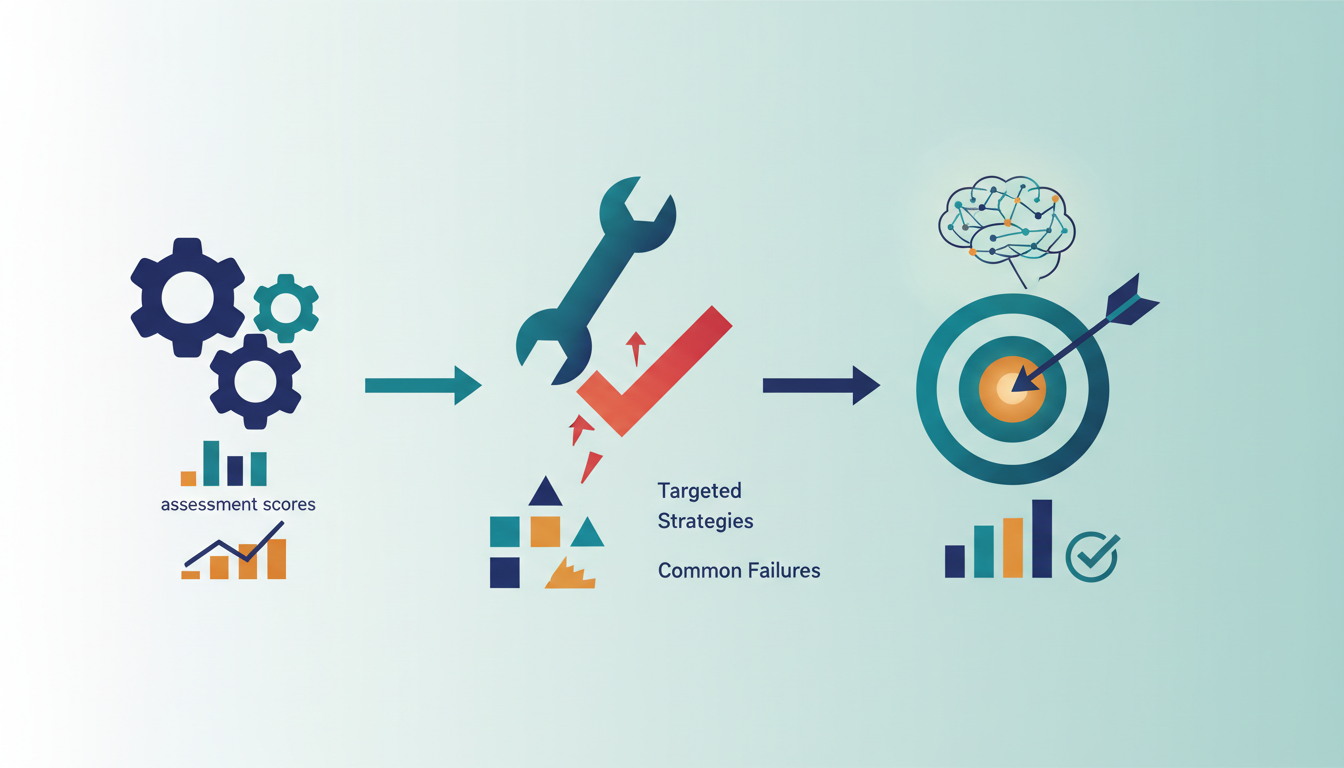
Quantitative metrics sort improvement strategies into distinct operational tiers based on assessment scores. Pieces landing between 75 and 99 show Good Quality but Needs Refinement to incorporate original insights and industry knowledge. Drafts falling in the 50 to 74 range signal Moderate Quality requiring Significant Revision of structural elements and topic sentences. Scores below 50 trigger a regeneration protocol where operators must audit core messages before rewriting with clearer objectives. This tiered system stops teams from wasting time applying light edits to fundamentally broken drafts. Balancing automated scoring speed against the depth of human expertise needed for lower tiers creates friction. Low-scoring content often lacks context rather than suffering from grammatical failure. Brand alignment checks address this gap improved than simple spellchecking tools ever could.
| Score Range | Quality Tier | Strategic Imperative |
|---|---|---|
| 75, 99 | Good | Enhance authenticity and engagement hooks |
| 50, 74 | Moderate | Reorganize structure and add evidence |
| < 50 | Poor | Regenerate with specific prompts |
Executing Refinement Tactics for High-Scoring Content
Specific refinement tactics beat full regeneration when polishing content scoring between 75 and 99 for publication. Inserting strong hooks at paragraph starts disrupts the repetitive phrasing common in initial drafts. Varying sentence lengths keeps readers engaged while strengthening calls-to-action drives measurable user behavior instead of passive consumption. Editors sometimes over-correct for style and strip away the factual density that earned the high score in the first place. Structural flow must improve without diluting technical substance. Focusing these efforts on brand voice alignment resolves the disconnect between efficient generation and authentic communication. Good content stays stagnant without this targeted intervention and fails to convert readers. The final step verifies that analogies clarify complex points rather than confusing the audience with forced metaphors.
Structural Audit Checklist for Moderate-Quality Drafts
Structural reorganization takes priority over stylistic polishing for moderate-quality drafts scoring between 50 and 74. Operators strengthen topic sentences to ensure every paragraph opens with a clear, declarative claim rather than vague context. Reorganizing content and ensuring proper paragraph development fixes the drift AI-generated text often exhibits away from its core argument. Enhancing content depth comes next by inserting supporting evidence and addressing counter-arguments the initial draft omitted. Adding expert opinions or thorough examples merely layers complexity onto a broken framework without this foundation. Rushing this audit leaves factual inaccuracies that damage brand trust. Marketers seeking a specific step-by-step framework find that only disciplined execution of these checks resolves underlying factual inaccuracies in AI output. Ignoring structural deficits in favor of surface-level tweaks results in content that sounds professional but fails to deliver value. Verifiable utility for the reader matters more than simple readability.
Executing the Five-Step Regeneration and Editing Workflow
Regeneration Triggers for Low-Quality Scores
Language models can generate factually incorrect information while sounding confident, creating a risk profile where patching individual sentences fails to resolve systemic confusion. For scores below 50, operators must conduct a complete content audit to identify core messages, missing elements, confusion, and inaccuracies before attempting any rewrite. This approach contrasts with moderate-quality revisions, as the structural incoherence in low-scoring drafts prevents incremental fixes from succeeding. A framework built on over 3,000 article audits confirms that deep logical inconsistencies demand a fresh generation strategy using specific prompts and human expertise. The tension here lies between the speed of AI production and the time required to verify claims against authoritative sources before publication. Ignoring quality thresholds leads to publishing material that damages brand trust, whereas regeneration resets the baseline for accuracy.
- Identify missing elements and central confusion points.
- Rewrite sections with clearer objectives and stricter constraints.
- Integrate human expertise to validate new core messages.
Treating low scores as a hard stop for editing workflows ensures core errors are addressed.
| Failure Mode | Required Action |
|---|---|
| Unsubstantiated claims | Full regeneration |
| Logical inconsistencies | Complete audit |
| Voice mismatch | Prompt rewrite |
The cost of editing a fundamentally flawed draft exceeds the resource expenditure of starting over with improved constraints.
Implementation: Executing Refinement Tactics for High-Quality Content
Refining content scoring in the upper range requires targeted human editing to inject original insights that automated systems cannot fabricate. For scores between 75 and 99, the focus must shift to enhanced authenticity by adding original insights, industry knowledge, and case studies. While AI generates draft structures efficiently, it lacks the proprietary context necessary for high-value business communications. Operators must intervene when the output sounds generic or misses niche industry nuances. This intervention transforms adequate text into authoritative guidance that satisfies search quality guidelines for original, high-quality content.
- Inject specific case studies or internal data points to replace vague generalizations.
- Moderate-quality drafts fail primarily due to weak passage architecture rather than surface errors. For scores between 50 and 74, operators must address structural issues by reorganizing content, strengthening topic sentences, and ensuring logical flow. This structural deficit requires a systematic audit before any stylistic polishing can succeed.
- Reorganize content flow to align with entity management principles, ensuring logical progression.
- Strengthen topic sentences to eliminate vague openings that dilute the core argument.
- Insert missing counter-arguments to address the lack of depth common in automated outputs.
| Issue Type | Symptom | Required Fix |
|---|---|---|
| Logical Gaps | Disconnected paragraphs | Re-sequence using passage architecture |
| Shallow Depth | Lack of supporting evidence | Add expert opinions and data |
| Weak Hooks | Generic introductions | Insert specific industry context |
Integrated quality controls can reduce total creation time to an average of 9.5 minutes when these structural fixes are applied early. The tension lies in choosing between rapid regeneration and targeted editing; for scores above the minimum threshold, editing preserves valid data while fixing flow. However, skipping this audit risks publishing content that fails brand alignment checks despite passing grammar tools. Operators should use automated platforms to validate these structural elements before human review.
About
Daniel Reyes, Head of Content Engineering at Enterium, architects the very production pipelines this article evaluates. With over a decade in data and ML platform engineering, he spends his days building the ingestion, retrieval, and QA gates that prevent AI systems from prioritizing speed over reliability. His daily work involves configuring evaluation harnesses and vector stores to catch factual hallucinations and brand misalignments before publication. This hands-on experience directly informs the proposed 5-dimension assessment framework, transforming abstract quality concerns into concrete, reproducible engineering controls. At Enterium, a brand dedicated to vendor-neutral content automation methodologies, Daniel ensures that content operations rely on measurable standards rather than hope. By connecting theoretical assessment models to the practical realities of pipeline architecture, he provides B2B teams with the specific tools needed to enforce quality gates. This approach shifts the focus from raw throughput to systematic reliability, ensuring that automated content meets professional standards without sacrificing operational efficiency.
Conclusion
Scaling content operations reveals that structural coherence breaks long before grammar does. While many teams chase volume, the real operational cost emerges when a library of technically correct assets fails to convert because they lack logical depth. Relying solely on automated scoring creates a false sense of security if the underlying passage architecture remains fragmented. The market is shifting toward transparent sourcing as a primary quality signal, meaning organizations that do not document their data origins will lose competitive ground regardless of output speed.
Teams must implement a gated review workflow immediately, reserving human expertise for drafts that pass initial structural checks rather than attempting line-by-line edits on every asset. This approach preserves authentic voice while maintaining velocity. Do not wait for a quarterly review to address these gaps. Start this week by auditing your last ten published pieces specifically for logical flow and counter-argument inclusion, ignoring surface-level typos. If the narrative arc requires re-sequencing to make sense, the draft needs structural reconstruction before any stylistic polish. This targeted intervention ensures that speed does not compromise the authentic connection required to turn readers into customers.
Frequently Asked Questions
Brand safety concerns stop deeper integration for most marketing leaders today. Data shows 60% cite quality control as their primary blocker to scaling AI use effectively.
Universal adoption exists but strategic integration remains very low across industries. While 100% report using AI, only 13% state it is core to their actual operations.
The system penalizes unsubstantiated claims to prevent factual hallucinations from publishing. This protects the 60% of leaders worried about brand damage from erroneous content outputs.
It targets unverified facts and logical inconsistencies that erode user trust immediately. This matters because 100% of leaders use AI, yet many lack strict verification gates.
Generic outputs dilute brand authority when everyone uses similar generation tools.