AI search visibility: why 23x conversion rates matter
AI search visitors convert 23 times higher than organic traffic, proving lead quality matters more than volume. This disparity confirms that AI search visibility is the primary driver of high-value conversions in 2026, rendering traditional traffic metrics obsolete for serious brands. Your strategy must shift from chasing clicks to securing citation frequency and positive brand sentiment within generative models.
You will learn why standard SEO KPIs fail when measuring performance in AI environments and how to track specific indicators like mention frequency and competitor share instead. The discussion details the mechanics of auditing your presence across substantial platforms by manually testing key prompts and analyzing model outputs for accuracy. We also cover how to calculate ROI based on reputation impact and conversion data rather than simple page views.
Relying on legacy tools that conflate mentions with citations creates blind spots in your reporting. A reliable AI search optimization plan requires distinct measurement protocols that existing analytics suites often miss. By focusing on these core distinctions, you can build a reporting framework that accurately reflects your brand's standing in the age of generative answers.
Defining AI Search Visibility and Core KPI Distinctions
Defining AI Search Visibility Through Mention and Citation Frequency
AI search visibility quantifies brand presence within generative answers rather than ranking on a static list. LLM visibility is quantitatively set as the aggregate sum of outcomes across all prompts the to a specific category, rather than a single positional rank. Unlike traditional SEO, which targets a fixed position like number four, this metric aggregates outcomes across all the user prompts to measure total exposure. The definition relies on two distinct components: Mention Frequency, tracking how often a brand name appears in responses, and Citation Frequency, measuring direct links to source websites. Industry analysis indicates that visitors from these AI-driven interactions convert at significantly higher rates than organic traffic, shifting the focus from raw volume to qualified presence.
| Metric | Definition | Strategic Value |
|---|---|---|
| Mention Frequency | Count of brand name drops | Measures top-of-funnel awareness |
| Citation Frequency | Count of outbound links | Drives direct traffic and authority |
| Platform Coverage | Presence across models | Ensures durability against model bias |
Practitioners must track these signals across specific engines like Google AI Overviews, ChatGPT, and Perplexity to gain a complete picture. A critical limitation is that standard analytics tools often conflate mentions with citations, obscuring the true driver of value. The lack of a fixed result set means visibility is fluid; a brand might dominate one prompt variation while remaining invisible in another slightly rephrased query. Brands ignoring this distinction risk optimizing for false positives. Establishing a baseline audit using manual prompt testing helps separate name-drops from actionable links before deploying automated tracking solutions.
Measuring AI Search ROI via Conversion Rates and Brand Sentiment
Return on Investment for AI search derives from conversion lift and sentiment shifts rather than raw traffic volume. Operators determine financial impact by correlating Brand Sentiment analysis with direct conversion events, as traditional vanity metrics fail to capture the value of cited answers. Visitors arriving from generative interfaces convert at higher rates than those from standard organic results, redefining the value proposition of ranking in summaries versus blue links. However, attributing revenue solely to citation frequency remains complex without explicit user surveying or specialized tracking parameters. Brands must track prompt-level outcomes to isolate the specific queries driving high-value actions.
| Metric Category | Measurement Method | Business Impact |
|---|---|---|
| Conversion Rates | Compare AI referral traffic against organic baselines | Validates high-intent user acquisition |
| Brand Sentiment | Analyze descriptive language in model outputs | Protects reputation and trust signals |
| Competitor Share | Audit mention percentage versus rivals | Quantifies market position in answers |
Deploying infrastructure that captures both the frequency of mentions and the qualitative tone of Citation Frequency data is necessary for accurate measurement. Relying exclusively on traffic volume ignores the superior quality of AI-driven leads. Ignoring sentiment analysis risks missing how brands are being described by AI models in their answers, which directly impacts brand reputation. Enterprises should prioritize optimizing for favorable descriptions over mere inclusion. Immediate action involves auditing current model outputs for key commercial prompts to establish a sentiment baseline.
AI Search Visibility vs Traditional SEO Positional Rankings
AI search visibility aggregates outcomes across flexible prompts rather than targeting a fixed slot in a list of ten results. Traditional SEO optimizes for a specific position, such as rank four, whereas generative platforms synthesize answers from a fluid range of sources without a static SERP structure. This shift requires tracking Mention Frequency and Citation Frequency instead of monitoring positional drift. Operators must measure the sum of appearances across the queries to understand true market presence.
| Feature | Traditional SEO | AI Search Visibility |
|---|---|---|
| Primary Metric | Positional Rank (e.g. #4) | Share of Voice / Coverage |
| Output Format | Fixed list of ten links | Synthesized narrative text |
| Success Signal | Click-through rate | Brand citation and sentiment |
| Scope | Static keyword set | Flexible prompt variations |
Data indicates that visitors from these synthesized responses convert at rates significantly higher than standard organic traffic, redefining the value of exposure beyond simple clicks. The critical tension lies in the loss of deterministic control; a brand cannot guarantee a specific output position because the Platform Coverage depends on which substantial AI models the brand appears in, such as Google AI Overviews, ChatGPT, and Perplexity. Unlike the predictable mechanics of blue links, generative answers vary by user context and model version, making consistent auditing necessary. Enterprises relying solely on legacy rank trackers miss the nuance of Competitor Share within the generated text itself. To navigate this volatility, organizations should perform regular audits to map prompt-level performance and secure authoritative citations across substantial models.
Mechanics of Tracking Citations and Auditing Performance
Operational Mechanics of Auditing AI Prompts and Citations
Executing a valid audit requires deciding on key prompts, querying distinct models, and tracking mention frequency alongside sentiment to establish a baseline. This process shifts measurement from static keyword positions to the aggregate favorability of brand responses across broad prompt categories. Operators must distinguish between a generic name drop and a direct link to their domain, as tools often conflate these distinct signals. There are three primary steps to measure AI search visibility: perform an audit, use existing tools, and manually check key prompts. Performing an audit involves deciding on key prompts to show up for, asking them to different AI models, and tracking mention and citation frequency. The procedure follows three specific phases: first, define the scope of entities to monitor; second, query target systems like Google AI Overview and ChatGPT with standardized inputs; third, record output variations over time.
| Metric | Definition | Measurement Target |
|---|---|---|
| Mention Frequency | Brand name appears in text | Volume of occurrences |
| Citation Frequency | Direct URL link provided | Link attribution count |
| Sentiment Analysis | Tone of the description | Positive vs. Negative framing |
Manual verification remains necessary because algorithmic outputs vary by user context and timestamp. Teams should analyze AI responses weekly to detect drifts in competitor share or sudden drops in visibility. A critical limitation is that identical prompts yield different results depending on the requester's history and when the query is made, complicating reproducibility. Because the exact same prompt can give very different results depending on factors like who asked it and when it was asked, audit data must account for this inherent volatility rather than assuming a fixed baseline. The operational cost of this rigor is high, but relying on unverified tool dashboards risks optimizing for false positives.
Deploying GA4 and Manual Checks to Capture AI Traffic
Google Analytics detects website traffic from AI sources by analyzing landing pages and referral patterns distinct from traditional organic search. Operators configure GA4 to isolate these sessions, tracking clicks and form submissions that indicate business value originating from generative interfaces. Advanced tracking tools like GA4 determine landing sources, clicks, and form submissions to measure business originating from AI. This data validates whether visibility improvements translate into tangible engagement rather than mere name drops.
Supplementing automated analytics requires a disciplined manual audit protocol executed weekly. Teams must query standardized prompts across platforms like ChatGPT and Perplexity to record mention frequency and sentiment shifts over time. This human verification layer addresses the volatility of LLM outputs, where identical prompts yield divergent results based on temporal factors. The economic argument for this rigor is driven by the potential loss of leads, sales, and conversions if a brand fails to appear in LLM summaries or citations, representing an opportunity cost rather than just a direct expense.
| Metric | Data Source | Operational Action |
|---|---|---|
| Referral Traffic | GA4 Configuration | Isolate non-search organic referrals |
| Citation Consistency | Manual Weekly Log | Track link presence in outputs |
| Sentiment Trend | Qualitative Review | Flag negative description shifts |
A critical tension exists between relying on aggregate traffic data and the granular reality of citation tracking, which demands specific verification of links within model outputs. Automated tools often conflate mentions with citations, obscuring the difference between brand awareness and actionable referral potential. Since no single tool can give a thorough analysis of AI search optimization (AIO), operators must combine Google Analytics data with manual tracking to start their analysis effectively. This approach ensures operators detect inconsistent AI search results before they erode brand equity. To maintain consistency, teams should manually check all key prompts on a weekly basis to track mentions, citations, and sentiment for both the brand and its competitors.
Mitigating Tool Limitations and Inconsistent AI Search Results
Single-vendor dashboards often conflate brand mentions with verifiable citations, creating false confidence in visibility data. Tools failing to distinguish between a name drop and a direct link obscure the actual pathway to revenue. This aggregation error inflates performance metrics while masking the absence of actionable referral traffic.
Operational consistency fractures further because identical prompts yield divergent outputs based on user context and timing. The flexible range of potential answers means a static snapshot rarely reflects the full competitive environment. Operators face a specific tension: relying on automated tools risks data contamination, while manual verification guarantees accuracy at the cost of significant labor hours.
| Limitation Type | Technical Consequence | Operational Risk |
|---|---|---|
| Metric Conflation | Mentions counted as citations | Overestimated ROI |
| Result Volatility | Inconsistent prompt outputs | Unreliable baselines |
| Coverage Gaps | Missing platform-specific logic | Blind spots in strategy |
To address these discrepancies, it is necessary to recognize that different AI models care about different factors; for example, optimizing for Google AI Overview appearances means including multi-modal content, while optimizing for ChatGPT citations relies on establishing a consistent, authoritative online brand identity. Our platform isolates citation frequency from mere textual presence, ensuring reported metrics reflect actual link generation. Teams avoid the trap of optimizing for visibility metrics that do not correlate with traffic. The cost of unverified data is the misallocation of engineering resources toward content that models ignore. Precise measurement requires separating signal from noise before allocating budget.
Calculating ROI and Optimizing Content for AI Overviews
Defining AI Search ROI Through Direct Traffic and Conversion Lifts
Direct traffic growth and improved lead-to-customer conversion rates define ROI in AI search rather than raw impression volume. Traditional metrics track position, but AI search visibility demands proof of commercial outcome. Visitors arriving via links embedded in generative responses exhibit intent signals distinct from standard organic referrals. These users convert at notably higher rates than traditional organic visitors, creating a strategic imperative to prioritize summary inclusion over low-value keyword volume conversion potential. Failure to appear in summaries forfeits high-intent leads before competitors can engage them High-Value Traffic Migration. Operationalizing this definition requires monitoring direct traffic alongside citation frequency increases across substantial models. Improved conversion rates suggest that appearing in AI responses plays a key role in broader conversion rate optimization efforts. Brands must track these lifts alongside branded search volume increases to validate awareness growth. Relying solely on derivative statistics introduces noise into the measurement model. The only definitive method to attribute revenue to AI channels involves direct customer inquiry during the sales process.
| Metric Category | Traditional SEO Focus | AI Search ROI Focus |
|---|---|---|
| Primary Signal | Keyword Ranking Position | Citation Frequency |
| Traffic Type | Organic Search Volume | Direct Traffic Lifts |
| Outcome Measure | Click-Through Rate | Lead-to-Customer Rate |
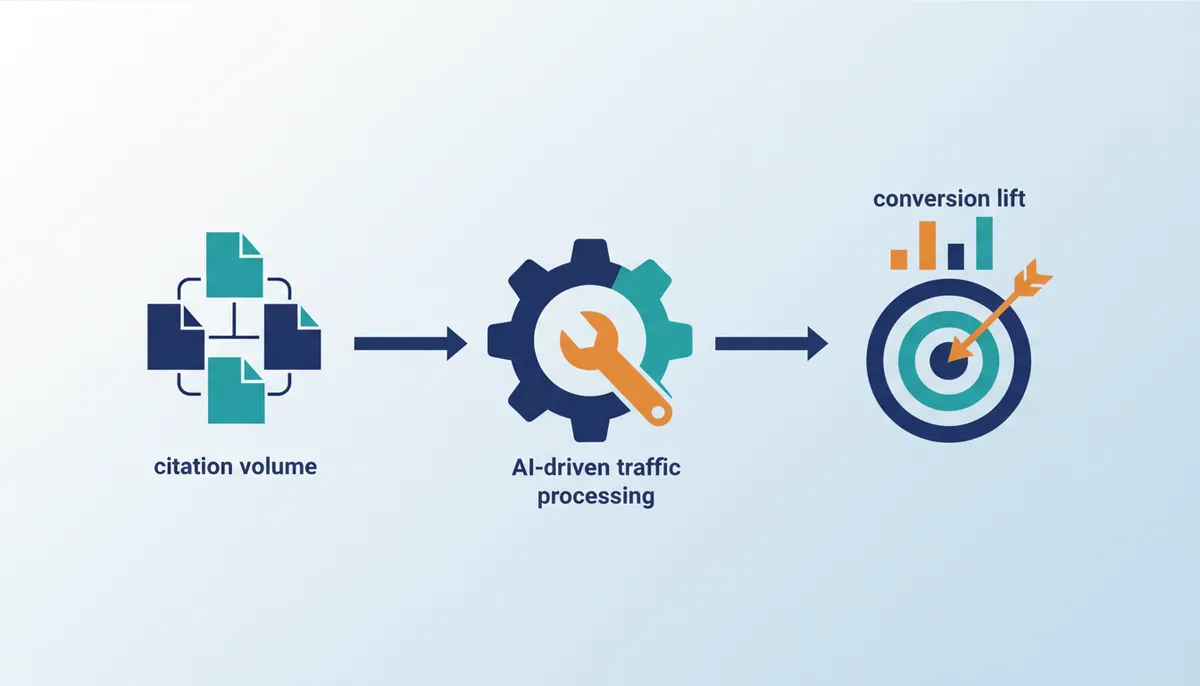
Teams should build dashboards that weight conversion quality over raw traffic quantity. Optimization for visibility that fails to drive revenue wastes resources.
Writing AI-Optimized Content to Maximize Citation Frequency
Structure content clusters to demonstrate the complete topical expertise that AI models prioritize for citation selection. Brands using interconnected FAQ pages and deep content hubs see improved results in AI systems because these structures satisfy the model's need for authoritative context complete topical expertise. The mechanism relies on semantic density. Interconnected content clusters that thoroughly answer related questions are preferred by AI systems over isolated content pieces, influencing visibility scores. Maximizing surface area for mentions can dilute the specific answer density needed for direct citations if the content lacks focus.
Takeaway: Audit your top five commercial prompts weekly; ensure your content directly answers the prompt question to maximize the likelihood of citation.
Weekly KPI Tracking Checklist for AI Prompt Appearances
Execute manual prompt audits weekly to detect shifts in mention frequency before they impact revenue. This routine replaces static rank tracking with a flexible assessment of platform coverage across the full range of queries the to your category platform coverage. Operators must record citation counts and sentiment scores for every substantial model to establish a reliable baseline.
| Metric | Definition | Action Threshold |
|---|---|---|
| Mention Frequency | Count of brand name appearances | Monitor for shifts |
| Citation Frequency | Count of URL links in output | Verify presence |
| Direct Traffic | Visits from AI referrers | Correlate with KPIs |
| Conversion Rate | Lead-to-customer % from AI | Optimize landing pages |
Strategy ROI is gauged through KPI improvements, direct traffic increases, elevated brand awareness, and expanding conversion rates. A tension exists between optimizing for multiple AI platforms and maintaining consistent messaging. Each model weights authority signals differently, requiring distinct content adjustments rather than a single universal fix. Different AI models care about different factors. Optimizing for Google AI Overview appearances means including multi-modal content. Optimizing for ChatGPT citations relies on establishing a consistent, authoritative online brand identity. Brands must track KPIs for key prompts weekly to monitor AI appearances effectively.
Strategic Best Practices for Multi-Platform AI Optimization
Defining Competitor Share as an AI Search KPI
Competitor Share quantifies a brand's citation volume relative to the total market mentions for specific prompts. Unlike absolute Mention Frequency, this metric reveals positional weakness even when raw citation counts rise. Traditional search measurement relied on static positions, yet AI visibility demands analyzing the sum of outcomes across conversational threads. KPIs are set as measurable metrics used to gauge progress towards brand goals.
- Identify the top prompts the to your category.
- Tally total citations for your brand and named rivals.
- Divide your citation count by the aggregate total to derive the percentage.
The shift from traditional keyword ranking to LLM visibility represents a contemporary timeline where brands must account for outcomes across all prompts the to their category rather than static lists. The limitation is that tools often conflate mentions with citations, requiring manual verification of direct links versus name drops. Operators must distinguish between being named and being the source of truth. It is necessary to track brand mentions across substantial platforms including ChatGPT, Perplexity, and Gemini to ensure data fidelity. LLM visibility is quantitatively set as the aggregate sum of outcomes, moving beyond simple presence to include the favorability of a brand's appearance inside AI-generated responses.
Meanwhile, the trade-off is complexity; tracking share requires monitoring multiple models simultaneously rather than a single index. Brands ignoring this shift risk invisibility despite strong SEO performance. New generation tools are explicitly described as built for this model, indicating a functional divergence from legacy tools that were not designed to parse AI-generated responses or citations.
Implementing Direct Customer Surveys to Attribute AI Traffic
Adding a specific "How did you hear about us?" field to contact forms remains a reliable method to validate AI search optimization impact when automated tools fail to distinguish referral traffic. To measure business originating from AI, the simplest method is to ask customers via a contact form question. This direct feedback loop captures attribution data that standard analytics often miss due to the conversational nature of generative platforms.
- Update your primary intake form to include a field for source attribution.
- Include "AI Assistant" or "Generative Search" as a distinct option alongside traditional channels.
- Correlate these self-reported sources with Mention Frequency trends identified during manual audits.
While third-party tools attempt to track visibility across platforms, they cannot definitively link a specific user session to an AI recommendation without explicit user confirmation. Writing content for AIO involves providing direct answers in a scannable format, yet proving that specific content drove a sale requires this human verification step. The limitation of this approach is reliance on user memory and willingness to answer, which introduces a variable response rate compared to passive tracking. However, the data gathered provides concrete evidence needed to calculate true ROI for best practices for ai search optimization.
Deploying this survey mechanism helps establish a baseline for attribution. Without this direct line of inquiry, organizations may struggle to accurately separate AI-driven revenue from organic noise, especially given that AI search visitors can convert at significantly higher rates than visitors from traditional organic search.
Validating AI Content Updates When Brand Visibility Fails
Content updates become necessary when a brand fails to appear in AI search results despite active optimization efforts. If a website does not appear in AI search, content updates may be necessary. Operators must first audit structural scannability, as AI models prioritize interconnected content clusters over isolated posts to demonstrate topical expertise.
- Verify that FAQ pages provide direct, verbatim answers to specific user queries rather than abstract concepts.
- Ensure content clusters thoroughly answer related questions, as these are preferred by AI systems over isolated content pieces.
- Format data for machine readability, focusing on thorough topical expertise rather than narrative fluff.
| Factor | Traditional SEO | AI Optimization |
|---|---|---|
| Primary Unit | Individual Page | Content Cluster |
| Success Signal | Keyword Rank | Citation Quality |
| Structure | Siloed Topics | Interconnected Answers |
The economic argument for these updates centers on preventing the total loss of leads and conversions represented by invisibility in LLM summaries. However, relying solely on high-volume content without depth often fails to meet the specific structural requirements models demand for citation. Brands using thorough, interconnected structures see improved performance because they satisfy the model's need for complete context rather than fragmented keywords. This approach mitigates the risk of being excluded from generative answers entirely. Implementing this validation checklist helps restore platform coverage. The next step is to run a manual audit of your key prompts across substantial models.
About
Sofia Marchetti is a B2B Content Strategist specializing in how automated content systems drive demand generation and topical authority. Her decade of experience in B2B SaaS directly informs this analysis of AI search visibility, where traditional traffic metrics fail to capture brand presence within LLM responses. At Enterium, Sofia leads the development of vendor-neutral methodologies that help marketing-ops teams measure citation frequency and sentiment across generative platforms. This article translates her daily work building scalable content pipelines into actionable frameworks for tracking Return on Investment in an AI-first search environment. By focusing on reproducible measurement rather than hype, she connects complex pipeline architecture to concrete revenue outcomes. Enterium serves as the editorial front for these practices, documenting how modern teams validate content automation effectiveness without relying on black-box solutions. Sofia's approach ensures that strategies for improving mention rates and brand reputation are grounded in data that matters to technical marketers and content engineers shipping production systems today.
Conclusion
Scaling AI optimization reveals a critical breaking point: high-volume content production often creates structural noise that prevents models from extracting verifiable answers. The operational cost of this inefficiency is not merely lower traffic, but the complete exclusion from the generative conversation where high-intent users now reside. Organizations must pivot immediately from chasing individual page rankings to engineering interconnected content clusters that satisfy the model's need for thorough context. Without this structural shift, brands risk becoming invisible to the very systems designed to surface expertise.
I recommend that enterprises halt standalone article production until their existing library demonstrates clear topical connectivity and machine-readable data formatting. This transition must occur within the current planning cycle to prevent further erosion of potential revenue streams. The industry is moving toward measuring aggregate presence rather than isolated positions, making deep structural integrity the only viable path forward. Start by manually auditing your FAQ pages this week to ensure they offer direct, verbatim responses to specific user queries rather than abstract concepts. This immediate action validates whether your content meets the strict scannability standards required for citation. By prioritizing citation quality over keyword density, you align your digital assets with the fundamental mechanics of modern retrieval systems. Securing your brand's future requires treating content as a structured database for AI consumption rather than a collection of narrative essays.
Frequently Asked Questions
AI search visitors convert 23 times higher than traditional organic search traffic. This massive difference means brands must prioritize securing citations over chasing raw page view volume to capture high-value leads effectively.
AI visibility aggregates outcomes across all prompts rather than relying on a single positional rank. Unlike traditional search, there is no fixed list of ten results where a brand holds a specific spot.
A mention counts brand name drops while a citation provides a direct link to your website. Confusing these two metrics creates blind spots because only citations drive direct traffic and establish true authority.
You must track presence across Google AI Overviews, ChatGPT, and Perplexity separately. Each engine uses different factors for inclusion, so dominating one prompt variation does not guarantee visibility in another model.
Calculate ROI by correlating brand sentiment analysis with direct conversion events instead of vanity metrics. Visitors from generative interfaces convert at significantly higher rates, proving reputation impact drives more value than simple traffic.
References