Prompt tracking ignores 36,000 hidden brand mentions in AI
When ChatGPT Model 5 dropped citations in August 2025, legacy tools crashed. They treated AI prompt volatility like stable search rankings. That assumption is fatal. The industry must abandon the illusion of precise placement in favor of measuring brand durability and sentiment stability within generative outputs. You need sample design methodologies to filter noise. Why? Because Ahrefs reported merely three citations for a site that Copilot internally recognized over 36,000 times. We must implement average response tracking to gauge contextual relevance across thousands of prompt variations instead of fixating on binary visibility.
Gartner predicts that 75% of IT work will soon be human-AI augmented. The stakes for accurate measurement have never been higher. As ChatGPT surged to 900 million weekly users by February 2026, the window for relying on flawed, static metrics closed. Success demands a pivot toward pattern recognition over precision. Stakeholders must understand that protecting market share in these fluid ecosystems requires entirely new strategic frameworks.
The Critical Distinction Between AI Prompt Tracking and Traditional Rank Tracking
Defining AI Prompt Tracking Volatility vs Rank Tracking Stability
AI prompt tracking volatility quantifies output instability across repeated queries. It stands in stark contrast to the relative steadiness of traditional rank tracking. Conventional tools depend on static indexes. Generative models do not. They display extreme response variance driven by adaptive reasoning modes and shifting citation behaviors. ChatGPT released model 5 in August 2025. Citation visibility plummeted because the system ceased rendering as many citation links in the HTML. This structural shift broke legacy tracking tools that assumed persistent link presence. Agentic execution drives this change. It generates unique artifacts instead of retrieving fixed URLs.
Real-World Impact of ChatGPT Model 5 on Citation Tools
The August 2025 release of ChatGPT Model 5 caused immediate tracking failures. Visible citation links in the HTML output vanished. Optimizers misinterpreted this interface change as a performance drop. They assumed link presence would persist. GPT-5 uses a massive 256K token context window to synthesize answers rather than retrieve static URLs. This architectural shift means third-party scrapers now miss the majority of brand mentions embedded within complex reasoning chains. A specific Copilot case study revealed a site showing only three citations in Ahrefs while the actual count exceeded 36,000. Relying on traditional rank tracking metrics creates a false negative signal during platform updates. The drawback is measurable blindness to actual brand visibility when the display layer changes. Operators must shift from counting links to sampling response volatility across diverse prompt variations. Ignoring this distinction leads to unnecessary optimization spend on non-existent problems. The real metric is pattern recognition across thousands of queries, not a single ranking position.
Why Measuring AI Prompts Like Rank Tracking Fails
Traditional rank tracking relies on static indexes where personalization levels remain tolerable enough to build a narrative of success. Generative AI breaks this model. Measuring prompts like rank tracking is too volatile for stable metric collection. Agentic execution drives this failure. Third-party scrapers miss brand mentions embedded within complex reasoning chains. A specific comparison reveals the depth of the disconnect between legacy tools and actual model behavior.
| Metric Type | Data Stability | Primary Failure Mode |
|---|---|---|
| Rank Tracking | High | Minor index lag |
| Prompt Tracking | Low | Interface rendering changes |
| Volatility Tracking | Variable | Sample size insufficiency |
Ignoring this distinction causes measurable data loss during model updates. When systems deploy multimodal capabilities to analyze visuals, the output format shifts dynamically. Parsers expecting static text break. Unlike SEO, where a rank drop signals an optimization issue, an AI visibility drop often signals only a change in how the model renders citations. Operators relying on average response metrics without accounting for this volatility will misinterpret interface updates as performance failures. Stability in generative AI requires tracking patterns across thousands of samples, not single-point rankings.
Mechanics of Volatility Tracking and Sample Design Methodologies
Mechanics: Defining Volatility and Average Response in AI Tracking
Volatility tracking quantifies output instability. It signals when an algorithmic update or data source shift alters brand perception over time. This mechanism distinguishes itself from static ranking by measuring the frequency of appearance changes rather than position alone. Agentic execution drives high volatility. It does not always indicate failure. It often reflects the model's adaptive reasoning across diverse user intents. Average response tracking aggregates sentiment and inclusion data across related prompts to establish a baseline of overall visibility. By shifting focus from single-prompt rankings, this approach captures context that sample design methodologies often miss in volatile environments. Data suggests organizations spending an average of 1.7% of revenue on AI still struggle with cost forecasts due to inefficient metric collection. Relying on all-or-nothing ranking signals creates blind spots where brand presence exists but remains unmeasured by legacy tools.
| Metric Focus | Primary Signal | Operational Risk |
|---|---|---|
| Volatility | Stability of presence | False negatives during model updates |
| Average Response | Sentiment aggregation | Dilution of specific keyword performance |
Enterium clients must prioritize pattern recognition over precise placement to mitigate financial waste. Ignoring response volatility leads to reactive policy changes that fail to address underlying representation shifts.
Applying Sample Design to Capture Brand Presence in AI
Deploying a fixed sample design methodology captures 80, 85% of visibility shifts that single-prompt tracking misses due to inherent model volatility. This approach aggregates responses across varied query structures to calculate an average response metric. It establishes a baseline unaffected by transient agentic execution artifacts. Organizations targeting stability must reject the premise of static ranking. Deep reasoning modes dynamically alter output composition.
- Define a controlled prompt set covering core brand attributes and related industry terms.
- Execute queries across multiple sessions to capture variance from unified architecture routing logic.
- Aggregate results to identify sentiment trends rather than binary citation presence.
- Compare baseline data against new samples to detect algorithmic drift or data source contamination.
Relying on hypothetical prompts yields fragile data. Sample design prevents resource waste on chasing noise. Fixed samples work.
| Tracking Method | Primary Metric | Failure Mode |
|---|---|---|
| Single Prompt | Binary Ranking | False negative during reasoning shifts |
| Sample Design | Aggregate Sentiment | Misses hyper-specific edge cases |
Enterium operators must prioritize pattern recognition over precise placement to fix inaccurate citation reporting. High-frequency sampling exposes when a brand disappears from Claude or Perplexity AI outputs due to minor weight adjustments. Ignoring this volatility leaves enterprises blind to reputation risks until they manifest as significant revenue loss. Strategic stability requires accepting that perfect precision is impossible in generative systems.
Risks of Algorithmic Updates on Citation Link Visibility
The August 2025 ChatGPT Model 5 release eliminated visible citation links from HTML outputs. Legacy tracking dashboards immediately reported false negatives. This structural shift occurred because the new unified architecture routes queries through deep reasoning modes that synthesize answers rather than retrieve static URLs. Operators relying on static link counts misinterpreted this interface change as a performance collapse. Brand presence remained stable within the generated text. The cost of this volatility is measurable. Tools assuming persistent link presence now miss the majority of mentions embedded in complex reasoning chains.
Frontier models iterate rapidly. The noted GPT-5.5 timeline for professional reasoning agents further alters output stability without warning. Unlike traditional index updates, these architectural changes do not merely reweight signals. They fundamentally alter the DOM structure that scrapers target.
- Legacy parsers fail when citation anchors disappear from the rendered HTML.
- Reasoning-centric designs prioritize synthesized context over explicit source attribution.
- Reporting dashboards show sudden drops despite unchanged optimization efforts.
Organizations must adopt volatility tracking to distinguish between actual visibility loss and mere formatting shifts. Relying on single-prompt snapshots yields unreliable data when model behavior fluctuates this wildly. The Enterium platform recommends aggregating average response metrics across varied query sets to a resilient baseline. This approach isolates genuine algorithmic penalties from harmless interface updates. Stakeholders can then evaluate brand safety rather than chasing phantom ranking drops.
Strategic Implementation of New AI Tracking Frameworks for Brand Visibility
Application: Defining Volatility and Average Response Metrics for AI
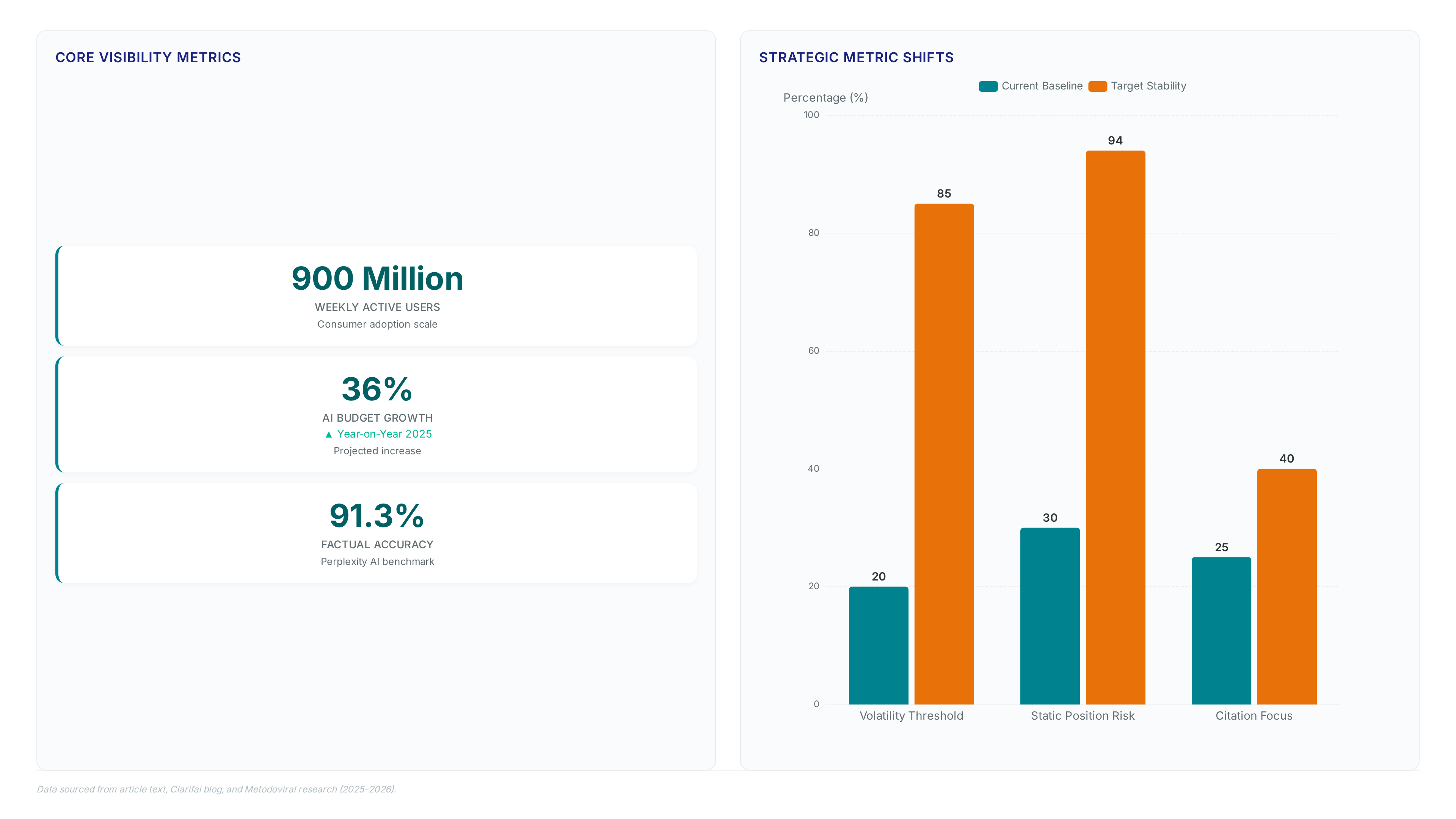
Defining volatility requires measuring output instability across repeated queries. Tracking static position fails when models suppress citation links. This metric signals algorithmic shifts that alter brand perception without changing underlying content quality. Operators must distinguish between genuine visibility loss and interface changes where models synthesize answers instead of retrieving URLs. High volatility does not always indicate failure. It often reflects adaptive reasoning across diverse user intents.
Average response tracking aggregates sentiment and context inclusion across a spectrum of related prompts to establish a stable visibility baseline.
Deploying a fixed sample design methodology captures significant visibility shifts that single-prompt tracking misses due to inherent model volatility. Consumer adoption reached 900 million weekly active users. The scale of potential variance requires rigorous statistical sampling rather than anecdotal observation.
- Execute diverse queries.
- Aggregate results.
- Identify pattern recognition trends over precise placement.
A tension exists between chasing specific citation counts and understanding broader sentiment inclusion within generated text. AI budgets are projected to increase by 36% year-on-year in 2025. Inefficient spending on tools measuring volatile metrics becomes a tangible risk for operators. Network engineers managing AI visibility infrastructure face a clear reality: success metrics must shift from "winning" a finite game to navigating an infinite one with strategic stability.
Agentic execution generates unique artifacts per query. This inherently inflates variance compared to traditional index lookups. Relying on third-party tools that mimic legacy rank tracking leads to false negatives when interfaces change. The cost of ignoring this shift is measurable in wasted resources and misaligned stakeholder expectations regarding brand durability.
Shifting Stakeholder Expectations from Volume to Strategic Stability
C-level reporting must replace upward trajectory charts with volatility baselines. Modern model outputs structurally lack citation links. Executives often misinterpret the drop in visible URLs as a performance failure. The shift reflects a move toward synthesized answers rather than retrieval. Educating leadership requires framing investment as risk mitigation rather than growth hacking. Custom quotes for enterprise plans prioritize data sovereignty over raw volume. The narrative must pivot from "winning" a finite ranking game to navigating an infinite environment where strategic stability dictates market share protection.
A practical checklist for aligning expectations includes:
- Define volatility baselines.
- Reject binary ranking narratives.
- Focus on sentiment durability.
Evaluating the ROI and Risks of Modern AI Tracking Investments
Defining AI Citation Drop-Off and HTML Visibility Metrics
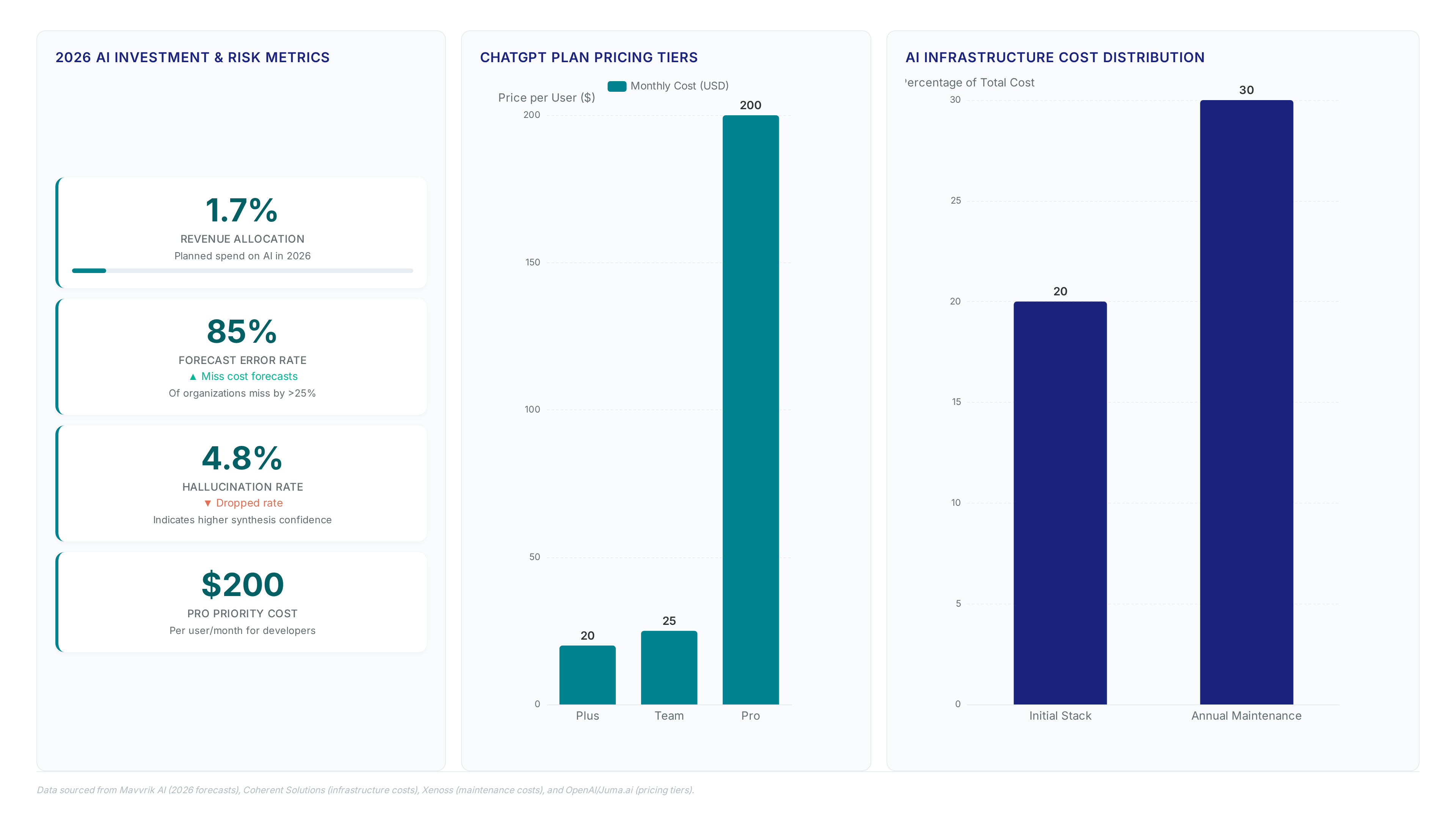
ChatGPT Model 5 reduced HTML citation links in August 2025. Traditional rank-tracking tools broke. They rely on static anchor counts. This structural shift occurred because the unified architecture prioritizes synthesized text over retrieving specific URLs. It creates false negative signals for optimizers. Traditional dashboards registered this interface change as a performance collapse. Brand presence often remained stable within the generated prose. The hallucination rate dropped to 4.8%. This indicates higher confidence in synthesized answers that omit explicit links. Operators measuring only HTML anchors miss the majority of mentions embedded in complex reasoning chains. A single prompt check yields unreliable data due to inherent personalization and reasoning depth variations. Enterprise teams paying $200 per user for priority access still face unpredictable output structures that defy linear ranking logic. Visibility is no longer binary but probabilistic. Organizations must adopt volatility tracking to detect sudden drops in mention frequency unrelated to content quality. This approach shifts the focus from chasing hypothetical top spots to establishing a strategic stability baseline. Enterium recommends deploying fixed sample designs to capture these broad visibility shifts accurately. Budget requests for AI tracking will otherwise continue to yield vanity metrics that misrepresent actual market share protection.
Applying Volatility Tracking to Detect AI Model Shifts
Volatility tracking distinguishes optimizer failure from platform shifts like the August 2025 Model 5 update that broke citation counters. Traditional rank tracking fails because interface changes, such as reduced HTML link display, create false negatives in visibility reports. Operators must differentiate between genuine brand exclusion and architectural pivots where models synthesize answers rather than retrieve URLs. The cost of misinterpretation is high. Teams often waste resources fixing non-existent optimization gaps when the underlying model simply changed its output format.
| Dimension | Rank Tracking Approach | Volatility Tracking Approach |
|---|---|---|
| Metric Focus | Static position counts | Response stability over time |
| Failure Signal | Sudden drop in URL count | Deviation from historical baseline |
| Data Source | Third-party crawlers | Aggregated prompt samples |
| Strategic Value | Illusory growth charts | Risk mitigation intelligence |
Implementing this requires shifting from single-prompt checks to sample design methodologies that aggregate responses across varied query structures. This approach captures the true scope of brand presence. Third-party tools often underreport by narrow margins. Reliance on limited crawler data misses the breadth of visibility found in financial modeling workflows where deep reasoning dominates. High volatility does not always indicate failure. It frequently reflects adaptive reasoning across diverse user intents. Stakeholders must accept that strategic stability replaces mindless volume as the primary success metric. Investing in tools like Enterium allows organizations to monitor these fluctuations without demanding impossible linear growth curves. The right choice depends on whether the goal is vanity reporting or genuine market share protection within generative ecosystems.
Ahrefs Citation Counts vs Copilot Data Volume Discrepancies
A single project website recorded 1 to 3 citations in Ahrefs yet registered over 36,000 actual references within Copilot. This exposes a critical data blindness. Third-party crawlers parse HTML anchors that modern models increasingly omit from their rendered output.
| Metric Dimension | Ahrefs Observation | Actual Copilot Volume |
|---|---|---|
| Citation Count | 1 to 3 links | >36,000 references |
| Data Source | Parsed HTML anchors | Internal model context |
| Visibility Signal | False negative drop | Massive unseen scale |
Relying on scraped HTML creates a false narrative of brand exclusion. The content actually dominates the response synthesis. Enterprises automating work emails via Microsoft Copilot operate at a scale invisible to external rank trackers. The volatility perceived by optimization teams often reflects tool limitations rather than genuine market share loss. Operators depending on these incomplete datasets risk misallocating resources to fix non-existent visibility gaps. The data volume difference suggests that traditional metrics capture less than a fraction of true brand presence in generative answers. Strategic stability requires acknowledging that most citations now exist as synthesized knowledge rather than clickable links. Teams must shift focus from counting visible URLs to monitoring broader sentiment patterns across diverse prompt variations. This approach mitigates the risk of panic responses to artificial dips in reported numbers.
About
Arjun Patel, an Applied LLM Engineer at Enterium, specializes in benchmarking LLM providers and RAG architectures for real-world content workloads. His daily work involves rigorous, vendor-neutral testing where he measures cost, latency, and quality simultaneously. This makes him uniquely qualified to address the volatility in AI prompt tracking. Unlike traditional rank tracking, Patel's empirical data reveals how model updates, such as the August 2025 release of ChatGPT Model 5, can abruptly alter citation visibility independent of optimization efforts. At Enterium, a B2B publication dedicated to documenting how technical teams scale content pipelines, Patel applies this same precision to deconstruct industry myths. He connects the abstract challenge of prompt volatility to concrete engineering realities. He explains why current tracking tools often fail when HTML output structures shift. By focusing on reproducible methodologies rather than hype, Patel provides the technical clarity content leaders need to navigate these fluctuations without relying on misleading success metrics.
Conclusion
Scaling prompt monitoring reveals that synthesized knowledge creates hidden operational debt when teams rely on incomplete HTML scrapers. As AI budgets swell, the cost of chasing phantom visibility gaps outweighs the value of accurate data. Traditional rank tracking fails to capture the nuance of internal model contexts. This leads to misallocated resources and strategic confusion. The break point occurs when leadership demands linear growth metrics for a non-linear, probabilistic system.
Adopt a dual-layer verification strategy by Q3. Mandate that all visibility reports cross-reference external crawler data with internal prompt simulation logs. Do not trust single-source metrics for critical decision-making. If your current stack cannot simulate diverse user queries to capture sentiment shifts, it is insufficient for enterprise-grade AI operations. This transition is not about discarding old tools but augmenting them to reflect the reality of generative answer synthesis.
Start this week by auditing one high-value keyword where your current tracker shows a decline. Run that query through three distinct AI models manually. Document the variance in brand mention versus actual link output. This immediate, hands-on comparison will expose the specific blind spots in your current reporting framework. It validates the need for deeper, context-aware monitoring solutions.
Frequently Asked Questions
Legacy tools fail because ChatGPT Model 5 reduced visible citation links in HTML output. This structural shift broke trackers assuming persistent link presence, causing massive reporting errors despite actual brand knowledge remaining intact within the system.
Sample design methodologies capture significant visibility shifts that single-prompt tracking misses entirely. By aggregating data across hundreds of prompt variations, this approach filters noise and provides a realistic baseline of overall brand visibility patterns.
Brands must prioritize measuring brand resilience and sentiment stability over static ranking positions. Success now demands pattern recognition across thousands of queries to ensure contextual relevance rather than chasing hypothetical top spots.
AI prompt volatility quantifies output instability across repeated queries, unlike stable traditional rankings. Generative models display extreme variance driven by adaptive reasoning, making single-position metrics unreliable for measuring actual performance or inclusion rates.
Gartner forecasts that 75% of IT work will soon be augmented by human-AI collaboration. This high adoption rate increases the stakes for accurate measurement and necessitates new strategic frameworks for brand protection.