Open Knowledge Format: Stop Agent Context Blindness
The Open Knowledge Format specification dropped as a draft on June 12, 2026, targeting a specific failure mode: agent context blindness. Raw markdown links build a functional knowledge graph without the weight of proprietary SDKs or complex registries.
Enterprise knowledge currently rots in silos like Confluence, Notion, and Slack. Engineers waste cycles rebuilding integrations for every new agent. The Open Knowledge Format cuts this redundancy by defining organizational concepts as simple markdown files with minimal YAML frontmatter. External databases for identity management are unnecessary; the file path itself, such as tables/orders.md, acts as the primary key. Agents parse relationships directly from the text, bypassing custom APIs and authentication layers entirely.
This graph-based model outperforms static RAG pipelines that hallucinate due to poor context linking. Adopting this standard stops the scattering of critical runbooks and metric formulas across disconnected platforms. The result is a persistent, navigable web of information any AI can query immediately upon deployment.
The Role of OKF in Modern AI Context Management
Open Knowledge Format as a Vendor-Neutral Markdown Specification
Published on June 12, 2026, the Open Knowledge Format standardizes organizational data through simple directories, remaining strictly vendor-neutral. A concept document is nothing more than a single markdown file containing YAML frontmatter and free-form text. File paths serve as unique identities, removing the need for external registries or complex ID generation logic. Organizations currently scatter critical runbooks and metric definitions across Confluence, Notion, and Slack, creating fragmented contexts for artificial intelligence. This fragmentation is the root cause of agent unreliability.
Using YAML Frontmatter and File Paths to Structure Concept Documents
YAML frontmatter transforms static markdown files into structured AI agent knowledge by embedding machine-readable metadata. An OKF bundle functions as a directory of markdown files representing concepts such as tables, datasets, metrics, playbooks, runbooks, and APIs. The format uses YAML frontmatter with one required field, type, and optional metadata fields including title, description, resource, tags, and timestamp. This structure allows agents to parse semantic meaning without custom integrations or proprietary SDKs. File path identity serves as the primary key; a file located at tables/orders.md inherently defines the concept identifier tables/orders. This approach removes the database layer typically required for registry management. Standardization of metadata explicitly tells AI what content represents rather than forcing models to guess intent from unstructured text. Operators gain portable and version-controllable organizational knowledge through careful planning of hierarchical layouts before populating bundles. Teams eliminate the ambiguity that drives hallucination rates between a significant share and the vast majority by defining concept documents through file system geometry. The result is a navigable graph where markdown links assert relationships conveyed by the surrounding prose.
Validating OKF Adoption Through File System Identity and Linking
Confirm file path identity by verifying that tables/orders.md functions as the concept identifier tables/orders without registry overhead. This mechanism eliminates ID generation logic, allowing the file system to serve as the primary key for AI agent knowledge. Google Cloud recommends piloting the format with a bounded set of 20 to 50 concepts for initial adoption to validate this mapping. Knowledge graphs form through cross-links between markdown files, creating relational data structures without complex backend databases. A link from concept A to concept B asserts a relationship in this model, with the specific kind of relationship conveyed by the surrounding prose rather than implicit metadata. Because the file system acts as the API, the format requires no authentication, SDK, or additional API layer. OKF represents knowledge as a directory of markdown files readable without specific software unlike vendor-specific catalogs that lock knowledge behind proprietary SDKs. Curated documents retain value as standard Markdown files even if the specification is abandoned, which reduces pilot failure costs. Validation involves ensuring every concept file resolves via its path and that cross-references maintain graph integrity. Adoption succeeds when teams effectively package organizational knowledge as plain markdown files so any agent can read it without custom integrations.
Inside the OKF Bundle Architecture and Graph Mechanics
How Markdown Links Assert Knowledge Graph Relationships
Standard markdown syntax functions as the edge definition layer, where hyperlinks between files assert existence without requiring a separate registry. Unlike complex graph databases needing schema migrations, OKF relies on the file system where a link from tables/orders.md to customers.md establishes a navigable node connection. The semantic nature of this relationship derives entirely from the surrounding prose rather than the link attribute itself. For instance, text stating "joins to" implies a database foreign key, while "escalate to" indicates an operational workflow dependency. This approach allows teams to form cross-links between the markdown files that agents traverse logically. The mechanism avoids the ambiguity often found in unstructured retrieval systems. By embedding relationship context in sentences, the format ensures that an AI agent interprets the connection based on linguistic cues adjacent to the URL. This stands in contrast to raw vector search, which might retrieve related documents but fails to define the directional logic binding them.
| Feature | Traditional RAG | OKF Linking |
|---|---|---|
| Relationship Definition | Probabilistic similarity | Explicit prose context |
| Graph Maintenance | Vector index rebuilds | File system edits |
| Tooling Dependency | High (Embedding models) | None (Text editors) |
A limitation arises if authors omit descriptive text around links, leaving agents to guess the relationship type. Because the specific kind of relationship is conveyed by the surrounding prose, clear writing is necessary for the directory to function as a navigable graph. This keeps the knowledge base machine-interpretable without custom parsing logic.
Navigating Concept Directories Without Vector Databases
Agents traverse file paths as primary keys, bypassing vector index latency entirely. This architecture treats the directory structure as the knowledge graph, where tables/orders.md serves as the immutable identifier tables/orders without database registration. Unlike RAG systems that retrieve scattered, uncurated chunks from various surfaces, OKF stores curated, version-controlled concepts that agents read directly. The mechanism relies on file path identity rather than generated embeddings. An agent resolving a link to ../customers.md executes a standard file system read operation, eliminating the need for complex backend database queries or SDKs. This approach forms a navigable graph through cross-links between the markdown files, allowing relational data traversal without schema migrations.
| Feature | Vector Database RAG | OKF File System |
|---|---|---|
| Identity | Hash-based embedding | File path string |
| Query Layer | Similarity search | Path resolution |
| Updates | Re-indexing required | File write only |
| Tooling | Specialized service | OS kernel |
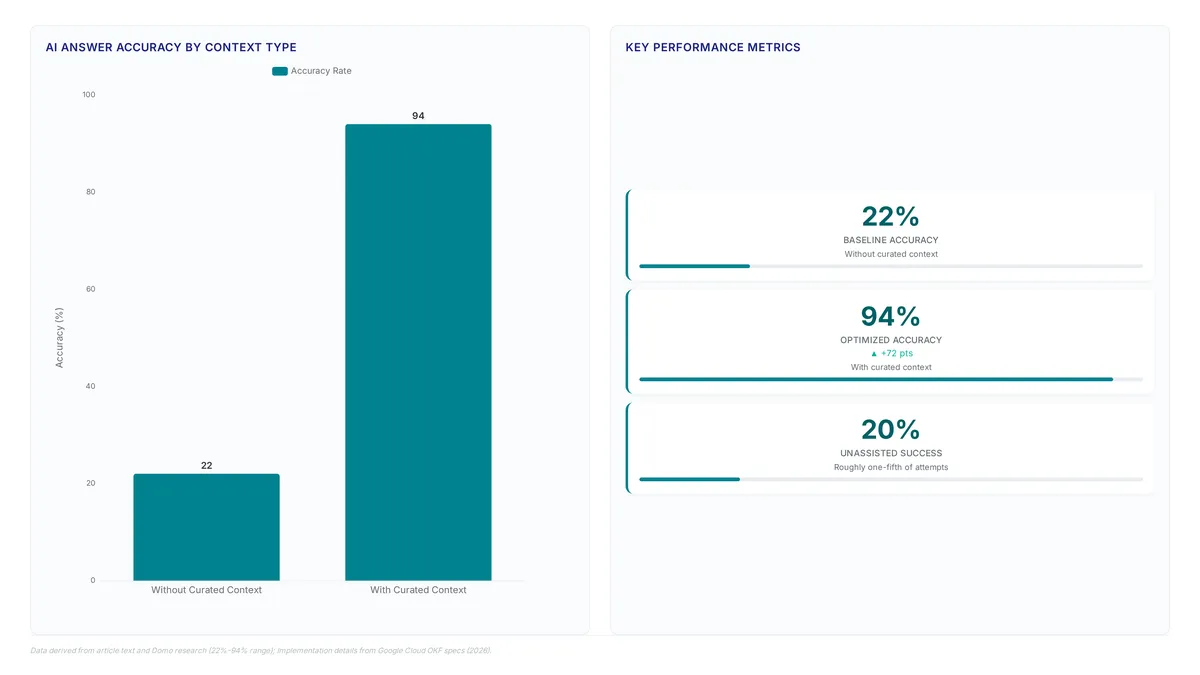
Simplicity trades semantic fuzzy matching for strict structural dependency. If a file moves, the link breaks immediately, whereas vector search might still surface the content via similarity. Without curated context, even the best-performing AI models fabricate answers roughly one-fifth of the time, making this deterministic navigation vital for accuracy. Organizations can use this path-based identity model to guarantee agents access verified runbooks and schema definitions instantly. Migrating static documentation to markdown bundles establishes this deterministic ground truth before scaling agent deployments.
Validating File Path Identity as Concept Identifiers
The file path tables/orders.md functions as the immutable concept identifier tables/orders, eliminating external registry dependencies. This architectural constraint forces organizational knowledge sharing to align with the physical file system, meaning identity is resolved via directory traversal rather than database lookup. The system requires no ID generation logic because the file path itself acts as the primary key, a design choice that simplifies agent traversal during troubleshoot operations when latency matters.
Operators must verify that relative links resolve correctly without authentication layers, as the file system serves as the API. A constraint arises when teams attempt to alias paths; the format relies on direct file paths rather than generated IDs to maintain simplicity. Unlike vendor-specific catalogs that lock knowledge behind proprietary interfaces, this approach keeps data readable without specific software. Consequently, agents avoid fabricating relationships between disjointed data silos, a common failure mode in uncurated contexts. Validating bundle integrity involves ensuring that concept files exist at their declared paths before agent ingestion. The next step is auditing existing documentation directories for path consistency to prepare for automated graph traversal.
Strategic Advantages of OKF Over Traditional RAG Systems
Defining OKF, RAG, and MCP Roles in AI Context
Open Knowledge Format (OKF) functions as a pre-curated markdown specification where organizational schemas and runbooks exist as static, version-controlled files rather than probabilistic chunks. Retrieval-Augmented Generation (RAG) performs query-time retrieval from unstructured corpora, necessitating heavy infrastructure like vector databases and embeddings to manage scattered data. The Model Context Protocol (MCP) operates distinctly as a runtime connection layer for live actions, requiring a dedicated server to bridge agents with flexible APIs.
| Feature | OKF | RAG | MCP |
|---|---|---|---|
| Primary Role | Stable knowledge storage | Unstructured chunk retrieval | Live tool execution |
| Infrastructure | Filesystem / Git | Vector DB + Embeddings | MCP Server |
| Latency Profile | Instant file read | Query-dependent | Network-bound |
| Data State | Static / Versioned | Flexible / Indexed | Real-time |
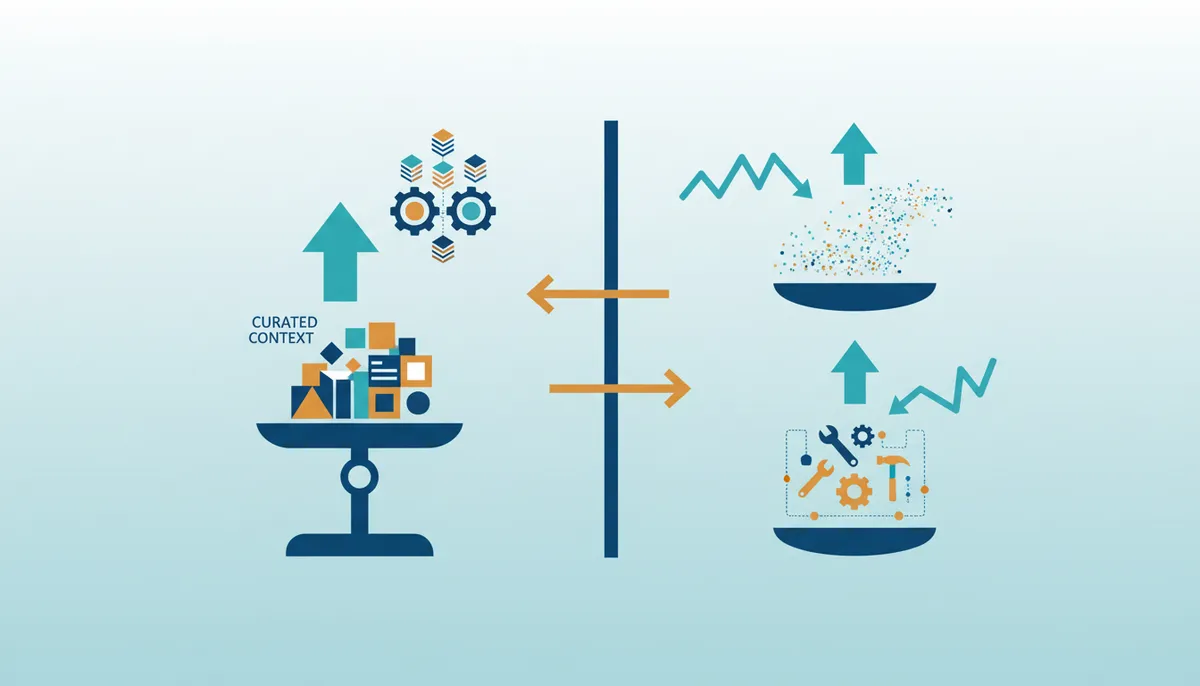
OKF bundles anchor agent reasoning in verified truth before invoking RAG for breadth or MCP for action. Relying solely on RAG for core definitions introduces unnecessary variance into the reasoning chain. Structural interoperability provided by plain text markdown ensures that knowledge remains portable across any git repository without vendor lock-in. Operators must distinguish these layers to prevent context pollution.
Deploying OKF for Stable Knowledge Versus RAG for Unstructured Archives
Operational stability demands OKF for static runbooks while reserving RAG for flexible document corpora. Unlike RAG, which relies on probabilistic vector retrieval, OKF stores curated, version-controlled concepts that agents can read directly. The decision matrix below clarifies deployment boundaries based on data volatility and infrastructure tolerance.
| Dimension | OKF Deployment | RAG Deployment |
|---|---|---|
| Target Data | Schemas, metrics, runbooks | Logs, emails, manuals |
| Infrastructure | Filesystem only | Vector DB + Embeddings |
| Update Cycle | Git commit (manual) | Continuous ingestion |
| Failure Mode | Stale reference | Irrelevant retrieval |
OKF bundles retain full readability as standard Markdown even if the specification evolves, minimizing pilot failure costs during early adoption phases. This reversibility allows data teams to test structured knowledge patterns without committing to complex orchestration layers. Conversely, RAG remains necessary for querying vast, unindexed archives where semantic similarity outweighs precision. The cost is manual maintenance; however, for high-value assets like revenue tables, this overhead guarantees accuracy that probabilistic retrieval cannot match. Organizations should initiate a bounded, reversible pilot on a set of 20 to 50 concepts before expanding scope. This approach validates the graph structure without disrupting existing retrieval pipelines.
Mitigating Experimental Specification Risks in OKF Version 0.1
Adoption of the Open Knowledge Format currently carries specification volatility because version v0.1 remains explicitly experimental. Google characterizes this release as a starting point rather than a finished standard, warning that field names may change as the schema matures. This fluidity creates a specific tension for operators: while structural interoperability provides a shared mechanism to locate context, semantic interpretation still relies on non-standardized conventions. Teams implementing this knowledge standard for AI must distinguish between the stable file paths and the mutable metadata definitions within the YAML frontmatter. Unlike RAG systems that hide schema logic inside vector embeddings, or MCP which rigidly defines tool interfaces, OKF exposes its grammar directly to the file system. The risk is not data loss, as bundles retain value as standard markdown even if the specification evolves, but rather the engineering overhead required to reconcile breaking changes in the type definitions. Current bundles should be treated as mutable prototypes, isolating them from production-critical agent loops until the spec stabilizes beyond the draft phase. Success requires tracking 0.1 percent metadata drift across 1 major version cycle.
Implementing Validated OKF Bundles for Data Teams
Defining OKF Bundle Structure and Concept Files
Construct an OKF bundle as a directory of markdown files where file paths serve as immutable concept identifiers. This structure eliminates the need for external registries by encoding identity directly into the filesystem hierarchy. Organize the root directory with specific subfolders like metrics/ for calculations and tables/ for schemas to separate concerns logically. Each concept file requires a YAML frontmatter block containing the mandatory type field to classify the content for agent parsing.
- Create a new .md file within the appropriate subdirectory, such as tables/orders.md.
- Insert the YAML frontmatter at the top, including the mandatory type field and optional metadata like title and description.
- Write the concept body in standard Markdown, using links to assert relationships between files.
- Validate the bundle syntax using available open-source tools to ensure compliance with the specification.
Agents interpret markdown links as graph edges, allowing them to traverse from a metric definition to its underlying source table without vector search ambiguity. The physical arrangement of files dictates the logical knowledge graph, making directory hygiene a functional requirement rather than an aesthetic choice. The format relies on standard markdown files, ensuring that knowledge remains portable and readable without proprietary SDKs.
Implementing Data Team Knowledge Bases and SRE Runbooks
Data teams prevent metric errors by codifying calculation rules directly into markdown concept files. For example, a monthly_recurring_revenue metric file can prevent errors regarding annual plan division by explicitly stating caveats like 'Annual plans divide b'. This approach decouples organizational knowledge from the specific tools used to create it, ensuring portability across different agent frameworks. By documenting these caveats in a vendor-neutral markdown spec, organizations avoid the trap of locking context within proprietary systems. SRE teams apply the same logic to incident response, creating agent-readable runbooks that link diagnosis steps to system components. This structured navigation allows agents to consume knowledge representations designed for AI rather than relying on brittle, unstructured text. The operational tension lies between granular detail and agent token limits; overly verbose runbooks increase latency, while sparse ones force risky assumptions. Effective bundles balance this by enforcing concise, high-signal documentation.
- Define the runbook structure with clear symptoms and resolution paths.
- Embed hyperlinks to related system concepts like database schemas.
- Document clear escalation paths within the markdown for scenarios requiring human intervention.
Validating OKF Directories and Gating CI Pipelines
Execute the open-source validator via npx okf-validate./my-knowledge-bundle or node validator/okf-validate.mjs./your-bundle to verify syntax before agent ingestion. This command inspects the directory structure containing specific file types such as index.md and log.md against the specification currently in Draft status at version 0.1. The tool returns a pass or fail status while identifying rule violations like missing type fields in concept files.
- Run the validation script against your local bundle path.
- Inspect output for rule violations regarding required metadata.
- Configure the pipeline to halt deployment on non-zero exit codes to maintain quality.
Agents struggle with context gaps, and hallucination rates across top models range from 22 percent to 94 percent when lacking proper context. The format eliminates the need for proprietary SDKs to read knowledge bases, reducing integration costs associated with vendor-specific catalogs. A failure here prevents corrupted context from degrading downstream agent performance.
About
Arjun Patel is an Applied LLM Engineer who benchmarks LLM providers, models, and RAG architectures for content workloads. His daily work involves dissecting the friction points where organizational knowledge fails to reach AI agents due to fragmented storage in platforms like Confluence or Notion. This direct experience with inference economics and data accessibility makes him uniquely qualified to analyze the Open Knowledge Format (OKF). At Enterium, a brand dedicated to documenting how modern teams build and scale content with LLMs, Arjun applies rigorous, vendor-neutral evaluation to emerging specifications. The OKF bundle's reliance on plain markdown aligns precisely with Enterium's methodology of creating reproducible, human-gated content pipelines. By focusing on how plain text structures can bypass proprietary SDKs, Arjun connects the theoretical benefits of OKF to the practical realities of production content automation. His analysis provides the concrete, decision-useful insights that B2B content leaders need to architect reliable systems without relying on locked-in ecosystems.
Conclusion
Unstructured context drives instability in AI operations, not model capability. When agents navigate ambiguous documentation, organizations pay the compounding cost of verifying fabricated outputs. The OKF bundle addresses this by transforming ad-hoc notes into a deterministic graph that strictly governs how machines consume knowledge. This shift moves the operational burden from correcting hallucinations to maintaining high-signal entry points. Teams must treat knowledge validation with the same rigor as code compilation to prevent context gaps from degrading agent reliability.
Adopt this specification immediately if your current workflow relies on brittle text files that lack enforced metadata or explicit linkage rules. Do not attempt to scale agent deployments without first establishing a gated validation step in your pipeline that rejects non-compliant bundles. This ensures that only structured, verifiable context reaches the inference layer. Start this week by running the open-source validator against your existing documentation directory to identify missing type fields and broken structural links before they cause downstream errors. This single action isolates syntax errors that currently allow ambiguity to persist in your system. By enforcing these constraints early, you eliminate the guesswork that leads to unreliable automation.
Frequently Asked Questions
This forces teams to curate concept documents that define clear relationships and prevent such widespread factual errors during agent queries.
File paths serve as primary keys, removing complex ID logic.
OKF bundles fix this by using markdown links to create a navigable graph that agents can query immediately.
The type field is the only required metadata entry.
Markdown links assert relationships between concepts without custom code.
References