Multimodal video analysis reclaims 54% of lost ad inventory
Over half of video URLs are blocked unnecessarily because keyword-only filters miss context that multimodal AI now captures.
Legacy brand safety protocols are actively destroying value by hiding appropriate inventory from advertisers. Integral Ad Science and Reuters data reveals that 54% of URLs were rejected based solely on keywords, despite the underlying content being safe when analyzed for full context. This inefficiency persists even as the industry shifts toward complete evaluation methods that process video, audio, speech, and images simultaneously to determine actual risk.
Multimodal AI tools are reclaiming this lost inventory by replacing blunt exclusion lists with precise content-level evaluation. The shift explains why news video inventory becomes inaccessible during high-traffic periods like election cycles when brands rely on outdated settings. More importantly, it details the measurable return on investment achieved when marketers align their emotional tone analysis with specific content verticals rather than generic safety flags. Teams ignoring these AI-powered video outcomes risk falling behind as competitors enable previously invisible audience attention.
The Role of Multimodal AI in Modern Content Evaluation
Defining Multimodal AI Analysis of Video Audio and Images
Static keyword lists frequently miscategorize safe inventory as risky because they parse text alone. Multimodal AI analysis evaluates video, audio, speech, and images together to assess tone and intent holistically. This contextual content evaluation moves beyond the limitations of simple text matching. Testing by Integral Ad Science and Reuters revealed that 54% of URLs were blocked based on keywords alone, even though the underlying content would be considered appropriate once evaluated for full context, tone, and intent. By synthesizing visual and auditory signals, these systems distinguish between dangerous rhetoric and news reporting about it.
Creative innovation is cited as an advantage of AI by 61% of industry executives in current studi. This statistic reflects a shift toward analytics that adapt placement systems to maximize reach. The move from keyword blocking to context analysis represents a strategic cost reallocation. Budget shifts from lost inventory value toward more sophisticated analytical tools. Brands relying on legacy keyword blocking are likely excluding half their potential audience unnecessarily. Teams should revisit their exclusion settings. Failing to do so in the wake of multimodal AI may cause them to fall behind. This false positive rate renders significant news inventory invisible to advertisers during critical election cycles. Traditional keyword blocking relies on static lists that flag terms like "war" or "crisis" regardless of whether the video condemns or reports on the event. The mechanism fails because it lacks semantic understanding. A documentary about conflict looks identical to extremist propaganda to a simple scanner.
Multimodal AI resolves this by analyzing video, audio, speech, and images together to assess tone and intent holistically. Unlike text-only scanners, these systems detect sarcasm, mourning, or neutral reporting. Brands gain safe access to high-attention inventory previously deemed too risky. Operational complexity is the price of this precision. Teams must audit exclusion lists that may not have been reviewed recently. Jamie Finstein, VP of Media Center at IAB, notes that failing to revisit settings in the wake of multimodal AI causes teams to fall behind.
The implication for Q4 planning is clear. Relying on blunt keyword filters creates a self-imposed scarcity of premium inventory. Marketers citing brand safety as a primary blocker often overlook that their safety tools are the very cause of missed opportunities. Publishers can mitigate misclassification by providing clear metadata and transcripts. Verification systems interpret content accurately with this data. Valuable ad slots remain unpurchased without this structural adjustment. Competitors using contextual analysis capture the audience instead. The limitation is no longer safety versus reach. The constraint is outdated static lists versus flexible, context-aware evaluation.
Keyword Blocking Versus Contextual AI for Brand Safety
Static keyword lists block appropriate inventory by matching terms without semantic understanding of surrounding context. This blunt mechanism forces a binary choice between risk exposure and lost revenue opportunities. Traditional systems flag words like "crisis" regardless of whether the content condemns or reports on the event. The cost of this imprecision is measurable. Teams failing to revisit settings face a significant burden in missed engagement.
| Feature | Keyword Blocking | Contextual AI |
|---|---|---|
| Evaluation Scope | Text strings only | Video, audio, speech, images |
| Decision Logic | Binary match/no-match | Semantic tone and intent |
| Inventory Impact | High false-positive rate | Recovers undervalued assets |
| Setup Complexity | Low (static lists) | Medium (model tuning) |
The drawback involves operational maturity, with 60% of marketing leaders citing brand safet. Legacy tools offer simplicity yet generate excessive false positives. Contextual analysis eliminates these errors through complete evaluation. Shifting to AI requires trusting probabilistic models over deterministic lists. This cultural hurdle stops many buyers. Cost efficiency remains the top benefit of AI adoption in 2026, cited by 64% of respondents who prioritize budget op. Brands relying on rigid exclusion lists effectively discard high-value news inventory during peak attention cycles. Maintaining outdated exclusion lists reduces total addressable market without improving actual safety outcomes. Marketers are advised to audit current exclusion logs. Identifying over-blocked categories before deploying semantic evaluation layers prevents revenue loss.
Inside Creator-Led Content Mechanics and Emotional Payoffs
The Peak-End Rule and Raw Emotional Beats Explained
The Peak-End Rule dictates that audiences recall only the most intense emotional moment and the final resolution, ignoring average sentiment. Content building to a satisfying payoff saw organic view rates rise significantly across platforms. On TikTok specifically, satisfying payoffs increased view rates and engagement substantially.
Raw emotional beats function as the primary driver because they replace declarative claims with authentic visualization. Assets provoking genuine reactions saw a lift in organic view rate compared to polished, safe content. However, emotional alignment is vertical-specific; anxiety lifts results in beauty but stifles fashion. This creates a deployment constraint where generic "positive" tone settings fail to capture category-specific nuance. Operators must configure evaluation systems to detect emotional resolution rather than broad sentiment scores. Teams relying on static exclusion lists risk filtering out the exact raw emotional beats that drive conversion. Success requires shifting from negative-list blocking to positive identification of emotional payoff structures.
Creator-Led Hooks Versus Brand-Led Product Messaging
Assets leading with direct product messaging suffer a 44% drop in view rates compared to content prioritizing an emotional hook first. This performance gap emerges because audiences reject immediate sales pitches in favor of narrative engagement. When brands lead with benefits rather than storytelling, brand favorability drops by 12% and consideration plummets by 41%. The mechanism driving this failure is the violation of viewer expectation for entertainment or utility before transaction. Teams relying on surface-level metrics often miss why raw emotional beats outperform polished corporate messaging. While some argue that clear product messaging accelerates buyer journeys, the data indicates it accelerates exit rates instead. A critical limitation for operators is that 81% of teams lack the measurement frameworks to track these deep emotional signals accurately. Without investing in advanced analytics, brands cannot distinguish between a viewer ignoring a product and a viewer rejecting a format. Consequently, content strategies relying on declarative claims will continue to underperform against creator-led demonstration.
Implementing Demonstration Over Declarative Claims
Replace abstract product assertions with visual proof sequences showing actual usage to drive measurable engagement gains. Analysis reveals that demonstration outperforms declarative claims by 33% in brand favorability and 15% in consideration. Content marketers must structure narratives around tangible evidence rather than verbal assurances. The report identifies five specific behaviors that differentiate high-performing content from ignored content.
- Display before-and-after results immediately to establish visual credibility.
- Integrate authentic creator explanations detailing specific styling choices.
- Avoid opening with direct benefit statements that trigger audience rejection.
Generic AI stacks often miss these nuances, focusing on volume rather than the operational core integration seen in governed systems. While 100% of marketers use generative tools for creation, only 13% integrate them deeply enough to replicate this contextual awareness. Teams relying on static templates often miss the consideration lift associated with raw emotional beats. The creator economy ad spend is projected to reach $37 billion in 2025, growing four times quicker than the total media industry.
Measurable ROI from Aligning Emotional Tone with Content Verticals
Multimodal Contextual Tools for Tone and Intent Analysis
Multimodal AI replaces static keyword lists by processing video, audio, and imagery simultaneously to determine semantic safety. Traditional blocking mechanisms often flag content based on isolated terms, ignoring the surrounding narrative that defines actual risk. By evaluating the complete tone rather than simple string matches, these systems recover undervalued ad slots that legacy filters incorrectly reject.
The shift addresses a specific operational failure where brands miss peak engagement windows due to over-cautious automation. During high-attention periods like election cycles, broad exclusion lists remove brands from the exact moments consumers are most engaged with media. This creates a tension between safety protocols and market presence that only granular analysis can resolve. Teams that do not revisit their settings in the wake of multimodal AI risk falling behind as competitors access premium placements.
| Analysis Method | Scope | False Positive Rate |
|---|---|---|
| Keyword Blocking | Text strings only | High |
| Multimodal AI | Video, audio, images | Low |
Operators must audit current exclusion policies to align with these technical capabilities. Industry advisors recommend pulling up exclusion lists to ask when they were last reviewed, noting that for many teams, the answer may be longer ago than they would like to admit. Failure to update these parameters means suitable inventory remains flagged incorrectly, leaving value on the table.
Shifting Brand Messaging to the Payoff for Higher View Rates
Audit the first three seconds of your last five content briefs to determine if early product placement is suppressing retention. Moving the brand mention to the video payoff aligns with the peak-end rule, preventing the significant view rate erosion observed when assets lead with direct messaging. This structural adjustment addresses a common failure mode where audiences disengage before the narrative hook establishes value.
| Structural Choice | Audience Outcome |
|---|---|
| Product-First | Immediate disengagement |
| Payoff-First | Sustained retention |
However, marketing leaders frequently cite brand safety and quality control as the primary blockers preventing such contextual flexibility. This tension forces a trade-off: rigid early blocking protects reputation but sacrifices the very inventory where engaged audiences reside. The cost of this caution is measurable, as undervalued inventory often carries a hidden "risk premium" that context-aware systems aim to eliminate.
Implementing emotion-tracking requires shifting briefs from static keyword lists to flexible tonal goals. Content showing the product in use or authentic creator explanations significantly outperforms declarative "this is amazing" messaging in both brand favorability and consideration. The limitation here is operational; legacy verification stacks often lack the multimodal capacity to distinguish between a risky keyword and a safe context, forcing a reliance on blunt exclusion lists. Teams must recalibrate their safety settings to allow narrative buildup without triggering false positives. The implication for next week is clear: delay the brand reveal until the emotional payoff to capture the full value of the view.
Weekly Audit Checklist for Exclusion Lists and Brand Safety Settings
Pull current exclusion lists immediately to identify when brand safety settings were last reviewed against modern contextual standards. Static keyword filters frequently over-block undervalued inventory by lacking the nuance to distinguish between harmful speech and legitimate news coverage. This operational gap creates a hidden risk premium where safe content remains unpurchased due to blunt matching logic.
- Audit the timestamp on your current exclusion lists to ensure they reflect recent multimodal capabilities.
- Inquire whether your verification stack uses multimodal contextual tools that analyze audio and visual tone together.
- Compare blocked URLs against actual content context to recover viable inventory previously rejected by keyword alone.
| Legacy Blocking | Contextual Analysis |
|---|---|
| Static Keywords | Semantic Meaning |
| High False Positives | Detailed Intent Detection |
| Broad Exclusion | Precision Targeting |
The primary barrier to adopting these advanced systems is not technical feasibility but the fear of quality control failures during the transition. Teams relying on outdated lists face a strategic disadvantage as competitors access premium inventory at lower costs. Given that AI can still misclassify content in fast-moving news cycles, this audit should be treated as an ongoing priority to maintain alignment with evolving content landscapes, ensuring transparency and accountability from verification partners.
Migrating to Contextual AI Safety and Metadata Optimization
Defining Contextual AI Safety and Metadata Optimization.
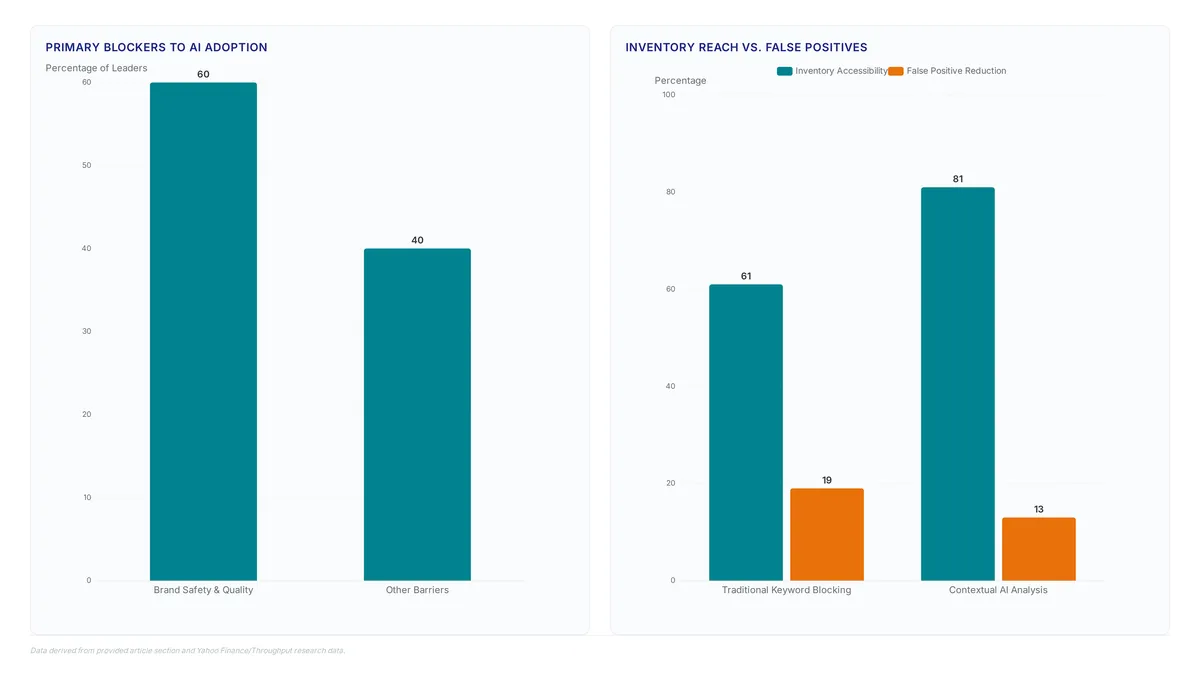
Replace static keyword filters with multimodal analysis that evaluates audio, visual, and semantic signals simultaneously to determine true brand suitability. Traditional blocking mechanisms rely on string matching that frequently misclassifies safe content, whereas modern systems interpret tone and intent to enable previously inaccessible inventory. This shift transforms brand safety from a binary exclusion tool into a precision instrument for inventory valuation.
- Configure verification tools to process video frames and speech patterns rather than transcript text alone.
- Audit current exclusion lists to identify over-blocking caused by lack of contextual nuance.
- Implement metadata schemas that explicitly tag tone variables for downstream algorithmic consumption.
The primary tension lies between immediate safety assurance and long-term reach expansion; relying solely on keywords guarantees zero risk but sacrifices volume. However, content analysis reveals that sophisticated models reduce false positives by understanding semantic context rather than isolated triggers. Operators must recognize that failing to update these parameters leaves high-value inventory unreachable during peak engagement cycles.
Teams using Enterium should prioritize metadata enrichment to ensure algorithms correctly classify video assets before bidding occurs. Without explicit metadata signaling tone and intent, even advanced systems may default to conservative categorization, effectively nullifying the investment in smarter tools.
Revising Exclusion Lists and Updating AI Classification Settings
Operationalize safety by replacing static keyword filters with multimodal contextual tools that analyze audio and visual tone simultaneously. Legacy lists often block safe inventory because they cannot distinguish between a discussion of risk and the risk itself, creating a hidden penalty on reach. Teams must transition from simple string matching to systems that evaluate semantic meaning, as traditional methods frequently reject valid content due to false positives keyword blocking.
Execute this audit using the following workflow:
- Pull current exclusion lists to identify the last review date against modern standards.
- Verify if your verification stack processes video frames and speech patterns rather than transcript text alone.
- Reclassify brand safety settings to allow context-rich news inventory during high-attention political cycles.
- Request multimodal analysis capabilities from partners to reduce unnecessary URL blocking.
However, maintaining rigid lists increases the cost of missed opportunities more than it reduces reputational risk. Use Enterium to configure these classification parameters precisely, ensuring your exclusion logic matches the sophistication of the content environment.
Meanwhile:
- Audit the first three seconds of current assets to identify premature product messaging.
- Restructure narratives to delay brand identification until after the emotional hook resolves.
- Deploy Enterium to validate that metadata optimization aligns with these new narrative constraints.
About
Sofia Marchetti is a B2B content and demand-generation strategist who specializes in aligning automated content systems with revenue outcomes. Her decade of experience in B2B SaaS makes her uniquely qualified to analyze how multimodal AI shifts the value of video and creator inventory. At Enterium, she documents how modern teams architect LLM-driven workflows that move beyond simple text generation to include reliable video and visual strategies. This article connects those high-level industry findings to the practical reality of content operations, showing practitioners how to adjust their quality gates and distribution models. By using her background in topical authority and durable distribution, Sofia provides a clear path for brands to reclaim undervalued inventory without sacrificing brand safety or strategic focus.
Conclusion
Scaling multimodal AI reveals a critical fracture where rigid exclusion logic actively cannibalizes reach. While executives cite automation as a primary advantage, relying on outdated keyword blocking causes brands to discard nearly half their potential inventory value. This operational immaturity creates a paradox where fear of adjacency risks suppresses the creative innovation required to combat audience fatigue. The market has shifted from theoretical potential to actual implementation, meaning legacy workflows that prioritize static lists over contextual understanding are now a direct drag on performance.
Organizations must transition their brand safety protocols from reactive blocking to proactive contextual analysis by the next budget cycle. Do not wait for a crisis to update your verification stack; the cost of missed opportunities now outweighs the perceived safety of broad exclusions. Start by auditing your current exclusion logs this week to identify any rules based solely on transcript text rather than visual or audio context. If your system cannot distinguish between negative news coverage and negative brand adjacency, you are paying a premium for underperforming inventory.
Configure your classification parameters to allow context-rich inventory during high-attention cycles. Use Enterium to validate that your metadata optimization aligns with these new narrative constraints. The immediate priority is to restructure briefs that force direct product messaging before establishing emotional relevance. By delaying brand identification until after the emotional hook resolves, you reduce the cognitive friction that drives viewers away. This structural adjustment ensures your multimodal AI deployment captures value rather than merely filtering risk.
Frequently Asked Questions
Keyword filters block 54% of URLs that are actually safe for brands. This massive false positive rate hides valuable news inventory from advertisers during peak election cycles when audience attention is highest.
Teams must audit their exclusion lists immediately to avoid falling behind. Ignoring this review causes brands to miss high-attention inventory while competitors use contextual AI to access previously blocked content safely.
The technology analyzes video, audio, speech, and images together for context. This approach prevents the 54% blocking error rate by distinguishing between dangerous rhetoric and neutral news reporting about the same events.
Videos with direct product messaging suffer a 44% drop in view rates. Brands should align emotional tone with content verticals to avoid this steep decline in audience engagement and visibility.
A critical 81% of teams lack the measurement framework to track success. Without these metrics, operators cannot validate the return on investment from shifting budget toward advanced contextual analysis tools.
References