Content types that drive modern marketing results
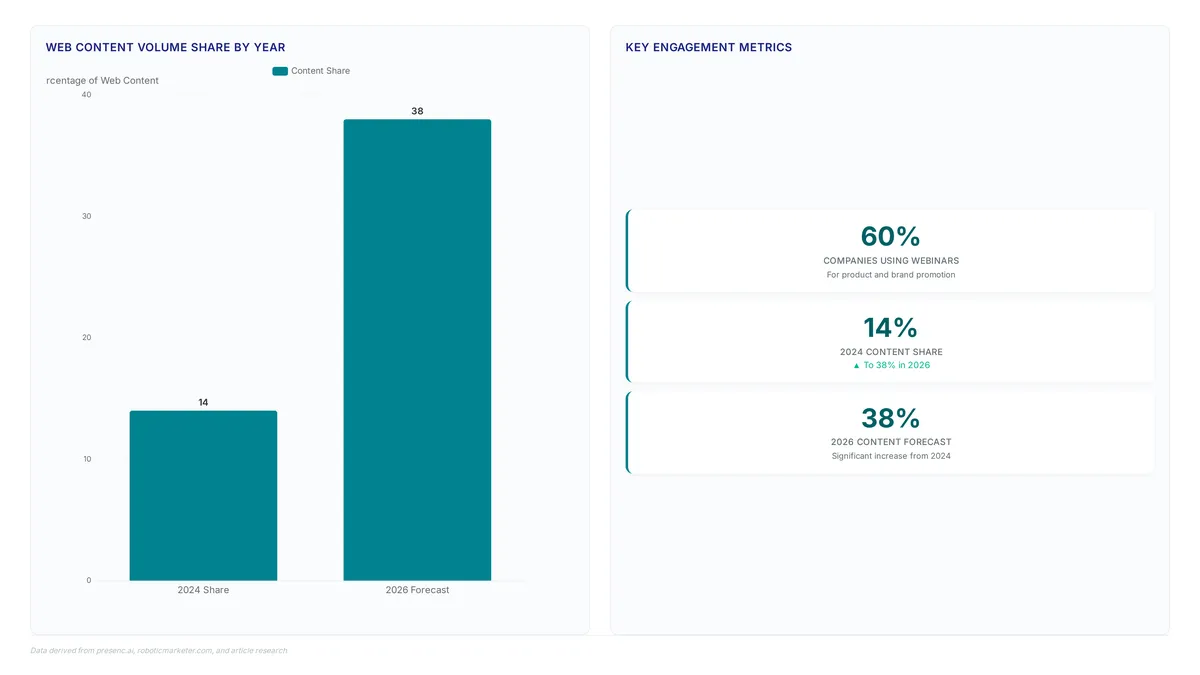
With 38% of business web content now involving AI assistance, defining your content type strategy is no longer optional. Generic creation fails in the modern marketing environment. Businesses must produce a variety of formats to genuinely engage audiences and enhance company statistics. Success demands a rigorous approach to the specific purpose, structure, and community acceptance that define effective digital content.
This guide dissects the strategic role these formats play in targeting specific audience needs, interests, and preferences. We will also dissect the operational mechanics required to maintain the typical structure that makes reading easy and organized for your community.
Finally, we provide a comparative analysis of format effectiveness, ranging from blog posts and video content to webinar presentations. While presenc.ai research highlights the surge in automated creation, the core value remains in how these tools serve distinct goals like informing, educating, and documenting specific occurrences. Understanding these nuances separates brands that merely publish from those that build lasting communities.
The Strategic Role of Diverse Content Types in Modern Marketing
Defining the Six Core Content Types for Digital Strategy
Six distinct formats comprise the modern content system, each fulfilling a specific role in acquiring and retaining audiences. Blog posts remain the most common written form, serving as regularly updated website features that cover specific topics to drive organic search visibility. Video content combines high-fidelity visuals with audio for education and storytelling, an approach where 91% of companies using video marketing tools report positive results. Social media acts as the primary engagement engine, using imagery and short-form videography on platforms to support direct community interaction and brand awareness.
Teams often underestimate the resource cost of maintaining distinct voice profiles across these six mediums simultaneously. Operationalizing this mix requires significant upfront investment in quality checkpoints before generation begins. Automation solutions help manage these quality gates, ensuring consistent brand voice without manual friction across all format types.
Applying Video Marketing and Newsletter Tactics for Audience Growth
Video marketing succeeds when creators distill narratives into sub-two-minute clips that respect viewer attention limits. While the majority of firms report positive outcomes from this medium, the operational constraint remains strict fidelity to audio clarity and steady framing. Authentic storytelling drives retention more effectively than polished but generic corporate messaging.
This environment necessitates newsletter integration as a stabilizing retention channel. Unlike social feeds, newsletters deliver personalized updates directly to user inboxes, bypassing algorithmic filtering to promote products and website content. Balancing the high engagement of video with the stable ownership provided by email lists defines the modern retention stack.
| Feature | Video Content | Newsletter Content |
|---|---|---|
| Primary Goal | Awareness & Education | Retention & Sales |
| Distribution | Platform Algorithm Dependent | Direct Inbox Delivery |
| Optimal Length | Under 2 Minutes | Variable / Brief |
| Key Metric | Views & Shares | Open Rate & Clicks |
Entering 2026, teams with limited budgets cannot sustain manual workflows for these distinct formats without assistance. AI-driven strategies now convert raw data into draft copy and visuals rapidly, enabling small teams to compete with larger entities. Orchestration layers are required to synchronize these video and text pipelines efficiently. Without such automation, the cost of human labor for scaling hyper-segmented content becomes prohibitive. The logical next step involves auditing current production bottlenecks where manual effort stalls volume.
Comparing Podcast Reach Versus Webinar Engagement Metrics
The distribution architecture distinguishes these formats, with podcasts favoring asynchronous reach while webinars offer structured presentation opportunities. Podcasts function as long-form audio assets designed for deep-dive storytelling and broad brand authority. This format supports a strategy where brands build intimate connections with listeners. However, the passive nature of audio presents different analytical considerations compared to interactive sessions.
Conversely, webinar platforms enable structured presentations that drive audience participation. This approach addresses market saturation by demanding higher engagement to secure visibility through direct interaction. Marketers must align format selection with specific campaign metrics rather than production convenience.
| Feature | Podcast | Webinar | |
| Primary Goal | Brand Authority | Immediate Engagement | |
| Duration | Variable | Fixed | |
| Interaction | Low (Asynchronous) | High (Synchronous) | |
| Feature | Barrier | Time Commitment | Scheduling Conflict |
| Podcast | High (Editing/Production) | Low (Asynchronous) | |
| Webinar | Medium (Live Event) | High (Fixed Time) | |
| Video Short | Low (Rapid Turnover) | None (On-Demand) | |
| Blog Post | Medium (Drafting/SEO) | None (On-Demand) | |
| Newsletter | Low (Compilation) | None (On-Demand) | |
| Social Post | Low (Real-time) | None (On-Demand) |
Operational Mechanics of High-Performance Content Creation
Blog Post Length Ranges and Keyword Integration Mechanics
Blog posts typically range from a few hundred words up to several thousand, a flexibility that dictates structural depth and keyword density. In 2026, an estimated 38% of all web content published by businesses involves AI assistance at some stage of the creation process, requiring precise parameter tuning to maintain distinct brand voice. Operators must define a brand voice profile before generation begins to ensure consistency across these variable lengths.
The technical workflow for integrating keywords follows a strict sequence:
- Identify target audience interests to select the topics.
- Research accurate data points to support the chosen thesis.
- Map primary keywords to specific structural elements like headers and meta descriptions.
- Generate draft content using established voice parameters.
- Execute human-in-the-loop quality gates before publication.
| Parameter | Short-Form (2,000 words) |
|---|---|
| Keyword Density | High frequency, exact match |
| Primary Goal | Immediate traffic capture |
| AI Role | Draft expansion |
Relying solely on volume without quality checkpoints risks diluting brand identity with generic output. Automation accelerates production, yet unverified scaling introduces significant reputational noise. Teams should implement Enterium solutions to automate these validation steps, ensuring every published post meets strict stylistic and factual standards before reaching the audience.
Achieving this requires strict adherence to technical constraints regarding duration and fidelity. The under-two-minute rule addresses declining viewer attention spans by forcing narrative compression. Content exceeding this threshold often sees retention drop before the core message lands. Production quality acts as the primary signal for brand credibility.
Enterium provides the orchestration layer necessary to enforce these quality gates automatically. The platform integrates quality checkpoints that validate audio levels and duration before distribution. This ensures every asset meets the set structural purpose without manual rework. Operators gain the ability to scale video output while maintaining consistent brand voice profiles across all channels.
Technical Specification:
- Duration: Under 120 seconds
- Audio: Clear, noise-reduced track
- Visuals: High fidelity
Mandatory Quality Checkpoints for AI-Driven Brand Voice Profiles
Automated pipelines fail without human oversight gates before publication. Content teams with limited resources cannot manually customize assets at the required scale, making structured validation necessary. The primary mechanism is a brand voice profile, a technical specification defining tone and syntax parameters before generation begins. This profile acts as the input schema for all downstream creation.
| Checkpoint Stage | Validation Target | Outcome |
|---|---|---|
| Pre-Generation | Brand Voice Profile | Consistent tone alignment |
| Post-Draft | Keyword Integration | Search visibility |
| Pre-Publish | Safety & Accuracy | Risk mitigation |
Operators must execute a strict sequence to maintain quality. First, define the voice parameters to guide the model. Second, verify that keyword placement feels organic rather than forced. Third, route the draft through a human review for factual accuracy. Fourth, check formatting consistency against brand guidelines. Fifth, approve the final asset for distribution.
Adding these gates slows throughput but prevents brand damage from hallucinated claims. Speed tempts teams to skip steps, yet the cost of reputational repair exceeds the delay of a manual check. Establishing these quality checkpoints ensures that automated output remains safe for public consumption. Deploy these validation layers as non-negotiable pipeline stages.
Comparative Analysis of Format Effectiveness for Audience Engagement
Defining Engagement Mechanics in Social Media Versus Newsletters
Algorithmic distribution on social platforms enables brands to build relationships with diverse audiences. Newsletters function differently by sending personalized messages directly to inboxes after users grant explicit permission. The core difference involves control versus volume since social channels provide scale while limiting access, whereas email offers ownership with slower organic growth.
Many marketers confuse broad visibility with genuine engagement, yet community-led strategies targeting niche forums often beat generic high-volume publishing in conversion rates. This change demands hyper-personalized delivery systems that adapt to individual preferences instead of relying on mass messaging. Social media faces a substantial constraint because the sheer volume of daily posts creates a saturated environment where publishing alone guarantees nothing. Newsletter success relies on defining the target audience by understanding their needs, interests, and preferences to stop subscribers from leaving. Teams must verify that automation tools support segmentation so message relevance does not fade across different audience groups, especially since small budgets prevent manual customization at scale.
Deploying Webinars and Podcasts for Authority and Depth
Webinars generate immediate interaction through structured Q&A sessions while podcasts deliver long-form storytelling for diverse audiences. Research indicates that 60% of companies apply webinars to promote products and brands effectively. Successful webinar content requires interactive elements like quizzes and polls to keep attendees focused during live events.
Podcasts offer a different engagement model by delivering valuable information without constant advertising pressure. This format creates backlinking opportunities that improve search engine optimization over time. Buzzsprout, Podbean, and Simplecast serve as popular distribution channels that manage hosting and RSS feeds for global delivery.
Strategic planning for 2026 emphasizes that growth in content formats will expand beyond simple copy, driven by AI capabilities in curation and repurposing. Marketers often face a tension between the high production cost of live events and the sustained effort required for episodic audio. Newsletters fit into this workflow when you need to notify existing subscribers about upcoming webinar registrations or new podcast episodes. Aligning audience segmentation strategies allows for hyper-targeted invites rather than broad blasts.
Blog Posts Versus Video Content: Reach Versus Retention Trade-offs
Blog posts provide persistent search visibility while video drives immediate algorithmic distribution through high-engagement signals. Using different types of content helps with audience research by allowing companies to identify what improves or hinders their content marketing strategy. Videography is highly engaging for product demos and brand storytelling and is shareable on platforms like YouTube.
Balancing the deep-dive capability of text against the viral potential of motion defines the strategic choice. Operators must establish quality checkpoints before any automated or scaled content reaches the public to maintain trust. This gating mechanism ensures that speed does not compromise the accuracy required for complex technical subjects. When deciding when to publish newsletters, teams should analyze whether the goal is broad awareness or direct client value delivery.
Data-Driven Optimization Strategies for Content Performance
Defining Data-Driven Content Optimization Frameworks
Measuring analytics identifies what improves marketing strategy instead of relying on guesses about performance. Teams analyze content results by tracking specific engagement metrics across blogs, videos, and social posts to determine which formats connect. Audience segmentation drives hyper-personalized delivery, moving brands away from generic distribution models.
Operators miss the nuance that a variety of formats ensures reach to all audience types without this granularity, as different content types appeal to different audiences. Scaling production through repurposing creates tension with maintaining the distinct structural integrity each platform demands. Traditional methods focus on single assets, but 2026 strategies prioritize curation and repurposing to expand scope without linear cost increases. Optimizing for volume alone sacrifices the brand voice consistency required for long-term retention. Operators must distinguish between simple format conversion and true strategic adaptation to avoid diluting message impact. Ignoring these optimization frameworks results in a fragmented content system that fails to convert despite high output volumes. True performance requires closing the loop between initial creation and analytical feedback to refine future inputs continuously.
Executing Analytics Workflows to Fix Low Engagement
Fixing low engagement starts by isolating format-specific failure modes rather than assuming universal content fatigue. Operators diagnose low engagement on social media by auditing share-to-view ratios. Poor video performance often stems from failing to keep content brief, with ideal messages delivered in under two minutes.
The volume of content production has reached a scale where over 150 billion pieces of content are being produced daily as of 2026, creating noise that generic strategies cannot penetrate. Diverse formats provide a constant supply of advertisements that can be modified, repositioned, and repurposed to test variable signals against this saturation. Teams with limited resources cannot manually sustain the pace required to turn raw data into draft-ready copy without automation, making manual iteration a bottleneck. Strategic planning emphasizes expanding beyond simple copy, yet content teams with small budgets are increasingly unable to manually create and customize assets at the required pace. Automated approaches ensure that content types serve as distinct data points rather than redundant noise. Setting up multi-format tracking dashboards introduces initial complexity, yet the alternative is invisible distribution.
Validation Checklist for Sustainable Content Results
Validating sustainable results requires confirming assets meet core criteria: purpose, structure, and community acceptance. Successful execution demands deciding on a pertinent topic, producing insightful material, and practicing rigorous preparation. A diverse choice of content helps achieve long-term, sustainable, and positive results. The industry shift toward community-led content distinguishes visible brands from those relying on volume alone.
About
Sofia Marchetti is a B2B content and demand-generation strategist who specializes in aligning automated content systems with revenue outcomes. Her decade of experience in B2B SaaS makes her uniquely qualified to dissect content types, as she daily engineers pipelines where specific formats drive distinct stages of the buyer's path. At Enterium, Sofia leads the development of methodologies that change raw LLM output into structured, high-trust assets like case studies and technical guides. This article reflects her operational reality: defining audience needs to select the precise content structure required for market acceptance. Unlike generic generators that produce undifferentiated text, Enterium's approach ensures every content type serves a measurable business purpose within a governed workflow. By mapping content varieties to specific pipeline goals, Sofia demonstrates how modern teams scale topical authority without sacrificing quality. Her insights provide the strategic framework necessary for building durable content operations that compound over time.
Conclusion
At the current scale of 150 billion daily assets, generic distribution strategies collapse because they treat every format as a interchangeable unit rather than a distinct data signal. The operational cost of manual iteration now exceeds the value of the output, creating a bottleneck where teams cannot refine messages fast enough to match audience attention spans. While webinars and short-form video serve different purposes, relying on human-only workflows to optimize these variables leads to invisible distribution. The real shift in 2026 is not just the volume of AI generation but the necessity of using automation to close the loop between analytical feedback and future inputs.
Organizations must implement automated, multi-format tracking dashboards immediately to survive this saturation. Do not attempt to manually audit share-to-view ratios across thousands of assets; the latency will render your insights obsolete before you act. Start by deploying an Enterium analytics workflow this week that automatically flags video assets exceeding the 120-second threshold and cross-references them against noise-reduction metrics. This specific action isolates format-specific failure modes without requiring additional headcount. By anchoring your strategy in real-time data rather than intuition, you change raw production volume into a sustainable competitive advantage. The window for manual optimization has closed, making intelligent automation the only viable path forward for brands seeking measurable growth.
Frequently Asked Questions
Ninety-one percent of companies using video tools report positive results. This high success rate means businesses must prioritize clear audio and short durations under two minutes to effectively engage their specific target audiences today.
Research indicates that 60% of companies utilize webinars to promote brand awareness. This widespread adoption requires your presentations to focus heavily on educational value and customer engagement to stand out in a crowded digital market.
Over 150 billion pieces of content are produced daily, creating massive saturation. Small teams cannot manually match this pace without automation, making AI assistance essential for maintaining consistent output and quality across all formats.
In 2026, an estimated 38% of web content involves AI assistance. This shift means brands must integrate automated tools to manage distinct voice profiles and maintain quality gates without overwhelming their internal marketing resources.
Successful video narratives must be distilled into clips under 120 seconds. Respecting these strict attention limits ensures higher retention rates compared to longer formats, forcing creators to focus on authentic storytelling over generic messaging.
References