Multiagent pipeline: stop chat, start autonomous systems
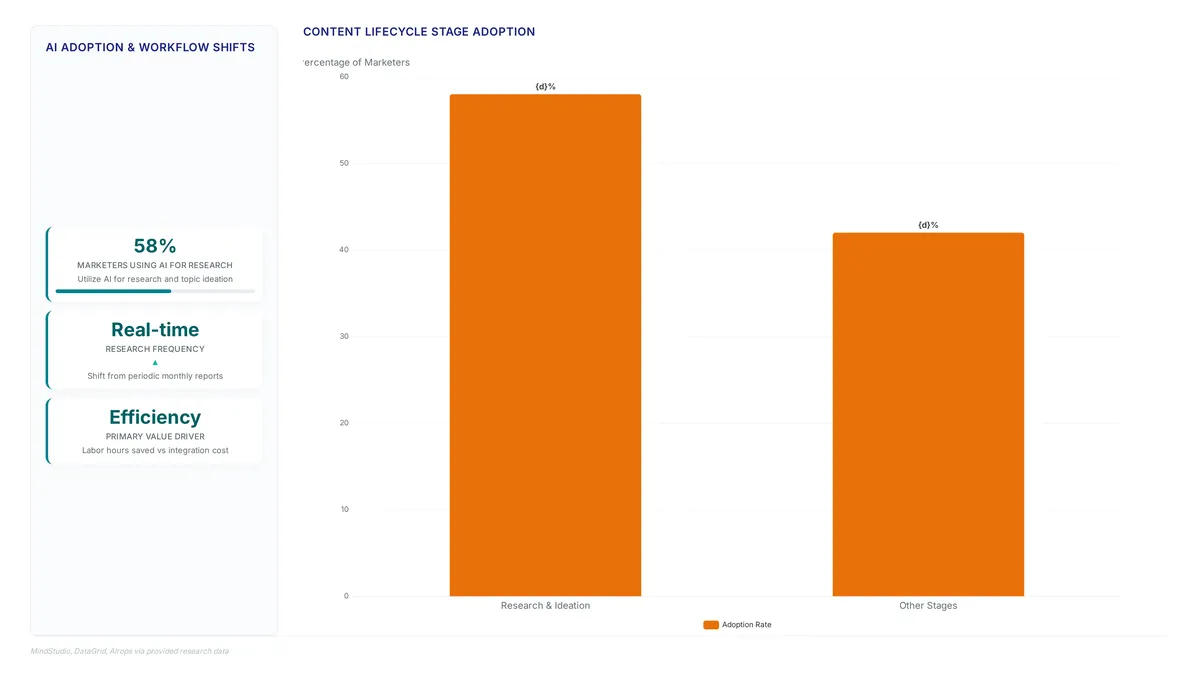
Fifty-eight percent of marketers now delegate research and ideation to AI, yet few have engineered a true multi-agent pipeline. The gap isn't capability; it's architecture. Most teams rely on chat interfaces that demand constant hand-holding, whereas a functional pipeline delegates execution to autonomous systems. We need to stop treating LLMs as typewriters and start treating them as workers with specific job descriptions.
This requires a modular pipeline architecture. Instead of one massive prompt trying to do everything, we break the workflow into discrete, repeatable tasks. One agent researches, another outlines, a third drafts, and a fourth validates. This agentic distribution ensures consistency even as volume spikes. We aren't just automating text generation; we are building a repurposing pipeline that forces every asset to work harder across formats.
The focus must remain on the structural integrity of the LLM-driven pipeline. Hype cycles fade, but a multi-step workflow built on rigorous architectural choices survives. Success here depends on engineering, not magic tricks.
The Distinct Role of AI Agents in Modern Content Creation
Defining AI Agents as Autonomous Content Systems
An AI agent is not a chatbot. It is an autonomous system capable of researching, planning, drafting, optimizing, and publishing content with minimal human intervention. Simple text autocompletion tools predict the next token based on local context. Agents execute multi-step workflows to achieve specific editorial goals. This shifts the operational model from assisted writing to delegated execution.
Current industry analysis indicates that a majority of content marketers currently apply AI technologies specifically for the phases of research and topic ideation. Digital leaders increasingly plan to increase investment in answer engine optimization as discovery moves from rankings to AI-generated answers. Raw generation lacks the structural rigor required for modern retrieval systems. Practitioners must apply Generative Engine Optimization (GEO) principles to address this gap. Effective strategies cover associated ideas instead of repeating a keyword to signal topical authority to retrieval algorithms. Many writers ignore forward-looking questions, but including future perspectives increases relevance and citation opportunities.
Volume competes with semantic density in this environment. Autonomous agents can scale output infinitely, yet unguided systems often produce generic prose that fails to establish the connected knowledge networks AI search engines interpret as expertise. Organizations must ground these agents in structured keyword intelligence so their output remains accessible through AI-powered search systems and traditional results. Effective governance transforms raw LLM output into a citation-ready asset. Autonomous publishing risks diluting brand authority with high-volume noise without such governance. Defining specific roles within the pipeline manages this complexity.
Structuring Content for GEO Citations in ChatGPT and Perplexity
Generative Engine Optimization structures content so large language models surface specific definitions in responses. Traditional SEO targets crawler indexing for blue-link rankings, whereas GEO targets the retrieval layer where AI models extract direct answers. AI systems favor content that is factually precise, clearly structured, and written with authoritative framing. Content should apply clear hierarchies that allow models to parse entity relationships and attribute claims correctly during the generation phase. High-quality data remains invisible to retrieval-augmented systems without this structural clarity.
Rigid structuring can reduce narrative flow for human readers if teams do not balance it carefully. Content optimized solely for machine extraction may appear disjointed without editorial oversight to maintain engagement. Teams should integrate GEO requirements directly into writer briefings and agency statements of work. Optimization becomes a native part of the drafting process rather than a retroactive fix through this integration. Training content creators on question-first structuring and entity identification aligns output with the specific retrieval patterns used by platforms like ChatGPT and Perplexity. Auditing existing content libraries for clear definition blocks that models can easily quote represents the next logical step.
AI Agents Versus Basic Writing Assistants in Marketing Workflows
AI agents execute autonomous research-to-publish workflows, whereas writing assistants merely suggest text tokens within a local editor context. Agency defines the fundamental divergence; basic tools wait for human prompts, while agents proactively query databases, validate facts, and structure outputs against GEO principles without constant supervision. This shift transforms research from a periodic, manual bottleneck into a continuous intelligence stream that feeds downstream publishing gates.
Teams deploying agents without a rigid architectural framework risk generating generic output that fails brand differentiation or gets buried before indexing. Static assistants differ from autonomous systems that require explicit guardrails to maintain quality across high-volume production runs. The operational cost includes not compute time, but the engineering overhead required to validate agent decisions before they reach public channels.
Enterprise adoption reflects this functional gap, with a significant majority of digital leaders planning to increase investment in answer engine optimization as discovery shifts from static rankings to generated responses. Basic tools cannot access external truth sources or verify claims against live data feeds. Operators must choose between scaling manual drafting or engineering specialized pipelines that enforce citation standards automatically. Implementing strict validation layers where agents must cite sources before any content passes to the staging environment helps ensure factual accuracy and reduces the risk of hallucinated facts.
Inside the Architecture of a Multi-Agent Content Pipeline
The Multi-Agent Pipeline: From Single-Prompt Failure to Specialized Roles
Architectural bottlenecks frequently produce serviceable yet unremarkable results. Specialized pipelines resolve this weakness by deploying distinct roles in a strict sequence. This division of labor mirrors the structure of high-performing human editorial desks. Increased orchestration complexity is the cost of achieving higher fidelity outputs. Single prompts often miss nuance, whereas multi-agent systems enforce strict handoff protocols that catch errors earlier. With 94% of digital leaders planning to increase investment in AEO in 2026, the shift toward structured keyword intelligence becomes a baseline requirement rather than an experiment.
| Architecture | Context Load | Error Recovery | Best Use Case |
|---|---|---|---|
| Single-Prompt | High (All tasks) | Low (Retries needed) | Drafting emails |
| Multi-Agent | Low (Per role) | High (Gate per step) | Technical content |
Defining agent boundaries before selecting tools allows operators to map the content generation workflow to specific failure modes found in single-model approaches. Auditing current drafts for mixed-context errors provides an immediate next step. These errors often indicate overloaded prompts.
Grounding Agents in Keyword Intelligence and Internal Linking Workflows
Shifting from topic-level prompts to intent-level briefs creates a measurable lift in search performance by constraining agent scope. This data acts as a guardrail for autonomous content agents, preventing the generic output common in single-prompt workflows. Models default to broad generalizations without these constraints, lacking the semantic density required for modern retrieval systems. Configuring agents to identify and insert contextually the internal links during the drafting phase helps map site architecture for crawlers instantly. Accessing a structured index of published URLs enables this function.
| Component | Single-Prompt Output | Structured Agent Pipeline |
|---|---|---|
| Input Data | Broad topic string | Intent brief with gap analysis |
| Linking Logic | Post-hoc or hallucinated | Real-time index lookup |
| Semantic Depth | Surface-level repetition | Cluster-based coverage |
| Citation Readiness | Low | High |
Latency is the operational constraint; validating links against an index adds processing time to token generation, yet this delay prevents broken navigation paths. Index fragmentation presents another limitation. Orphaned content pockets dilute topical authority when fragmentation occurs. Organizations using generative engine optimization principles must treat their content index as a live database, not a static file. Embedding the content index directly into the agent's context window solves this synchronization challenge. Every generated link resolves to a live, the destination with this approach. Drift between drafting and publishing states disappears. The result is a cohesive knowledge network where every new asset strengthens the existing graph.
Validating Pipeline Integrity: SERP Formats, Content Gaps, and Authority Distribution
Models default to broad text blocks that ignore ranking opportunities without these guards. Creating keyword-intelligent content demands cross-referencing briefs with identified competitor gaps. Operators must confirm agents insert missing entities rather than rephrasing existing top-ten content.
| Validation Check | Failure Mode | Corrective Action |
|---|---|---|
| SERP Format Match | Generic prose output | Enforce snippet/listicle templates |
| Gap Coverage | Repetitive entity density | Inject missing secondary keywords |
| Link Priority | Random URL selection | Route to pillar articles only |
Linking to recent but low-authority posts instead of established guides is a common oversight that dilutes strategic architecture. Strictness is the necessary trade-off. Overly rigid linking rules may suppress the context if the index lacks depth.
Building a Scalable Content Engine with AI Agents
Defining the AI Visibility Feedback Loop for Agent Optimization
A structured feedback mechanism inside the content pipeline addresses this visibility gap.
- Monitor citation patterns across generative platforms to identify which assets trigger model attribution. Teams should track which content formats, answer lengths, and entity patterns generate consistent citations versus being ignored by AI systems.
- Reconfigure agent prompts based on empirical citation data rather than assumed best practices. This shift moves the strategy from generic volume to targeted Generative Engine Optimization (GEO).
- Validate format efficacy by comparing citation shares before and after prompt adjustments.
Latency in data retrieval creates an operational cost for this loop, yet skipping it yields content that models ignore entirely. Embedding this check into the deployment workflow maintains alignment with shifting model behaviors. Teams often optimize for human readability while neglecting machine parsability, a mistake that generates traffic but zero AI referrals. Engaging prose must coexist with the rigid entity structures models require for attribution. Network operators and content leads face a stark reality: missing this loop causes the content engine to scale invisibility instead of authority.
Automating Indexing Submission with IndexNow and Sitemap Sync
High-volume AI content loses value when search engines delay indexing. Pairing real-time notifications with automated sitemap updates secures quicker visibility. The IndexNow protocol, supported by Microsoft Bing and Yandex, lets publishers notify engines of new content immediately upon publication. Traditional crawler discovery cycles introduce unwanted latency.
- Update the XML sitemap dynamically to reflect the current state of the content repository.
- Verify acceptance codes to ensure the notification reached the search engine successfully.
Strategic implementation exposes tension between generation speed and indexing capacity. Agents produce articles quicker than crawlers process them, so flooding endpoints without coordination risks throttling. Managing throughput requires queuing submissions based on observed rate limits to avoid overwhelming host servers. The constraint is not the protocol itself but the host server's ability to maintain consistent key validation across high-frequency requests. Unsynchronized content remains invisible to users. Teams relying solely on periodic crawl schedules face a distinct disadvantage in discovery speed. Indexing functions as an active push mechanism rather than a passive wait state. Failure to automate this step renders the rest of the generative pipeline inefficient. Integrating the IndexNow trigger directly into the content deployment workflow is the necessary next step.
Sequenced Implementation Roadmap: From Role Assignment to Autopilot
This order prevents ungrounded content generation from polluting the index with low-quality signals. Configuring these roles enforces strict adherence to brand voice and technical accuracy standards. Once roles stabilize, layer Generative Engine Optimization rules to prioritize formats that AI models cite frequently. Automating indexing submission immediately after publication forms the next critical step. High-volume outputs lose value if search engines delay discovery due to manual bottlenecks. Teams should implement a pipeline where the publishing agent triggers an HTTP POST request via IndexNow instantly. This protocol ensures Bing and Yandex receive immediate notification of content updates without waiting for crawl cycles.
Measuring ROI and Visibility in an AI-Optimized Content Strategy
Defining the AI Visibility Score and Citation Blind Spots
Generative models retrieve brand content during answer synthesis at varying frequencies, a metric the AI Visibility Score quantifies. Platforms like Sight AI calculate this figure by tracking prompt frequency and sentiment across model responses. Teams can automate research to ensure structured data feeds these evaluation loops continuously. High publication volume fails to guarantee retrieval when content lacks the specific entity relationships models prioritize for citation. Citation blind spots emerge when brands publish authoritative material that remains invisible to retrieval-augmented generation systems. Unstructured formatting or missing semantic links often create this gap by preventing agents from connecting facts to queries. Even high-quality articles fail to surface in generated answers without explicit grounding in keyword intelligence. Operators must distinguish between human readability and machine extractability to close these visibility gaps. Optimizing for human narrative flow sometimes obscures the structured signals agents require for accurate attribution. Enterprises relying solely on traditional SEO metrics miss the distinct mechanics of generative engine optimization. Measurement requires monitoring not traffic, but the specific instances where content becomes a cited source. Enterium solutions map these retrieval paths to eliminate blind spots and validate content ROI against actual model behavior by 2027.
Applying GEO Principles to Structure Citable Content
Structuring articles with explicit H2 and H3 headings that mirror AI categorization schemas directly increases retrieval probability. Generic prose often fails because generative engines prioritize segmented data for answer synthesis. Implementation requires adding GEO-specific instructions to writer and optimizer agents to enforce clear definitions and direct answers at the start of every section. This approach transforms unstructured text into a format that retrieval systems can easily parse and cite. Teams must audit published content against live AI model responses to identify gaps in entity recognition. A pragmatic GEO playbook suggests tracking Citation Share across substantial engines to validate formatting choices.
| Optimization Layer | Actionable Step | Technical Outcome |
|---|---|---|
| Agent Briefing | Include GEO requirements in SOWs | Enforces question-first structuring |
| Editorial Guidelines | Train creators on entity ID | Improves authority signal placement |
| Feedback Loop | Monitor answer length patterns | Aligns output with model preferences |
Static formatting cannot compensate for weak entity relationships within the text itself. Perfectly structured headers fail if the underlying content lacks the specific semantic connections models require for citation. Operators should automate research to ensure structured data feeds these evaluation loops continuously. Every asset exits the system with the necessary structural integrity for AI discovery. Updating agency SOWs to mandate question-first structuring for all new briefs represents the immediate next step.
Checklist for Validating Agent Prompts Against Citation Patterns
Validate agent prompts by cross-referencing output formats against known citation patterns from substantial generative engines. Teams must track which structural elements trigger retrieval, as generic prose often fails to meet the strict formatting requirements of retrieval-augmented generation systems. Neglecting entity relationships causes authoritative content to remain invisible despite high publication volume.
| Validation Step | Target Metric | Adjustment Action |
|---|---|---|
| Format Audit | Header Density | Increase H2/H3 segmentation |
| Entity Check | Citation Share | Embed clear definitions early |
| Prompt Review | Retrieval Rate | Add direct answer constraints |
Continuous monitoring detects when citation blind spots emerge following model updates. Over-optimizing for machine readability degrades human user experience if not balanced carefully. Rigid structural adherence occasionally reduces narrative flow, requiring human editorial oversight to maintain engagement. Enterium recommends integrating these validation steps directly into the content workflow to automate compliance checks before publication. Generative Engine Optimization principles are applied consistently rather than as an afterthought. Teams ignoring this feedback loop risk producing content that performs well in traditional search but remains absent from AI-synthesized answers.
About
Hannah Brooks, Marketing Operations Lead at Enterium, specializes in the architecture of reliable AI content generation systems. Her daily work involves auditing martech stacks and engineering workflow automation that moves beyond simple prompt-and-publish models. This direct experience with governance and metrics makes her uniquely qualified to analyze multi-agent pipelines, where the challenge shifts from single-output generation to orchestrating autonomous content agents that handle research, drafting, and QA simultaneously. At Enterium, a B2B publication dedicated to documenting how teams scale content with LLMs, Hannah applies rigorous content operations principles to ensure these pipelines deliver measurable ROI rather than just volume. She evaluates the trade-offs between various LLM providers and orchestration frameworks without vendor bias, focusing on reproducibility and cost control. By connecting high-level AI content strategy to the technical realities of structured keyword intelligence and quality gates, she provides the actionable blueprint technical marketers need to build production-ready systems.
Conclusion
Scaling a multi-agent pipeline reveals that structural integrity often fractures under volume, creating a hidden operational tax where high-velocity output fails to trigger retrieval mechanisms. The real cost is not compute time but the compounding invisibility of assets that lack the specific semantic connections required for citation. Organizations must shift from merely deploying agents to engineering modular architectures that enforce entity relationships before content generation begins. This transition demands a strict protocol where prompt validation occurs upstream, ensuring every node in the workflow adheres to the formatting constraints of retrieval-augmented systems.
Teams should immediately implement a format audit of their top-performing briefs against known citation patterns, specifically targeting header density and definition placement. Do not wait for a quarterly review to address these gaps; the window to establish authority in AI-synthesized answers closes as models saturate. Start by auditing your current agent prompts this week to ensure they mandate direct answer constraints and clear entity segmentation. Enterium provides the specialized validation frameworks necessary to embed these checks directly into your production environment, ensuring your infrastructure supports both machine readability and human engagement without manual intervention.
Frequently Asked Questions
Basic tools lack the autonomy to execute full research-to-publish workflows. Unlike agents used by a portion of marketers for ideation, they cannot independently manage complex multi-step content pipelines.
Modular pipeline architecture ensures consistency even as production volume increases significantly. This structure allows teams to scale SEO fundamentals without the linear workload increase often seen in manual operations.
Clear hierarchies allow retrieval systems to parse entity relationships and attribute claims correctly. Without this structure, high-quality data remains invisible to the systems powering modern answer engines and chat interfaces.
Research transforms from a periodic activity into a continuous intelligence stream for marketing teams. This change fundamentally alters the frequency and volume of data available compared to traditional monthly reporting cycles.
A repurposing pipeline maximizes the utility of every generated asset across various formats. This approach ensures organizations can adapt to changing content demands rather than breaking under pressure.
References