Autonomous content agents fix broken translation
Manual translation workflows fail because 40% of global consumers refuse to buy from brands lacking native language content. The autonomous content agent replaces this broken model by managing the entire workflow of creating, translating, and updating technical content across multiple languages in real-time. Traditional agency hiring cycles cannot survive continuous deployment. Terminology governance ensures proprietary terms remain consistent without human error bottlenecks. AI content agents integrate directly with business data to propagate master document updates instantly.
Efficiency gains are measurable. Research indicates that AI agents have been observed to automate a 4-hour research workflow, completing the task in just 18 minutes. This drastic reduction in manual labor time allows teams to focus on strategy rather than repetitive translation tasks. By adopting a multi-agent architecture, enterprises achieve the speed required for modern global scale while maintaining the accuracy that simple generative tools cannot guarantee.
Autonomous Content Agents Define the next-generation of Technical Documentation
Defining Autonomous Content Agents vs Generative AI Drafts
A content agent operates as an autonomous AI system executing full lifecycle management well beyond simple draft generation. Basic generative tools demand constant prompting. Specialized agents access brand voice, analyze CRM data, and interpret existing documentation styles to enforce strict governance. This distinction shifts the operational model from reactive creation to proactive orchestration. Generative models produce raw text based on immediate inputs. Autonomous systems function as infrastructure bridges connecting disparate tools and business logic. They validate terminology against a global glossary before any output reaches a user, ensuring semantic consistency across languages.
Enterprises must transition from slow manual translation to autonomous documentation to avoid the high costs of English-only constraints. Specialized agents scan, score, and rewrite technical assets against strict industry standards. Deploying these systems ensures that technical accuracy scales with deployment velocity.
Structuring Data with the Semantic Triple Method
Maximizing these agents requires a concept called the Semantic Triple. The Semantic Triple structures data as Subject-Predicate-Object tuples to define explicit entity relationships for AI agents. This format transforms unstructured text into machine-readable logic. Autonomous systems distinguish between different technical components based on set predicates rather than statistical probability.
| Component | Function | Example Value |
|---|---|---|
| Subject | The entity being described | API Gateway |
| Predicate | The relationship or action | Requires |
| Object | The target or attribute | TLS 1.3 |
A single mistranslated dependency in high-stakes documentation can result in significant damage control costs. Semantic precision becomes a financial imperative. The cost is increased upfront modeling effort. However, this constraint prevents the propagation of logical errors across languages that generic models frequently introduce. By enforcing structured triples, teams ensure that updates to a master document propagate accurately without manual re-verification of every semantic link. This approach turns documentation into a governed database rather than a collection of static files.
The Hidden Costs of English-Only Technical Documentation
English-only documentation creates immediate churn risk when global users cannot access product instructions in their native language. Growth-focused leaders often overlook these hidden costs until revenue leaks from frustrated customers who simply leave. If a user cannot understand how to operate a device or API in their primary tongue, they are likely to churn rather than struggle through confusion. This friction compounds when manual translation bottlenecks delay updates. International markets receive outdated or unsafe guidance while English versions evolve.
The operational gap widens as teams attempt to enrich unstructured data from spreadsheets or transcripts without automated workflows to handle the volume. Content generation automations that pull from multiple sources and publish polished copy eliminate the need for slow, error-prone manual drafting cycles. Terminology governance relies on AI agents using a global glossary to apply proprietary terms correctly in every language. This prevents inconsistent branding and potential safety hazards across regions.
Autonomous agents enforce semantic consistency. Technical updates propagate instantly across all supported languages without manual intervention. This approach transforms documentation from a static liability into a flexible asset that scales with your codebase.
Manual Translation Workflows Fail to Meet Modern Deployment Speeds
The Mechanics of Manual Translation Bottlenecks
Engineering teams push code updates on Tuesday. French and German manuals often wait until the following month for synchronization. This structural lag creates a compliance void between live software and user guidance. Static files simply cannot match the velocity of continuous integration pipelines. Global users end up following outdated instructions. Support ticket volume spikes. Firms face exposure to liability. Financial stakes exceed mere lost revenue opportunities. A single mistranslated term in high-stakes hardware documentation can trigger over $100,000 in damage control costs and legal fees. Human-only review cycles struggle to validate terminology consistency across dozens of files before release deadlines arrive. Manual processes function as a business risk rather than simple operational friction. Market data indicates the AI documentation sector expands by 23.5% annually as firms seek to eliminate these bottlenecks. Teams coordinating disjointed steps through human overhead replicate the function of intelligent middle layers inefficiently. Cumulative delays prevent enterprises from achieving real-time localization. International markets suffer fragmented product experiences. AI agents address this by acting as intelligent middle layers that stitch together tools, data, and workflows, ensuring parallel release readiness.
Financial Liability from Mistranslated Technical Specs
One mistranslated word in a hardware manual leads directly to product misuse or safety hazards. This financial exposure stems from the inability of human-dependent workflows to maintain semantic consistency across rapid deployment cycles. Standard translation tools often lack the contextual awareness to distinguish between a "network socket" and a "light socket." Dangerous ambiguities appear in localized instructions. Autonomous agents function as intelligent middle layers that stitch together tools, data, and workflows. They effectively replace the coordination efforts that would otherwise require multiple teams to execute manually. By enforcing terminology governance, these systems prevent the semantic drift that triggers liability. The cost is the initial engineering effort required to define strict guardrails for the agent's decision matrix. Automated systems may propagate errors at scale rather than correcting them without these controls. Operators must prioritize architectural integrity over raw speed to avoid compounding errors. These guarded pipelines ensure technical accuracy matches deployment velocity. The immediate step is transitioning from slow, manual translation to autonomous documentation to maintain real-time accuracy.
Accelerating Research Workflows with AI Agents
Autonomous agents compress a standard 4-hour research workflow into just 18 minutes by executing parallel data synthesis tasks. This architectural shift replaces sequential human coordination with an intelligent middle layer that stitches together disparate tools and data sources without manual intervention. Companies relying on legacy manual processes frequently experience international launch delays spanning months. This creates unacceptable market entry latency. Human oversight ensures brand guideline integration while agents handle the bulk of data gathering and initial draft generation. The constraint is rigorous upfront configuration of the semantic context. Without set guardrails, agents may hallucinate technical relationships. Architects design these pipelines to enforce strict terminology governance. "Network socket" never conflates with "light socket" across languages. This approach eliminates the compliance gap where code updates ship Tuesday while manuals lag until next month. Propagation across versions reduces human hours for a standard 4-hour research workflow into just 18 minutes by executing parallel data synthesis tasks.
Strategic Implementation Requires a Multi-Agent Architecture for Global Scale
Auditing Technical Entities for LLMO Strategy
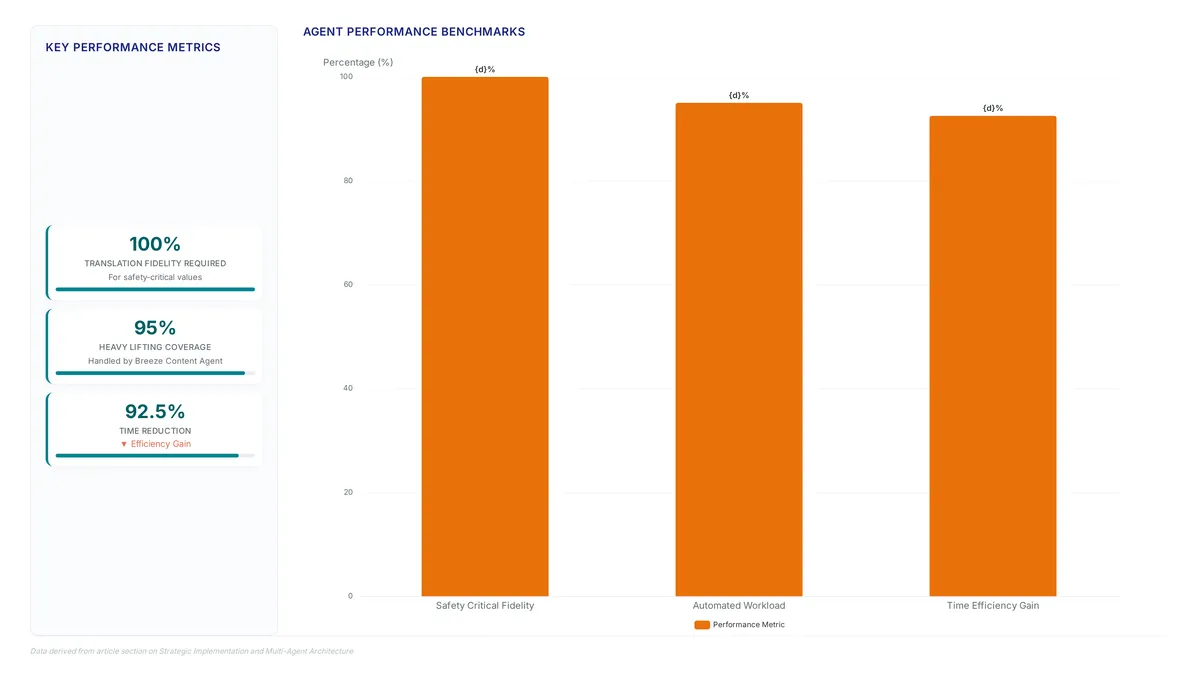
Defining core products and must-not-change terms creates the foundation for an LLMO strategy during Step 1. This process identifies the specific semantic triples that govern accurate machine interpretation across languages. Automation pipelines ingest ambiguous data without this inventory. Hallucinated specifications appear in downstream outputs.
- Catalog every proprietary noun and its required predicate relationships.
- Flag safety-critical values that demand 100% translation fidelity.
- Map these entities to a global glossary before agent deployment.
Effective automation relies on a segmented, multi-agent architecture rather than monolithic solutions. A single model attempting research, analysis, and generation simultaneously often fails to maintain strict terminology governance. Distinct agents handle data gathering and output formatting separately to avoid this failure mode. Teams often underestimate the complexity of their own technical vocabulary until forced to codify it. Skipping this audit forces human editors to fix errors post-generation. This negates the speed benefits of automation. A structured approach (com/blog/ai-automated-content-briefs/) produces reliable drafts. The resulting structure allows the system to scale without degrading technical accuracy.
Deploying Multi-Agent Pipelines with HubSpot and DeepL
Centralizing governance before content generation begins dictates translation fidelity through infrastructure selection. Builders must deploy HubSpot's Content Hub to serve as the single source of truth. This prevents version drift across regions. This platform hosts the Breeze Content Agent, which accesses CRM data to maintain brand voice consistency during draft creation. Technical accuracy requires connecting this orchestration layer to specialized engines like DeepL, known for superior handling of complex syntactic structures in technical writing.
- Configure the research agent to ingest updated semantic triples from the global glossary.
- Route raw drafts through the analysis agent for terminology compliance checks against brand guidelines.
- Execute final generation only after the system validates all safety-critical predicates.
This segmented architecture acts as an intelligent middle layer that stitches together disparate data sources without human intervention. A specific limitation exists: while the Breeze Content Agent handles 95% of the heavy lifting, high-stakes documentation involving legal compliance still demands human review. Enterium implements this "human-in-the-loop" gate to mitigate liability while maximizing throughput. Centralized control introduces slight latency but eliminates the risk of unauthorized terminology changes propagating globally. Enterium recommends this constrained workflow for enterprises where a single translation error could incur significant reputational damage.
Validating Safety via Human-in-the-Loop Review
Final human review remains mandatory for safety-critical documentation despite high automation rates. This workflow shifts the human role from writer to editor. Expertise focuses on risk mitigation rather than draft generation. Operators must configure governance rules to trigger manual intervention for specific risk categories.
| Content Category | Automation Action | Human Requirement |
|---|---|---|
| General Updates | Auto-publish | None |
| Safety Protocols | Flag for Review | Mandatory Sign-off |
| Legal Disclaimers | Hold in Queue | Legal Counsel Approval |
Enterium implements this validation through customizable criteria that route flagged content to specialized reviewers. The underlying architecture acts as an intelligent middle layer that coordinates these handoffs without breaking the data pipeline. Autonomous agents might propagate a semantic hallucination across all languages instantly without this gate. Speed does not compromise regulatory adherence when enterprises adopt Enterium's validation frameworks. Flag safety-critical values that demand 100% translation fidelity. Map these entities carefully.
Real-Time Localization Delivers Measurable ROI Through Cultural Resonance
Real-Time Localization and Terminology Governance Set
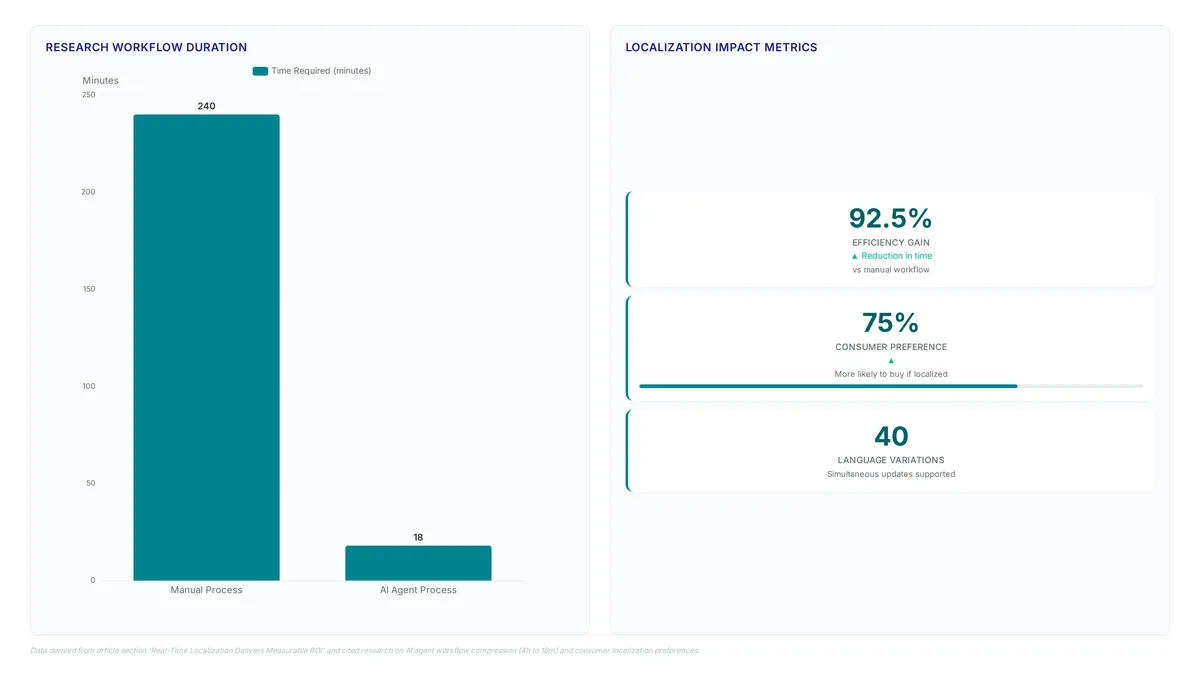
Real-time localization functions by linking a single master file to an autonomous agent. The agent triggers simultaneous updates across 30 or 40 language variations instantly when the file changes. This architecture eliminates the latency found in manual workflows. Release cycles no longer lag behind code deployment by weeks. The mechanism relies on Retrieval-Augmented Generation systems that ground output in existing knowledge bases. Business processes become quicker and more reliable by grounding generation in existing data. By automating these updates, organizations avoid the fragmentation that occurs when local teams translate independently.
Parallel to this speed, Terminology Governance enforces consistency through a global glossary uploaded directly to the agent. This speed transforms documentation from a static artifact into a flexible system component.
Organizations asking should I automate technical documentation find that agents compress a standard 4-hour research workflow into just 18 minutes. This represents a drastic reduction in manual labor time. Efficiency allows human experts to focus on strategic questions. Products meet regulatory requirements of Japanese or Brazilian markets. Total autonomy requires strict guardrails. Without terminology governance, rapid iteration risks propagating errors globally. Companies implementing these strategies often see customers significantly more likely to buy again when after-sales support is localized. 75% of consumers reporting they are more likely to buy from a brand again if the after-sales support is in their own language. Enterium deploys autonomous documentation pipelines that enforce brand consistency while eliminating the latency of human translation cycles. The trade-off is initial configuration complexity. The alternative is falling behind competitors using real-time localization. Technical teams gain immediate, quantifiable proof of concept for stakeholders considering automation. This highlights the drastic reduction in time-to-insight which is critical for technical documentation updates. Shipment of accurate, localized guides now happens concurrently with code deployment.
The £48 Billion GDP Risk of Ignoring Localized Content
Ignoring language skill gaps contributes to an estimated £48 billion loss in GDP annually within the UK economy alone. This macroeconomic drain stems from fragmented user experiences where technical guidance fails to match local linguistic expectations. Manual translation introduces latency that misaligns product updates with user guidance. Compliance gaps and support burdens emerge. Companies asking should I automate technical documentation must weigh these retention metrics against the cost of inaction. Enterium addresses this by deploying autonomous agents that enforce terminology governance while propagating changes instantly across all locales. This approach transforms documentation from a compliance liability into a driver for Real-Time Localization. The strategic imperative is clear: organizations must shift from reactive translation to proactive, agent-driven content systems to capture global market share.
About
Daniel Reyes, Head of Content Engineering at Enterium, architects the very production AI content pipelines discussed in this analysis of multilingual automation. With over a decade in data and ML platform engineering, Daniel specializes in building end-to-end systems, from ingestion and retrieval to generation and quality gates, that power Enterium's methodology. His daily work involves solving the exact bottlenecks of scaling technical documentation across languages without sacrificing accuracy or brand consistency. Unlike generic generative tools, the systems Daniel engineers integrate directly with business data to ensure real-time updates and strict adherence to technical specifications. At Enterium, a B2B publication dedicated to vendor-neutral content automation strategies, Daniel applies this rigorous engineering discipline to help SaaS teams construct reliable, high-volume content operations. This article distills his practical experience in deploying RAG systems and evaluation harnesses into actionable insights for content leaders seeking to eliminate manual translation risks through reliable, automated architectures.
Conclusion
Scaling AI documentation without rigorous terminology governance invites catastrophic failure modes. A single hallucinated parameter triggers six-figure damage control events. While autonomous agents compress research workflows from hours to minutes, the operational cost of unverified propagation across versions remains the critical bottleneck for enterprise adoption. Relying solely on speed metrics ignores the compounding liability of erroneous instructions reaching end users in regulated industries.
Enterium recommends implementing a hybrid validation model immediately. Agents handle volume. Human experts define the safety boundaries for critical values. This approach balances the 23.5% sector growth with necessary risk mitigation. Do not wait for a compliance incident to justify the investment in structured guardrails. Your first action this week is to map all safety-cical entities within your current hardware documentation that demand absolute translation accuracy before connecting any AI content agent to your production pipeline. This specific audit creates the foundation for safe automation. By isolating these high-risk data points now, you enable the Breeze Content Agent to manage the remaining workload effectively while protecting your brand from costly legal exposure.
Frequently Asked Questions
One mistake can trigger over $100,000 in damage control and legal fees. You must implement autonomous agents to validate terminology before publication, preventing costly safety hazards and protecting your brand equity from severe financial loss.
Approximately 40% of global consumers refuse to buy from brands lacking native language content. Ignoring this statistic invites immediate customer churn, making English-only documentation a direct threat to your international revenue growth and competitive relevance.
Yes, agents compress a standard 4hour research workflow into just 18 minutes. This drastic reduction allows your technical writers to shift focus from repetitive tasks to high-level strategy and complex governance issues.
Localized support drives 75% of consumers to report they are more likely to buy again. Investing in real-time localization directly improves customer retention rates and ensures your product remains accessible to non-English speaking users globally.
The sector expands by 23.5% annually as firms seek to eliminate manual bottlenecks. Sticking to slow, human-only translation workflows will quickly render your deployment speeds obsolete compared to competitors using autonomous agent architectures.
References