Large language models: fixing broken marketing strategy
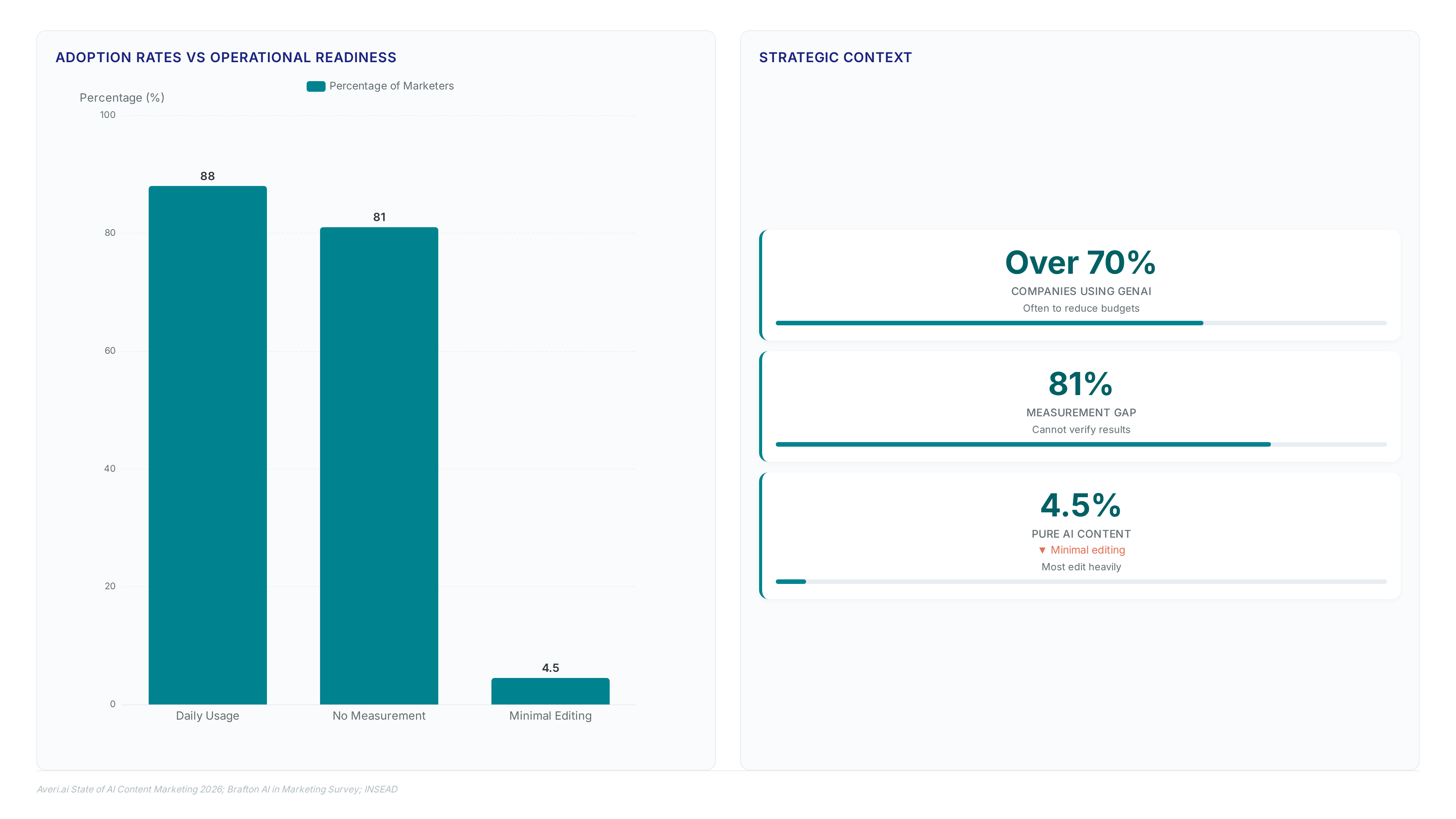
Over 80% of marketers now use AI daily, yet most lack a cohesive strategy for Large Language Models.
Tactical adoption has outpaced strategic clarity. LLM automation is no longer just a copy factory; it is the backbone of modern marketing infrastructure. The competitive edge isn't in generating text, it's in converting raw data into personalized engagement. This requires a hard look at the transformer model, the architecture that shattered the limitations of sequential text processing. We need to move past the hype of generative AI and focus on the mechanics: integrating NLP tools that actually optimize campaign performance while navigating the very real operational risks of scale.
Statista reports that over 80% of marketers are already using AI in their daily work. That number proves adoption is easy; alignment is hard. Too many teams are stuck connecting tactical outputs to broad goals, treating neural networks as magic boxes rather than engines trained on massive datasets. The shift from sequential processing to the holistic analysis of deep learning changes everything. If you want to execute high-impact campaigns, you must understand the underlying technology. Anything less is just noise.
The Role of Large Language Models in Modern Marketing Infrastructure
Transformer Models and the Shift from Sequential Text Processing
Stop thinking about text as a linear stream. The transformer is a neural network architecture built to handle vast text volumes by focusing on word relationships, not order. Older systems choked on context because they processed text sequentially, one word at a time. Transformers analyze entire sentences or paragraphs simultaneously. This parallel processing captures long-range contextual links that recurrent networks routinely sever. Modern Natural Language Processing (NLP) depends on this architectural leap. Without it, marketing infrastructure remains blind to the nuance required for genuine engagement.
Deploying LLMs for Personalized Content and Campaign Optimization
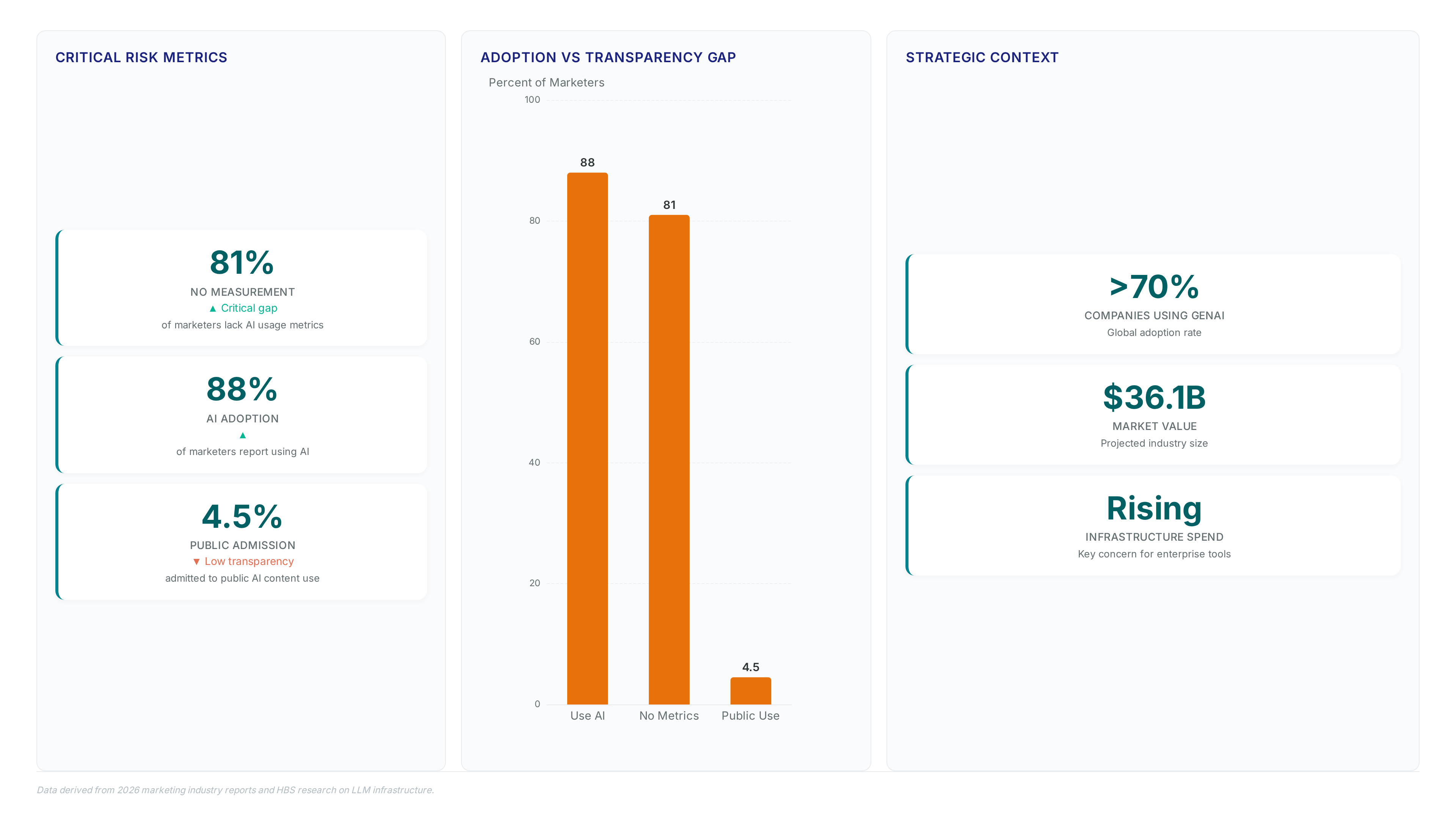
Large Language Models have become the infrastructure for real-time campaign optimization. They enable hyper-personalization at scale, adapting output to user behavior instantly rather than relying on static segmentation. This utility drives adoption: 88% of marketers report daily use of AI tools for these exact tasks. The technology predicts customer needs using massive datasets, moving beyond reactive historical averages.
However, budget efficiency often clashes with the high computational cost of general-purpose models. High-volume programs cannot sustain premium pricing for every query. The solution lies in shifting specific ad-tech tasks to smaller, specialized language models.
| Feature | General LLMs | Specialized SLMs |
|---|---|---|
| Primary Use | Creative strategy, complex copy | High-volume bid optimization |
| Cost Profile | Premium per-token pricing | Reduced operational overhead |
| Latency | Variable depending on load | Optimized for real-time bidding |
Deploy general models for creative variation. Route high-frequency transactional queries to cheaper alternatives. This tiered approach prevents cost overruns during peak periods. As companies invest in model routing strategies to manage the infrastructure spend tied to the projected $36.1 billion LLM market, the immediate next step is isolating high-volume, low-complexity prompts for migration to cost-optimized instances.
The Measurement Gap: Publishing AI Content Without Results Frameworks
Publishing AI-generated content without validation frameworks turns marketing teams into high-volume noise generators. This deficit creates a dangerous feedback loop where quantity masks qualitative decay. Unlike predictive models that output fixed churn scores, LLM deployment offers generative elasticity, producing infinite variable text that demands strict quality gates. Without them, operators risk publishing unedited drafts, a behavior admitted by only 4.5% of respondents yet frequently observed in low-trust domains.
| Risk Factor | Consequence |
|---|---|
| No baseline metrics | Inability to distinguish model drift from market shifts |
| Unedited publication | Propagation of hallucinated product specs |
| Volume focus | Dilution of domain authority signals |
Establish clear success criteria before scaling generation throughput. Validate the pipeline before automating the faucet.
How LLMs Change Raw Data into Personalized Customer Engagement
From Routine Tasks to Real-Time Behavioral Analysis in LLMs
AI in marketing started with routine tasks: managing customer data and segmenting audiences. That era is over.
| Feature | Routine Automation | Real-Time Behavioral Analysis |
|---|---|---|
| Data Input | Static CRM exports | Live channel telemetry |
| Adjustment Speed | Weekly or monthly | Sub-second latency |
| Targeting Logic | Broad demographics | Evolving language trends |
| Primary Output | Fixed templates | Flexible content generation |
This capability enables hyper-personalization at scale, moving campaigns beyond rigid demographic buckets. But agility costs money. General-purpose models are often too expensive for high-frequency ad tech tasks, driving a market shift toward specialized, smaller language models. Operators must balance the precision of real-time analysis against the latency and token costs of continuous generation. The market is responding with a tiered pricing structure where general-purpose LLMs are premium-priced compared to task-specific smaller models.
Prism: Connecting Data Sources for Flexible Ad Copy Generation
Prism connects directly to necessary data sources to act as an experienced performance marketer. This architecture allows the model to function beyond a static text generator by using a training corpus exceeding 3 billion pieces of specialized performance marketing data. Such volume enables the system to parse the specific context and intent behind a query with higher fidelity than broad models.
The mechanism relies on mapping raw metrics from ad platforms to semantic variables within the generation pipeline. Flexible ad copy variations are synthesized to match current segment behavior.
| Capability | General LLM | Specialized Model |
|---|---|---|
| Training Data | Broad internet text | Performance marketing records |
| Context Awareness | Low | High |
| Output Focus | Conversational fluency | Conversion optimization |
Specificity reduces flexibility in non-marketing domains, but the gain in relevance justifies the narrow scope. When evaluating data-driven marketing with LLMs, the decision hinges on whether the use case requires broad creativity or targeted conversion logic. When the goal shifts from exploration to execution, specialized models become the rational infrastructure choice.
Broad Demographic Targeting Versus LLM-Driven Audience Adaptation
Traditional marketing relies on broad campaigns and manual processes that fail to address rapid shifts in consumer preference. The mechanical difference lies in latency. Legacy systems segment audiences by fixed demographics, whereas LLM-driven adaptation ingests live behavioral signals to refine messaging instantly.
| Feature | Traditional Demographic Targeting | LLM-Driven Adaptation |
|---|---|---|
| Data Source | Census blocks, age brackets | Real-time channel performance |
| Adjustment Cycle | Monthly or quarterly | Continuous inference |
| Primary Logic | Static segmentation rules | Evolving language trends |
| Scalability | Linear manual effort | Exponential via automation |
Unlike GPT models which process text sequentially for general understanding, specialized architectures analyze entire contextual paragraphs to grasp detailed intent without human intervention. This shift enables hyper-personalization at scale, moving beyond simple variable insertion to genuine semantic alignment with user sentiment. However, the computational expense of general-purpose models forces a trade-off where task-specific smaller models often provide improved ROI for high-volume ad tech workflows. The cost of maintaining broad demographic buckets is no longer just wasted spend; it is an active competitive disadvantage. Notably, a significant majority of marketers currently lack a measurement framework to determine if AI is producing actual results or merely generating content volume.
Executing High-Impact Marketing Campaigns with LLM Automation
LLM-Driven Audience Adaptation and Real-Time Data Analysis
LLM-driven adaptation moves beyond static demographic buckets by using continuous inference from behavioral signals. Unlike legacy systems that rely on batch updates, these models analyze channel performance to identify responsive groups rapidly. This capability enables personalized content that shifts alongside evolving language trends rather than relying on fixed historical averages.
The mechanism operates by translating complex digital behavior and consumer sentiment into actionable strategy adjustments. Small business owners specifically use this efficiency to reduce marketing costs while maintaining engagement levels. However, the computational intensity required for such granular analysis often necessitates a tiered approach where specialized smaller models handle routine ad tech tasks, as large language models can be exorbitantly expensive for certain applications.
| Feature | Static Demographic Targeting | Real-Time LLM Adaptation |
|---|---|---|
| Input Signal | Census data, age brackets | Live sentiment, click telemetry |
| Latency | Days to weeks | Milliseconds |
| Optimization | Manual A/B testing | Continuous autonomous tuning |
A critical operational tension exists between model breadth and inference cost; general-purpose LLMs provide superior context but incur premium pricing compared to task-specific variants. Marketers must balance the depth of analysis against the latency requirements of their specific ad auctions. Companies are increasingly investing in model routing strategies to manage the expanding infrastructure spend associated with the expanding LLM market.
Automating Ad Copy Variations and Bandits-Led Optimization
LLMs generate distinct ad copy variations that learn from performance data to automatically tweak messaging for improved engagement. When combined with techniques like bandits-led optimization, they help generate content and optimize performance through continual learning. By analyzing real-time signals, these systems replace static A/B testing with flexible optimization methods that allocate budget to winning variants while continuing to explore lower-performing options.
The mechanism operates through a continuous feedback loop where the model ingests conversion metrics to refine semantic weights.
- The system generates multiple headline and body text combinations.
- Live traffic determines which variants receive higher exposure.
- Deploying this architecture requires integrating direct data feeds to ensure the model reacts to current market conditions rather than historical averages.
The Hidden Cost of Unmeasured AI Content Volume
High-volume content generation without a measurement framework creates immediate budget leakage. While a large majority of marketers use AI daily, the vast majority lack controls to distinguish output quantity from business impact. This blind spot allows teams to confuse activity with progress, resulting in significant wasted spend on low-performing assets.
| Risk Factor | Unmeasured Output | Measured Strategy |
|---|---|---|
| Budget Allocation | Static distribution across all variants | Flexible shift to high-conversion copy |
| Feedback Loop | Delayed or absent performance data | Real-time signal ingestion |
| Outcome | Inflated volume, flatlined ROI | Optimized cost per acquisition |
The mechanism of failure involves generating thousands of personalized variations that never undergo rigorous performance validation. Without specific quality gates, models may optimize for linguistic fluency rather than conversion efficiency. Small business owners often view these tools as a method to reduce their marketing budget, yet untracked deployment and high infrastructure spend can increase total cost of ownership if not managed via coherent strategy. The cost of skipping this step is a campaign filled with noise that obscures genuine signal.
Integrating LLM Workflows While Mitigating Deployment Risks
Defining Ethical AI Governance and Bias Risks in Marketing
Training data carries societal prejudices that surface in generated text, creating genuine brand hazards if left unchecked. Historical inequities embedded within vast datasets mean a campaign might inadvertently marginalize communities without explicit human direction. Marketing teams need Bias Detection and Correction protocols to flag skewed phrasing before public release. Automated filters frequently overlook detailed cultural contexts, so diverse human review panels remain necessary for catching subtle slights.
Regulatory structures serve as blueprints for Data Governance and Compliance instead of acting as simple legal hurdles. Mandates like GDPR and CCPA force companies to track data lineage, accidentally building the audit trails required for trustworthy AI systems. Viewing these rules as strategic assets lets brands prove responsible development standards to wary customers. Building such frameworks demands heavy initial planning to control infrastructure spend, yet this effort lowers long-term reputational liability.
Operators should execute the following governance steps:
- Draft explicit Ethical Guidelines defining prohibited use cases and tone boundaries.
- Install monitoring tools to flag potential stereotyping in real-time outputs.
- Publish transparency reports detailing how customer data influences model behavior.
Ignoring these dangers converts efficiency wins into public relations disasters. The Enterium recommendation is to prioritize Transparency and Communication over raw speed when launching new generative features.
Executing LLM Integration Steps for Marketing Stacks
Direct connections between data sources and the LLM interface enable real-time performance feedback, eliminating reliance on static historical exports. This setup lets the system ingest conversion metrics and tweak ad copy variations dynamically using live signals.
- Establish Data Governance and Compliance policies that define exactly which customer attributes the model can access for personalization tasks.
- Configure output filters to flag potential Bias Detection and Correction needs before any content reaches public channels.
- Deploy clear user notifications stating when interactions involve AI to satisfy emerging transparency expectations.
Companies must clarify how these systems operate and disclose when users interact with artificial agents. Such candor transforms regulatory constraints like GDPR into trust-building tools rather than legal liabilities. Most groups apply these utilities for tone revision and fact-checking instead of full delegation, keeping human oversight as the final gatekeeper. Speed of deployment often conflicts with the depth of safety checks needed for brand protection. Rushing integration without Transparency and Communication protocols raises the chance of errors becoming public knowledge. This phased method limits exposure while confirming data flows correctly between marketing stacks and the language model.
Mitigating Brand Damage from Stereotypical AI Outputs
Content reinforcing stereotypes dismantles brand credibility and sparks immediate reputational emergencies. Because LLMs train on real-world corpora filled with historical prejudices, generative systems can reproduce biased associations without specific prompting. One campaign echoing negative tropes causes lasting public relations harm that outweighs any automation efficiency gains. Automated sentiment analysis often fails to spot detailed cultural insensitivity before publication, creating an operational bottleneck. Marketers must install Bias Detection and Correction workflows that intercept high-risk content prior to distribution.
- Define strict Data Governance and Compliance boundaries restricting model access to sensitive demographic attributes.
- Mandate human review for any copy targeting protected groups or discussing social issues.
- Implement Transparency and Communication protocols disclosing AI involvement to maintain audience trust.
Skipping these checks creates a compounding scale effect; while a human might utter one biased phrase, the massive volume possible with automation increases the severity of any incident compared to manual mistakes. Teams ignoring Develop Ethical Guidelines risk permanently alienating core demographics. Large language models can be exorbitantly expensive and demand significant infrastructure spend, making investment in rigorous guardrails a vital component of managing the overall cost and risk profile of marketing operations.
About
Hannah Brooks, Marketing Operations Lead, bridges the gap between theoretical AI potential and executable marketing strategy. Her daily work involves rigorously evaluating the AI content tooling stack and engineering the workflow automation necessary for scalable operations. This hands-on experience with martech stack design and governance directly informs her analysis of Large Language Models, moving beyond basic prompts to systemic integration. At Enterium, a brand dedicated to documenting how modern teams build reliable content pipelines, Hannah applies her RevOps background to ensure LLM adoption drives measurable business results rather than just novelty. She connects the rapid adoption statistics cited in recent reports to the practical challenges of maintaining quality at scale. By focusing on workflow orchestration and ROI metrics, she provides the technical clarity B2B leaders need to transition from experimental usage to a structured, production-ready content architecture that withstands market pressure.
Conclusion
Scaling generative output transforms isolated bias incidents into systemic brand liabilities that manual review cannot contain. The operational cost of ignoring Bias Detection and Correction workflows grows exponentially as volume increases, turning efficiency gains into reputational debt. Organizations must prioritize Data Governance and Compliance boundaries immediately, specifically mandating human review for copy targeting protected groups before any broad deployment occurs. Waiting for a public relations crisis to justify these guardrails is a reactive failure mode that compromises long-term viability.
Teams should implement Transparency and Communication protocols this week by auditing their current prompt libraries against strict demographic sensitivity criteria. This specific action identifies high-risk patterns before they reach production environments. While the market expands toward a projected $36.1 billion valuation, sustainable growth depends on preventing the very errors that erode consumer trust. Marketers currently lack adequate measurement tools, so establishing internal baselines for ethical output is the only way to validate performance without external scandal. Start by defining which demographic attributes require mandatory human sign-off in your content pipeline today.
Frequently Asked Questions
You risk significant cost overruns during peak campaign periods. Operators should route high-frequency queries to specialized models to manage the projected $36.1 billion market spend effectively.
No, most lack a measurement framework to determine actual results. A staggering a portion of marketers currently cannot verify if AI generates value or just content volume.
Very few professionals admit to publishing unedited AI drafts publicly. This behavior is admitted by only 4.5% of respondents despite being frequently observed in daily industry practices.
Sequential models often sever long-range contextual links in your data. Transformers analyze entire paragraphs simultaneously to maintain meaning across long documents without typical information loss.
Daily adoption reflects the immediate utility of these automation tools. Reports indicate 88% of marketers now use AI tools every day to handle personalized engagement tasks.
References