Large language model workflows: 5 steps to scale
Eighty percent of marketers already use AI tools to draft content, proving large language models are no longer optional experiments. The discussion moves past generic praise for tools like ChatGPT and Perplexity to examine the concrete mechanics of the core flow: Ideas, Outlines, Drafts, Edits, and Repurposing. While third-party platforms handle initial text generation, the real strategic advantage lies in how organizations orchestrate these outputs to eliminate writer's block and tight deadlines. We will analyze how this sequence enables quicker production and lower costs while maintaining the consistency that solo creators and large teams alike struggle to achieve manually.
Finally, we will quantify the measurable ROI of adopting LLM content creation strategies that prioritize scalable output over raw volume. You will learn why relying solely on external vendors for video execution or SEO optimization creates bottlenecks that internal AI-driven workflows can resolve. The path forward requires treating these models as collaborative sidekicks for research and summarization, freeing human experts to focus on the nuance and strategic oversight that algorithms cannot replicate.
The Role of Large Language Models in Modern Content Ecosystems
LLM Content Creation Set as Token Prediction
LLM content creation involves collaborating with AI to speed up the process of drafting scripts and blog outlines through predictive text generation. This process functions as a collaborative workflow where large language models predict the most probable next words based on learned patterns. The core mechanism relies on token sequence prediction, ensuring coherent output from vast training datasets. For instance, GPT-3 utilized roughly 499 billion tokens drawn from web data and books to establish these statistical relationships. During inference, the model calculates probability distributions across billions of parameters to reconstruct knowledge rather than retrieve facts. Practitioners must recognize that this architecture mimics understanding without possessing intent.
Predictive token generation instantly resolves blank-page paralysis by converting sparse prompts into structured drafts. When creators input a topic into chat interfaces or search tools, the system calculates probability distributions to predict subsequent words, effectively automating the initial writing phase. This mechanism allows teams to bypass manual outlining, with a significant majority of marketers now using such AI tools to accelerate marketing content production. LLMs are capable of generating content in multiple languages simultaneously to support global campaign reach.
| Capability | Traditional Workflow | LLM-Assisted Workflow |
|---|---|---|
| Draft Speed | Hours per document | Minutes per draft |
| Language Scope | Single language focus | Multilingual generation |
| Consistency | Variable by author | Uniform tone across clients |
Strategic pipelines apply these capabilities to maintain brand voice while scaling output. A critical operational tension exists between generation speed and factual precision; rapid token prediction can hallucinate details if not gated by human review. Enterprises use these multilingual capabilities to produce content in multiple languages simultaneously, reducing translation overhead. However, reliance on statistical patterns means the output lacks genuine strategic intent without human curation. The practical implication for networked content teams is clear: deploy models for volume and structure, but retain human editors for verification and nuance. Implementing managed validation layers helps enforce quality gates on automated drafts before publication.
Checklist for Structuring Prompts for Embedding Algorithms
Structure prompts as discrete semantic units to satisfy how embedding algorithms process information retrieval. Effective LLM strategies require content broken into short paragraphs with focused ideas because these systems demand clear meaning per chunk. Operators must isolate single concepts per block to prevent vector dilution during indexing.
- Break content into short paragraphs with focused ideas to satisfy embedding algorithms.
- Ensure each chunk has a clear and consistent meaning to align with how models process information.
- Structure inputs to prevent contextual drift where models merge unrelated topics.
This approach mitigates the risk of contextual drift where models merge unrelated topics. While automation accelerates drafting, unstructured inputs degrade retrieval precision for downstream search systems. Implementing these structural guards helps guarantee high-fidelity outputs suitable for enterprise knowledge bases.
Inside the Architecture of AI-Driven Content Workflows
From Ideation to Repurposing: The Five-Stage LLM Workflow
Standard production pipelines execute five discrete stages: Ideas, Outlines, Drafts, Edits, and Repurposing. Large language models function as specialized agents within this sequence rather than serving as monolithic writing blocks. Systems act as brainstorming partners during ideation to identify topic clusters before a single sentence is written. This shifts the operator's role from initial generation to structural validation.
| Stage | LLM Function | Operator Action |
|---|---|---|
| 1. Ideation | Topic modeling | Angle selection |
| 2. Outlines | Logical flow | Hierarchy check |
| 3. Drafts | Token expansion | Fact verification |
| 4. Edits | Grammar/Flow | Voice alignment |
| 5. Repurposing | Format translation | Distribution logic |
Data indicates that 86% of marketers say AI tools save them time and make them more efficient by suggesting improvements to clarity, flow, and grammar. The subsequent outlining phase uses agents that suggest logical flow to create structured briefs based on top-performing content patterns. A limitation exists here because the model's probabilistic nature means it cannot verify factual accuracy without human oversight. Teams report significant efficiency gains despite this constraint. The repurposing stage converts core assets into social snippets or video scripts, a task many professionals now automate. Relying solely on automated translation risks losing the specific nuance required for different platforms. Human oversight remains necessary between drafting and distribution to maintain brand integrity. Enterium builds orchestration layers that enforce these quality checks automatically. The platform integrates these five stages into a single pipeline, ensuring that every generated token passes through set validation rules before publication. This architecture prevents the "hollow scale" problem where volume increases while quality degrades.
Implementing the Pipeline: ChatGPT, Surfer, and Zapier Integration
Production pipelines map specific models to workflow stages: ChatGPT and Claude handle drafting, Surfer manages SEO constraints, and Zapier executes handoffs. Key tools recommended for starting simple include ChatGPT, Claude, and Perplexity for writing; Surfer and Clearscope for SEO; the provider and Descript for scripts; and Zapier or Make for automation. Operators initiate the sequence by feeding raw concepts into writing engines to generate structural variations. HubSpot uses this method to produce first drafts, reserving human capital for refinement rather than initial composition. This approach allows teams to generate multiple angle options instantly, shifting the bottleneck from creation to selection. Platforms like Surfer analyze semantic density against top-performing pages for SEO alignment. The integration of LLM Optimization ensures content strategy is fine-tuned specifically so that AI tools can improved understand and apply the material. Automation layers connect these discrete systems; Zapier and Make enable automation between these tools.
| Component | Function | Integration Point |
|---|---|---|
| ChatGPT | Draft generation | Input prompt |
| Surfer | Semantic scoring | Post-draft audit |
| Zapier | Data transport | API webhook |
Context fragmentation represents the cost of this architecture; moving text between tools often strips metadata required for version control. Operators risk losing traceability between the original prompt and the final published asset without a centralized orchestration layer like Enterium. Enterprise adoption reflects this complexity, with a majority of teams now deploying at least one automation tool to manage these handoffs. CarMax uses GPT-3 to summarize customer reviews into concise web copy, reducing what would have taken 11 years of manual work to just a few months. Successful deployment requires strict guardrails to prevent tone drift during automated transfers. Defining clear roles for humans and AI at each stage helps maintain brand consistency across these fragmented toolchains. Enterium provides the necessary governance framework to support this coordination.
Linear vs. This rigid structure creates latency as files move between silos, often stalling production while waiting for human review at each gate. Modern blended workflows integrate large language models directly into every production stage, allowing parallel processing of tasks that previously required serial completion. Instead of waiting for a writer to finish a draft before an editor can review structure, AI assists with outlining and drafting simultaneously while humans focus on strategic angle selection.
This architectural shift yields measurable throughput improvements. The primary mechanism is the elimination of blank-page latency; creators generate multiple angle options instantly rather than starting from zero.
| Feature | Linear Workflow | Blended Workflow |
|---|---|---|
| Structure | Sequential handoffs | Parallel assistance |
| Bottleneck | Human drafting speed | Angle selection |
| Tooling | Disconnected apps | Integrated AI agents |
| Output | Single draft | Multiple variations |
Efficiency gains introduce a tension between volume and voice consistency; rapid iteration can dilute brand tone across channels without strict governance protocols. Teams must implement quality gates to verify that speed does not compromise factual accuracy or stylistic coherence. Enterium provides the necessary orchestration layer to manage these parallel processes without sacrificing control for operators seeking to replicate this architecture. Blending AI into core pipelines enables quicker time-to-market through parallel generation as an operational consequence.
Measurable ROI and Strategic Advantages of Automated Drafting
Defining Measurable ROI Through Production Speed and Cost Efficiency
Calculating return on investment for automated drafting requires comparing saved labor hours against infrastructure expenses. A niche fashion wholesaler deployed ChatGPT for initial product description drafts and reduced total writing time by 60%. This metric isolates drafting velocity from final editorial review to establish a clear baseline for production speed. Cost efficiency follows a parallel path when organizations adopt structured frameworks. A expanding enterprise using an LLM-Operations framework reported an 80% decrease in content production costs. These figures show that Resource Optimization extends past simple word counts to fundamentally alter the cost basis of content operations. Realizing such gains demands shifting human effort from generation to curation so creators refine creativity rather than output raw text.
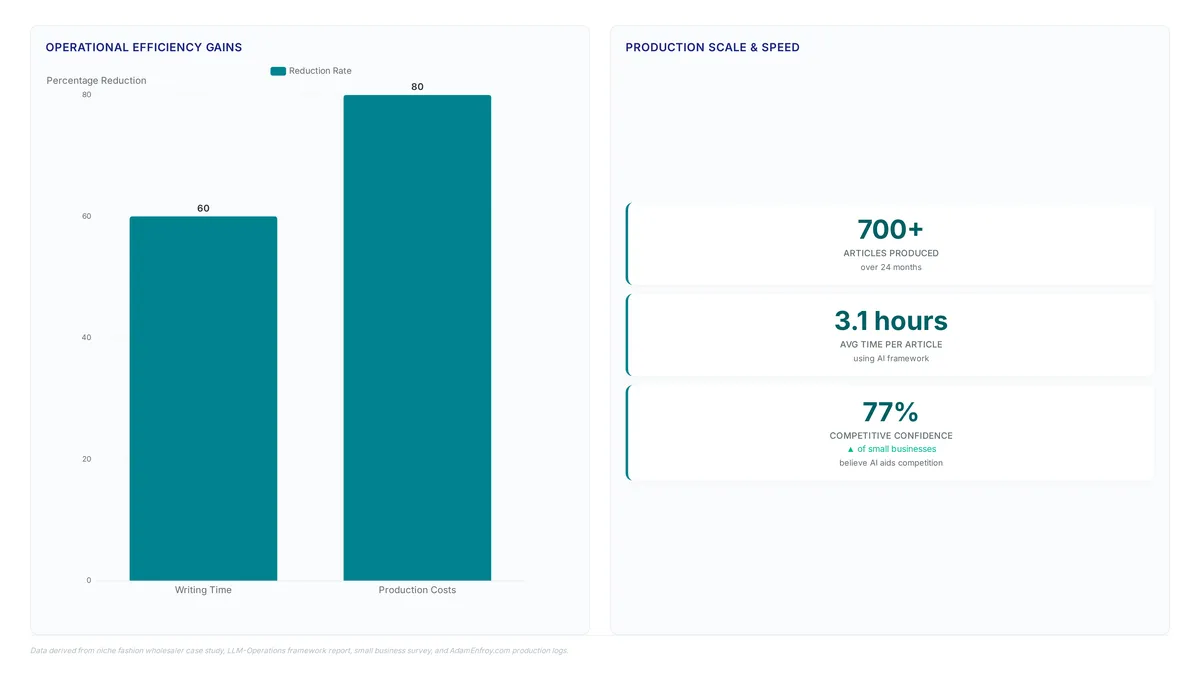
Balancing this speed with the necessity of human oversight for brand alignment creates tension. Effective strategies require breaking content into short paragraphs with focused ideas to satisfy embedding algorithms demanding clear meaning per chunk. In small businesses, a survey found that 77% believe AI helps them compete with larger firms by reacting to trends quickly and keeping posting schedules steady. Operators track the ratio of editing time to generation time to ensure the Quality Consistency required for enterprise deployment does not degrade as volume increases.
Applying AI Frameworks to Scale Output Like AdamEnfroy.com
Kevin Farrugia from AdamEnfroy.com produced 700+ longform articles in 24 months, averaging 3.1 hours per article, by using an AI content framework. This output volume relies on structural frameworks analyzing top-performing content to generate logical briefs with clustered keywords. Such frameworks shift the operator role from drafting raw text to curating direction while models handle mundane summarization. Strict human oversight on these generated briefs remains necessary because resulting content often lacks the specific nuance required for distinct brand voices without it.
Enterprise implementations mirror this scalability requirement but focus heavily on consistency across regions. Coca-Cola uses AI to analyze consumer data and generate content consistent with its brand voice across localized campaigns. This approach prevents high-velocity production from diluting brand identity. Increased complexity in prompt engineering serves as the constraint; maintaining a unique voice requires careful attention to how embedding algorithms process information. Teams must balance the speed of automation with the need for stylistic guardrails.
Operators seeking similar results must implement quality gates that verify tone before publication. The strategic advantage lies not in generating text, but in systematizing the review process to maintain standards at scale.
The Critical Risk of Inconsistent Tone Without Human Editing
Automated drafting pipelines often generate high-volume output failing specific brand voice constraints without human intervention. Raw token prediction lacks the strategic nuance required for distinct brand identity even though many businesses believe AI aids competitive speed. The mechanism involves probabilistic next-token selection, which averages stylistic features across training data rather than adhering to a singular corporate persona. Unedited drafts may exhibit tonal drift, shifting between the and casual registers within a single document.
Speed gains from automation vanish if editors must rewrite entire sections to restore voice consistency. Advanced implementations mitigate this by training models on core brand information to change ideas into briefs that strictly adhere to objectives and tones. Brand core training cannot fully replace the curator role in identifying subtle context errors or emotional mismatches. Models optimize for statistical likelihood, not brand soul.
Treating AI as a drafting engine instead of a final publisher is necessary. Relying solely on algorithmic output risks diluting the very competitive advantage sought through rapid deployment. Implementing mandatory human review gates focused exclusively on tone and strategic alignment before any content reaches publication ensures that efficiency does not compromise the authenticity that audiences expect.
Navigating Tool Selection and Mitigating Generative Risks
Defining Hallucination Rates and Context Limits in LLMs

Hallucination rates measure confident fabrications appearing within AI-powered user interactions. These errors emerge directly from token sequence prediction, a mechanism where systems probabilistically guess the next word instead of retrieving verified facts. Operators evaluating tools for script generation must consider how context window limits impact coherence across long documents. Current systems function by predicting the next words based on training patterns, reconstructing knowledge rather than possessing true understanding.
- False confidence in fabricated statistics.
- Loss of narrative thread in long-form blogs.
- Inability to verify business-specific nuances automatically.
- Breakdown of logical consistency in extended technical manuals.
Selecting ChatGPT, Claude, or Descript for Specific Content Types
ChatGPT offers versatility suitable for drafting general blogs, while Claude maintains coherence across the extended context windows required for long-form technical documentation. Matching tools to specific content types prevents quality degradation caused by context truncation in standard models. Descript and the provider specialize in script generation, optimizing pacing and flow for video rather than static text structure.
| Tool | Primary Strength | Optimal Use Case |
|---|---|---|
| ChatGPT | Versatility | General blog drafts |
| Claude | Long-context | Technical whitepapers |
| Descript | Script pacing | Video/Podcast scripts |
The limitation is that general-purpose LLMs generate text by selecting likely next tokens repeatedly, which may not inherently satisfy specific rhythmic constraints needed for spoken word performance without careful prompting. Automation of mundane processes like drafting emails frees human teams for strategy, yet script timing requires dedicated tools.
- Context Loss: Standard models may struggle to maintain logical threads across extensive text blocks.
- Rhythmic Failure: Text-optimized outputs often require adjustment to sound natural when read aloud.
- Citation Gaps: Versatile models may generate unverified sources without research guards.
- Tone Drift: Generic engines often fail to sustain specialized voices over thousands of words.
Specialized content pipelines route queries to the appropriate engine, ensuring script pacing aligns with audio requirements while long-form context remains intact for legal or technical accuracy. This segmentation prevents the coherence failures observed when a single model attempts diverse formats. The workflow demands distinct engines for distinct token patterns. Different tasks require different computational approaches to maintain fidelity.
Mitigating the Over-Reliance Risk and Garbage In Garbage Out
A significant portion of marketers identify accuracy as their primary concern when deploying generative systems. This statistical anxiety reflects a tangible operational failure mode where unverified inputs degrade output fidelity. Without strict human oversight, organizations risk automating misinformation at scale. The mechanism here is straightforward: models predict token sequences based on probability, not truth verification. When operators feed ambiguous prompts into these systems, the resulting garbage in, garbage out flexible can increases errors rather than correcting them. Solutions require restructuring the workflow around curation instead of abandoning automation.
About
Hannah Brooks, Marketing Operations Lead at Enterium, specializes in the architecture of AI content automation and the governance required to scale it. Her daily work involves rigorously evaluating large language model providers and orchestrating complex workflows that change raw generation into reliable business assets. Unlike generic overviews, her analysis stems from building production-ready pipelines where latency, cost, and output quality are measured against strict RevOps metrics. At Enterium, a B2B publication dedicated to vendor-neutral content engineering methodologies, Hannah documents how modern teams move beyond simple prompting to establish reliable content operations. She connects the theoretical potential of LLMs to the practical realities of workflow orchestration, ensuring that automation serves strategic goals rather than creating noise. Her insights reflect Enterium's core mission: helping technical marketers and content leaders build reproducible systems where humans manage quality gates while machines handle volume. This piece distills her experience in designing stacks that deliver measurable content ROI without compromising editorial integrity.
Conclusion
Scaling generative workflows reveals a critical fracture point where raw velocity collides with the compounding cost of unverified outputs. While drafting speed increases, the operational burden of correcting hallucinated facts or diluted brand voices can erode initial efficiency gains. Organizations must recognize that automation without rigorous curation simply accelerates the distribution of errors. The strategic imperative shifts from merely adopting tools to engineering reliable validation layers that sit between generation and publication.
Enterium recommends implementing a mandatory human-in-the-loop governance framework before expanding your AI content volume beyond pilot programs. This approach ensures that strategic oversight remains the constant variable while production scales. Do not treat model confidence scores as factual guarantees; instead, deploy structured review protocols that verify claims against primary sources. The window to establish these quality gates closes as competitors flood channels with low-fidelity noise, making trust your only sustainable differentiator.
Start this week by mapping your current content pipeline to identify exactly where human verification occurs and where it is assumed. Audit these touchpoints to ensure no draft bypasses a fact-checking gate before reaching an audience. By anchoring your workflow in verified accuracy rather than unchecked speed, you secure a foundation for scalable growth that protects brand integrity.
Frequently Asked Questions
Models predict text statistically rather than verifying actual facts. Humans must verify truth because the system only calculates likelihood across 499 billion training tokens.
Automated drafts significantly reduce total writing time by 60%. This metric isolates drafting velocity, allowing editors to focus on strategic nuance instead of initial blank-page paralysis.
Yes, 77% of small businesses believe AI helps them compete with larger competitors. These tools enable smaller teams to maintain consistent tone and scale output without burning out.
An LLM operations framework reported an 80% decrease in content production costs. This efficiency allows teams to resolve bottlenecks caused by relying solely on external vendors for execution.
Effective strategies require breaking content into short paragraphs with focused ideas. This satisfies embedding algorithms demanding clear meaning per chunk, ensuring coherent generation from vast training data.
References