Google search drops 27% if you skip variant moves
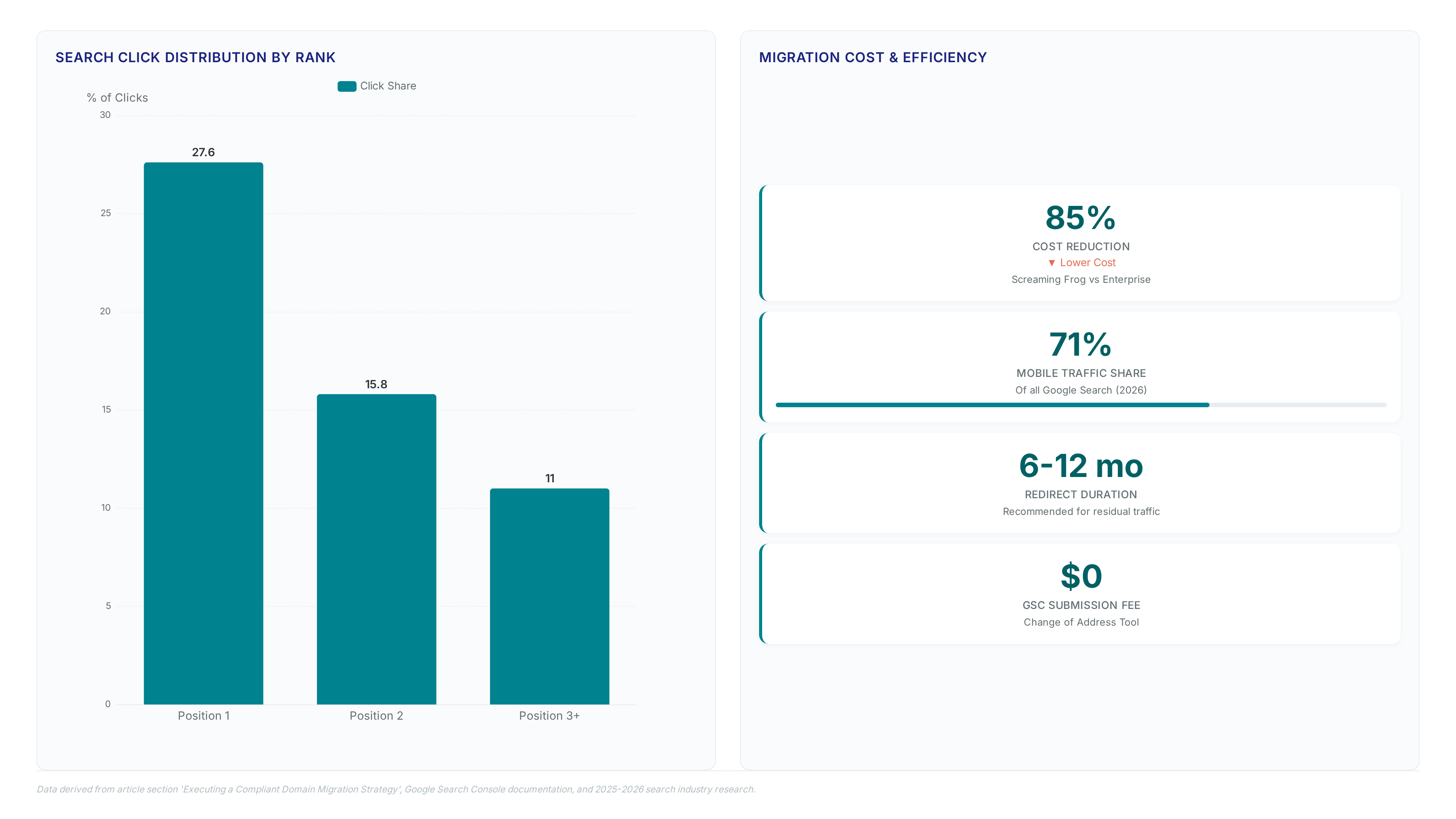
Position 1 captures 27.6% of clicks while Position 2 drops to 15.8%. That gap is why Google's mandate for thorough domain variant migration is non-negotiable. You must migrate domain variants like www and non-www versions even when they sit idle. This isn't bureaucracy; it's a requirement driven by stricter AI-era verification demands. We need to dissect the internal mechanics of the Change of Address tool to understand why Google Search Console now requires notices for every subdomain to successfully transfer search rankings. This notice complements 301 redirects to preserve the organic search traffic that constitutes a majority of all trackable website visits.
Seven confirmed algorithm updates hit in 2025 alone. The margin for error is gone. Search Engine Journal reports that Google's updated documentation explicitly warns against using the tool for simple HTTP to HTTPS moves, yet insists on its use for complex domain shifts. Execute a compliant strategy that addresses these specific migration scenarios, or watch your site fall off page one where visibility plummets below 1%.
The Critical Role of Domain Variants in Modern Migration
Google Change of Address Tool Definition and Scope
Announced in 2020, the Google Change Of Address tool acts as a site-wide notice designed to transfer historical SEO signals when moving domains. It works alongside 301 redirects, which manage URL-level signals, by explicitly informing Google that an entire website has permanently relocated. NiceNIC utilized this specific process during their transition to NiceNIC.com to ensure historical SEO signals transferred correctly to the new domain. Industry discussions citing John, a Google representative, confirm that setting up redirects alongside the tool helps Google understand changes during site migrations. The utility covers permanent domain-to-domain shifts rather than protocol changes or host migrations.
Operators must submit requests for every verified variant, including unused subdomains and www/non-www versions, to prevent ranking fragmentation. Linking patterns remain vulnerable to crawl errors if all variants go undeclared. A single redirect rule offers simplicity, yet the requirement demands granular declaration across all property versions. Collecting unused subdomains risks leaving a significant share of organic traffic sources exposed to potential ranking loss during the transition window.
Submit requests only after verifying all domain variants in Search Console via DNS or HTML tags.
Migrating Unused WWW and Non-WWW Domain Variants
Ranking fragmentation happens when you skip the unused www and non-www variants. Every verified version of the old domain, including inactive subdomains, must receive the migration signal within Search Console. Legacy linking patterns redirect traffic incorrectly when these dormant variants go unaddressed, diluting the authority transfer to the new destination. 301 redirects handle individual URL movements, yet the Change of Address tool acts as a global directive for the entire domain entity. Updated guidance explicitly states that site owners should include WWW, non-WWW, and subdomain variants even if they are not actively used.
SEO Visibility Risks in Domain Migration
Position 1 captures 27.6%, making signal loss during migration catastrophic for traffic. This disparity defines the SEO visibility risk inherent in incomplete domain transfers. Google maintains a dominant global search engine market share as of January 2026, so ranking degradation on this single platform dictates overall site performance. Operators skipping unused variant migration fracture their historical SEO signals, causing the new domain to inherit only a fraction of previous authority. The mechanism fails because linking patterns often target non-www or subdomain versions that lack the Change of Address directive. NiceNIC used the Change of Address Tool The tool alone cannot fix unverified variants; operators must manually validate every subdomain before submission.
Internal Mechanics of the Change of Address Tool
Change of Address Tool Processing Timeframe and Mechanics
Processing takes 3, 30 days for the Change of Address tool to complete its initial phase, yet full propagation across Google systems often extends longer depending on crawl frequency. Incomplete signal transfer occurs if operators fail to migrate every domain variant simultaneously during this latency window. Documentation confirms that domain migrations work best when all variants of a site are migrated properly, a constraint frequently overlooked during rushed deployments. Operators must submit separate requests for unused www, non-www, and subdomain versions to prevent linking patterns from triggering unintended crawls of legacy URLs. Neglecting dormant variants allows Google to index old paths, fragmenting authority and diluting the historical SEO signals intended for the new domain.
Scope defines the mechanical limitation since the tool functions as a global directive rather than a URL-level fix, demanding thorough coverage to succeed. Unlike 301 redirects which handle individual path mapping, this mechanism validates the entire entity shift. Users can only submit these requests through the unique Search Console interface available for direct domain migration signaling requests. Failure to align the processing timeframe with complete variant submission risks permanent ranking loss during the transition window.
Scenarios Where Change of Address Tool Use Is Discouraged
Google explicitly discourages using the Change of Address tool for four specific infrastructure changes because permanent domain identity remains unchanged. Applying the tool to HTTP to HTTPS upgrades, WWW to non-WWW switches, category URL restructuring, or host migrations constitutes a procedural error that dilutes signal clarity. Industry discussions referencing John confirm that standard 301 redirects suffice for these internal shifts without triggering full domain transfer logic.
Maintenance of these redirect chains must continue for at least 6, 12 months, or indefinitely if possible, to preserve user access and crawl continuity. Unnecessary complexity presents the primary risk; invoking the tool signals a complete entity move to a new root domain, confusing the indexer when the root identity persists. Updated guidance from June 18, 2026, clarifies that stricter information applies only to actual domain replacements, not protocol or host adjustments. Unlike true migrations requiring variant verification, these scenarios demand only consistent path-level forwarding rules. Overusing the tool fragments the historical SEO signals intended for genuine domain replacements, potentially causing ranking volatility during routine maintenance.
Risks of Relying on Incomplete Google Documentation for Migrations
Sloppy documentation creates danger through omission. The rationale for this strictness appears only in a hidden Changelog entry rather than the primary guidance text. This separation creates a critical gap where operators miss the necessity of verifying every domain variant in Search Console. A tangible example of this sloppiness involves a sentence missing the preposition "about" after "decisions," illustrating how easily key instructions become garbled. Relying on such incomplete resources risks fracturing historical SEO signals during the transfer process.
Enterium advises that ignoring these buried details leaves redirect strategies vulnerable to configuration errors. Traffic loss becomes measurable as Google fails to associate old paths with the new destination. Operators must cross-reference main guides with update logs to capture full requirements.
Executing a Compliant Domain Migration Strategy
Defining the Scope of Verified Domain Variants in Change of Address
Submit Change of Address requests for every unused subdomain and www/non-www variant to prevent signal fragmentation during migration. Operators must verify en.example.com, www.example.com, and example. Com as distinct properties before initiating any transfer logic. This verification step requires DNS records or HTML tags confirmed via Google Tag Manager to satisfy strict property ownership checks. Failing to include inactive variants leaves historical linking patterns unresolved, causing Google to treat redirected traffic as unverified noise rather than a coordinated move.
- Identify all active and dormant subdomains associated with the legacy domain.
- Verify each variant individually within the Search Console property list.
- Operators must submit separate Change of Address requests for every subdomain and www/non-www variant to prevent signal fragmentation.
- Verify ownership of all dormant properties like en.example.com and www.example.com within Search Console using DNS records or HTML tags.
- Initiate distinct migration tasks for each verified variant, mapping them individually to the target domain destination.
- Confirm that server-side redirects remain active for at least six months to support the transfer logic.
This granular approach ensures that historical linking patterns pointing to unused paths do not degrade overall search visibility. NiceNIC utilized the Change of Address Tool The strict verification requirement exists because domain migrations function optimally only when every single variant moves in unison. Neglecting a single inactive subdomain creates a blind spot where crawl budget wastes on unverified redirects. Google updated these site migration. This opacity forces operators to audit for variants that appear irrelevant but actively influence ranking stability.
Post-Migration Redirect Maintenance and Tooling Cost Verification
Maintain 301 redirects for the recommended 6, 12 month duration to capture residual traffic from dormant linking patterns.
- Deploy crawling agents to validate redirect chains across all subdomain variants weekly.
- Audit server logs to confirm Googlebot receives correct status codes on legacy paths.
- Calculate tooling expenses against team size to optimize technical audit budgets.
| Tool | Primary Function | Annual Cost (Single User) |
|---|---|---|
| Screaming Frog | Technical Extraction | $259 |
| Ahrefs | Competitive Intelligence | $11,880 (10-user) |
| GSC | Migration Submission | $0 |
Operators often overlook that Screaming Frog costs roughly 85% less than enterprise alternatives for pure technical auditing tasks, a fact verified by pricing analysis. While GSC remains the sole interface for submitting Change of Address requests, it lacks native depth for extracting canonicals or meta robots compared to dedicated crawlers. A Vienna-based advisory firm demonstrated this complementary workflow by combining Ahrefs with crawling software to fix 150 on-page issues over nine months, as detailed in their case study. The fiscal constraint is clear: a 10-user deployment of specialized audit tools costs approximately £1,790, whereas competitive intelligence suites demand significantly higher capital allocation. Neglecting this verification phase risks breaking the chain of authority before new-example. Net fully inherits trust signals. Enterium advises that indefinite redirect retention eliminates the risk of premature signal loss during extended indexing cycles.
Diagnosing Search Performance Failures After Migration
Defining Unverified Variant Errors in Search Console
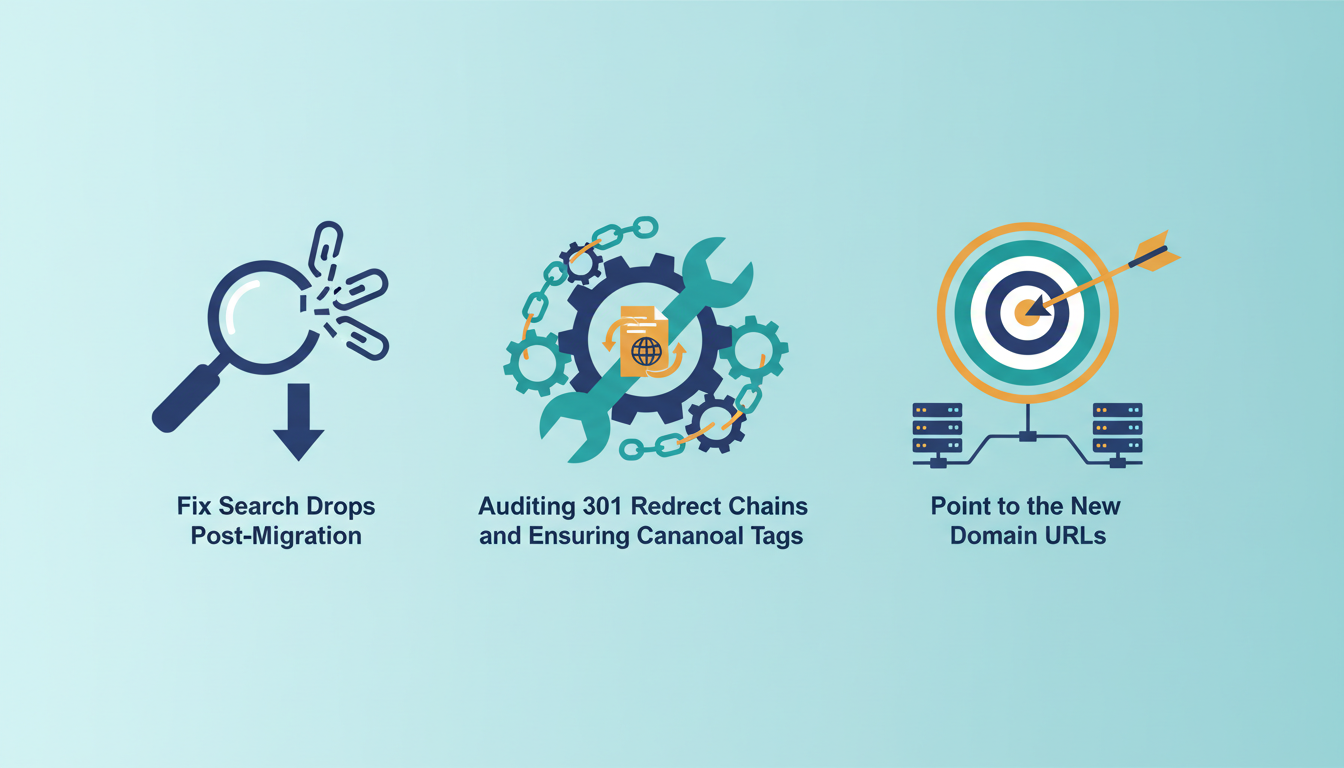
Search visibility evaporates when domain variants such as www prefixes or specific subdomains lack explicit verification within Search Console, effectively locking the Change of Address Tool. Personnel tasked with repairing search performance following a domain transition frequently overlook that Google Tag Manager verification acts as a mandatory gatekeeper for every single property variant. The migration tool simply refuses to process requests without this fundamental step, stranding historical rankings on the legacy domain. Linking patterns often trigger crawls on dormant paths, creating the root cause of these failures. An unused subdomain left unverified prevents Google from associating traffic with the migration event, causing the engine to treat the flow as a broken redirect instead of a moved resource. This specific gap explains sudden ranking disappearances despite correct server-side configurations. The NiceNIC Domain Migration Documentation updates from June 18, 2026, clarified these requirements yet buried the reasoning in a separate Changelog This separation creates a blind spot where operators verify only active URLs. Enterium recommends auditing all potential subdomains before initiating any move to prevent this specific failure mode.
Diagnosing Redirect Chains and Incomplete Variant Migration
Ranking losses occur immediately when missing variant submissions break the Change of Address signal chain. Google updated guidance on June 18, 2026, to require stricter information. The mechanism fails when linking patterns direct crawlers to an unverified variant, causing the search engine to treat the move as disjointed noise rather than a coordinated migration. Verifying every subdomain increases administrative overhead and requires distinct DNS records or HTML tags for each property. This friction leads many teams to skip unused variants, directly resulting in fragmented authority transfer. Operators must audit all potential entry points before submission to prevent visibility decay. Redirect loops trap crawlers before they reach the new domain, creating a secondary failure mode.
Validating Redirect Duration and Tooling Costs for Audits
Operators must sustain 301 redirects for the full 6, 12 month window while budgeting for deep-crawl auditing tools. Keeping legacy paths active prevents Googlebot from encountering dead ends when linking patterns trigger crawls on dormant subdomains. Validation costs vary notably by tool selection and team size. Teams choosing based solely on upfront price risk missing the 150+ on-page issues that specialized crawlers identify during optimization phases. Free verification in Google Search Console lacks the historical depth required to catch pre-migration errors compared to paid alternatives. Relying only on basic checks leaves organizations vulnerable to the same documentation sloppiness Google itself exhibits in its own guidance. Enterium recommends pairing free submission tools with paid crawlers to ensure no variant remains unverified. This dual-layer approach mitigates the risk of ranking loss when linking patterns unexpectedly activate unused domain paths.
About
Arjun Patel, an Applied LLM Engineer at Enterium, brings rigorous empirical analysis to the complexities of domain migrations. While his daily work focuses on benchmarking LLM providers and optimizing RAG architectures for content pipelines, the structural integrity of data movement remains central to his engineering methodology. Just as he evaluates latency and quality metrics when scaling content automation, Patel understands that migrating search visibility requires precise signal transfer, not just simple redirection.
At Enterium, a brand dedicated to documenting how technical teams scale content operations, Patel applies this same exacting standard to search infrastructure. He connects the mechanics of Google's Change of Address tool to broader content engineering principles, treating domain moves as critical data pipeline events. His analysis strips away speculation, offering practitioners a factual breakdown of how the notices complement 301 redirects to preserve historical SEO signals. This approach ensures that content leaders can execute migrations with the same reliability expected in high-stakes AI deployments.
Conclusion
Scaling migration efforts reveals that crawl budget exhaustion becomes the primary bottleneck when legacy redirect chains exceed three hops, causing indexation rates to plummet regardless of content quality. The operational reality is that maintaining a 12-month redirect window incurs compounding server latency costs that most budget models ignore until traffic stabilizes at a lower baseline. You must treat the Change of Address submission as merely the starting gun for a rigorous, month-long verification sprint rather than a set-and-forget configuration.
Organizations should mandate a dual-layer audit protocol using both free console validators and deep-crawl paid tools within the first 14 days of migration. This specific window is critical because Google's initial processing phase often masks underlying canonical conflicts that only surface once the cache refreshes. Do not rely on surface-level status codes; instead, verify that link equity flows correctly through every dormant subdomain variant before assuming safety.
Start by running a full-site crawl against your staging environment this week to identify any redirect loops before they consume production crawl budget. This immediate action isolates configuration errors while you still control the deployment timeline, preventing permanent visibility loss before the public launch.
Frequently Asked Questions
Neglecting unused subdomains leaves 53% of organic traffic sources exposed to ranking loss. Operators must migrate all variants to prevent signal fragmentation and ensure complete transfer of historical SEO equity during the move.
Position 1 captures 27.6% of clicks while Position 2 drops to 15.8%. This steep decline makes avoiding signal loss during migration critical for maintaining visibility and sustaining high traffic volumes effectively.
Google maintains a 90.04% global search engine market share, making its migration tools essential. Ignoring proper variant handling risks falling off page one where visibility drops significantly below the one percent threshold.
Visibility drops below 1% once a site falls off the first page of results. This catastrophic loss underscores why migrating every domain variant is non-negotiable for preserving organic search performance.
Failing to migrate all variants risks losing 53% of organic traffic sources. Comprehensive migration ensures that legacy linking patterns do not cause crawl errors or dilute authority transfer to the new domain.