Google spam update: June 2026 AI rules
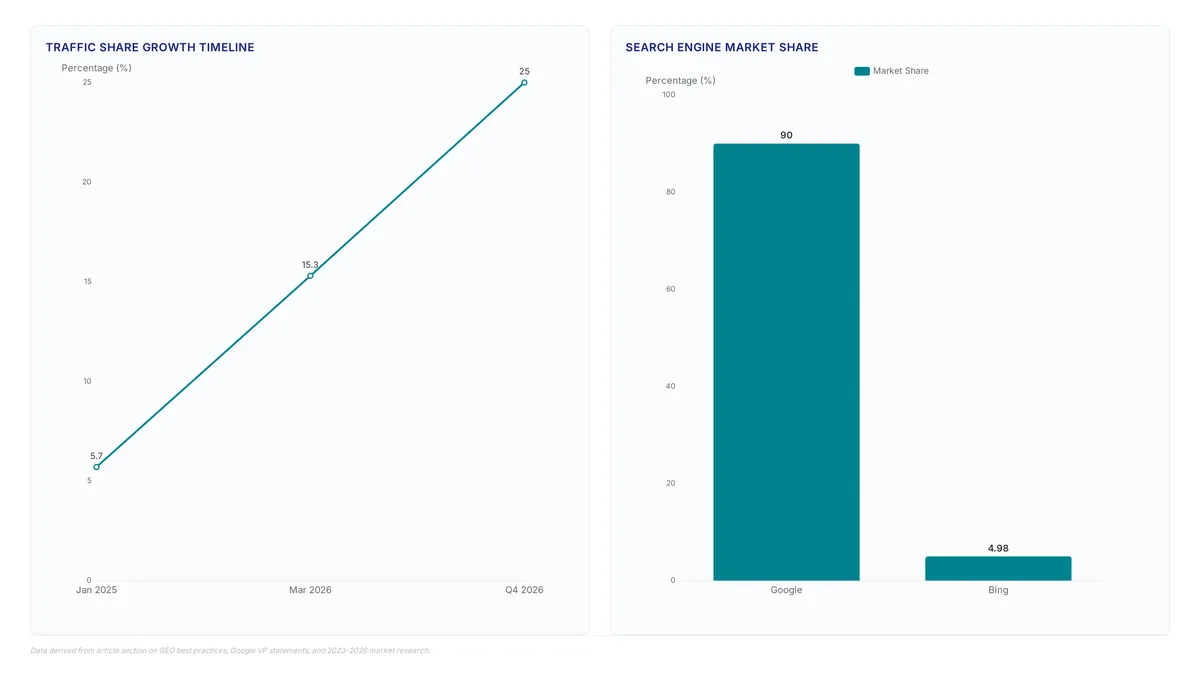
Google's June 24 spam update explicitly targets manipulation of generative AI responses and citations. This rollout confirms that tactics designed to game AI Overviews or AI Mode now face the same enforcement as traditional search spam, marking a definitive shift in how Search Console metrics define visibility. The surge in AI chatbot web traffic, which nearly quadrupled for Google's Gemini from January 2025 to March 2026 according to companieshistory.com data, highlights why protecting these surfaces is now a priority for the search giant.
Readers will learn how attribution modeling has changed now that John Mueller clarified that hidden links only count as impressions when users actively open them. warns against panic before diagnosing specific page types or directories. The article also details why SEO recovery requires distinguishing between actual content quality issues and temporary volatility during the rollout.
Finally, we examine the tangible measurable ROI from aligning strategies with emerging GEO best practices rather than chasing inflated impression counts. Understanding the distinction between link appearance and true user engagement is critical as desktop CTR trends diverge from mobile performance. This analysis provides the framework needed to navigate a environment where buying citations is as dangerous as any legacy black-hat tactic.
The Role of AI Impressions and Spam Definitions in the June 2026 Update
Defining Spam in AI Overviews and AI Mode
The June 2026 spam update codified a critical expansion: tactics built to manipulate AI Overviews and AI Mode responses now fall under explicit Spam definitions. Buying or altering citations within AI answers constitutes a policy violation equivalent to traditional web spam. This definition shift closes a previous loophole where manipulation of generative outputs lacked explicit enforcement criteria. Operators must distinguish these violations from standard ranking fluctuations by observing the Search Status Dashboard for rollout completion signals. Unlike legacy metrics, an AI impression counts only when a link visibly appears in a generated response or becomes visible after a user expansion action.
How Google Counts AI Impressions in Search Console
Visibility gaps plague current reporting. An AI impression registers strictly when a link appears in AI Overviews or AI Mode, excluding hidden elements until user interaction occurs. John Mueller clarified that links concealed behind an expansion trigger no metric update until a user explicitly opens them, creating a visibility gap for collapsed content. This counting method means Search Console data reflects actual link presence rather than underlying content influence on the generated answer. Operators shifting from traditional SEO to GEO frameworks must recognize that unclicked expansions remain invisible in reporting dashboards. Google's Gemini AI chatbot saw its share of AI chatbot web traffic nearly quadruple from a small fraction in January 2025 to a significantly larger portion by March 2026, yet the measurement logic remains rigid regarding user interaction. A page influencing an answer without a visible, expanded link generates zero impression data, masking true attribution impact.
| Metric Scope | Counting Trigger | Visibility Status |
|---|---|---|
| Static Link | Immediate display | Counted |
| Expanded Link | User click action | Counted |
| Hidden Citation | None (pre-click) | Uncounted |
High-influence content appears low-performing until users manually expand citations, creating an operational blind spot. Low numbers in the current report may indicate hidden placements rather than absent ones because click data is missing.
Avoiding False Positives When Analyzing Traffic Drops
Panic is a poor strategy during rapid enforcement cycles. A sudden traffic decline does not automatically indicate content quality failures. Historical data tracked across 26 confirmed spam updates indicates that rollout durations vary widely, making immediate reaction risky. Shushrita M. A freelance SEO consultant, advises operators to identify consistent patterns across page types before assuming content is bad. Panic-driven changes often introduce new errors while the system stabilizes. The economic model of "scaled content abuse" is no longer viable, as the SpamBrain system targets tactics designed to deceive users. Distinguishing this from legitimate volatility requires patience. Operators should monitor the Search Status Dashboard for rollout completion signals rather than daily fluctuations.
| Diagnostic Step | Action Required |
|---|---|
| Pattern Analysis | Check affected directories |
| Query Review | Isolate specific search terms |
| Timeline Check | Wait for rollout finish |
Diagnostic precision prevents unnecessary rework when ranking volatility stems from indexing latency rather than policy violations. Trusting third-party tools with real-time data can lead to false conclusions about what counts as spam in AI search.
Inside the Mechanics of Rapid Enforcement and Attribution Modeling
Defining AI-Influenced Demand and Branded Search Pathways
Branded search volume acts as the primary proxy for AI-influenced demand when direct referral data remains invisible to standard analytics. Similarweb observed that 55.9% of downstream traffic arrived via branded queries after users encountered a ChatGPT recommendation, confirming that AI platforms drive intent rather than direct clicks. This mechanism creates a distinct attribution gap where influence occurs without an immediate click-through event. Traditional referral metrics fail here because they track the final hop, missing the initial trigger inside the generative interface.
The operational cost of this shift is a blind spot in attribution modeling. Relying solely on AI referral traffic ignores the substantial portion of users who copy a brand name or navigate directly after seeing an AI suggestion. As noted by industry analysis, AI influence can happen without a click, rendering pure referral counting insufficient for measuring true impact.
| Metric Type | Captures AI Influence? | |
| Primary Limitation | ||
| Referral Traffic | No | Misses copy-paste navigation behavior |
| Branded Search | Yes | Requires baseline normalization to isolate lift |
| Direct Navigation | Partially | Hard to attribute to specific AI exposure |
Operators must treat branded query spikes as the leading indicator of AI visibility success. Ignoring this pathway leads to underestimating the ROI of content optimized for generative engines.
Tracking AI Search Impressions Through Attribution Blind Spots.
Direct measurement of AI search impressions fails when content influence occurs without a visible link in the result pane. John Mueller clarified that Search Console counts an impression only when a link explicitly appears in AI Overviews or AI Mode, creating a data void for hidden citations. Operators facing low reported counts must shift focus to downstream demand signals rather than relying on broken referral paths. The primary mechanism for detection involves monitoring spikes in branded search volume that correlate with known AI query patterns.
This attribution gap exists because current models track the final hop, missing the initial trigger inside the generative interface. Aleyda Solís notes that attribution modeling has a blind spot where AI-influenced demand arrives through direct search channels. Operators must correlate query logs with AI rollout timelines to identify these invisible influence events. Relying solely on referral traffic underestimates total visibility by excluding users who bypass the citation to search directly.
| Metric Type | Visibility Scope | Limitation |
|---|---|---|
| AI Impressions | Linked citations only | Misses hidden or text-only mentions |
| Branded Queries | Total intent signal | Requires baseline normalization |
| Referral Traffic | Direct clicks | Captures less than half of influenced visits |
This approach isolates AI-driven intent from organic noise, providing a clearer view of actual market penetration.
Q1 2026 benchmarks reveal mobile's top position dropped about 2.2 percentage points while desktop gains appeared below the third position. This divergence indicates that desktop recovery alone does not offset months of mobile softness, reflecting a one-quarter anomaly rather than a structural reversal. Operators must isolate device-specific CTR to avoid masking mobile degradation with aggregate desktop improvements.
The mechanics of this split suggest that attribution modeling fails when combining form factors with distinct user behaviors. Rapid enforcement cycles exacerbate volatility on mobile interfaces where screen real estate limits visibility compared to desktop layouts. Consequently, reliance on combined traffic data creates a false positive for recovery when mobile visibility remains suppressed.
| Metric | Mobile Trend | Desktop Trend |
|---|---|---|
| Top Position | Declined ~2.2 pts | Stable |
| Lower Positions | Flat | Gaining share |
| Net Impact | Negative offset | Insufficient recovery |
Diversifying traffic sources provides a necessary buffer against such platform-specific volatility. Strategies incorporating mainstream AI-powered search offer stability when organic CTR diverges by device. The cost of ignoring this split is continued investment in mobile optimizations that yield diminishing returns during enforcement windows. Enterium recommends deploying separate monitoring dashboards for mobile and desktop cohorts to detect these divergences early. Isolating the signal prevents misallocation of engineering resources toward generalized fixes that miss the device-layer root cause.
Measurable ROI from Aligning SEO Strategies with GEO Best Practices
Defining Good GEO as the Foundation for Search Visibility
Generative Engine Optimization (GEO) executes standard SEO practices that drive traditional search visibility. Brendon Kraham, Google's VP of Search and Commerce, confirmed that effective SEO aligns directly with good GEO because the underlying work remains identical regardless of the interface. He emphasized that Google does not evaluate third-party SEO tools or vendors, noting these external platforms lack access to internal ranking metrics. Operators must recognize that tactics driving visibility in legacy blue links carry directly into generative experiences without requiring a separate playbook. This alignment means investing in traditional SEO simultaneously with emerging answer engine strategies to maintain thorough coverage. Pages performing acceptably in standard results may still face exclusion from generative surfaces due to subtle quality thresholds. Enterprise sites managing over 100,000 URLs face a complex compliance cost involving a five-layer sequential check of crawl access and content quality to avoid being flagged by new AI-manipulation policies. AI recommendations often trigger direct brand queries rather than immediate clicks, so tracking this metric provides a useful indicator of cross-platform visibility. Operators should discard vendor claims of special access and focus resources on verifiable content quality improvements.
Measuring Branded Search Growth to Capture AI-Driven Traffic
Track branded search volume to gauge the impact of AI recommendations, as AI influence can happen without a click. This data point exposes an attribution gap where AI-influenced demand manifests as organic search rather than platform referral. The report's authors suggest that branded search is a way to gauge the impact of AI recommendations, making it worthwhile to track brand demand alongside rankings. Relying solely on referral logs misses the majority of this value chain. The measurement blind spot arises because standard analytics categorize this traffic as organic, obscuring the generative trigger. Aleyda Solís notes that current models fail when AI influence occurs without an immediate click, stating that measuring AI Search impact only through "AI referral traffic" is not enough. This limitation requires reviewing desktop and mobile click-through rates separately before drawing conclusions from a combined figure, as recent benchmark data shows the two devices moving in opposite directions.
| Metric Focus | Traditional SEO | GEO-Aligned Analysis |
|---|---|---|
| Primary Signal | Click-through Rate | Branded Query Volume |
| Attribution Path | Direct Referrer | Organic Search Spike |
| Key Constraint | Link Availability | Impression Visibility |
The operational cost involves correlating impression logs from Search Console with branded query timestamps without native integration. Ignoring this correlation leaves revenue attribution incomplete and underestimates the true ROI of generative optimization efforts.
Risks of Relying Solely on AI Referral Traffic Metrics
Current attribution models possess a blind spot because AI-influenced demand frequently arrives through standard Search rather than direct AI referrals. Relying exclusively on referral logs ignores the pathway where users encounter a suggestion, leave the interface, and manually type a brand name. This behavior renders narrow metrics insufficient for capturing true content value. Similarweb previously noted that a majority of downstream traffic follows this indirect branded route, yet many operators still fail to correlate branded search growth with upstream AI visibility. Budget misallocation toward channels that appear performant only because they capture spillover demand is the measurable result of this oversight. Aleyda Solís highlighted that AI influence often occurs without an initial click, making single-source attribution dangerously incomplete. Operators using attribution blind spots as a baseline will systematically undervalue high-performing content that drives brand affinity rather than immediate clicks. Strategies optimizing for the wrong signal emerge when teams ignore these indirect pathways.
Steps for Diagnosing and Fixing Traffic Declines During Spam Updates
Defining the Diagnostic Scope for Spam Update Impacts

Distinguishing a spam update impact from baseline volatility requires isolating specific page types and query patterns rather than assuming broad content failure. The June 2026 rollout explicitly targets scaled content abuse, cloaking, and sneaky redirects, differentiating these policy violations from the recalibration seen in core updates. Operators must note that this enforcement cycle focuses on content manipulation tactics, including efforts to manipulate generative AI responses in Search. Shushrita M. A freelance SEO consultant, advised against overreacting while the update settles, stating, "A sudden decline does not automatically mean your content is bad.
The primary analytical constraint here is temporal; because enforcement cycles can conclude rapidly, the window to distinguish between a temporary ranking shuffle and a hardcoded penalty is narrow.
Executing Real-Time Monitoring During Two-Day Rollouts
Shift diagnostic frequency from weekly reviews to daily checks because the June 2026 spam update rollout was exceptionally fast, completing in just two days (June 24 to June 26, 2026), whereas previous spam updates have ranged from several days to nearly a month. This acceleration reduces the traditional grace period for fixing violations before full global impact occurs. Operators must isolate affected page types and query patterns immediately rather than waiting for volatility to settle. A sudden decline does not automatically indicate poor quality, requiring precise pattern recognition over panic. Deploying automated alerts on Search Console performance data helps catch ranking changes as soon as they appear.
- Filter logs by device type to separate mobile slips from desktop gains.
- Cross-reference branded search volume against organic impressions.
- Flag any citation manipulation attempts targeting AI Overviews.
The cost of delayed reaction is significant visibility loss before the rollout window closes. Unlike previous cycles with longer durations, there is limited time for extended observation; diagnosis should begin as soon as the update is announced.
Compliance Checklist for Generative AI Manipulation Tactics
Validate citations immediately because tactics designed to game AI Overviews now trigger standard spam penalties. This enforcement applies globally across all languages, indicating a unified model deployment rather than region-specific patches. The policy definition expanded in May 2026 to explicitly close loopholes for manipulating generative AI responses. Non-compliance risks exclusion from both traditional results and AI Mode surfaces entirely.
| Tactic Category | Detection Vector | Risk Level |
|---|---|---|
| Citation Buying | Cross-reference validation | Critical |
| Hidden Text | DOM structure analysis | High |
| Scaled Abuse | Pattern matching | High |
Operators must execute this diagnostic sequence to verify content integrity:
- Audit citation sources for purchased or altered references targeting generative answers.
- Scan page structures for hidden text or cloaking intended to deceive parsing models.
- Review crawl logs for anomalies indicating policy violations in scaled content generation.
The cost of ignoring these checks is total visibility loss, as recovery from spam penalties is described as a process requiring patience measured in months.
About
Hannah Brooks, Marketing Operations Lead at Enterium, analyzes the intersection of algorithmic enforcement and automated content pipelines. With a background in RevOps and martech stack design, she is uniquely positioned to dissect the June 2026 Google Spam Update, which explicitly targets generative AI manipulation. Her daily work involves architecting governance gates and quality assurance workflows that prevent the exact citation-gaming and synthetic inflation tactics Google now penalizes. At Enterium, a brand dedicated to vendor-neutral content automation methodologies, Hannah ensures that scaling content via LLMs remains compliant through rigorous human-in-the-loop verification rather than risky shortcuts. This update validates Enterium's core thesis: sustainable scale requires reliable pipeline architecture, not just prompt engineering. By focusing on measurable ROI and reproducible quality standards, her approach helps B2B teams navigate spam filters without sacrificing volume. For organizations relying on automated publishing, aligning workflow orchestration with these evolving spam policies is no longer optional, it is the primary defense against visibility loss.
Conclusion
The rapid surge in bot traffic, which nearly quadrupled from a small fraction to a significant share in just fourteen months, fundamentally breaks the assumption that organic visibility equals human engagement. This shift creates a persistent operational cost where teams waste resources optimizing for automated parsers rather than actual users. The expansion of spam policies to explicitly target citation manipulation means that tactics once considered clever shortcuts now trigger immediate exclusion from both traditional results and AI Mode surfaces. Recovery from these penalties is not a matter of days but requires months of demonstrated compliance, making proactive diagnosis necessary before a rollout begins.
You must implement a strict validation protocol for all citation sources immediately, specifically checking for any purchased or altered references designed to influence generative answers. Do not wait for a manual action notice; the window for extended observation has closed. Start by auditing your top fifty landing pages this week to identify any hidden text or DOM structures that could be flagged as scaled abuse. This specific diagnostic step isolates high-risk content before it drags down your entire domain reputation. By focusing on content integrity now, you secure your position against future volatility without relying on unstable shortcuts.
Frequently Asked Questions
The update completed in just two days, far faster than previous cycles. Historical data shows some past updates took up to 27 days, requiring quicker diagnostic responses from SEO teams today.
Hidden links only count as impressions after a user clicks to expand them. This means 55.9% of downstream traffic may arrive via branded search while remaining invisible in standard impression reports.
This surge explains why manipulating AI citations now triggers the same severe spam penalties as traditional tactics.
A sudden drop does not automatically mean your content quality is poor or failing. Experts advise diagnosing specific page types before reacting, as rapid enforcement often causes temporary measurement noise.
Branded search volume is now a more reliable indicator of AI influence than raw impressions. Since 55.9% of downstream traffic arrives through branded queries, this metric captures hidden citation impact better.
References