Endtoend AI workflow: build enterprise pipelines
Google's algorithm updates have wiped out a significant share of AI content that failed quality differentiation, proving that AI content workflow design is a survival metric rather than a luxury. You will learn how to define the scope of an end-to-end workflow, architect the multi-layer systems necessary for enterprise scale, and implement automated publishing operations that bypass the fragility of human-dependent processes.
Infrastructure separates obsolescence from operation. Manual approaches force users to write every prompt and edit individually, creating a bottleneck. Enterprise solutions apply prompt templates and automated quality checks to process thousands of requests simultaneously. Services on AWS, Microsoft Azure, and Google Cloud provide the necessary serverless computing and vector databases needed to manage these loads without infrastructure bottlenecks.
Building this system is not merely about generating text quicker but creating a resilient architecture that handles identity access management and data encryption by default. The goal is a production-ready environment where business logic takes precedence over server management.
Defining the End-to-End AI Content Generation Workflow
Defining the Automated Pipeline from Request to Publishing
An end-to-end AI content generation workflow operates as a unified pipeline handling every phase from initial request to final publication. This structure eliminates disjointed manual efforts where individuals craft prompts separately and edit outputs one by one. Enterprise implementations use prompt templates to automate creation, processing thousands of simultaneous requests while enforcing automated quality checks prior to publishing. Cloud platforms enable this scalability by adjusting computing resources on demand without requiring infrastructure modifications, a capability necessary when updating thousands of product descriptions in a single day.
Mapping the Five Layers of an Enterprise Content Pipeline
An Enterprise AI workflow breaks down into five distinct, connected layers instead of relying on a single model. This architectural separation ensures raw User Input transforms into structured context before reaching generation models. The Prompt Engineering Layer subsequently enriches this input with brand guidelines, preventing generic outputs lacking specific organizational voice. Once prompts are optimized, the AI Generation Layer executes asset creation across text or image modalities using scalable cloud compute. Differentiation occurs in the Quality Assurance Layer, which validates grammar, facts, and brand alignment before any public exposure. Historical data indicates that a significant share of AI content failed to survive substantial algorithm updates due to insufficient quality differentiation at this stage. Automated systems now track usage costs per piece, enabling granular financial monitoring that manual processes cannot replicate. Finally, the Storage and Publishing Layer moves approved assets to cloud storage and triggers deployment to set channels.
| Layer | Primary Responsibility |
|---|---|
| User Input | Collects request metadata and constraints |
| Prompt Engineering | Applies brand rules to raw input |
| AI Generation | Renders content via LLMs |
| Quality Assurance | Validates accuracy and tone |
| Storage/Publishing | Archives and deploys final assets |
Skipping enrichment or validation layers creates a fragile pipeline vulnerable to reputation damage. Non-compliance with new workflow standards, specifically regarding governance and E-E-A-T, represents a potential total loss of investment for non-compliant assets. Configuring explicit failure states in the QA layer reduces the risk of publishing inaccurate or low-quality content.
Manual Prompting vs Enterprise Automation and Scalability
Manual AI forces operators to write every prompt individually, generating single assets with manual editing and publishing steps. This approach collapses under volume because human throughput cannot match algorithmic demand. Enterprise AI replaces this bottleneck with prompt templates that automate creation and process thousands of requests simultaneously. These systems embed automated quality checks and publishing pipelines to maintain consistency at scale. Cloud infrastructure provides the necessary scalability to handle such loads by scaling computing resources on demand without infrastructure changes. Local workflows fail here because they lack the elastic capacity to update thousands of product descriptions in a single day. Cloud environments also support easy AI integration by offering managed services for LLMs, vector databases, and workflow orchestration. This architecture allows engineers to focus on business logic rather than server maintenance.
| Feature | Manual Workflow | Enterprise Workflow |
|---|---|---|
| Prompt Creation | User writes every prompt | Prompt templates automate creation |
| Throughput | One piece at a time | Thousands of requests automatically |
| Validation | Manual editing | Automated quality checks |
| Deployment | Manual publishing | Automated publishing pipelines |
Practical implementations now configure AI to insert target keywords at a specified density, shifting optimization from a post-generation task to an inherent generation constraint. This reduces the step count of traditional workflows notably. However, rigid templating can limit creative variance if the prompt engineering layer lacks sufficient contextual nuance. Operators must balance standardization with flexibility to avoid sterile output. Teams adopting cloud-native automation can process thousands of requests automatically as an immediate consequence. Migrating high-volume content streams to cloud-based pipelines allows organizations to capture these efficiency gains.
Architecting the Multi-Layer AI Content Pipeline
The Prompt Engineering Layer and Template Reusability
The Prompt Engineering Layer enriches raw user input with brand guidelines before any model generation occurs. AI engineers improve prompts before sending them to the model using this layer, transforming vague requests into structured instructions that adhere to organizational voice. This process prevents the propagation of inconsistent tone across thousands of generated assets.
Reusable templates serve as the mechanical foundation for this enrichment, standardizing output for specific content types like blog posts, product descriptions, technical documents, email campaigns, and knowledge base articles. Workflow templates in 2026 allow for the automatic conversion of content requests into complete briefs, ensuring every submission includes necessary context such as target audience and keyword constraints.
| Content Type | Template Function |
|---|---|
| Blog Posts | Injects SEO structure and call-to-action placement |
| Technical Docs | Enforces formatting rules and terminology glossaries |
| Email Campaigns | Applies compliance disclaimers and tone modifiers |
Overly strict templates may stifle novel insights, while loose ones invite hallucination. The industry is moving towards coordinated small groups of AI agents, suggesting that static prompt engineering may soon evolve into flexible, multi-agent orchestration where context is negotiated rather than hardcoded. This shift indicates a future where multi-agent orchestration replaces single-prompt interactions. Treating prompt templates as version-controlled code rather than static text files enables teams to roll back failed prompt strategies instantly and audit exactly which instruction sets produced specific output errors.
Integrating Cloud Services for Scalable AI Model Deployment
Services on AWS, Microsoft Azure, and Google Cloud enable engineers to construct scalable automated pipelines that unify production workflows. These platforms route data from user input layers directly to generation models without manual intervention. Building this architecture requires connecting discrete services for orchestration, storage, and compute to handle variable load.
- Ingest: Accept requests via API gateways or CRM triggers.
- Orchestrate: Use serverless functions to manage state between layers.
- Generate: Call LLMs or image models based on routed prompts.
- Publish: Move approved assets to storage buckets for distribution.
Specialized agents handle distinct content types, creating a modular cost model where resources match task complexity. This approach allows operations teams to track usage and costs per content piece for granular financial monitoring of the generation pipeline. Large-scale implementations, such as Contentful's AI Actions, demonstrate automating repetitive enterprise tasks like image tagging to free human creators for strategy. The shift signals that departments are actively rebuilding their production pipelines around these automation primitives.
| Feature | Manual Process | Cloud Pipeline |
|---|---|---|
| Scaling | Linear staff increase | Elastic compute |
| Integration | Siloed tools | Unified API |
| Cost Model | Fixed overhead | Usage-based |
Enterprise security features like IAM and encryption protect sensitive data throughout this multi-step flow. Defining clear boundaries between the prompt engineering and generation layers helps maintain auditability.
Validating User Input to Minimize Invalid API Requests
Workflow templates convert raw requests into complete briefs, yet unverified inputs trigger costly model invocations. The User Input Layer must enforce schema validation before any token generation begins. Operators configure this gate to reject payloads missing critical metadata like topic or word count. Unsupported file types and malformed JSON structures are dropped immediately at the ingress point.
| Validation Type | Action | Outcome |
|---|---|---|
| Missing Details | Block Request | Prevents ambiguous prompts |
| File Type | Reject Extension | Stops unsupported media |
| Schema Format | Drop Payload | Avoids parsing errors |
This pre-filtering reduces noise reaching the Prompt Engineering Layer, ensuring only viable data consumes compute resources. Automation of last-minute requests eliminates administrative overhead by routing valid tasks instantly while discarding invalid ones without human intervention. A rigid intake process prevents downstream failures where poor input degrades output quality regardless of model sophistication.
- Define required fields for each content type explicitly.
- Implement file extension whitelists for media uploads.
- Return specific error codes to the source system.
Implementing strict input contracts maintains pipeline efficiency. Validating data early avoids wasting cycles on irredeemable prompts.
Automating Quality Assurance and Publishing Operations
Defining Automated Quality Assurance Triggers and Metrics
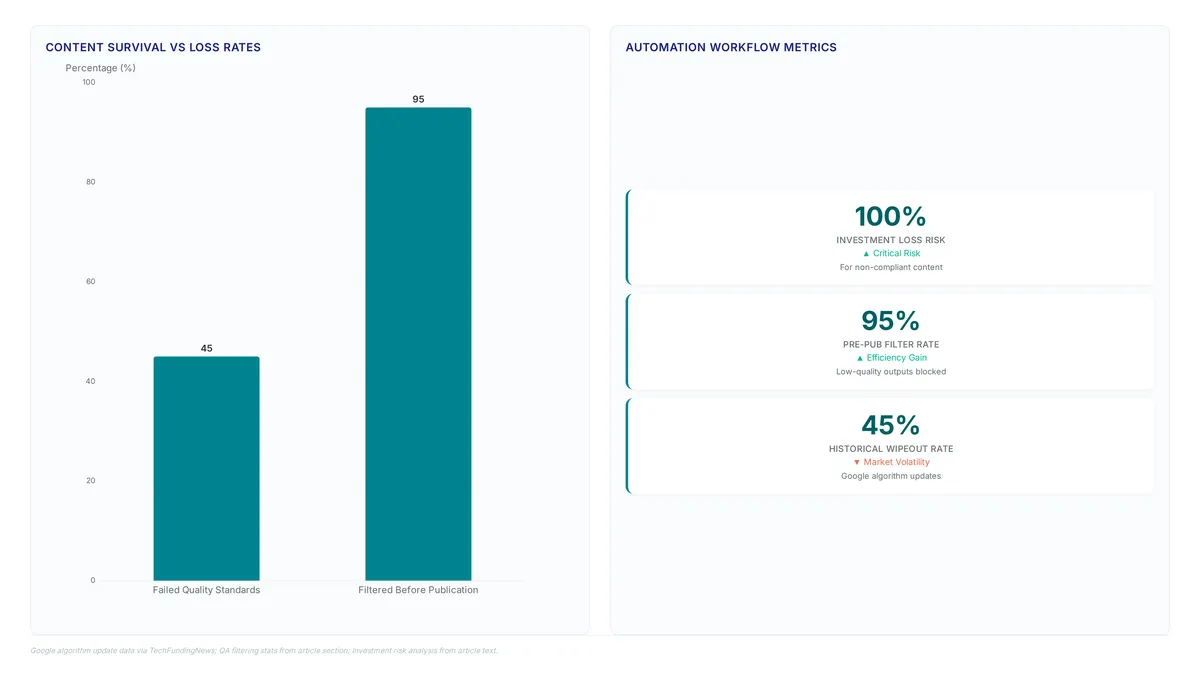
Validation routines fire the moment generation finishes, swapping manual gates for code-based checks. This layer inspects grammar, brand voice, and readability before an asset hits the storage queue. Engineers embed these tests inside the generation loop instead of treating optimization as a separate, post-generation step. Positioning Grammarly as a final quality layer ensures it refines output instead of attempting primary generation.
| Check Type | Trigger Event | Action on Failure |
|---|---|---|
| Syntax | Draft Complete | Auto-correct |
| Brand Voice | Pre-publish | Request Rewrite |
| Factuality | Final Review | Human Flag |
Density limits and heading validation stop structural errors early. Full automation brings risk though; tasks needing credibility checks and originality verification still require human eyes. Relying only on automated scoring yields homogeneous output that search engines punish. Operators configure workflows to route low-confidence scores to a manual review queue while auto-approving high-confidence items. This hybrid method balances speed with the need for human judgment on complex topics. Enterium recommends defining clear acceptance thresholds for each metric to minimize friction between automated systems and editorial teams.
Executing Multi-Platform Publishing via API Gateways
Serverless functions trigger API calls routing finalized assets to WordPress, headless CMS platforms, and social channels at once. This architecture kills manual upload delays by converting one approved blog post into a LinkedIn article, newsletter draft, or presentation outline instantly. Teams rebuilding production pipelines around this model report consistent formatting across all endpoints without human intervention. A comparison of deployment targets highlights distinct integration requirements for each platform type.
| Target Platform | Integration Method | Content Transformation |
|---|---|---|
| WordPress | REST API / MCP Server | Full HTML + Metadata |
| Headless CMS | GraphQL Mutation | Structured JSON Blocks |
| Social Media | Native API Adapter | Truncated Text + Image |
Operators using an AI Engine Pro implementation on WordPress demonstrate how MCP servers coordinate small agent groups to handle these diverse API schemas. The system tracks usage costs per platform, ensuring that high-volume social posting does not exceed budget thresholds. External API gateways introduce latency risks if a specific platform rate-limits the connection.
The shift to automated A/B testing and image tagging represents a maturity shift where media management occurs parallel to text distribution. Newer tools entering public beta in 2026 specifically target these AI search capabilities to optimize how repurposed content appears in discovery feeds. Maintaining valid authentication tokens across six different platforms often outweighs the benefit for smaller teams. Enterium recommends deploying a dead-letter queue to capture failed publish attempts rather than halting the entire pipeline. This approach ensures that a temporary outage on one social network does not prevent the primary article from reaching the corporate website. The constraint is increased storage usage for error logs, which requires regular cleanup policies.
Mitigating Content Wipeout Risks Through Continuous Monitoring
Continuous monitoring of editing time and approval rates prevents the algorithmic penalties that previously erased nearly half of undifferentiated AI output. Operators must implement Check Content Quality gates that track accuracy scores and reuse frequency before any asset reaches publication.
| Metric Category | Specific Signal | Operational Action |
|---|---|---|
| Efficiency | Editing time | Rewrite prompt templates if human edit duration exceeds baseline |
| Governance | Approval rate | Halt workflow branch if rejection rate spikes above threshold |
| Value | Content accuracy | Trigger fact-check loop for low-confidence entities |
Ignoring these signals creates administrative bloat as teams waste cycles chasing approvals instead of refining strategy. Modern systems now track usage and costs per content piece, enabling granular financial monitoring of the entire generation pipeline. This visibility reveals which prompt configurations drive value versus those incurring token costs without conversion. A failure to automate these checks leaves organizations exposed to the same volatility that decimated early adopters relying on volume over verification. Enterium recommends embedding these validation loops directly into the cloud workflow to ensure every published item meets enterprise standards before it risks public indexing.
Optimizing Workflow Performance and Reliability
Defining API Response Time and Token Usage Metrics
Unmonitored latency in API response time often causes slow execution, just as inefficient token usage patterns drain budgets. Engineers track five specific variables: API response time, workflow speed, failed requests, token usage, and cost per request. These metrics establish a baseline for diagnosing bottlenecks within automated pipelines. Modern architectures include built-in modules for tracking usage and costs, enabling granular financial monitoring of each content piece. This visibility allows teams to automate requests and eliminate the administrative overhead of chasing approvals. Hidden inefficiencies compound as volume scales without these controls.
Speed alone cannot define success if output standards degrade. Current standards now mandate governance and E-E-A-T as measurable metrics alongside production velocity. Ignoring quality gates to improve workflow speed creates technical debt that requires manual remediation later. Effective workflows integrate SEO checks directly into the generation process rather than treating optimization as a separate, post-generation step. Operators should treat content generation as a build pipeline with strict acceptance tests rather than an open-ended creative process.
Scaling E-Commerce Descriptions with Cloud Auto-Scaling
Static infrastructure fails when batch processing volume spikes suddenly. This limitation becomes critical for scenarios like an e-commerce business needing to update thousands of descriptions in a single day. Cloud platforms resolve this by automatically scaling computing resources based on demand without requiring infrastructure changes. This elasticity ensures that a surge in requests triggers immediate provisioning of additional instances, preventing the workflow from stalling during peak loads.
Modern standards require configuring AI to automatically insert target keywords and generate meta descriptions during the drafting phase. The architecture separates generation from validation, ensuring that a temporary slowdown in quality checks does not block new input. Rapid scaling introduces a cost variance though; teams must monitor token usage closely to avoid budget overruns during high-volume events. Unlike manual processes that process one piece of content at a time, automated pipelines handle thousands of requests simultaneously, demanding strong error handling for failed API calls.
State management complexity increases as distributed nodes require coordinated secret management and consistent prompt templates. Cloud providers offer enterprise-grade security features such as Identity and Access Management (IAM) and role-based access control to protect sensitive information throughout the workflow. Specialized AI agents are deployed to handle different content types, suggesting a modular approach where specific agents are assigned to specific tasks to optimize resource allocation. This approach ensures that if one model provider experiences latency, the system can route traffic elsewhere without downtime. Scalability remains necessary for enterprise content operations, and cloud platforms are necessary for handling large batches that would be difficult to manage locally.
Continuous Improvement Checklist for Prompt Templates and Rules
Stale prompt templates drive inconsistent output that fails brand voice validation checks. Operators must establish a recurring cycle to test new AI models against current benchmarks rather than relying on initial configurations. This process involves updating business rules to reflect evolving style guides and integrating fresh user feedback directly into the engineering layer. Teams should treat content as a build pipeline with versioned artifacts and acceptance tests to maintain stability.
Neglecting this maintenance invites catastrophic failure during search engine updates. Google algorithm updates have historically wiped out a significant portion of AI-generated content that failed to meet specific quality differentiation standards. Survivors of these events utilized differentiated workflows rather than basic generation methods. Positioning tools like Grammarly as a final quality layer adds a necessary non-generative check before publication. Enterprise platforms are currently launching in public beta phases, signaling a shift toward mature operations for AI search. Production systems become vulnerable to rapid obsolescence without these iterative updates.
About
Arjun Patel is an Applied LLM Engineer who specializes in benchmarking LLM providers, models, and RAG architectures specifically for content workloads. His daily work involves rigorous, vendor-neutral evaluation of inference economics, focusing on the critical trade-offs between cost, latency, and output quality that define production systems. This direct experience makes him uniquely qualified to dissect end-to-end AI content generation workflows, as he routinely architects the very pipelines discussed in this article. At Enterium, a B2B publication dedicated to documenting how modern teams build and scale content operations, Arjun applies this practical engineering rigor to every analysis. Unlike theoretical overviews, his guidance stems from building reproducible systems where humans remain on the quality gates. By connecting specific cloud infrastructure choices on AWS, Azure, or Google Cloud to tangible content outcomes, he provides the concrete, decision-useful data that content engineers need to ship reliable automation next week.
Conclusion
Scaling an end-to-end AI content generation workflow reveals that raw throughput becomes a liability when secret management and prompt versioning lag behind output volume. The operational cost of maintaining these systems is not merely financial but reputational, as static templates inevitably drift from brand voice and search engine expectations. Content that lacked differentiated structure vanished during substantial updates because it failed to meet survival requirements. Moving into 2026, successful operations must pivot from simple generation engines to thorough systems that automate research and on-page SEO while strictly enforcing E-E-A-T standards. You should mandate a transition to modular agent architectures that separate outlining from drafting by the next fiscal planning cycle. This specific structural change ensures that your workflow can absorb model latency without halting production. Start by auditing your current prompt library against your latest style guide this week to identify templates that have not been updated in over six months. Treating content creation as a rigid build pipeline with acceptance tests is the only way to prevent catastrophic ranking losses during future algorithm shifts.
Frequently Asked Questions
Skipping validation layers creates fragile pipelines vulnerable to algorithmic removal. Historical data shows a portion of content fails without strict differentiation, so teams must automate grammar and fact checks before publishing.
Enterprise systems process thousands of requests simultaneously using prompt templates instead of manual entry. This scalability allows businesses to update massive product catalogs in a single day without infrastructure bottlenecks or human delays.
Cloud platforms provide Identity and Access Management plus data encryption to protect confidential information. These enterprise-grade security features ensure that sensitive business logic remains safe while the system scales computing resources on demand.
This layer enriches raw user input with brand guidelines to prevent generic outputs. By applying specific writing instructions before generation, the system ensures every asset reflects the unique organizational voice required for survival.
Integrating SEO checks directly changes traditional step counts by removing separate post-generation optimization phases. This unified approach ensures content meets search standards immediately, reducing the manual editing burden on engineering and marketing teams significantly.
References