Content stacks need 13 specialized AI agents
Agencies now deploy thirteen distinct AI agents to manage modern content stacks, replacing single-tool dependencies with specialized workflows. This shift defines the new reality where content marketing tools must operate as interconnected systems rather than isolated utilities. The thesis is clear: successful agencies are abandoning generic generators for custom content pipelines that enforce strict brand governance across distributed teams.
You will examine how AI visibility metrics now dictate strategy more than traditional SEO scores, forcing a reevaluation of how brands track presence in generative answers. The analysis details the mechanics of multi-agent writers that handle drafting, editing, and compliance without human bottlenecks. We also explore automated publishing architectures that push content directly to CMS instances while maintaining audit trails for every modification.
The discussion moves to GEO monitoring workflows necessary for verifying if AI models accurately represent client data during query time. You will learn why prompt-level tracking is becoming a non-negotiable requirement for agencies managing multiple client accounts with conflicting voice guidelines. Finally, the text outlines how to construct these agency content workflows using proprietary logic rather than relying on black-box platforms that obscure their indexing methods.
The Role of AI Visibility and Brand Voice in Modern Content Stacks
Defining AI Search Visibility vs Traditional SEO Metrics
Static blue links are dead; AI Search Visibility measures brand presence within generative answer engines. Traditional SEO tracks keyword rankings and click-through rates on search engine results pages. In contrast, AI visibility tracking quantifies how often an LLM cites a source when answering user queries directly. This shift requires agencies to adopt GEO strategy (Generative Engine Optimization), which prioritizes structured authority over keyword density. SEO optimizes for human scanning. GEO optimizes for machine retrieval and citation logic.
Brand voice customization ensures that when AI systems synthesize answers, they reflect specific tonal attributes instead of generic summaries. A successful approach is built around visibility, credibility, and measurable business outcomes. The tactical difference lies in the target: SEO targets the indexer, while GEO targets the synthesizer. Operators must monitor prompt-level tracking to verify if their content appears in model outputs for specific intents.
Relying solely on visibility metrics ignores the risk of hallucination or context loss during synthesis. High visibility without brand control leads to accurate citation but incorrect attribution of sentiment. Agencies consolidating stacks must design content ecosystems to rank in search, earn citations in AI answers, and remain visible as AI agents become part of the buying process. Measurement frameworks must evolve to focus on technical accuracy, content quality, and search experience optimization. Teams should integrate these checks before scaling automated publishing pipelines to maintain E-E-A-T signals that build trust. This analysis, authored by Sight AI and published on 7 Jul 2026, shows the urgency of adapting to these evolving.
Deploying Full-Cycle Stacks for Multi-Client Workflows
Agencies deploy full-cycle stacks to unify disjointed auditing, strategy, generation, and governance tools into a single operational pipeline. Fragmented systems often cause inconsistent brand voice in AI content because generation models lack access to centralized style constraints used during strategy phases. Specialized agents now handle distinct lifecycle stages, managing research, generating content, preparing multiple formats, and surfacing actionable insights while human oversight protects brand consistency. This separation allows teams to scale output without diluting client-specific tone or safety protocols.
Automation speed often clashes with brand fidelity. Accelerating research and drafting workflows requires understanding limitations before relying on AI for high-stakes marketing. The right content marketing stack now needs to cover the full cycle, from tracking where your brand appears in AI-generated answers, to creating optimized content, to getting it indexed and published automatically. By isolating generation from governance, operators can apply strict prompt-level tracking before any text reaches a.
| Workflow Stage | Function | Operational Goal |
|---|---|---|
| Auditing | Visibility Tracking | Measure citation frequency in LLM answers |
| Strategy | Planning | Define brand constraints and topic clusters |
| Generation | Drafting | Produce content variants at scale |
| Governance | Review | Enforce tone and fact-check outputs |
Consolidating these functions prevents the "leaky pipeline" where unvetted drafts bypass review gates. When governance sits downstream of generation, teams catch errors before they damage domain authority. Integrating IndexNow can accelerate indexing once content passes quality checks, ensuring that high-volume production does not compromise the precise brand voice clients require for trust. This aligns with workflows that automate research, outlines, and on-page SEO while maintaining governance.
Pricing Tiers: Subscription Models vs Engineering-Light Workflows
Optimization tools vary notably in entry pricing and target audience, creating distinct tiers for different agency needs. Market analysis compares platforms by entry pricing, best-fit team, and standout features, forcing agencies to choose between thorough, fixed-cost platforms and modular alternatives. This pricing dichotomy influences whether teams adopt unified dashboards for AI visibility tracking or manage manual aggregation across disparate systems.
| Feature | Established Tools | Engineering-Light Entrants |
|---|---|---|
| Entry Cost | Starts at a monthly fee | Free audit / Freemium options |
| Target User | High-volume agencies | Low-volume publishers |
| Workflow Depth | Full-stack integration | Point-solution audits |
| Scalability | Linear cost increase | Usage-based scaling |
Integration depth battles upfront capital expenditure. Established optimization tools command subscription fees starting at a modest monthly rate, new entrants are using free audits and engineering-light workflows to attract users. Premium tiers offer unified dashboards. Lighter workflows often require manual aggregation of data across disparate systems. Agencies must evaluate whether the convenience of a single pane of glass justifies the fixed overhead before achieving scale. Rigid subscription models can lock teams into underutilized capacity during client churn cycles if not matched to active project counts. Flexible, audit-first models allow operators to align expenses directly with revenue. For operators deciding on a stack configuration, mapping current client volume against break-even points before committing to annual contracts ensures financial efficiency.
Inside Multi-Agent Writers and Automated Publishing Architectures
Multi-Agent Writer and Automated Indexing Mechanics
A multi-agent content writer distributes research, drafting, and formatting tasks across specialized nodes rather than relying on a single generative pass. This architecture allows human oversight to protect brand consistency while automated agents handle repetitive volume. Modern unified platforms consolidate AI brand monitoring, multi-agent writing, and automated indexing into a single operational stack.
The indexing mechanism in advanced workflows relies on IndexNow protocols to push content updates directly to search engines, bypassing traditional crawl delays.
| Workflow Stage | Manual Process | Automated Agent |
|---|---|---|
| Topic Research | Human-led query | Parallel agent scraping |
| Draft Generation | Single prompt | Multi-agent collaboration |
| Publishing | Manual CMS entry | Direct API push |
| Indexing | Passive wait | Active IndexNow ping |
Unified platforms simplify strategy and creation, allowing teams to triple output while cutting production time. If the seed instructions lack nuance, the resulting volume amplifies generic phrasing rather than distinct brand personality. Agencies must balance the efficiency of automated workflows against the risk of diluting unique client perspectives.
Best practices suggest validating agent outputs against a static brand corpus before enabling bulk publishing. This gate ensures the system maintains strategic judgment rather than merely accelerating noise.
Configuring Brand Voices for High-Volume Client Workflows
High-volume generation platforms handle distinct brand voices for each client account within a single workspace. Operators define tone, terminology, and style rules once, then apply these constraints across blog posts, ad copy, and landing pages. This approach supports structured human-in-the-loop workflows where agents draft content while editors verify alignment with organizational objectives. The system scales output volume without diluting specific client identity markers.
Automated publishing routes finalized drafts directly to CMS endpoints, whereas manual workflows require file exports and individual uploads. Automation reduces turnaround time but demands strict pre-flight quality gates to prevent brand drift. Manual intervention remains necessary for high-stakes campaigns requiring detailed strategic judgment that algorithms cannot replicate. Agencies often balance these modes, automating routine updates while reserving human review for flagship content.
| Feature | Automated Publishing | Manual Publishing |
|---|---|---|
| Speed | Immediate deployment | Hours to days |
| Risk | Higher error propagation | Lower error risk |
| Use Case | Routine updates | Strategic campaigns |
Teams must validate prompt-level tracking to ensure every generated asset reflects the correct client identity before distribution. Experts recommend testing voice configurations against a control set of approved historical content prior to full deployment.
Custom Pipelines vs Finished Content Products
Some platforms function as infrastructure for building custom content pipelines rather than delivering a finished product. Agencies connect multiple AI models directly to internal CRMs and publishing tools, creating a bespoke workflow architecture. This approach contrasts sharply with platforms offering immediate, pre-packaged content generation where the underlying mechanics remain opaque. The primary trade-off involves implementation time versus long-term flexibility in automated publishing.
Custom pipelines require significant upfront engineering to define data schemas and error handling logic. Finished products provide instant utility but often lack the granular control needed for complex brand voice adherence across diverse client accounts. Speed of deployment conflicts with the ability to fix slow content indexing through direct protocol manipulation like IndexNow.
| Feature | Custom Pipeline | Finished Product |
|---|---|---|
| Setup Time | High (weeks) | Low (hours) |
| Data Integration | Direct CRM/DB access | Limited API imports |
| Model Flexibility | Swap models per step | Vendor-locked models |
| Indexing Control | Direct protocol injection | Dependent on vendor queue |
Operators must weigh the cost of development against the risk of vendor lock-in. Conversely, building a custom stack allows direct intervention when search algorithms shift, ensuring content remains visible in generative search environments.
Agencies prioritizing immediate output volume may prefer turnkey solutions, while those managing high-stakes brand assets often require the transparency of a custom build. Strategic consolidation depends on whether the organization values speed of launch or architectural sovereignty.
Implementing Custom Content Pipelines and GEO Monitoring Workflows
Prompt-Level Granularity in AI Visibility Monitoring
Establish prompt-level tracking to isolate exactly which queries trigger brand mentions across generative search interfaces. Simple mention counts fail because they ignore the specific semantic context required for retrieval. Tools like Promptwatch differentiate performance by mapping client visibility to distinct user intents rather than aggregate frequency. Without this resolution, operators cannot distinguish between high-value commercial queries and irrelevant noise.
To implement this monitoring workflow, configure your pipeline to log query-response pairs:
- Define a seed list of commercial and informational user intents the to the client brand.
- Execute automated queries against target models using variable prompt templates.
- Record the presence or absence of the brand in the generated output.
- Correlate visibility gaps with specific content deficiencies in A critical limitation is that model updates frequently shift response distributions without notice. This volatility means a brand visible today may disappear tomorrow if the underlying retrieval logic changes. The operational consequence is that monthly audits are insufficient; continuous monitoring is required to maintain AI visibility. Agencies relying on static reports risk optimizing for yesterday's algorithm. Strategic consolidation of these checks into a unified dashboard prevents data fragmentation.
Mapping AI brand presence to traditional media metrics requires converting raw mention counts into competitive share-of-voice ratios. Peec functions as a specialized monitor that quantifies how often client brands appear within generative answers relative to competitors. This approach translates unstructured LLM outputs into the percentage-based KPIs agency stakeholders expect from legacy clipping services. Without this normalization, raw volume data obscures whether a brand dominates a specific narrative niche or simply appears frequently in low-value contexts.
The implementation workflow translates semantic analysis into actionable reporting through four distinct stages:
- Define the competitive set by listing primary rivals for each client vertical.
- Configure sentiment scoring thresholds to filter neutral noise from positive or negative associations.
- Aggregate mention frequency across target models to calculate total market visibility.
- Export normalized percentages to replace vague qualitative assessments in monthly reports.
Agencies often assume that higher mention volume equals market leadership, yet a smaller competitor may secure disproportionate influence by dominating high-intent commercial queries. The limitation lies in the model's training cut-off; sentiment reflects the data available at index time rather than real-time press releases. Operators must contextualize these scores against breaking news cycles to avoid misinterpreting stale model bias as current brand health.
This structured output enables agencies to demonstrate value using the same linguistic framework as traditional media buying.
Agencies missing AI visibility monitoring face the most urgent gap in 2026 stacks. A valid technology foundation requires consolidation across three functional categories: content creation at scale, workflow automation, and dedicated observation layers. Without unifying these discrete operations, teams cannot validate whether generative search algorithms surface client brands correctly.
| Function | Primary Objective | Operational Risk if Missing |
| Content Creation | Scale output volume | Manual bottlenecks limit throughput |
| Workflow Automation | Execute CMS publishing | Human error delays indexing |
| Visibility Monitoring | Track prompt responses | Brand invisibility in AI answers |
Implementing this architecture demands strict configuration to connect creation engines directly to publication endpoints.
- Map user intents to specific commercial queries for each client vertical.
- Configure auto-publishing hooks that push finalized drafts to the CMS without manual intervention.
- Establish feedback loops where visibility data informs the next content cycle.
Teams relying on disjointed tools often lose traceability between the initial prompt and the final published asset. Enterium recommends auditing current stacks against these three pillars immediately. If your system cannot automatically publish an article and then verify its appearance in a specific AI chatbot response, the workflow remains incomplete. Consolidation is not merely about cost efficiency but about maintaining a verifiable chain of custody for client assets.
Strategic Consolidation of Content Stacks for Multi-Client Scalability
Defining the Three Pillars of Agency Content Stacks
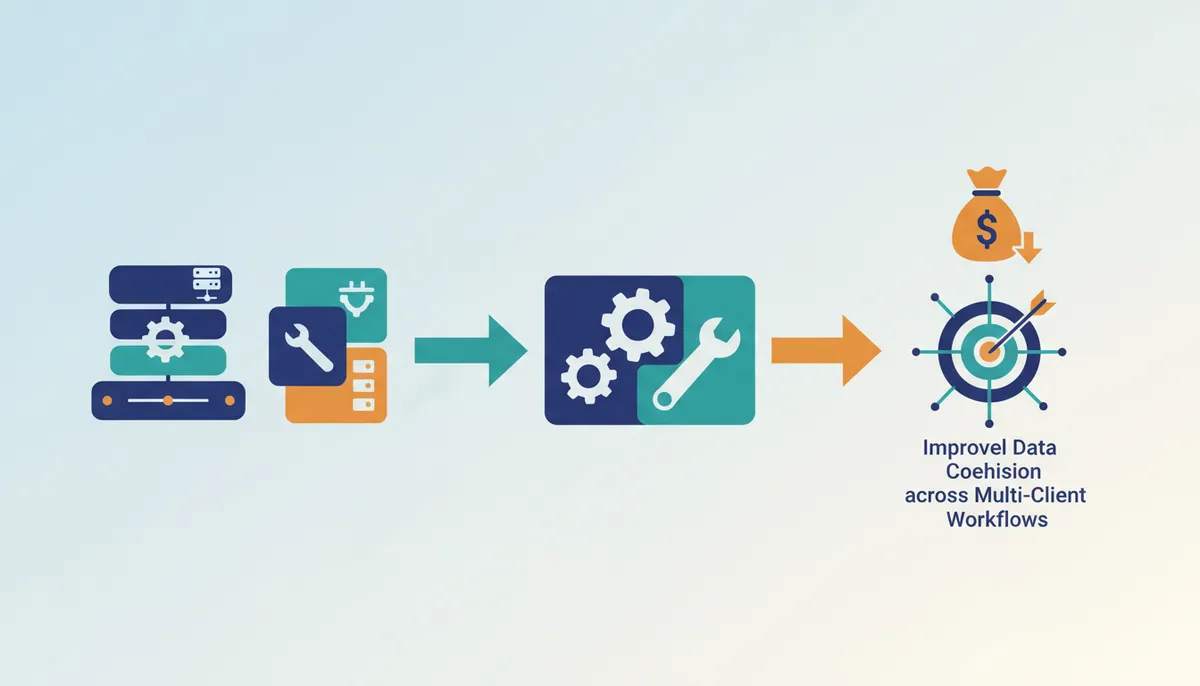
Fragmentation drains agency resources when content creation at scale, AI visibility tracking, and workflow automation operate in isolation. Unified platforms merge planning, drafting, and performance metrics into one system to eliminate this drag. Data silos emerge when GEO strategy fails to guide real-time drafting, forcing teams to manually reconcile search appearance numbers. Agencies evaluating consolidation should check if their current setup allows prompt-level tracking to directly influence output. Mapping tools against these three pillars reveals breaks in the automated publishing chain. Reproducible workflows demand that brand voice customization survives volume spikes without manual intervention.
Deploying Unified and Specialized Architectures for Multi-Client Scalability
Choosing an architecture means balancing unified data context against specialized generation throughput. All-in-one platforms merge AI brand monitoring with multi-agent creation and automated indexing built for agency scale.
Disjointed point solutions create data silos that block the real-time prompt-level tracking needed for brand safety across clients. Structured human-in-the-loop workflows stay necessary because teams must edit AI drafts to match organizational goals. Businesses generate the content by combining automation with analytics instead of relying on text production alone. Operators should note that agent workflows handle research and formatting while humans protect strategic judgment.
Mapping client needs against these architectural differences matters before committing to a stack. The cost is measurable when disconnected tools prevent immediate feedback loops.
| Feature | Unified Platform Approach | Specialized Generation Approach |
|---|---|---|
| Primary Focus | Integrated monitoring and writing | High-volume generation |
| Workflow Type | Multi-agent collaboration | Template-based scaling |
| Best Fit | Agencies needing visibility data | Teams prioritizing output speed |
The 2026 Risk of Missing AI Visibility Monitoring
Generative search engines may ignore or misattribute output lacking this telemetry layer, making high-volume production ineffective. Traffic can drop while output volume stays constant, a silent failure mode distinct from traditional SEO ranking losses. Consolidating disjointed checks into one workflow stops unindexed or hallucinated brand associations from accumulating. Agencies asking if they should consolidate their content stack must prioritize this visibility gap over raw generation speed. Ignoring this metric reduces relevance in generative answer engines by 2026.
About
Arjun Patel is an Applied LLM Engineer who benchmarks LLM providers, models, and RAG architectures specifically for content workloads. His expertise in vendor-neutral evaluation across cost, latency, and quality makes him uniquely qualified to analyze the environment of content marketing tools for agencies. Unlike generalist marketers, Arjun's daily work involves stress-testing AI content creation pipelines and measuring inference economics, directly informing his assessment of agency content workflows and automated publishing systems. At Enterium, a B2B publication dedicated to AI content automation, Arjun documents how technical teams build scalable content pipelines using real-world data rather than hype. This article's focus on AI visibility tracking, IndexNow integration, and multi-client management stems from his rigorous, hands-on experience comparing LLM providers and SEO tools in production environments. By grounding recommendations in reproducible benchmarks, Arjun ensures that the analysis of AI-generated content tools provides actionable architecture decisions for content engineers and marketing-ops leaders seeking to optimize their AI search optimization strategies.
Conclusion
Scaling content operations reveals that disjointed toolchains create silent failure modes where output volume remains high while actual visibility collapses. The operational cost of maintaining separate systems for generation and verification is no longer just financial; it is a loss of strategic control over how brands appear in generative answers. Agencies relying solely on template-based scaling without integrated monitoring will find their content ignored by search engines, regardless of production speed. This architectural gap turns high-volume output into a liability rather than an asset.
Organizations must commit to consolidating their stacks into unified platforms that merge AI brand monitoring with creation workflows before the end of the year. Do not wait for traffic metrics to plummet before addressing these data silos. The window to establish prompt-level tracking within a cohesive system is closing as generative engines evolve. Start by mapping your current client workflows against the unified platform approach this week to identify where feedback loops are broken. This immediate audit reveals whether your current setup supports real-time brand safety or merely accelerates unverified output. Prioritizing integrated visibility over raw speed ensures your content remains the and attributed correctly in the shifting search environment.
Frequently Asked Questions
New entrants often start subscription fees at $89 per month. This pricing allows agencies to access specialized multi-agent workflows without large upfront investments while replacing single-tool dependencies with interconnected systems.
These systems isolate generation from governance to enforce strict tone controls. Agencies deploy thirteen distinct AI agents to manage modern content stacks, ensuring human oversight protects brand consistency before any text reaches a CMS.
Prompt-level tracking verifies if content appears in model outputs for specific intents. This non-negotiable requirement helps agencies manage multiple client accounts with conflicting voice guidelines while preventing hallucination or context loss.
GEO optimizes for machine retrieval and citation logic rather than human scanning. Operators must monitor visibility metrics to ensure their brand earns citations in AI answers instead of just ranking on static blue links.
These architectures push content directly to CMS instances while logging every modification. This approach creates a full-cycle stack that unifies disjointed auditing and generation tools into a single operational pipeline for scalability.
References