Content guardian agents stop brand hallucinations now
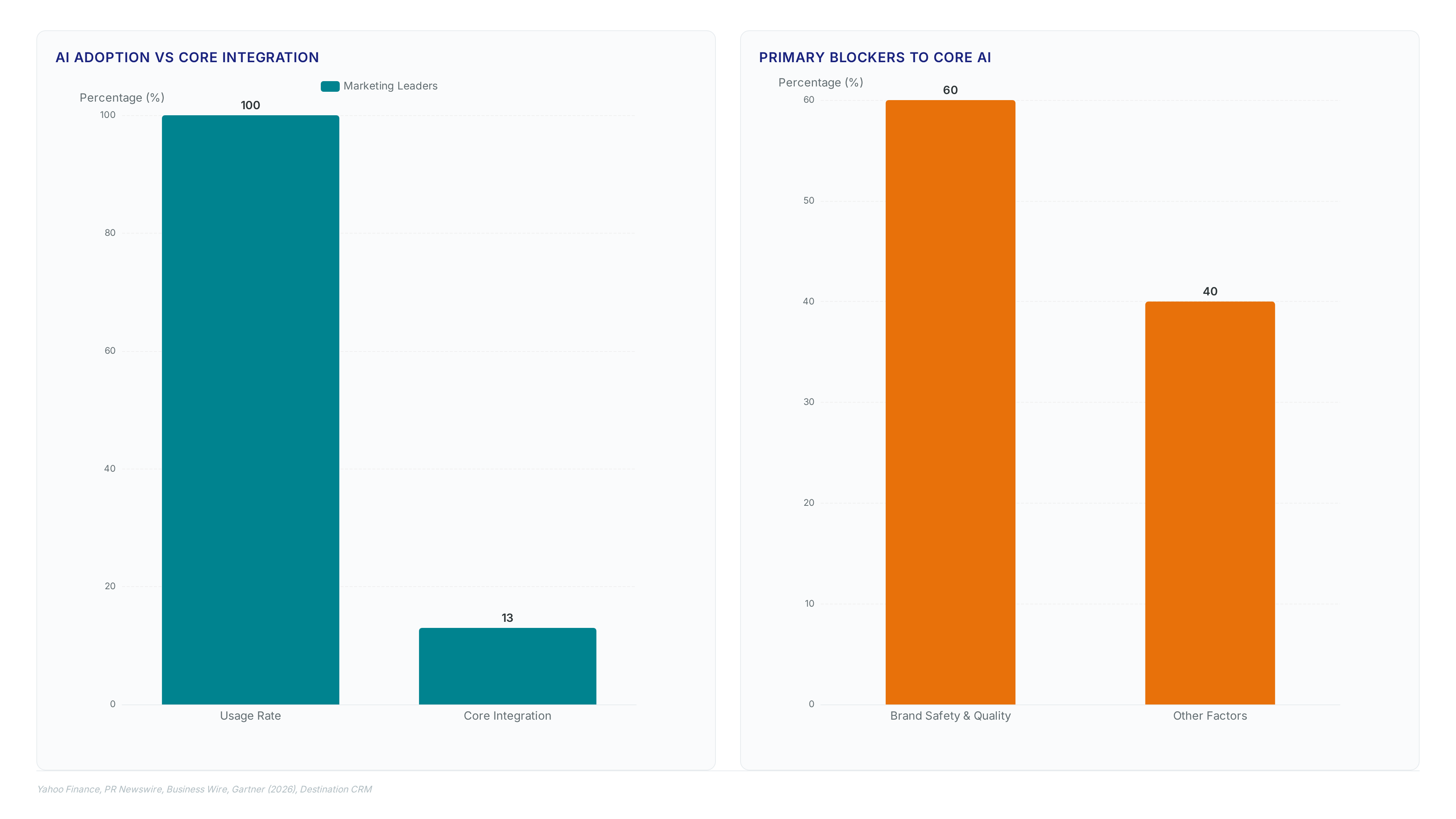
Only 13% of marketing leaders consider AI core to operations despite universal adoption, a gap driven by quality fears.
These systems do more than accelerate output. They autonomously oversee terminology and consistency to ensure brand compliance. Modular agent bundles now score and flag errors in real-time without disrupting writer workflows.
The technical reality relies on API-first architecture that keeps sensitive data secure within established pipelines. Specific implementations like the Contentful Sidebar App allow enterprises to enforce governance directly inside authoring environments. Measurable ROI cases show how pre-flight checks simplify localization and maintain technical accuracy for regulated industries. This shift marks the transition from unchecked generation to governed intelligence.
The Role of Content Guardian Agents in Modern Generative AI Operations
Markup AI delivers the industry's first Content Guardian Agents℠ platform, acting as a technical trust layer for Generative AI content operations. This modular, multi-agent architecture bundles specialized agents responsible for distinct quality dimensions like terminology, tone, and grammar into a unified approach. The system executes a deterministic framework where every asset receives a quality score before publication.
Marketing leaders cite brand safety as a primary blocker to AI integration, driving this operational shift. Embedding checks directly into authoring environments removes the latency found in post-generation review cycles. Enterprises customize governance rules within the multi-agent architecture, selecting automatic rewrites or mandatory human review based on specific risk tolerance. Relying on generation speed without this verification layer invites significant brand risk. The cost is necessary to prevent hallucinations from reaching production systems. Guardian agents serve as the filter ensuring content quality meets enterprise standards as the functional range of AI tools expands.
Real-Time Scoring and Rewriting Within the Contentful Sidebar
Content Guardian Agents execute a deterministic scan, score, and rewrite loop directly inside the Contentful Sidebar App. This API-first architecture analyzes terminology and compliance without moving data outside the secure authoring environment. Writers receive instant feedback on tone and clarity while sensitive assets remain within established pipelines. Context-switching disappears, enhancing productivity at scale. The underlying MCP-powered design ensures governance logic travels with the content rather than sitting in a separate silo. Governance becomes an embedded service instead of a downstream audit. Enterprises deploy these agents to enforce standards at the point of generation.
Overcoming Brand Safety Blockers to Make AI Core to Operations
Many marketing leaders report using AI for content creation, yet only a fraction consider these systems core to operations due to persistent quality fears. The distinction lies between generative speed and governed reliability. This shift moves focus from volume generation to risk mitigation. Content Guardian Agents resolve the deadlock by embedding deterministic evaluation directly into the authoring workflow. The platform scores, flags, and rewrites content in real-time, allowing guardian agents to autonomously oversee AI outputs. Implementing a unified trust layer allows enterprises to address quality constraints effectively. AI operates as a core utility rather than an experimental risk in this production environment.
Inside the Modular Architecture of Real-Time Content Scoring and Guardrails
Modular Multi-Agent Architecture for Quality Dimensions
Parallel agent tasks replace monolithic review cycles to score content quality in real-time. Distinct modules evaluate terminology, clarity, tone, and grammar simultaneously during a scan, score, rewrite sequence. This multi-goal scoring method assigns a deterministic trust value to each dimension before aggregating a final compliance rating.
- Terminology Agent: Validates terms against approved corporate glossaries.
- Tone Agent: Measures semantic distance from brand voice profiles.
- Clarity Agent: Flags complex sentence structures or passive voice.
- Grammar Agent: Corrects syntax errors and enforces style guides.
| Component | Function | Output |
|---|---|---|
| Scanner | Pattern matching | Risk flags |
| Scorer | Deterministic algorithm | Trust percentage |
| Rewriter | Generative modification | Compliant draft |
Developers keep sensitive data inside secure authoring environments because the underlying API-first architecture operates via the Model Context Protocol. Latency grows linearly as active guardrails increase, forcing teams to weigh strictness against real-time performance needs. Most deployments prioritize terminology and compliance agents first while deferring tone adjustments to post-generation review to maintain editor responsiveness. Such modular design allows Content Guardian Agents to scale oversight without creating a bottleneck in the content pipeline.
API-First Integration and Contentful Sidebar Workflows
Writers avoid context switching because pre-flight checks execute inside Contentful via a purpose-built Sidebar App. Text receives immediate feedback on tone and clarity while assets remain within established pipelines since this API-first architecture scans, scores, and rewrites without moving sensitive data outside the secure authoring environment. Governance rules apply automatically before publication through the deterministic workflow supported by the underlying MCP-powered architecture.
- Ingest: Content enters the sidebar trigger upon save or request.
- Evaluate: Specialized agents measure terminology, consistency, and grammar against brand standards.
- Remediate: The system offers instant rewrites or flags violations for human review.
| Integration Mode | Data Movement | Latency Profile |
|---|---|---|
| Native Sidebar | Zero egress | Real-time |
| External API | Full payload transfer | Network-dependent |
Non-compliant drafts stay out of version history when guardrails embed directly into the interface. Open API access permits custom tooling yet demands rigorous schema validation to prevent injection attacks, creating tension between developer flexibility and strict governance. Balancing inline editing convenience with the security need for isolated processing environments remains necessary. Operators should configure Content Guardian Agents to require human review for high-risk compliance categories while allowing automatic rewrites for tone adjustments. Workflow velocity persists without sacrificing oversight through this method. Enterium recommends mapping governance rules to specific content types before enabling automated remediation policies.
Addressing Brand Safety Blockers in Enterprise AI Adoption
Autonomous quality oversight converts generative outputs from liability risks into governed assets. Bessemer Venture Partners research indicates that while 100% of marketing leaders apply AI for creation, a mere 13% integrate it deeply due to safety fears. Content Guardian Agents℠ intercept drafts before publication to score terminology, tone, and clarity against strict brand policies. Hallucinated claims or off-brand phrasing fail to enter the public sphere because of this real-time scoring mechanism. Rushing verification enables errors while excessive latency kills productivity, presenting a sharp tension between generation speed and verification depth. Embedding checks directly within the authoring environment rather than as a post-process step solves this problem.
| Risk Factor | Consequence Without Guardrails | Mitigation Strategy |
|---|---|---|
| Hallucination | False claims damage credibility | Real-time fact verification |
| Tone Drift | Brand voice inconsistency | Semantic distance scoring |
| Compliance Gap | Regulatory fines | Policy enforcement agents |
Manual review cannot match AI generation velocity. Human editors alone create a bottleneck that forces teams to choose between speed and safety. Governance must be automated and synchronous with creation to resolve this operational deadlock. Enterprises can adopt the Enterium recommended approach of inline agent validation. Every sentence meets standards before a human ever sees the final draft.
Measurable ROI from Enforcing Brand Voice and Compliance in Regulated Industries
Defining Enforceable Brand Voice Rules for Regulated Content Blocks
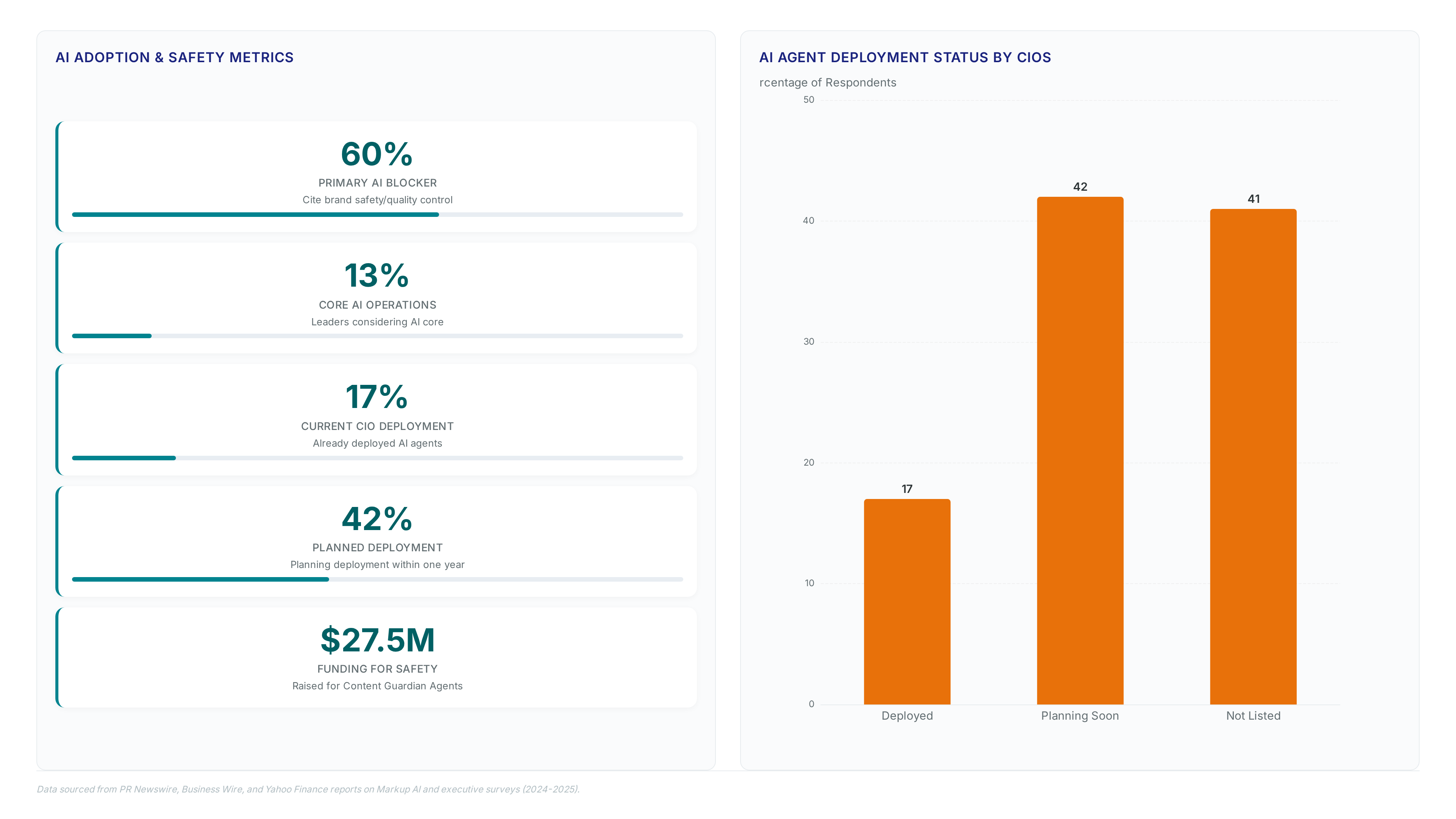
Abstract guidelines become useless constraints unless translated into concrete rules for every modular content block. A modular, multi-agent architecture bundles specialized agents responsible for distinct dimensions of content quality, including terminology, consistency, tone, clarity, and grammar. This technical reality addresses a specific market statistic: 60% of marketing leaders cite brand safety and quality control as the primary blocker to making AI core to their operations. Tools designed solely to accelerate content creation often miss these nuances. Business alignment optimizers prioritize terminology enforcement and compliance to ensure regulatory adherence. The harder, more consequential problem involves ensuring that everything produced by humans and AI actually meets the standard.
Real-time scoring, flagging, and rewriting allow guardian agents to autonomously oversee AI outputs. Enterprises in regulated sectors enforce these compliance rules across every modular content block to maintain technical terminology consistency. Standards demanded by a brand must be met by all outputs.
Pre-Flight Checks to Simplify Source Content Before Localization Pipelines
Global brands simplify source content before it reaches translation pipelines through pre-flight checks. The mechanism deploys Content Guardian Agents to scan, score, and rewrite drafts within the authoring environment, ensuring technical terminology and tone align with brand standards prior to export. Inconsistent voice propagates across languages when unverified English source files enter high-volume localization workflows. Source content meeting standards before export helps manage the complexities of global localization.
An API-first architecture maintains an system of native integrations, including a purpose-built Sidebar App for Contentful, to unify tools and check compliance. Meeting customers exactly where their content lives separates effective platforms from generic tools. Enterprise-grade governance embeds directly into a writer's existing workflow so content is scanned and rewritten without ever leaving the authoring environment. Quality assurance shifts from a post-hoc audit to an upstream constraint. Sensitive data stays secure within established pipelines.
Network operators and content strategists see a clear implication: enforce consistency at the source to reduce downstream remediation costs. Guardian logic intercepts hallucinations before they become published liabilities for teams facing brand safety blockages. Tools that unify governance across distributed workflows help those managing complex content estates. Implementing these pre-flight gates secures the integrity of global content operations by simplifying source content before it enters translation pipelines.
Risks of Non-Compliant AI Content in Enterprise Marketing Operations
Unverified generative outputs introduce regulatory exposure and brand dilution. Automated interactions must remain accurate, on-brand, and clear to avoid this hesitation. Potential fines represent only part of the cost. Customer trust erodes when automated systems publish inaccurate claims. Guardian agents operate on a "Scan, Score, Rewrite" framework, providing a deterministic trust score for every piece of content analyzed to mitigate these risks.
Accelerating content creation often conflicts with ensuring outputs meet brand standards. Many organizations struggle with the lack of autonomous quality oversight required to validate content before publication, leaving them vulnerable to downstream legal challenges. Current workflows often lack real-time scoring that aligns with specific corporate glossaries. The risk profile of AI-generated content remains unacceptably high for regulated sectors without embedded guardrails. Deterministic evaluation layers intercept and rewrite non-compliant blocks within the authoring environment. Enterprises scale their use of AI with confidence through this deployment.
Strategic Advantages of Markup AI Over Traditional Generative Tools
Defining the Content Guardian Approach vs Basic Generation
Basic generation accelerates volume, yet Content Guardian Agents enforce strict quality gates that instantly scan, score, and rewrite text. Traditional tools offer passive suggestions, whereas this architecture assigns a deterministic trust score to every output. This distinction shifts operations from probabilistic advice to clear pass/fail metrics for brand compliance.
| Feature | Basic Generative Tools | Content Guardian Agents |
|---|---|---|
| Feedback Mode | Probabilistic suggestions | Deterministic scoring |
| Intervention | Post-draft review | Real-time rewrite |
| Primary Goal | Volume acceleration | Brand standard enforcement |
| Governance | Manual policy checks | Autonomous quality oversight |
The operational risk lies in scaling unverified outputs; without active governance, errors can compound across large campaigns. Markup AI addresses this by embedding guardian logic directly into LLM pipelines to reduce errors at the point of generation. The system prevents non-compliant content from reaching the editor by enforcing standards before human review. This structural difference ensures that every modular block meets technical terminology consistency requirements. The shift from generation-first to governance-first architecture represents the necessary evolution for scaling AI in regulated markets.
Deploying Guardian Agents Within Existing Content Workflows
Markup AI executes this through an API-first architecture that scans, scores, and rewrites drafts within tools like Contentful. This architecture ensures sensitive data remains secure inside established pipelines while enforcing deterministic scoring over probabilistic suggestions. Traditional style checkers offer passive advice, whereas these agents act as strict quality gates that demand compliance before publication.
| Dimension | Traditional Style Checkers | Content Guardian Agents |
|---|---|---|
| Integration Point | Post-draft export | Real-time authoring |
| Decision Logic | Advisory suggestions | Deterministic pass/fail |
| Data Security | Often requires upload | Stays in-pipeline |
| Primary Output | Highlighted errors | Auto-rewritten text |
Generative AI is now embedded across marketing layers, intensifying the need for this infrastructure to prevent errors at the source. Organizations should map current content workflows to identify exactly where guardian logic can intercept LLM outputs before they reach human editors. By meeting customers where their content lives, the platform removes context-switching and enhances productivity at scale.
Creation Speed Versus Measurable Commercial Impact in AI Tools
While standard models accelerate draft production, they lack the deterministic scoring required to validate commercial viability before publication. The distinction lies in shifting from probabilistic suggestions to a verified trust layer that guarantees content meets strict enterprise standards.
Unlike basic generators that offer advisory feedback, specialized agents enforce brand safety by blocking non-compliant text at the source. This approach addresses the fact that a majority of leaders cite quality control as their primary barrier to scaling AI initiatives. Recent industry recognition has highlighted global demand for verified quality over raw volume. Enterprises should adopt content governance for AI by selecting tools that provide deterministic scoring rather than mere suggestions. The tangible takeaway for stakeholders is clear: measurable commercial impact supersedes raw creation speed when protecting brand equity at scale. Markup AI is redefining what it means to govern content in the age of AI.
About
Sofia Marchetti is a B2B Content Strategist with over 12 years of experience driving demand generation in SaaS. Her expertise lies in building topical authority and ensuring content survives the rigors of AI search and GEO optimization. This background makes her uniquely qualified to analyze Content Guardian Agents, as she understands that automated scale fails without reliable quality gates. In her daily work, Marchetti rejects "AI slop" in favor of systems where humans remain on the governance gates, directly aligning with the trust-layer architecture these agents provide. Writing for Enterium, a brand dedicated to vendor-neutral content automation methodologies, she connects technical pipeline choices to revenue outcomes. Her analysis bridges the gap between theoretical AI capabilities and the production realities faced by marketing operations teams. By focusing on reproducible steps and concrete metrics, Marchetti ensures readers understand how Content Guardian Agents protect brand integrity while scaling output, turning a complex technology award into actionable strategy for content engineers and leaders.
Conclusion
Scaling generative AI beyond isolated pilots reveals a critical fracture: probabilistic models cannot guarantee the deterministic compliance required for enterprise deployment. When organizations rely on post-hoc human review, they create a bottleneck where speed gains evaporate under the weight of error correction. The operational cost of this latency is not merely financial but reputational, as inconsistent outputs erode trust quicker than algorithms can generate drafts. True scalability demands shifting from advisory tools that suggest edits to autonomous systems that enforce standards before content ever reaches an editor.
Enterprises must mandate deterministic scoring as a non-negotiable requirement for any AI tool entering their production environment by the end of Q2. This transition moves governance from a reactive checkpoint to an embedded infrastructure layer, ensuring that commercial readiness is verified at the source rather than audited after the fact. Without this architectural shift, marketing teams will remain trapped in a cycle of rapid creation followed by slow, manual remediation.
Start this week by mapping your current content workflow to identify the exact handoff point where LLM outputs first reach human editors. Insert a gating mechanism at this specific junction to test autonomous rewriting capabilities against your strictest brand guidelines. This single intervention transforms your workflow from a fragile chain of manual checks into a resilient system capable of sustaining high-volume output without compromising safety.
Frequently Asked Questions
Quality fears prevent deep integration for most marketing leaders today. Only 13% consider AI core because they lack trust in output safety. Implementing guardian agents resolves this by scoring content before publication to ensure brand compliance.
Markup AI secured specific capital to launch this industry-first platform. The company raised $27.5 million to build the trust layer required for governed intelligence. This investment enables real-time scoring and rewriting within existing authoring environments.
These agents execute scans directly inside the sidebar app. Writers receive instant feedback without leaving their secure pipeline. This approach removes context switching while ensuring every asset receives a quality score before publication occurs.
Distinct modules evaluate terminology, tone, clarity, and grammar in parallel. This multi-goal scoring method assigns a deterministic trust value to each dimension. Enterprises can then enforce governance rules based on specific risk tolerance levels.
The system acts as a technical trust layer for generative operations. It addresses the reality that 60% of leaders cite brand safety as a primary blocker. Autonomous oversight ensures content meets standards before it reaches production systems.