Content autopilot architecture for scale teams
204,008 marketers now run automated flows for copy and blog posts. The shift to autonomous content systems is no longer theoretical. A content autopilot system acts as an end-to-end AI agent orchestration platform, stripping manual intervention from discovery, writing, and publishing workflows. This architecture outgrows simple generation tools to become a self-sustaining engine for marketing automation.
True scale demands a multi-agent AI system where distinct agents handle specific stages of the AI content pipeline without human handoff. Legacy AI writing tools demand constant prompting; these systems manage content backlog management and execution simultaneously. We must also address dual optimization strategies for both traditional SEO optimization and GEO optimization to secure visibility in generative engine answers. You will learn how continuous content discovery mechanisms identify gaps while AI-generated answer optimization techniques secure citations in large language model responses. This approach builds a scalable content system capable of closing keyword gaps with AI while tracking model citations for search engine performance.
Content Autopilot Set as an End-to-End AI Agent Orchestration System
Content Autopilot as End-to-End AI Agent Orchestration
A content autopilot is a system where AI agents manage the entire content pipeline, demanding minimal human intervention for each piece. Standalone AI writing tools merely produce drafts. An orchestrated pipeline links distinct agents responsible for research, outlining, writing, SEO optimization, linking, and publishing. This structural adjustment directly targets content debt, the backlog that grows when production speeds fail to match the velocity needed for visibility in traditional search and generative results. Autonomy defines the difference. Basic tools need step-by-step instructions for every single task.
Operationalizing the Five-Layer Agent Pipeline for Scale
Teams unable to match modern publishing velocity convert manual bottlenecks into scalable throughput by operationalizing the five-layer agent pipeline. Canva identifies that content teams, particularly those operating with small budgets, are unable to manually create, customize, and publish assets at the pace required. Distinct layers for calendar management, drafting, and indexing resolve this capacity gap by automating the content debt accumulation cycle. AI content automation flows help brands scale content production and maintain output volume. Teams must configure strict quality gates before enabling full autonomy. Without set brand voice parameters, the system increases generic output rather than strategic assets.
Standalone AI Writers Versus Orchestrated Agent Systems
A standalone AI writer outputs raw text drafts. A true content autopilot chains specialized agents for research, SEO, internal linking, and publishing. This architectural distinction determines whether a team merely generates text or systematically resolves content debt. Relying on isolated generation tools creates a false economy where initial speed collapses under the weight of downstream editing and formatting tasks. Teams operating without agent orchestration struggle to close the gap between drafting and the velocity required for visibility in AI-powered search environments. Operational risk lies in accumulating unoptimized assets that require human rework to meet GEO optimization standards. The tangible outcome is a shift from reactive drafting to proactive system-led production.
Multi-Agent Architecture Drives Automated Discovery Writing and Publishing Workflows
Defining the Five-Layer AI Agent Stack for Content Automation
The architecture functions through five coordinated layers where specialized agents execute tasks without constant human direction. Layer 1 Discovery continuously analyzes keyword gaps and trending queries to identify content opportunities. Layer 2 Creation uses autonomous software systems that generate drafts optimized for traditional SEO signals. Unlike basic tools requiring step-by-step instructions, these agents analyze situations and execute multi-step workflows independently. Layer 3 Publishing handles distribution while Layer 4 Indexing monitors visibility across search environments. Layer 5 Optimization adjusts outputs based on performance feedback loops.
| Layer | Primary Function | Agent Action |
|---|---|---|
| Discovery | Gap Analysis | Identifies prompts answered by AI models |
| Creation | Drafting | Structures content for AI citation |
| Publishing | Distribution | Executes multi-channel release |
| Indexing | Visibility | Tracks inclusion in search indices |
| Optimization | Refinement | Adjusts based on citation data |
Large Language Models form the foundation by generating engaging headlines incorporating target keywords. This stack ensures AI creates structured content outlines by generating frameworks based on top-performing content. The system clusters related keywords and suggests logical flow to optimize briefs efficiently. Human oversight remains necessary for final quality gates. The operational consequence is a shift from manual writing to system orchestration. Teams must configure planning agents and memory layers rather than draft individual sentences. Defining clear criteria before deployment allows teams to focus on strategy, storytelling, and strengthening E-E-A-T signals that build trust and visibility.
From Manual Treadmills to Automated Flows: Solving Content Debt
Manual workflows relying on spreadsheets and static writer briefs create a structural deficit known as content debt, representing the widening gap between required output and actual shipment volume. This bottleneck persists because content teams, especially those with small budgets, cannot manually create, customize, and publish assets at the pace required by the current digital environment. The mechanism for resolution involves replacing linear drafting with automated flows where specialized agents execute discrete tasks without constant oversight. Unlike basic generators, these systems maintain calendar density even during peak operational periods by generating draft content on a fixed schedule.
| Workflow Type | Throughput Capacity | Primary Constraint |
|---|---|---|
| Manual | Low | Writer availability |
| Automated | High | Configuration precision |
The shift requires redefining the editor's role from creator to system architect who configures automated content workflows. AI-powered automation changes the equation fundamentally by reducing the time and effort required to maintain a consistent content presence across multiple channels. Teams must implement validation layers to ensure high-volume generation aligns with brand voice standards. This orchestration framework helps balance scale with precision, ensuring that increased output translates to captured market visibility. By automating research and on-page SEO, teams can focus on strategy rather than repetitive tasks, effectively closing the gap between content requirements and production capacity.
Validating IndexNow Integration and Instant Publishing Protocols
Verifying IndexNow support requires confirming the publishing layer sends immediate URL change notifications to Bing and Yandex. Layer 3 Publishing and Indexing uses automated CMS publishing combined with this integration to ensure instant visibility.
| Protocol Feature | Manual Crawl Discovery | IndexNow Push |
|---|---|---|
| Notification Method | Passive waiting | Immediate API call |
| Latency Source | Crawler schedule | Network round-trip |
| Visibility Window | Days to weeks | Minutes |
Operators should validate the publishing sequence to address slow content publishing:
- Confirm the CMS triggers a notification upon status change to published.
- Verify the API key matches the domain ownership record.
- Monitor server logs for successful responses from the index endpoints.
Content teams relying solely on this protocol without strong internal linking structures may experience delays despite successful pushes. Configuring these publishing protocols to include redundant health checks ensures the notification pipeline remains active even during upstream API degradation.
Dual Optimization for Traditional SEO and Generative Engine Visibility Maximizes Reach
Defining GEO vs Traditional SEO Reward Signals
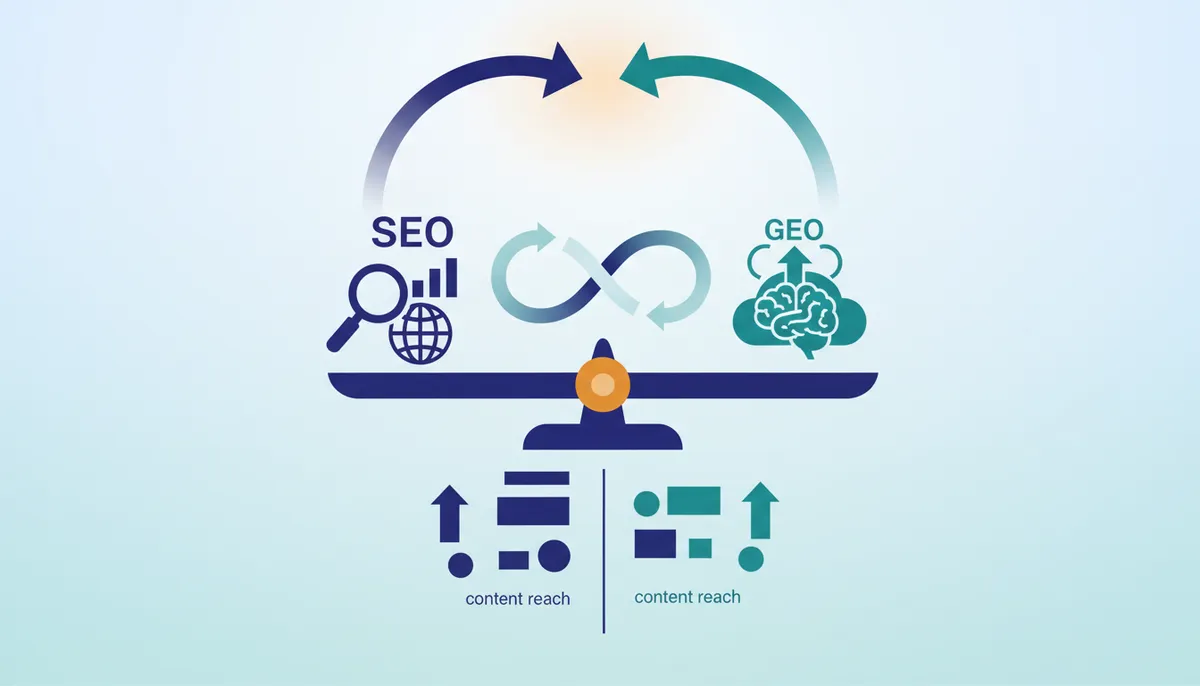
Search strategies increasingly distinguish between traditional discovery and AI-driven visibility. Generative Engine Optimization (GEO) shifts focus toward factual structure and explicit entity definition that language models can extract without ambiguity. Traditional methods rely on established indexing behaviors, yet large language models support content strategies designed for AI-driven discovery by parsing content for semantic relevance and citation readiness.
| Dimension | Traditional SEO Focus | GEO Requirement |
|---|---|---|
| Primary Signal | Domain authority and backlink profiles | Entity clarity and direct answers |
| Structure | Keyword density and page speed | Logical fact hierarchy |
| Goal | Click-through rate | Model citation probability |
A workflow that automates research, outlines, and on-page SEO while maintaining E-E-A-T addresses this gap by enforcing rigid factual schemas alongside standard optimization. The challenge arises when concise, model-friendly summaries conflict with the depth required for thorough coverage. Teams must balance these competing incentives rather than assuming one strategy satisfies both. Cost is high when depth gets sacrificed for brevity.
Tracking AI Citations Across Claude and Perplexity
Standard analytics dashboards often fail to capture brand mentions within generative responses on platforms like Claude and Perplexity. This approach contrasts with traditional SEO, where structured content drives organic visits while simultaneously earning AI citations. The critical distinction involves the reward signal: traditional engines apply backlink profiles, whereas generative engines favor factual clarity and direct answer structures.
| Dimension | Traditional Tracking | Generative Citation Monitoring |
|---|---|---|
| Metric | Click-through rate | Mention frequency in answers |
| Source | Server logs | Direct model queries |
| Goal | Traffic volume | Answer visibility |
Advisors recommend implementing continuous discovery loops to validate content authority across multiple model vendors. Without this active probing, brands remain blind to attribution gaps where their data informs answers without credit. Teams should treat citation tracking as a distinct workflow from standard performance reporting. Neglecting this layer leaves optimization efforts incomplete as search behavior shifts toward direct answers. Data shows missing citations correlate with lost context.
Comparing Organic Traffic Growth and AI Visibility Scores
Evaluating content performance requires separating organic traffic signals from AI visibility scores to identify specific pipeline failures. Teams implementing an AI content workflow that automates research and on-page SEO can isolate these variables effectively.
| Metric Dimension | Traditional SEO Indicator | Generative Engine Indicator |
|---|---|---|
| Primary Goal | Click-through rate | Direct answer extraction |
| Structure Need | Keyword optimization | Logical fact hierarchy |
| Failure Mode | Low crawl budget | Ambiguous entity definition |
| Success Signal | Backlink growth | Model citation frequency |
Operators must recognize that a single well-structured article can drive organic visits while simultaneously earning citations, but only if the entity clarity satisfies both crawlers and language models. Neglecting this dual requirement leads to systems that rank well in search but remain invisible in generative responses. Experts recommend configuring measurement agents to track these divergent signals independently rather than aggregating them into a single vanity metric. Clear separation reveals where filters block visibility.
Strategic Implementation Requires Brand Voice Configuration and Rigorous Performance Measurement
Configuring Brand Voice Guidelines and Editorial Constraints

Autonomous software agents analyze situations and execute multi-step workflows to apply brand guidelines across large content volumes.
- Establish a style baseline by using approved historical content to guide the generation of engaging headlines and logical flow.
- Enforce terminology consistency by clustering related keywords and topics to suggest structure during the drafting phase.
- Implement governance protocols that maintain E-E-A-T (Experience, Expertise, Authoritativeness, and Trustworthiness) signals throughout the creation process.
Agent-based enforcement maintains consistent rule application across thousands of generated assets. Teams balance strict guideline adherence with enough generative freedom to keep readers interested. Brands lacking proper configuration generate content missing the strategic storytelling needed for trust and visibility. Modern solutions embed editorial constraints directly into pipeline architecture so every artifact meets quality gates before publication. This approach treats content as a versioned build artifact requiring acceptance testing instead of a creative draft. A properly configured system reduces content debt by preventing errors at the source rather than correcting them post-publish.
Executing a Phased Rollout Strategy
This architectural choice prevents structural errors from propagating through the generation pipeline.
- Configure the orchestration layer to generate structured content outlines based on top-performing content frameworks for manual approval.
- Deploy agents initially on draft content for blogs, landing pages, and social media where topics are well-set.
- Expand scope to complex campaigns only after verifying consistency across the initial content batch.
Sequencing mitigates the risk of scaling hallucinated facts before guardrails are proven. Teams often rush to automate complex thought leadership only to find brand voice drift accumulates rapidly without early intervention.
Validating Publication Velocity and Indexing Speed Metrics
Operators diagnose bottlenecks by tracking four baseline metrics to ensure pipeline health: publication velocity, indexing speed, organic traffic growth, and AI visibility score.
- Measure publication velocity to identify agent concurrency limits causing flat output.
- Monitor indexing speed to detect discovery layer failures in search crawlers.
- Track organic traffic growth to validate that indexed content attracts users.
- Calculate an AI visibility score to assess citation frequency in generative answers.
Interpreting these signals requires distinguishing between generation delays and distribution failures. High velocity with stagnant traffic suggests issues in content quality or relevance rather than system throughput. Low velocity with high latency points directly to orchestration bottlenecks.
| Metric | Primary Failure Signal | Operational Implication |
|---|---|---|
| Publication Velocity | Flat output volume | Workflow configuration error |
| Indexing Speed | Slow crawler adoption | Integration failure |
| Organic Traffic | Stagnant user growth | Discovery layer failure |
| AI Visibility | Low citation count | Generative optimization gap |
A diagnostic check of the current pipeline reveals whether agents wait on external APIs or if the publishing queue is blocked. Addressing specific failure modes restores flow without requiring architectural overhaul.
About
Arjun Patel is an Applied LLM Engineer who benchmarks LLM providers, models, and RAG architectures specifically for content workloads. His expertise in vendor-neutral evaluation across cost, latency, and quality makes him uniquely qualified to dissect the mechanics of a content autopilot system. Unlike generic overviews, Arjun's daily work involves stress-testing multi-agent AI systems and analyzing inference economics to build reproducible content pipelines. At Enterium, a B2B publication dedicated to documenting how modern teams scale content with LLMs, Arjun applies this rigorous engineering lens to separate hype from functional architecture. He connects deep technical analysis of AI content creation and GEO optimization to the practical realities of reducing content debt. By focusing on the specific trade-offs inherent in automated content publishing, Arjun provides the actionable data B2B leaders need to construct scalable systems. His insights bridge the gap between theoretical marketing automation and the concrete pipeline architecture required to ship reliable, high-volume content today.
Conclusion
Scaling a content autopilot system without rigorous calibration invites systemic failure where volume masks a collapse in quality. The immediate utility reported by marketers often creates a false sense of security, leading teams to bypass necessary editorial constraints in favor of raw output. This approach locks in poor patterns that demand costly retraining later. Operators must recognize that high publication velocity means nothing if indexing speed remains stagnant due to crawler rejection or low relevance. The real operational cost emerges when teams chase metrics like organic traffic growth without first validating that their distribution layers function correctly.
You should delay any aggressive volume scaling until your approval workflow consistently validates low-risk topics without manual intervention. Treat the initial deployment phase strictly as a calibration window where throughput is intentionally capped to ensure adherence to brand voice and factual accuracy. Do not let the promise of generative speed override the necessity of a stable AI visibility score.
Start this week by auditing your current pipeline for the specific bottleneck of flat output volume versus slow crawler adoption to distinguish between generation delays and distribution failures. Only after isolating this specific failure mode should you adjust your orchestration logic.
Frequently Asked Questions
Isolated tools create false economies requiring heavy human rework. Teams without agent orchestration fail to match the velocity needed for visibility in modern search environments.
Distinct automated layers resolve capacity gaps by preventing backlog accumulation. This approach allows 204,008 marketers to scale production and maintain output volume that manual teams cannot match.
Undefined parameters cause systems to generate generic output rather than strategic assets. Rigorous setup ensures the five-layer agent pipeline produces authoritative content aligned with specific brand standards.
Manual creation cannot meet the pace required by modern marketing demands. Small budget teams specifically need automation to create, customize, and publish assets at the necessary velocity.
Strategies targeting both traditional SEO and generative engines maximize overall reach. This method secures citations in large language model responses while closing keyword gaps with AI effectively.
References