Content automation stacks SaaS teams need now
SaaS buyers now spend less than a small fraction of their time speaking directly with vendors, forcing marketing content to carry the entire burden of education. This reality makes the content automation stack a strategic necessity rather than a mere productivity hack for teams facing unchanged headcounts. Treating this shift as a simple way to write quicker yields only marginal gains. Restructuring strategy into a closed loop creates a compounding organic growth engine.
Manual workflows hit a hard ceiling when facing the massive surface area required for modern topical authority. The three-layer architecture needed to manage signal collection, AI-assisted creation, and automated publishing solves this without proportional increases in hours. These systems serve both traditional search and the emerging demands of AI-generated answers.
Teams that fail to connect these elements into a unified workflow will struggle to replicate the velocity of competitors who treat automation as a fundamental capability shift. Human judgment remains irreplaceable for strategy, while tools handle the scale of comparison pages, feature explainers, and integration docs required in 2026. Success depends on moving beyond isolated experiments to a fully integrated operational model.
The Role of Content Automation in Overcoming SaaS Scaling Barriers
Defining Content Automation as an AI-Powered Scaling Engine
Content automation uses AI-powered tools to plan, produce, optimize, publish, and index material at scale without demanding proportional headcount growth. This capability shift eliminates disjointed manual processes where staff copy data between disconnected systems, a fragmentation that steals time from strategic narrative development. The mechanism functions by linking signal collection, generation, and publishing into one pipeline rather than stacking separate platform subscriptions.
Inconsistent publishing erodes topical authority and reduces the probability of AI models citing the brand. Manual teams producing limited articles monthly cannot match the volume required to maintain crawl signals or fill competitive gaps across a full topic cluster. Operators must deploy platforms unifying editorial, CMS, and analytics functions to remove manual handoffs between writing and live deployment. Solutions like Sight AI combine visibility tracking with automated publishing to serve both traditional search and generative engine optimization simultaneously. Without a connected engine, human judgment remains stuck in execution tasks like meta description updates instead of focusing on high-level differentiation strategy.
Next step: Audit your current stack for tool fragmentation; if you lack a unified pipeline, you are likely paying an opportunity cost in strategic depth.
Applying Automation to SaaS Topical Authority and GEO Content
Manual teams fail to sustain the dozens of pieces required for genuine topical authority. As SaaS buyers spend less time speaking directly with vendors, reliance on digital signals for discovery increases. Building this authority demands publishing related content clusters and filling competitive gaps quicker than human-only workflows allow. A typical manual pipeline forces marketers to copy outputs between disconnected tools, creating friction that automated systems eliminate by connecting signal collection to publishing.
The mechanism integrates content intelligence with generation to target both traditional search and AI-driven discovery platforms. A critical trend toward "AI visibility" tracking has emerged, as models reference less content from companies lacking a strong, automated presence. This reality erodes authority for brands that fail to maintain consistent output volume. The cost is measurable opportunity loss when senior staff manage disjointed toolchains instead of strategic narrative. Automation requires strict human oversight to prevent brand drift during high-volume production. Teams must balance speed with quality gates to ensure differentiation angles remain sharp. Inconsistent publishing directly undermines visibility in AI-generated answers and topical authority.
| Feature | Manual Workflow | Automated Stack |
|---|---|---|
| Tool Count | Multiple disconnected apps | Integrated pipeline |
| Output Capacity | Limited articles/month | Scalable clusters |
| AI Visibility | Low/Inconsistent | High/Tracked |
Automation addresses the compounding costs of inconsistency, such as lower crawl signals and eroded topical authority, by maintaining the content volume necessary for AI model referencing.
Manual vs Automated Workflows: The 3-to-5 Person Team Limit
Manual SaaS content operations stall when team output caps at a low volume of articles monthly against expansive roadmap requirements. This production ceiling creates a structural deficit where strategic goals outpace execution capacity, leaving competitive gaps unfilled and crawl signals weak. The constraint is not writer speed but the cognitive overhead of maintaining complex orchestration logic within limited human bandwidth. For small teams, the practical limit for sustaining high-fidelity workflows in platforms like HubSpot is strictly a few active sequences. Automation resolves this boundary condition by offloading execution logic to AI agents, allowing small teams to manage backlogs that would otherwise require doubling headcount.
The hidden cost of manual processing is the diversion of senior talent from narrative strategy to administrative coordination. When founders edit drafts or submit URLs manually, they forfeit the high-use activities that drive market differentiation. Automation reclaims this capacity by handling the execution layer, ensuring human judgment focuses solely on brand alignment and strategic angles rather than repetitive task management.
Inside the Three-Layer Architecture of Modern Content Stacks
The Content Intelligence Layer: From Signal Collection to Brief Generation
Automated keyword research and competitive gap analysis replace gut instinct within the Content Intelligence Layer. This foundation operates as a connected stack that monitors search trends to generate a prioritized queue of content briefs instead of relying on sporadic human intuition. Continuous tracking of competitor output allows the system to identify specific voids where a brand lacks presence in AI-generated answers, serving as a critical signal for GEO strategy. Many teams underinvest in this area, yet this data-driven approach remains the only method to sustain the volume required for genuine topical authority. A mature system functions not as a single tool but as an orchestration engine that shifts capacity from manual discovery to strategic narrative setting. Dependency on clean input signals limits this architecture; briefs may lack the structural logic needed for AI retrieval without strict entity definitions.
Operators must recognize that automating bad strategy simply scales noise. The human role shifts to validating the editorial roadmap before generation begins. Enterium recommends starting with a rigorous audit of current signal sources for teams seeking to implement this specific architectural approach to overcome scaling walls.
Executing Generative Engine Optimization Through Structured Entity Definitions
Structuring content so AI models retrieve and cite specific brand entities accurately defines Generative Engine Optimization. Clear entity definitions and FAQ-style formatting match how users phrase questions to AI assistants, distinguishing GEO from traditional SEO which targets link placement. Models lack the context needed to synthesize answers from documentation without these structural anchors.
Implementation requires four distinct elements to maximize visibility in synthesized responses:
- Defining brand entities with precise, unambiguous attributes.
- Formatting headers as direct questions matching user queries.
- Including authoritative sourcing within the immediate text block.
- Aligning content structure with how large language models parse context windows.
Narrative storytelling conflicts with the rigid data structures AI prefers for retrieval. Human readers appreciate context while AI models prioritize concise, attributable facts when generating answers. Over-narrativizing technical specifications often buries the specific data points models extract for citation.
Enterium recommends embedding these definitions directly into template logic rather than treating them as post-production edits. Ignoring this shift creates measurable invisibility. If a model cannot isolate a definitive answer, it will cite a competitor who has structured their data clearly. Content teams must transition from writing solely for human scanners to optimizing for machine extraction patterns. This dual-optimization strategy ensures assets perform across both traditional search indices and emerging AI answer engines.
Specialized AI Agents vs Generic Tools: Structural Logic in Content Generation
Specialized agents enforce strict structural logic for formats like listicles and comparison guides while generic LLMs output unstructured text blocks. Raw generative models often miss optimization rules required for high-ranking content, necessitating heavy human revision. Platforms like Sight AI deploy dedicated agents trained on specific schemas to ensure output adheres to GEO requirements without manual reformatting.
Rigid data schemas that break syncs between HubSpot, Salesforce, and content generators often cause the operational failure of generic tools, leaving lead data orphaned. Specialized systems avoid this issue by treating format constraints as hard rules rather than suggestions.
Teams relying on general-purpose models face a hidden cost. The time spent fixing broken formatting outweighs the speed gain of initial drafting. Marketers eliminate the friction of copying outputs between disconnected tools by delegating structural adherence to agents trained on specific article types. Human oversight focuses on strategic narrative rather than basic layout compliance within this pipeline.
Enterium recommends deploying format-specific agents to resolve the tension between volume and structural integrity. This approach ensures that every piece of content meets technical standards for indexing immediately upon generation.
Implementing a Closed-Loop Workflow for Automated SEO Publishing
Defining the AI-Assisted Creation and Human Review Stage
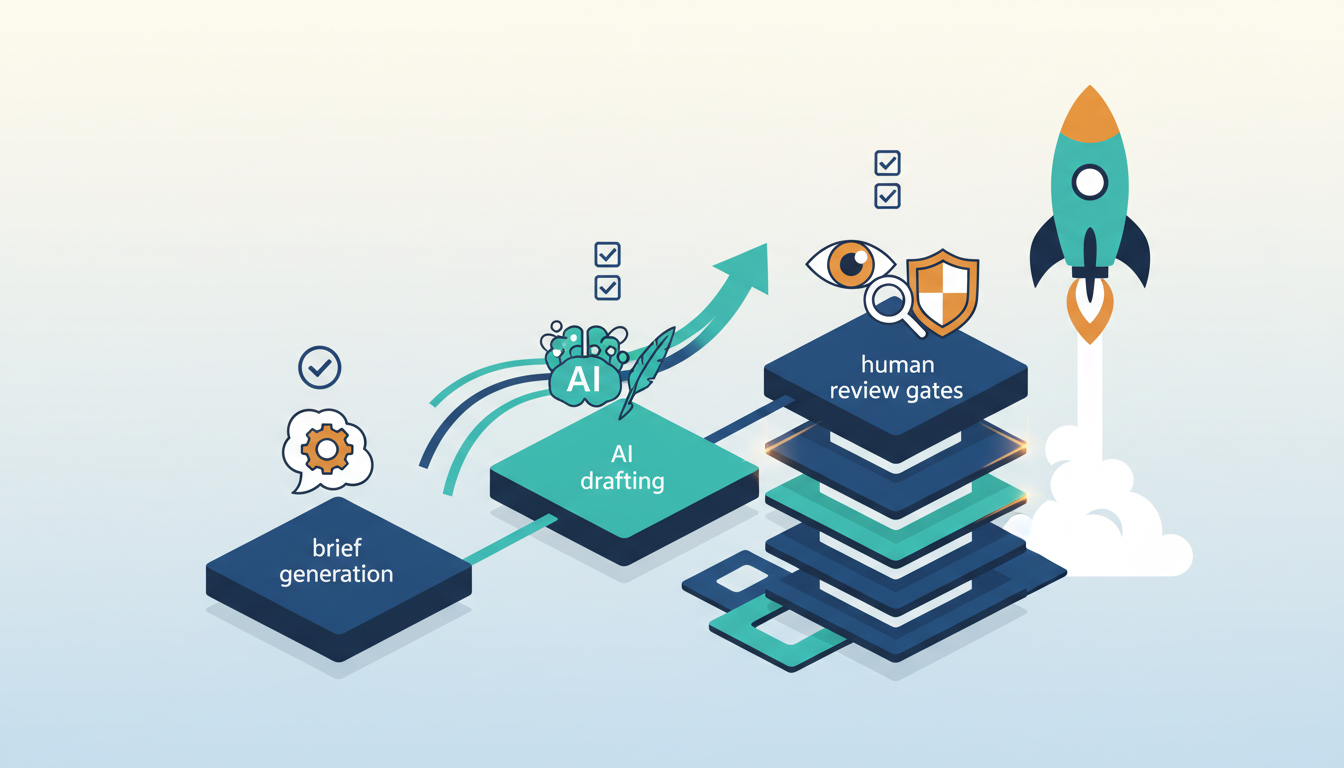
Specialized AI agents draft content using format-specific templates and brand voice guidelines to produce substantive first drafts. This stage converts prioritized briefs into structured text, distinguishing between generic LLM output and agent-generated pieces that adhere to strict structural logic. Tools like Sight AI combine visibility tracking with generation to maintain context across the pipeline. The mechanism relies on human-in-the-loop quality gates where marketers review for strategic accuracy rather than copyediting grammar.
- Agents ingest brief data to select the correct format template.
- Drafts are generated with embedded entity definitions for GEO compliance.
- Human reviewers validate brand alignment before publication approval.
- Approved drafts trigger downstream indexing workflows automatically.
Connectors like Zapier often bridge the gap between drafting tools and CMS platforms to execute these handoffs. Rigid templating can stifle unique narrative angles if human oversight remains passive. Teams must actively direct the strategic narrative while the system handles execution volume. This division of labor prevents the cognitive overload that typically halts manual pipelines. Enterium recommends treating this phase as a validation checkpoint, not a bypass for editorial judgment.
Implementation: Executing Stage 1 Signal Collection and Brief Generation
Automated systems monitor search trends to generate a prioritized queue of content briefs containing target keywords and GEO signals. This mechanism replaces sporadic human intuition with continuous data ingestion, ensuring the editorial roadmap reflects actual market demand rather than internal assumptions. Teams relying on manual gap analysis often miss rapid competitor shifts, whereas an automated stack identifies voids where brand presence in AI answers remains weak.
The implementation requires four distinct configuration steps to establish a functional signal loop:
- Connect trend monitoring tools to ingest real-time search volume changes.
- Configure competitor tracking to flag new content clusters immediately.
- Set AI prompt data feeds to capture emerging user question patterns.
- Define output schemas that embed entity definitions for downstream generation.
A limitation of this approach involves data volume; without strict filtering, the system generates excessive low-value briefs that overwhelm reviewers. The constraint is operator fatigue, which degrades the quality of human strategic oversight required for brand alignment. Platforms like Zapier serve as a connective layer to route only high-priority signals to the creation queue.
Thorough solutions such as Sight AI combine these visibility tracking capabilities with generation features, starting at a modest monthly rate for teams needing an integrated stack. This consolidation reduces the friction of moving data between disconnected tools, a common bottleneck in manual workflows. The strategic implication is clear: operators must tune signal thresholds carefully to balance coverage with manageability.
Enterium recommends starting with narrow topic clusters to validate signal fidelity before expanding the automation scope.
Validating Human Judgment Gates and Brand Alignment Checks
Human review must validate strategic accuracy before any automated publishing trigger activates. This gate prevents brand drift when AI agents scale output beyond manual monitoring capacities. Platforms like Sight AI offer "Autopilot content marketing systems" for full process automation, yet unchecked execution risks narrative misalignment. The mechanism requires explicit checkpoints where marketers assess tone and entity definition rather than grammar.
- Verify strategic narrative consistency against quarterly business objectives.
- Confirm brand alignment in entity descriptions and competitive framing.
- Approve priority queue adjustments based on emerging market signals.
| Checkpoint | Focus Area | Risk if Skipped |
| Narrative Gate | Strategic fit | Off-message content |
| Brand Gate | Voice consistency | Tone degradation |
| Priority Gate | Resource allocation | Wasted crawl budget |
Connecting tools via Zapier enables these "human-in-the-loop" quality gates to function without breaking workflow velocity. The configuration below illustrates a conditional pause for human sign-off:
Skipping this validation creates a tension between volume and trust; high-frequency publishing of misaligned content erodes topical authority quicker than silence. Enterium recommends treating these gates as non-negotiable infrastructure, not optional polish. The penalty for rapid, off-brand publication is a loss of credibility that algorithmic updates punish severely.
Measuring ROI and Maintaining Human Oversight in Automated Systems
Defining the Three Necessary Human Judgment Gates
Strategic narrative definition stands as the primary function resisting automation, requiring humans to dictate topical authority roadmaps and competitive angles. Algorithms lack the context to decide whether a brand should compete on price versus depth. Proprietary data forms a second gate, where owned customer surveys create a durable advantage generic models cannot replicate. Relationship-driven content constitutes the final boundary, demanding human trust for expert interviews and thought leadership pieces that build social proof.
Operational friction spikes when teams fail to distinguish manual from automated content workflows. Staff often copy outputs between 5–8 disconnected tools before realizing the inefficiency. Full autonomy carries a specific limitation: AI agents running backlogs cannot validate the strategic accuracy required for high-stakes brand positioning without explicit review protocols. Mature systems implement human-in-the-loop quality gates to review drafts for brand alignment rather than grammar. This structure ensures automation reclaims capacity for strategy instead of diluting brand voice with unverified scaling. Most SaaS marketing teams consisting of 3 to 5 people face a practical limit for building and maintaining high-quality workflows in substantial platforms of only 3 to 5 workflows, leaving the rest of the backlog to be managed by AI agents.
Tracking AI Visibility Metrics and Sentiment Across LLMs
Brand appearance in ChatGPT, Claude, and Perplexity answers now determines discovery for SaaS buyers spending most research time away from vendor sites. In 2026, SaaS buyers are spending less than a small fraction of their time speaking directly with vendors, shifting the burden of education and trust-building entirely to marketing content. Marketers shift focus from manual workflow bottlenecks to automated AI visibility loops that track mention frequency and sentiment across these generative engines. Dedicated tracking allows teams to detect when competitors displace their brand in model responses or identify which prompts trigger negative associations.
Sight AI addresses this gap by monitoring brand references across six substantial platforms, providing granular data on prompt triggers and emotional tone. This visibility layer integrates with IndexNow protocols to reduce the lag between content publication and model ingestion, ensuring fresh data informs AI responses quicker than manual submission allows. Generic tools often separate creation from measurement, leaving blind spots where brand perception drifts unchecked.
Flooding models with low-quality content increases noise while reducing citation probability. High-frequency publishing without structural logic dilutes authority, causing models to ignore the brand entirely during answer synthesis. Teams must balance output speed with the rigorous entity definition required for Generative Engine Optimization.
Operational success requires treating visibility data as a feedback loop rather than a static report. When sentiment scores dip or mention frequency stalls, the system must trigger immediate brief generation to address the specific gaps identified. This closed-loop architecture transforms passive observation into active reputation management, ensuring human strategists intervene only when narrative alignment risks emerge. Implementing content automation solutions can save marketing teams between 6 to 10 hours per week by streamlining repetitive tasks, allowing for more frequent analysis of these visibility metrics.
The Strategic Risk of Automating Brand Positioning Decisions
An AI agent cannot decide whether to compete on price, depth, or ease of use without human strategic input. Allowing automation to dictate these angles erodes competitive differentiation and creates generic market noise. Systems efficiently manage the execution layer. The cost of not automating includes the opportunity cost of marketers manually copying data between 5–8 disconnected tools, which reduces time available for the high-level narrative setting that algorithms cannot replicate.
Failure occurs when generative models optimize for statistical probability rather than distinct brand voice. Content blends into the background of search results. Relationship-driven content, specifically customer stories, expert interviews, and thought leadership, requires human trust and editorial craft to build the credibility necessary for conversion.
Manual versus automated content workflows diverge sharply at the point of strategic intent. Automation scales volume, but it cannot generate the proprietary data or unique perspective that defines a market leader. Enterprises ignoring this distinction risk becoming invisible commodity providers in AI-generated answers. Content automation reclaims time by handling the execution layer so that human attention can concentrate on the decisions that actually require it: setting the strategic narrative, identifying differentiation angles, and reviewing AI-generated drafts for brand alignment rather than writing from scratch.
About
Hannah Brooks, Marketing Operations Lead at Enterium, specializes in the precise architecture of modern content systems. Her daily work involves rigorously evaluating AI tooling stacks and engineering the workflows that connect them, making her uniquely qualified to dissect the mechanics of a functional content automation stack. Unlike theoretical strategists, Brooks operates where marketing operations meet technical execution, focusing on governance, workflow orchestration, and measurable ROI. At Enterium, a brand dedicated to documenting how teams practically scale content with LLMs, she applies this hands-on experience to separate viable pipeline architectures from hype. Her analysis stems directly from building the very systems SaaS teams need to overcome scaling walls without proportional headcount increases. By grounding her insights in real-world martech design and reproducible steps, Brooks provides the concrete, vendor-neutral guidance technical marketers require to implement reliable automation today.
Conclusion
Scaling automation reveals a critical breaking point where volume cannibalizes value if strategic oversight remains manual. The operational cost of ignoring this shift is wasted time, but the erosion of brand distinctiveness as generic outputs flood the market is worse. Marketing teams must recognize that while algorithms handle execution, they cannot replicate the human trust required for high-conversion narratives. Consequently, organizations should mandate a workflow separation by the start of the next quarter where AI manages draft generation and data aggregation, reserving human expertise exclusively for narrative framing and final editorial approval. This approach ensures that the 6 to 10 hours saved weekly are reinvested into developing proprietary insights rather than administrative shuffling. Without this deliberate partition, brands risk becoming invisible commodity providers within AI-driven search landscapes. Start by mapping your current content workflow this week to identify exactly which repetitive tasks consume your team's attention, then deploy an automated agent to handle those specific functions immediately. This targeted intervention allows your strategists to focus on the differentiation angles that algorithms simply cannot invent.
Frequently Asked Questions
Manual pipelines force marketers to copy data between disconnected tools, wasting strategic time. This fragmentation prevents the closed-loop system needed to maintain the a portion buyer engagement time available for direct vendor conversations today.
Inconsistent publishing reduces the content volume AI models need to reference your brand accurately. Without a steady stream of authoritative pieces, you lose the chance to capture the remaining a portion of buyer attention not spent on direct sales calls.
Automation handles scale but cannot replace human judgment required for high-level differentiation strategy.
Failing to automate creates an opportunity cost where senior staff manage disjointed toolchains instead of strategy.
Manual teams cannot produce the dozens of pieces required to build genuine topical authority effectively.
References
- SaaS Content Marketing Pipeline Automation 2026 | US Tech
- SaaS Content Marketing Automation: Complete Guide 2026: Build automated
- Best AI content marketing automation tools to scale your
- r/SaaS on Reddit: Social media content automation for saas
- AI in Content Marketing: Strategy, Tools, and ROI in
- For example, an AI-driven campaign targeting enterprise CMOs might