AI content automation beats manual bottlenecks
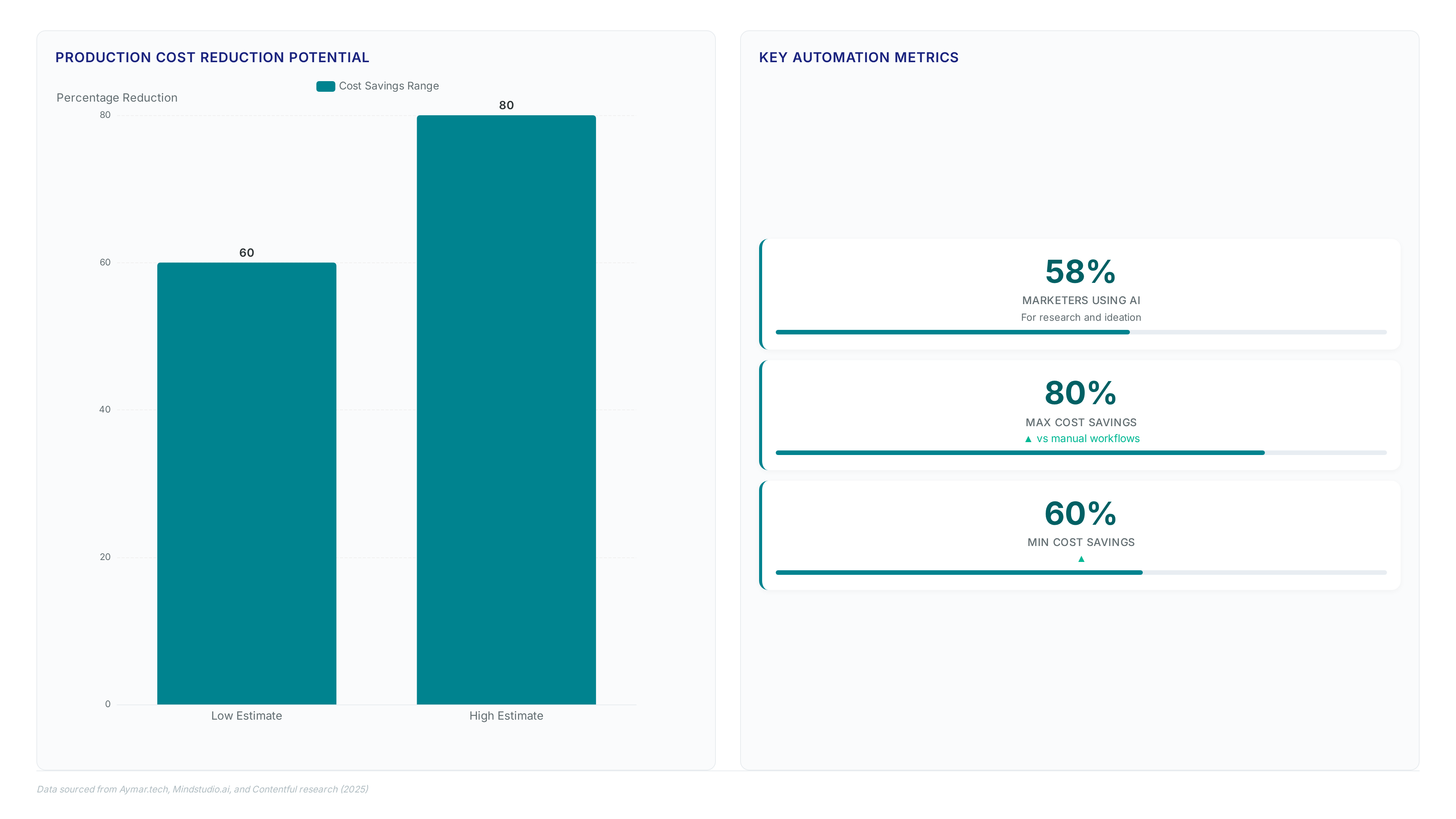
Brands can cut production costs by 60 to 80 percent through AI-powered content automation, according to Aymar Tech data.
The math is simple, but the operational shift is brutal. Artificial intelligence converts marketing from a manual bottleneck into a scalable engine for brand consistency. Pim van Willige argues that by automating creation, optimization, and distribution, teams eliminate repetitive tasks while delivering personalized content at scale. This shift allows organizations to focus on high-level strategy rather than getting bogged down in the mechanics of content ideation or performance tracking.
Below, we dissect the mechanics behind flexible template adaptation, where systems automatically adjust visual and textual elements for specific markets. We cover AI-driven batch creation, a method for producing vast numbers of content variations without manual editing. Finally, we execute a localized campaign using the hypothetical brand JoyFizz as a practical case study for implementing these tools in a real marketing stack.
The Role of AI Content Automation in Modern Marketing Stacks
Defining AI Content Automation and Flexible Template Adaptation
AI content automation employs artificial intelligence to execute creation, optimization, and distribution tasks efficiently. This definition moves beyond simple generation to include the systemic management of content lifecycles. Unlike static workflows, these systems apply predictive models to continuously optimize targeting and timing based on real-time campaign data. The primary value lies in automating cognitive heavy lifting, such as smart categorization and template standardization, which directly reduces managerial overhead. AI tools enable brands to quickly generate variations, schedule posts, and track performance.
Flexible template adaptation serves as the technical core for maintaining brand consistency at scale. This mechanism automatically adjusts text, colors, and images to align with specific market requirements without manual redesign. By integrating capabilities like those demonstrated in the JoyFizz hypothetical, brands can generate hundreds of content variations instantly. The system handles localization and personalization by modifying visual and textual elements to fit regional contexts.
Here is the trap: volume often kills distinctiveness. Without strict guardrails, output risks becoming homogenized across channels. Establishing these constraints early ensures the flexible elements enhance rather than dilute brand identity.
How JoyFizz Uses Personalization Engines for Audience Segments
The text outlines a practical hypothetical example using the fake brand JoyFizz to demonstrate implementation. This case demonstrates flexible template adaptation by auto-generating localized ad variants without manual redesign. This mechanism shifts operations from rigid, rule-based logic to adaptive AI systems that identify behavioral patterns to optimize continuously. Instead of static demographic buckets, the engine constructs hyper-specific customer segments using real-time behavioral data, notably boosting engagement. For a brand targeting massive potential user bases, such scale requires automating the translation of master assets into hundreds of regional versions instantly. Consequently, teams must prioritize creative asset management to organize stored elements before attempting large-scale personalization.
Should you use AI for content creation? Yes, provided your workflow includes review gates for the generated variations.
| Feature | Manual Process | AI Automation |
|---|---|---|
| Variant Generation | Hours per asset | Minutes per batch |
| Consistency | Human error prone | Template locked |
| Scaling | Linear cost increase | Marginal cost drop |
Integrating performance tracking early helps validate that automated segments actually convert improved than broad broadcasts. Without this feedback loop, the system optimizes for volume rather than revenue impact.
Manual Workflows vs AI Automation: Cost Savings and Efficiency Gains
Manual content production consumes hours per asset, whereas automated stacks generate variations in minutes. This shift from linear labor to algorithmic scaling allows teams to decouple output volume from headcount constraints. Traditional methods struggle with brand consistency across regions, often requiring exhaustive manual reviews that slow deployment. Conversely, AI-driven batch creation produces hundreds of localized ad variants instantly, ensuring visual and textual alignment without human fatigue.
The economic impact is substantial, with organizations reporting production cost reductions between a significant share and 80% by automating repetitive cognitive tasks. These savings stem not merely from speed but from eliminating the managerial overhead associated with smart categorization and template standardization. While manual workflows offer fine-grained control, they fail to scale efficiently when addressing large audience segments.
Teams must balance rapid generation with human oversight to maintain quality.
Inside the Mechanics of Flexible Template Adaptation and Batch Creation
From Rule-Based Logic to Agentic AI Workflows
Static if-then logic fails when market variables exceed human tracking capacity, necessitating a shift to Agentic AI. Unlike legacy scripts requiring manual rule updates, adaptive systems apply machine learning to identify patterns and optimize targeting continuously without intervention adaptive. This architectural evolution replaces rigid demographic buckets with micro-segments derived from hundreds of behavioral data points behavioral data.
| Feature | Rule-Based Automation | Agentic AI Workflows |
|---|---|---|
| Logic Type | Fixed conditional statements | Predictive probabilistic models |
| Optimization | Manual rule updates required | Continuous real-time adjustment |
| Segmentation | Static demographic groups | Flexible behavioral micro-clusters |
| Intervention | High human oversight | Autonomous execution |
The mechanism relies on predictive models that ingest campaign performance data to refine timing and content allocation autonomously mechanism. Unchecked agents may optimize for short-term engagement metrics at the expense of long-term brand equity if guardrails are not explicitly coded into the reward function. Operators must define strict boundary conditions before deployment to prevent drift. The transition demands a fundamental change in workflow design, moving from writing explicit instructions to defining outcome constraints and verification gates. Enterium recommends embedding generative capabilities directly into the content lifecycle to automate technical tasks like keyword optimization and image tagging workflow. Success requires treating the AI as an autonomous actor requiring clear mandates rather than a simple execution tool.
Self-Driving Pipelines for Full Lifecycle Management
Autonomous agents now execute planning, creation, and tracking to eliminate manual intervention in content lifecycles ( . This architecture replaces static scripts with Agentic AI systems capable of managing complex workflows without constant human oversight (Agentic AI). Unlike generic chatbots, specialized infrastructure like the provider IQ embeds specific brand context directly into the generation loop to prevent off-brand output (the provider IQ).
The operational shift moves from simple text generation to thorough pipeline governance.
- Agents analyze performance data to adjust future planning parameters automatically.
- Creation modules apply flexible templates that adapt visuals and copy for distinct markets.
- Reporting loops close the cycle by feeding engagement metrics back into the planning layer.
| Capability | Legacy Automation | Self-Driving Pipeline |
|---|---|---|
| Trigger | Manual schedule | Real-time performance signal |
| Adaptation | Fixed rules | Predictive adjustment |
| Scope | Single task | Full lifecycle |
A critical limitation exists in the initial setup phase; agents require precise brand guardrails to function effectively, or they risk scaling errors just as fast as valid content. Teams often underestimate the cognitive load required to define these initial boundaries before handing off control. The payoff is a system that solves slow production cycles by running parallel creation streams that human teams cannot match physically. Brands gain the ability to fix inconsistent branding in campaigns because the flexible template adaptation enforces visual rules at the code level rather than relying on designer memory. This structural enforcement ensures that even at high volumes, every asset remains within approved stylistic constraints.
Manual Updates Versus Real-Time Variable Optimization
Legacy tools require manual rule updates, whereas modern systems analyze hundreds of variables to optimize targeting dynamically. This shift replaces static "if-then" logic with machine learning models that forecast customer lifetime value without human intervention forecasting.
The operational difference lies in how each system handles scale. Manual workflows struggle as variable counts rise, forcing marketers to choose between broad segments or exhausting upkeep. Adaptive automation resolves this tension by continuously ingesting performance data to refine micro-segments in real-time optimize. Consequently, teams avoid the latency of human-led recalibration while capturing transient engagement windows.
Canva reported hundreds of millions of monthly active users, a scale where manual personalization is mathematically impossible for single operators. Best practices for AI marketing tools now dictate shifting from creation speed to decision velocity. The hidden cost of legacy systems is not labor; it is the inability to react to churn risk before revenue loss occurs. Enterium recommends auditing current pipelines for any logic requiring manual refreshes, as these represent unmitigated attrition risks in high-velocity markets.
Executing a Localized Campaign with AI-Driven Batch Production
AI-Driven Batch Production and Master Template Adaptation
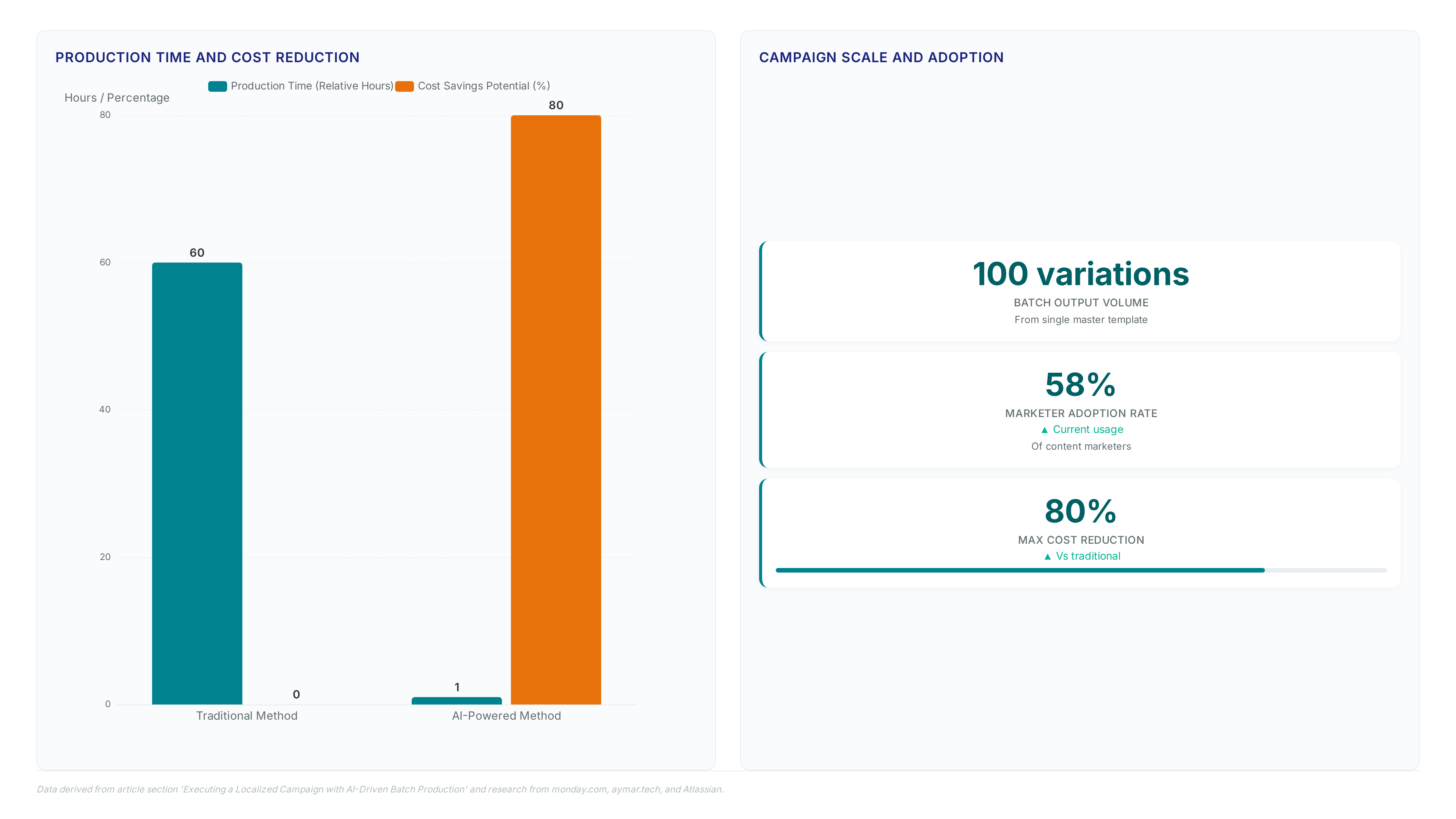
A single master ad template serves as the foundation, allowing algorithms to swap text, colors, and images for every target region. This flexible template adaptation mechanism removes manual redesign entirely, forcing visual alignment across disparate markets through code rather than human effort. The system automatically rewrites taglines for different cultures and languages, keeping the brand voice intact while respecting local nuance.
Measurable gains appear immediately in production schedules. Traditional content methods often demand hours of manual labor for a single asset, yet AI-powered approaches compress this window to minutes. Such compression enables teams to execute AI-driven batch creation, churning out hundreds of content variations at once to satisfy complex campaign requirements without breaking a sweat.
Relying on automated variation invites semantic drift if the master template lacks strict guardrails. Localized text might overflow its container or clash with an adapted color palette, destroying readability in seconds. Operators must install pre-flight validation gates that check text length and contrast ratios before the system renders final assets.
| Component | Manual Process | Automated Batch |
|---|---|---|
| Variation Count | Low (10-20) | High (100+) |
| Time per Asset | Hours | Minutes |
| Consistency | Variable | Strict |
Embedding these validation rules directly into the template schema stops downstream errors before they start. The immediate next step involves auditing existing master templates for flexible container sizing to accommodate unpredictable text expansion.
JoyFizz Case Study: Generating 100 Localized Ads in Minutes
Batch execution converts one master template into 100 distinct localized assets within minutes. This workflow replaces weeks of manual design labor with AI-driven batch creation, allowing the fictional soda brand JoyFizz to launch regional campaigns instantly. Marketers define the flexible template adaptation rules once, after which the machine automatically modifies text, colors, and imagery for specific cultural contexts.
The engine swaps a generic background for a snowy scene with the tagline "Cheery Christmas" or adjusts to a romantic red theme reading "Be My Cherry" for Valentine's Day. Traditional production methods often require hours of manual work per asset, whereas automated approaches reduce production time to minutes. This velocity enables the creation of hundreds of ads that would otherwise take weeks to produce manually. Teams can now focus on creativity and strategy instead of repetitive tasks, as the technology handles the heavy lifting of scaling content production.
Gating generation behind pre-approved copy libraries and strict visual guardrails remains mandatory. Without these controls, the efficiency gain from generating hundreds of ads becomes a liability rather than an asset. Operators must balance the desire for hyper-local relevance against the necessity of centralized brand governance.
- Design one master ad template with variable text and image slots.
- Configure regional rules for language and seasonal imagery adjustments.
- Execute batch generation to produce hundreds of on-brand variations.
- Validate all outputs against pre-set contrast and length constraints.
- Deploy finalized assets across regional channels simultaneously.
This architecture answers whether one should use AI for content creation by demonstrating that value lies in scaling approved patterns, not generating raw text. The technology excels when applied to structured repetition but demands rigorous initial setup to prevent brand drift. Implementing these guardrails before attempting large-scale deployment is necessary for success.
Validating ROI: Automated Approvals and Go-to-Market Acceleration
Workflows requiring flexible templates to replace hours of manual labor with minutes of automated execution justify using AI for content creation. Validating return on investment demands a shift from simple generation to governed batch creation and simplified approvals. Speed creates brand risk rather than market advantage without these controls.
Operators must verify their stack against this production checklist:
- Does the system generate hundreds of variations from one master file?
- Are AI-driven approvals embedded to centralize feedback loops?
- Does the tool automate distribution across regions without re-coding?
- Can the platform handle sudden spikes in localization requests?
Rapid output is useless if legal review bottlenecks the final mile. Platforms like Storyteq resolve this by integrating review directly into the asset pipeline, ensuring the marketing director of JoyFizz EMEA can approve USA assets instantly. This structural change eliminates the lag where campaigns lose relevance.
Automated workflows also remove the labor cost associated with analytics and attribution modeling. Teams stop gathering data manually and start acting on it. The result is not quicker content, but a measurable reduction in time-to-market for localized campaigns.
Auditing your current approval chain is the recommended first step. If a human manually resizes or re-formats assets, the process relies on manual effort rather than full automation; true scale requires removing the human from the loop entirely for repetitive adaptation tasks. With one click, the tool produces hundreds of ads in minutes. AI removes time-consuming work from content marketing through automated creation, batch production, and performance tracking.
Implementing an AI Content Automation Workflow in Five Steps
Defining Flexible Templates for Brand Consistency
Constructing flexible templates gives users master designs that AI modifies automatically for distinct markets. This mechanism swaps static assets for fluid structures capable of adjusting text, colors, and images to fit specific regional requirements without manual intervention. Marketers define these rules once to enable batch creation systems that generate hundreds of variations in minutes rather than weeks. Teams feed prompts containing brand data into the workflow, generate drafts, refine the content, and distribute it via connected platforms. This loop allows brands to scale production efficiently while maintaining strict quality controls across all outputs. Initial setup complexity presents a constraint; defining universal rules that accommodate local nuance requires precise parameterization to avoid cultural mismatches. Operators must balance rigid brand guidelines with the flexibility needed for genuine localization. Automated outputs risk appearing generic or tonally inconsistent without this calibration. Validating template logic against diverse market scenarios before full deployment is necessary. Teams should test edge cases where local context might conflict with global brand standards. This preparation ensures the system enhances rather than hinders campaign resonance.
Executing Batch Creation with Storyteq Workflows
Batch creation transforms a single master template into hundreds of localized assets within minutes. This mechanism replaces linear design labor with parallel AI-driven batch creation, allowing teams to launch regional campaigns instantly. By defining flexible template adaptation rules once, the system automatically modifies text, colors, and imagery for specific cultural contexts without manual intervention. Modern content operations teams are rebuilding production pipelines around this automation to handle continuous research and real-time intelligence, moving away from periodic reporting cycles. The workflow requires precise configuration to ensure brand compliance while maximizing volume. High-volume generation demands strict input validation because erroneous data scripts propagate errors across every generated asset instantly. Unlike legacy tools requiring manual updates, these systems analyze variables to prevent brand dilution at scale. Teams must verify that creative asset management protocols are embedded directly into the generation logic to avoid costly post-production fixes. Speed does not need to compromise the integrity of the brand message across diverse markets. Validating all variable dictionaries against brand guidelines before initiating large-scale batch jobs is a critical best practice.
Validating Software Integration and Market Adaptation
Verifying bidirectional syncing with CRMs like Salesforce before selecting a platform ensures data consistency. Effective automation requires data consistency to provide the necessary context for personalization. Flexible templates pull stale metrics without this deep integration, causing regional campaigns to misfire despite perfect creative assets. Creative tools do not function independently of sales data. Use this checklist to validate market adaptation capabilities:
- Does the system support batch creation that adjusts visuals for local holidays automatically?
- Can the tool modify taglines and colors based on real-time audience behavior?
- Does the platform centralize assets to eliminate email-based approval bottlenecks?
| Feature | Legacy Tool | Integrated System |
|---|---|---|
| Data Sync | Manual Upload | Bidirectional API |
| Localization | Static Files | Flexible Adaptation |
| Approval Flow | Email Chains | In-Platform Review |
Teams ignoring this integration step face fragmented workflows where creative output lacks strategic relevance. Prioritizing platforms that converge design and data layers is recommended. This architectural choice prevents the common failure mode where high-volume content production yields low-engagement results due to context gaps. The goal is governed scalability, not speed. Organizations should look for a solution that helps scale content production with flexible templates and integrates smoothly with advertising and marketing platforms.
About
Sofia Marchetti, a B2B Content Strategist with 12 years of SaaS experience, brings a rigorous, revenue-focused lens to AI-powered content automation. Unlike generic guides that prioritize volume, Sofia's daily work centers on building topical authority and distribution systems that survive the shift toward AI search. This article's practical approach to automating workflows directly mirrors her methodology: using LLMs not as a shortcut for "slop," but as a strategic lever to compound measurable business outcomes.
At Enterium, a publication dedicated to vendor-neutral content pipelines, Sofia documents how modern teams architect scalable operations without sacrificing quality. Her expertise in GEO (Generative Engine Optimization) and demand generation ensures that the automation frameworks discussed here are grounded in real-world trade-offs regarding cost, latency, and brand trust. By connecting technical pipeline architecture to revenue impact, she provides the actionable clarity B2B leaders need to implement AI tools that actually drive pipeline rather than just noise.
Conclusion
Scaling generative workflows reveals a critical friction point where raw output volume collides with brand coherence. While production metrics improve dramatically, the operational burden shifts from creation to governance. Teams that fail to embed creative asset management directly into generation logic face exponential rework costs as errors propagate across markets quicker than humans can correct them. The industry movement from static rules to adaptive AI means systems now optimize patterns without manual intervention, making initial architectural integrity more vital than ever.
Organizations must mandate bidirectional CRM syncing before deploying any high-volume content engine. Do not attempt to layer personalization on top of disconnected data silos. This integration ensures that flexible templates access real-time audience behavior rather than stale metrics that cause regional campaigns to misfire. Prioritize platforms that unify design and data layers to prevent the strategic disconnect where high output yields low engagement.
Start this week by mapping your current approval flows to identify where email chains replace in-platform reviews. Replace any workflow relying on manual file uploads with a solution supporting bidirectional API connectivity. This single step secures the data consistency required for genuine scalability and prevents the fragmentation that undermines automated strategies.
Frequently Asked Questions
Brands can reduce production costs by 60% to 80% through automation. This significant drop allows teams to eliminate repetitive cognitive tasks and focus resources on high-level strategy instead of manual bottlenecks.
Dynamic templates automatically adjust text and images for specific markets without manual redesign. This ensures brand consistency across hundreds of variations while preventing the homogenized output that often risks diluting identity.
Automated batch creation risks producing homogenized output that lacks distinctiveness across channels. Teams must establish strict guardrails early to ensure dynamic elements enhance rather than dilute the core brand identity.
Teams must prioritize creative asset management to organize stored elements before attempting large-scale personalization. Without this foundation, systems cannot effectively translate master assets into hundreds of regional versions instantly.
Automation shifts scaling from linear cost increases to marginal cost drops per asset. This decouples output volume from headcount constraints, allowing vast content generation without proportional increases in manual labor hours.