AI Visibility Score: Why Static SEO Fails Now
No static industry constant exists because AI Visibility Score values are generated dynamically by proprietary algorithms. Readers will learn how generative search engines quantify brand presence and why traditional SEO metrics fail to capture unprompted brand mentions in conversational AI responses.
The mechanics of AI search rely on complex algorithms that evaluate brand discovery potential differently than keyword-based indexing. Unlike legacy search engines, these systems prioritize contextual relevance within conversational AI responses, making the AI Visibility Score a critical but elusive benchmark for modern marketing. Understanding how AI model recommendations form requires dissecting the specific data points these systems weigh when constructing answers for users.
Implementing a systematic tracking framework allows organizations to measure their footprint across these evolving platforms effectively. By focusing on the flexible nature of these scores, teams can build resilient strategies that adapt to algorithmic shifts without relying on outdated performance indicators.
The Role of AI Visibility in Modern Brand Discovery
Defining AI Visibility Score and Generative Engine Presence
Stop counting keywords. The AI Visibility Score quantifies mention frequency and sentiment favorability when AI models respond to queries. Static search rankings depend on keyword matching, yet this metric evaluates flexible inclusion within conversational AI responses. Measurement requires analyzing data across platforms such as ChatGPT, Google AI Overviews, Gemini, Claude, and Perplexity. Generative engine optimization shifts strategy from crawler optimization to model retrieval and synthesis. High traditional search volume offers no guarantee of inclusion in these synthesized answers. The AI search environment demands a distinct framework where mention frequency and sentiment weigh equally against raw volume. Specialized infrastructure tracks unprompted mentions to calculate accurate visibility scores without superficial keyword counts. Systems must capture nuance in how brands appear in AI-generated answers rather than relying on simple string matching. Blind spots emerge where competitors gain recommendation share unnoticed if measurement lacks specificity. Establishing a baseline measurement across target models identifies current inclusion gaps.
Tracking Topic Opportunities and Fan-Out Queries in Audits
Operational audits evaluate brand appearance across generative AI platforms by assessing contextual relevance and brand authority instead of term frequency. Marketers often miss this distinction while assuming high search rankings guarantee model inclusion. AI visibility requires explicit presence within the synthesized response chain. An AI visibility audit tracks 'Topic Opportunities,' set as prompts where competitors appear but the user's brand does not. Competitors dominate the narrative layer where decisions are now synthesized if these gaps remain ignored.
| Metric Type | Traditional SEO Focus | AI Visibility Focus |
|---|---|---|
| Query Structure | Single keyword string | Complex, question-based prompts |
| Success Signal | Click-through rate | Citation frequency |
| Gap Analysis | Ranking position | Topic Opportunities |
Pipelines tracking flexible mention patterns address this volatility improved than static ranks. Legacy dashboards create measurable blindness into how models retrieve brand data. Operators cannot optimize what they cannot observe within the synthesis process. Strategic deployment shifts resources toward high-quality online content, a structurally sound website, and third-party validation that satisfy complex query chains. Brands appear when models aggregate facts through this approach, not when users type simple terms.
Traditional SEO Clicks Versus Conversational AI Recommendations
Traditional SEO tracks clicks on result pages while AI visibility measures inclusion within synthesized conversational responses. This shift moves focus from keyword matching to optimizing for influence weighting, a mechanism determining which sources drive model outputs. Methodologies incorporate 'influence weighting' to identify specific sources driving AI responses. Modern analysis evaluates whether a brand appears in the generated text itself rather than focusing on position.
| Metric Type | Primary Signal | Optimization Target |
|---|---|---|
| Traditional SEO | Click-through rate | Ranking position |
| AI Visibility | Citation frequency | Semantic authority |
High search volume does not guarantee model inclusion despite operator assumptions, as emerging data clarifies that engines assemble facts rather than rank URLs in isolation. The synthesis process selects discrete data fragments based on credibility while ignoring pages lacking contextual clarity. Deployments should audit content for structural integrity instead of term density. Visibility now depends on becoming a cited source within the answer chain. Missing a expanding audience segment relying on AI for discovery poses a real risk to brands failing to adapt. Audit for citation potential, not indexation.
Inside the Mechanics of AI Search and Mention Algorithms
How Training Data and Retrieval Mechanics Dictate Brand Visibility
Distinct underlying models and data sources drive response generation on platforms like ChatGPT, Google AI Overviews, Gemini, and Claude. Structural variance ensures a brand's appearance differs notably across these engines for identical queries. Proprietary model weights establish baseline knowledge while retrieval mechanisms dynamically fetch current context. This architecture creates an environment where static training interacts with live index access. A brand missing from a specific model's static corpus might still appear through real-time retrieval. Relying on a single platform yields an incomplete audit because retrieval policies differ. Some engines prioritize recent citations. Others favor high-authority domains from their static training set. Measuring on ChatGPT alone provides an incomplete picture. Coverage is needed across ChatGPT, Claude, Perplexity, Gemini, and other active platforms.
Engineers treat this fragmentation as a data availability challenge rather than a simple ranking defect. The operational fix involves mapping brand entities across all target models to identify coverage gaps caused by stale training data versus retrieval failures. Teams must verify that core brand definitions exist within the scope of each target LLM. Retrieval capabilities vary in compensating for missing core entities. Ignoring the distinction between static absence and retrieval failure leads to misplaced optimization budget. Content teams often write more articles when the actual blocker is that the model simply does not recognize the brand in its base knowledge. An AI visibility audit isolates these failure modes. The process distinguishes between brands that need improved content and those that need enhanced entity presence strategies.
Automating Cross-Platform Tracking for ChatGPT, Claude, and Perplexity
Manually executing queries across six platforms creates significant operational friction for teams maintaining consistent brand monitoring. Manual tracking is impractical at scale. Tracking 25 prompts across 6 platforms results in 150 individual queries to run and log weekly. This volume forces a choice between reduced prompt coverage or accepting significant data gaps in visibility reporting.
Without this automation, fixing inconsistent AI response tracking relies on sporadic sampling that misses transient model behaviors. A unified dashboard allows operators to correlate prompt variations with output shifts. The system identifies exactly which phrasing triggers brand inclusion or exclusion. This approach directly addresses the need to improve brand mentions in AI responses by providing the feedback loop required for iterative prompt engineering.
Model updates can cause sudden shifts in visibility that manual checks fail to catch until revenue impacts appear. Operators relying on sporadic audits cannot distinguish between a temporary glitch and a permanent ranking shift in the retrieval mechanisms.
Validating Mention Depth: First-Position vs Buried Brand Appearances
Response position dictates utility because generative models prioritize initial tokens for user attention. A brand appearing later in a response holds less commercial value than one appearing early. Both instances count as "visible" yet deliver different outcomes.
Fixing inconsistent AI response tracking requires distinguishing between total invisibility and deep burial. This granularity reveals whether a content gap exists or if the retrieval mechanisms simply deprioritize the entity for specific prompt structures. Teams relying on binary "mentioned/not mentioned" logs miss the nuance of buried recommendations that users never read. Without this depth validation, operators cannot distinguish between a model that does not know the brand and one that actively suppresses it.
Implementing a Systematic AI Visibility Tracking Framework
Categorizing Tracking Prompts: Awareness, Comparison, and Recommendation

Mapping buyer process stages to three distinct query structures defines the target prompts for effective tracking. Awareness queries address broad category exploration, while Comparison queries evaluate specific feature sets against competitors. Drafting broad questions tests category-level discovery potential effectively.
- Construct side-by-side evaluations to measure competitive positioning.
- Simulate direct purchase intent to validate conversion readiness.
Static keyword tracking fails to capture the volatility of AI responses because brands do not maintain visibility across consecutive interactions. This instability requires operators to measure citation frequency rather than simple ranking position. High volume in Awareness queries does not guarantee inclusion in Recommendation outputs since models prioritize contextual relevance and brand authority differently for each intent type.
Automating prompt execution across all three categories allows for the calculation of a unified AI Visibility Score. The platform aggregates mention frequency and sentiment data into a single reproducible metric. Teams risk optimizing for top-of-funnel mentions that never convert into model recommendations without this stratified.
Calculating Composite Scores Using Mention Frequency, Position, and Sentiment
Deriving a valid AI Visibility Score requires weighting raw mention counts against positional decay and sentiment polarity. Operators must first calculate mention frequency by dividing prompts containing the brand by the total tracked volume of 100, then multiplying by 100. This baseline figure proves insufficient without accounting for order because first mentions carry notably more influence than subsequent listings due to user behavior patterns.
- Aggregate these weighted values to generate the final composite metric.
The following logic demonstrates how systems process these variables into an actionable score:
Traditional SEO metrics track clicks, but this composite approach isolates actual narrative control within generative outputs. Sentiment calibration presents a constraint; without accurate polarity detection, the score remains volatile. Teams should implement this calculation regularly to detect shifts in how models frame brand authority relative to competitors.
Seven-Phase Validation Checklist for Automated AI Visibility Pipelines
Validating an automated pipeline begins by defining distinct tracking prompts across the buyer process. The implementation guide concludes with a checklist to confirm completion of seven phases, starting with defining 15 to 30 tracking prompts. Operators must configure data collection across multiple AI platforms to capture sufficient variance in model behavior. Mention frequency calculations lack the statistical power to reveal genuine trends versus model noise without this breadth.
The core validation step involves calculating a weighted score that prioritizes early positions and filters negative sentiment. Relying on raw counts ignores the reality that first mentions dominate user attention, rendering lower-ranked appearances less effective. Teams should verify their system applies these position multipliers before trusting the output.
| Phase | Action Item | Validation Metric |
|---|---|---|
| 1 | Define prompt set | Unique queries across process stages |
| 2 | Configure platforms | Multiple engines active |
| 7 | Report trends | Regular reporting cadence |
Automating this validation loop helps maintain continuous score accuracy. The final phase establishes a regular reporting cadence where score trends are explicitly tied to recent content activity. This linkage prevents teams from misattributing organic model drift to specific marketing interventions. Neglecting the sentiment adjustment phase creates a dangerous illusion of growth when brand perception is actually deteriorating.
Strategic Application of GEO for Competitive Advantage
Defining Displacement Opportunities in Competitive Benchmarking
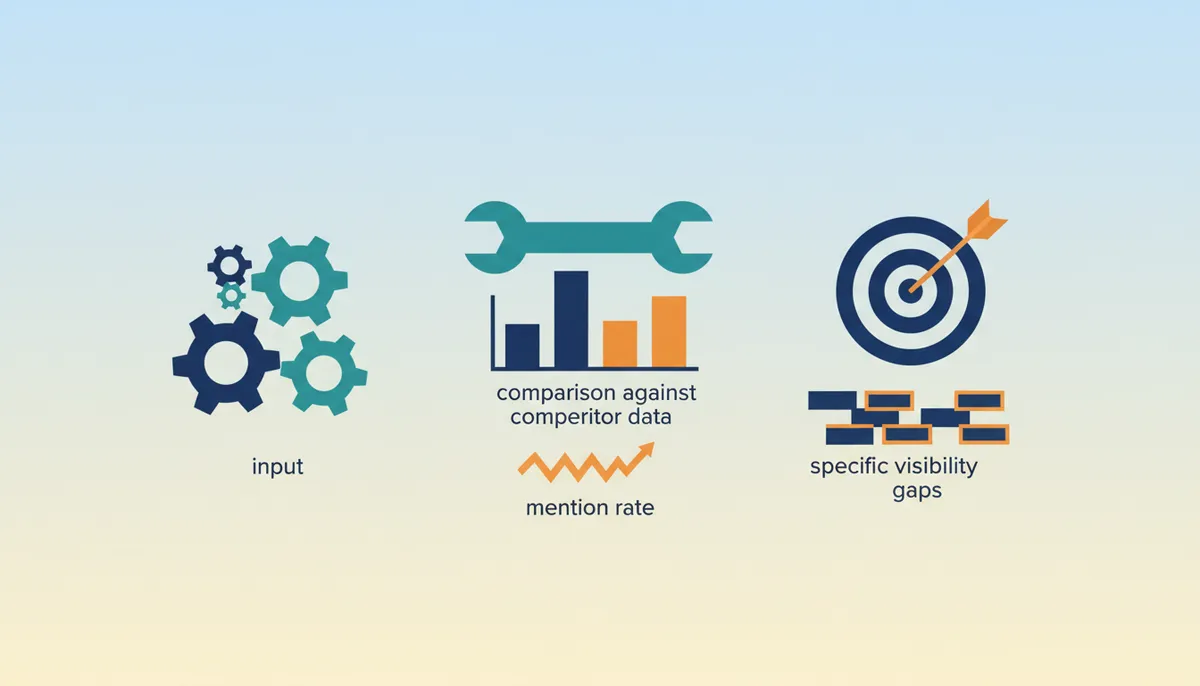
Displacement happens when a competitor shows up in generative answers while your brand stays silent. This metric pinpoints exact prompts where market presence vanishes despite heavy query volume. Analysts separate content coverage gaps from pure brand awareness deficits by tracking mention frequency across a fixed prompt set. The ratio suggests the underlying knowledge base lacks enough contextual data for the missing brand, not that the market ignores it.
Standard SEO tricks like backlinking frequently miss these specific voids. AI platforms value contextual relevance, brand authority, and source consistency far more than link graphs. An audit exposes these structural holes by comparing brand mentions against category leaders. Operators must target prompts where rivals dominate with high-quality, structurally sound content. Confusing coverage with awareness burns resources on brand campaigns when the real problem is missing technical documentation. Fixing these data gaps lifts a brand's presence in AI-driven search systems.
Executing a GEO-Optimized Content Plan with Direct Answer Structures
Prioritization starts with prompts showing low brand visibility while competitors hold strong positions. This method attacks specific displacement chances instead of spraying generic keywords across low-value queries. High-quality online content and structural consistency matter because AI models prioritize semantic authority. Specific structural formatting helps clarity, yet the main goal remains getting the brand to appear accurately in responses generated by AI-powered platforms.
Terminology must stay consistent across sources to build brand authority. Companies should align with standard industry phrasing so models train on clear data.
| Strategy Component | Execution Requirement |
|---|---|
| Prompt Selection | Low brand mention, high competitor density |
| Structural Format | Clear, contextually the answers |
| Terminology | Consistent, category-standard phrasing |
Text failing to provide immediate context often struggles to register in generative settings regardless of overall quality. This limitation forces a shift toward factual density, putting data-rich statements in opening sections.
Success requires tracking unprompted mentions across a fixed set of high-intent queries over time. Brands accepting old metric limits while adopting new methods gain early-mover advantage in benchmarking this new frontier. Auditing existing top-performing pages reveals current brand visibility in search.
Managing Timelines in AI Visibility Score Improvements
AI visibility gains often lag, mirroring the indexing cadence of underlying models rather than signaling optimization failure. Teams wondering whether to invest in AI-optimized content must expect this latency to prevent premature fixes or abandoned projects. Skipping the GEO iteration cycle window risks pouring resources into assets that already work well. Reacting to static snapshots before system stabilization creates volatile, contradictory tactical shifts. Operators should view the initial period as a settling phase where data collection outweighs reactive adjustment. Patience becomes a structural requirement for accurate signal detection in generative search environments, not a passive waiting game.
About
Daniel Reyes, Head of Content Engineering at Enterium, architects production-grade AI content pipelines that bridge raw data ingestion and automated publishing. His decade of experience building RAG systems and evaluation harnesses provides the technical foundation necessary to dissect the emerging metric of AI Visibility Score. Unlike superficial marketing metrics, this score demands an understanding of how retrieval-augmented generation and vector stores influence unprompted brand mentions in conversational AI. At Enterium, a B2B publication dedicated to documenting how teams scale content with LLMs, Daniel applies rigorous engineering standards to measure brand discovery within AI search responses. His daily work involves configuring quality gates and orchestration layers that directly impact how models retrieve and synthesize brand information. This practical expertise allows him to analyze AI visibility tools without hype, focusing instead on reproducible measurement strategies for technical marketers. By grounding the discussion in actual pipeline architecture, Daniel connects the abstract concept of AI presence to tangible content operations, guiding readers toward reliable, engineer-approved methodologies for tracking brand performance in generative search.
Conclusion
Scaling AI visibility reveals a critical breaking point: semantic authority decays when terminology drifts across sources, causing models to fragment brand identity despite high-quality content. The ongoing operational cost is not merely content creation but the rigorous maintenance of factual density in opening sections to ensure immediate context registration. Brands must shift from chasing static rankings to securing unprompted mentions across high-intent queries, recognizing that model indexing cadences dictate a longer latency period than traditional search engines.
Organizations should commit to a six-month stabilization window before evaluating the success of their generative optimization efforts. Reacting to data snapshots during this settling phase invites volatile tactical shifts that undermine long-term signal detection. Patience acts as a structural requirement for accurate measurement, preventing premature abandonment of assets that are simply awaiting model synchronization.
Start by auditing your top-performing pages this week specifically for consistency in industry-standard phrasing and structural clarity. Ensure your core definitions align with category norms so models train on clear, unambiguous data. This fundamental step secures the semantic ground needed for future gains. For brands ready to navigate this new frontier with precision, Enterium offers specialized solutions to measure and enhance your presence in generative search environments.
Frequently Asked Questions
Low visibility means missing unprompted brand mentions in AI responses.
No, high search volume does not guarantee inclusion in synthesized answers.
Audit for Topic Opportunities where competitors appear but you do not.
Ignoring dynamic mention patterns leads to strategic blindness.
Standard tools count strings while AI models weigh semantic authority.
References