LLMfriendly content: Why 85% of AI citations are recent
Eighty-five percent of AI Overview citations come from content published between 2023 and 2025, proving recency drives visibility according to Onely reports. This data confirms that LLM-friendly content is no longer optional but a strict requirement for digital survival in 2026. Marketers must shift focus from traditional search ranking to Generative Engine Optimization to ensure AI systems parse and cite their material effectively.
The article argues that legacy SEO tactics fail when chatbots like ChatGPT, Gemini, and Perplexity act as the new front page of the internet. These models ignore dense prose in favor of scannable structures containing clear definitions and conversational FAQs. Without schema markup and concise hierarchies, brands remain invisible to the millions of users querying AI tools before opening a search engine.
Readers will learn the specific mechanics of AI parsing and how to implement question-answer formats that algorithms prefer. Finally, the guide details strategic steps to build topical authority so your content gets recommended rather than ignored by automated systems.
Defining LLM-Friendly Content and Generative Engine Optimization
Defining LLM-Friendly Content and Generative Engine Optimization
Stop writing for blue links. Start writing for the answer box. LLM-friendly content comprises material structured with semantic clarity so large language models can parse, summarize, and cite it directly in responses. Unlike legacy optimization targeting the ranking algorithms of Google's 2020 era, this approach prioritizes machine readability through short sentences, definitional headers, and scannable lists. Generative Engine Optimization (GEO) is the distinct practice of architecting content specifically for AI interpretation rather than keyword density. The operational shift is measurable: 85% of AI Overview citations originate from content published within the last two years (2023, 2025). This recency bias forces publishers to treat freshness as a structural constraint, not an editorial preference.
Traditional SEO seeks a position on a list; GEO seeks direct inclusion in the generated text. Content optimized for ChatGPT or Perplexity must be easy to read, reuse, and recommend without additional interpretation layers.
| Feature | Traditional SEO | Generative Engine Optimization |
|---|---|---|
| Primary Target | Search Engine Crawlers | Large Language Models |
| Success Metric | Click-Through Rate | Citation & Inclusion Rate |
| Structure | Keyword Density | Semantic Clarity & Definitions |
| Output Format | Ranked List (SERP) | Conversational Answer |
Content optimized for GEO balances semantic richness with the brevity models prefer. LLMs grounded in knowledge graphs achieve 300% higher accuracy in their outputs compared to those relying solely on unstructured data.
How AI Chatbots Parse Structured Data and FAQ Sections
Chatbots do not "read" like humans. They consume short clear sentences and strong headings to isolate context for answer generation. Language models like ChatGPT and Gemini prioritize scannable structure over dense paragraphs when retrieving facts for responses. Pages updated within the last two months earn 28% more AI citations compared to older static content. Conversational FAQ sections provide the explicit question-answer pairs that retrieval systems extract for direct quotation.
| Element | Function for LLMs |
|---|---|
| Strong Headings | Define semantic boundaries for chunking |
| Lists | Separate distinct entities for extraction |
| FAQ Sections | Match user query intent directly |
Structural clarity ensures models can correctly interpret relationships between concepts. While Markdown aids ingestion, providing context-rich examples helps prevent misinterpretation of isolated facts. Implementing conversational Q&A formats ensures the system grasps both the query and the specific answer required. Products featuring thorough schema markup appear in AI recommendations 3 to 5 times more frequently than those lacking such structured data. Aligning document architecture with these parsing constraints secures visibility.
SEO Keyword Density Versus LLM Concise Structuring
Traditional SEO targets search engines while LLM-friendliness targets answer engines with distinct structural requirements. Legacy optimization relies on keyword density to signal relevance to ranking algorithms, whereas modern large language models prefer concise, structured information that answers questions directly without interpretive overhead. The operational shift is measurable: 44% of all AI Overview citations are derived specifically from content published in 2025 alone, indicating a sharp preference for recent, clearly architected data over older, keyword-stuffed pages. This divergence forces a choice between writing for algorithmic matching or for direct extraction by systems like ChatGPT and Gemini.
| Feature | Traditional SEO Focus | LLM-Friendly Focus |
|---|---|---|
| Primary Goal | Rank high in link lists | Appear in generated answers |
| Structure | Long-form narrative | Scannable Q&A and definitions |
| Key Metric | Keyword frequency | Semantic clarity and citation |
| Output | Click-through traffic | Direct brand mention |
Optimizing for dense keyword repetition can obscure the semantic clarity required for machine parsing. The industry is moving away from keyword stuffing toward "entity clarity" and "topic modeling," where AI systems understand relationships between concepts rather than just matching search terms. Teams must audit existing assets to ensure definitions are explicit and headers are descriptive rather than clever. Ignoring this shift risks reduced visibility in the expanding answer engine environment. Practitioners should rewrite introductory paragraphs to lead with direct definitions rather than context-setting fluff.
The Mechanics of AI Parsing and Semantic Structure
Recency Bias and the Two-Year Citation Window
Generative engines systematically deprioritize content exceeding a specific age threshold. This statistical dominance establishes a rigid two-year citation window where older assets effectively vanish from answer generation pools. The mechanism driving this exclusion is not semantic degradation but a probabilistic weighting system that favors recent token distributions. Unlike traditional search, where historical authority accumulates value, generative models treat age as a decay function. A practical limitation arises when legacy technical documentation retains accuracy but loses visibility due to timestamp metadata alone. Marketers must implement a rolling refresh strategy rather than static publishing. Enterium recommends auditing top-performing pages quarterly to update timestamps and re-validate claims against current data. This approach counters the algorithmic bias toward newness without requiring total content rewrites. The operational takeaway is clear: treat content currency as a binary gate for visibility, not a minor ranking factor.
Using Micro-Timeline Updates for Citation Boosts
Frequent content refreshes within a two-month window trigger re-crawling cycles that notably increase citation probability. Retrieval-based LLMs using real-time web scanning prioritize recent token distributions when populating generative answers. This behavior creates a specific operational requirement: static evergreen pages lose visibility unless operators enforce a strict update cadence. The mechanism relies on crawl budget allocation where agents revisit recently modified URLs more often than stable assets.
| Strategy | Crawl Frequency | Citation Potential |
|---|---|---|
| Static Archive | Low | Diminishing |
| Micro-Updated | High | Elevated |
| Real-Time Feed | Maximum | Highest |
However, updating solely for recency without adding semantic value risks flagging content as low-effort noise. The drawback of this approach is the engineering time required to validate factual accuracy during every iteration. Teams must balance the update velocity against the risk of introducing hallucinations or stale data points during rapid cycles. Operators should implement a rolling schedule where high-value pages receive minor structural additions every six weeks. These updates might include:
- New FAQ entries
- Expanded definition lists
- Refreshed comparative tables
- Additional context markers
- Revised metadata tags
- Updated code snippets
Enterium recommends configuring content management systems to automatically timestamp these sections, signaling freshness to parsing agents. This tactical adjustment ensures assets remain within the active citation window favored by answer engines.
Validating Crawler Access via CDN Log Analysis
Mintlify's CDN log analysis across 25 companies over a seven-day period found a median of 14 visits to llms.txt files and 79 visits to llms-full.txt files, demonstrating active AI agent crawling behavior (analysis. This data confirms that AI agents actively seek dedicated markdown entry points rather than parsing raw HTML DOM structures. Operators must verify these specific access patterns to distinguish genuine bot traffic from noise.
- Filter logs for
llms.txtandllms-full.txtrequests. - Isolate user-agents matching known LLM crawlers like ChatGPT.
- Cross-reference request frequency against content update timestamps.
| File Type | Purpose | Median Visits |
|---|---|---|
llms.txt |
Index pointer | 14 per week |
llms-full.txt |
Full content dump | 79 per week |
The reliance on flat markdown files introduces a versioning tension; serving raw data via llms-full.txt bypasses application logic but risks exposing unredacted drafts if file generation pipelines lack strict quality gates. Unlike HTML, these files rarely include flexible access controls, meaning any logged visit represents a successful data extraction event. Enterium recommends automating log alerts for sudden spikes in these specific file requests, as anomalous volume often indicates aggressive fine-tuning operations by third parties. Validating this access ensures your structured data remains the primary source truth for downstream models.
Strategic Implementation of GEO Best Practices
Application: Defining LLM-Friendly Content Architecture
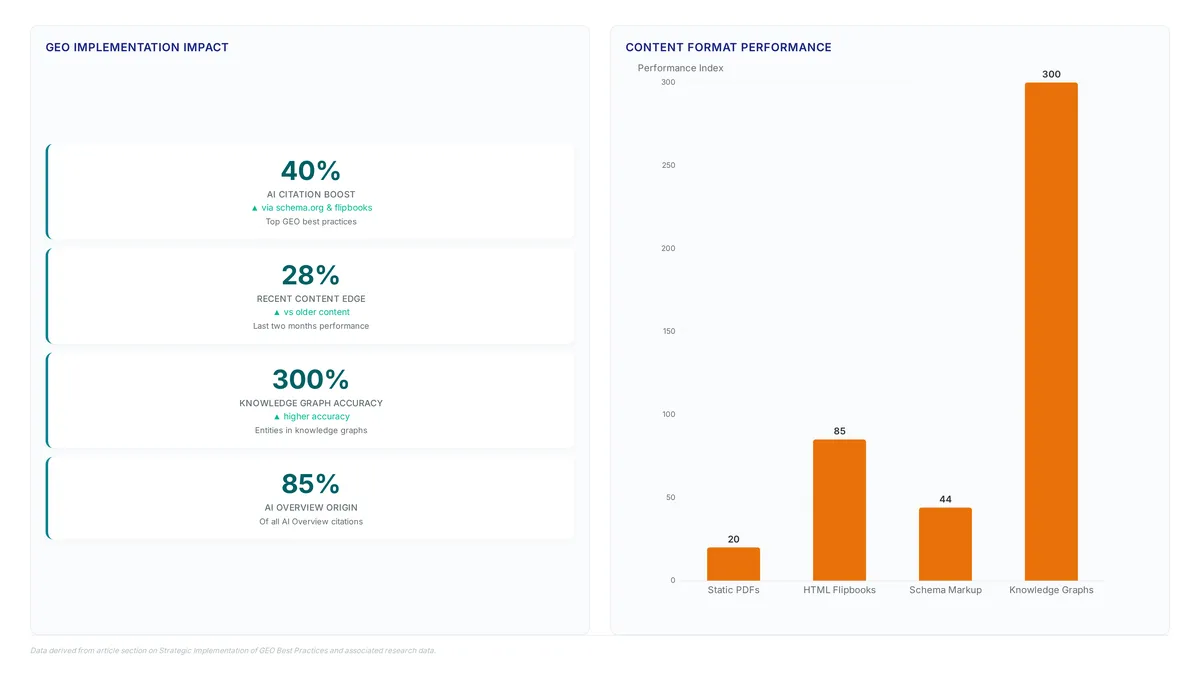
LLM-friendly content architecture requires semantic headings and factual density that allow AI systems to extract answers without interpretation. Unlike legacy SEO targeting Google's 2020 algorithm, this approach structures data for direct consumption by answer engines in the 2026 environment. When tools summarize web content, they prioritize pages that are clean, factual, and easy to parse rather than those optimized for keyword density. This shift demands a move from narrative paragraphs to scannable structures containing definitions, lists, and explicit comparisons.
| Feature | Legacy SEO Content | LLM-Friendly Structure |
|---|---|---|
| Primary Goal | Rank in search lists | Get cited in answers |
| Sentence Style | Complex, j-heavy | Short, clear definitions |
| Data Format | Dense paragraphs | Tables and lists |
| Target | Human skimmers | AI parsers |
Operators must implement conversational FAQ sections that directly answer specific user queries with high precision. The trade-off is reduced narrative flair; verbose introductions often confuse parsing logic and dilute citation probability. While traditional metrics track clicks, success here means appearing in responses where users never visit the source URL. Teams relying on Google's 2020 algorithm standards face obsolescence as discovery channels migrate to generative interfaces. The immediate step is auditing existing pages for semantic clarity and rewriting dense blocks into atomic, quotable statements.
Converting Static PDFs to Interactive HTML Flipbooks
You should convert PDFs to flipbooks because static files lack the semantic headings required for AI extraction. A flipbook is an online version of your PDF that lets readers flip pages, click links, and watch videos. Unlike the flat layout of a standard document, HTML-based flipbooks expose content structure to crawlers that cannot interpret binary blobs. This structural clarity directly addresses steps for improving AI mentions by transforming opaque data into parseable text.
| Feature | Flipbook | Static PDF |
|---|---|---|
| Structure | Semantic headings | Flat layout |
| Interactivity | Videos, links | Limited |
| Accessibility | Browser-ready | Requires download |
| Analytics | Trackable opens | None |
| AI Readability | Easy to parse | Hard to interpret |
The operational tension lies between preserving exact visual fidelity and enabling machine readability. Hiding key content behind JavaScript rendering or complex binary formats prevents AI agents from accessing the core information, effectively making the content invisible to answer engines. Operators must prioritize initial HTML payload delivery over decorative scripts to ensure visibility. While PDFs offer consistent printing, they fail to provide the trackable opens and time-spent metrics that modern analytics demand. The consequence of retaining dense PDFs is a total loss of citation potential in conversational interfaces. Publishers like Enterium recommend restructuring assets into interactive HTML to capture this lost visibility. Converting documents ensures that definitions and lists remain accessible rather than trapped in an image layer.
Validating Freshness and Structured Data Requirements
Content validation starts by confirming publication timestamps fall inside the active two-year citation window. The mechanism relies on recency bias where models prioritize recent token distributions over static historical data. A significant limitation exists for teams relying on "evergreen" strategies without scheduled refreshes, as visibility decays rapidly once the two-year threshold passes. Operators must implement a rolling update cadence to maintain citation potential.
Technical verification requires checking for thorough schema markup on every product or article page. Products featuring this structured data appear in AI recommendations 3 to 5 times more frequently than those lacking such implementation schema requirements. The trade-off is increased maintenance overhead, as schema must be updated alongside content changes to remain valid.
Prioritize Generative Engine Optimization over traditional SEO when the goal shifts from ranking in lists to securing direct answers. While SEO targets search engines, GEO targets answer engines that require clean, factual, and parseable structures GEO definition. Enterium recommends deploying this validation checklist immediately:
- Verify all pages display a "last updated" date within the last six months.
- Audit JSON-LD blocks for completeness against current Schema.org standards.
- Replace dense paragraphs with semantic headings and bulleted lists.
- Convert static PDFs into interactive, HTML-based flipbooks for improved parsing.
The operational consequence of skipping these steps is total exclusion from the new content discovery channel.
Executing a Step-by-Step Plan for AI-Readable Pages
Implementation: Defining the LLM-Friendly Checklist for Content Structure
Open every section with a one-sentence definition to anchor the model's logical chunking process. LLMs scan texts, split them into logical chunks, and give users a summary, so immediate clarity dictates citation probability. Operators must enforce a hard constraint keeping paragraphs under four lines to prevent context dilution during tokenization.
- Add FAQ boxes containing conversational Q&A snippets that directly answer user intent.
- Insert comparison tables to help AI systems parse parameter definitions without following deep link chains (consolidation.
- End sections with explicit takeaways to increase the likelihood of brand mentions in generated responses.
PlumLife demonstrated the business value of this approach by focusing on affordability tools and guides, resulting in a 69% yearonyear increase in new users from o organic growth. Strict structural requirements limit creative exposition. Teams sacrificing depth for rigid formatting risk producing shallow content that fails to establish true topical authority. The immediate next step is auditing existing pages against this checklist to identify structural gaps before the next content cycle.
Applying Descriptive Headings and Conversational Q&A Snippets
Replace generic headers with specific questions that mirror natural user queries to align with how answer engines parse intent. This structural shift moves beyond simple keyword matching to satisfy the semantic requirements of modern retrieval systems. For instance, restructuring credit card articles to include core subheadings like "what is a credit card" helps beginner-friendly content get picked up by LLMs answering core questions core subheadings. Rigid question formats can feel repetitive to human readers if overused without variation. Operators must balance query density with narrative flow to maintain engagement while satisfying algorithmic extraction rules.
Implementing conversational Q&A snippets requires a distinct formatting approach that isolates questions from declarative text. This discipline, often called Generative Engine Optimization, focuses specifically on content architecture to ensure AI engines quote sources accurately GEO. A common failure mode involves burying answers within long paragraphs, which forces models to hallucinate connections rather than extracting direct facts.
- Draft H3 headings as direct questions users ask voice assistants.
- Insert Q&A blocks immediately following the header with concise, factual answers.
- Avoid embedding the core definition inside a wall of text.
This approach fragments complex arguments into atomic units, potentially losing nuance required for advanced technical topics. Teams should reserve this format for definitional content rather than deep analytical workflows.
Validating Visual Context and One-Sentence Takeaways
Final validation requires wrapping every image in descriptive text to prevent interpretation errors during tokenization. When AI tools summarize web content, they pull from pages that are clean, factual, and easy to parse, making surrounding context necessary for accurate extraction. Models often hallucinate details if alt-text lacks specific semantic anchors, leading to factual drift in generated answers.
- Verify every visual has a caption explaining its relevance to the adjacent header.
- Ensure each section concludes with a distinct one-sentence takeaway for immediate citation.
- Confirm headings reflect specific user questions rather than abstract concepts Hierarchical Structure and Headers.
| Element | Validation Check | Impact |
|---|---|---|
| Captions | Contains entity names | Prevents hallucination |
| Takeaways | Single sentence summary | Increases quote rate |
| Headings | Question-based phrasing | Improves retrieval |
Operators must treat visuals as data sources requiring explicit labels rather than decorative elements. This approach directly addresses steps for improving AI mentions by grounding multimodal inputs in verifiable text. Without this guardrail, high-value diagrams remain invisible to reasoning engines. Adopt the Enterium standard of "text-first" visual deployment to maximize retrieval probability.
About
Sofia Marchetti is a B2B Content Strategist specializing in how automated content systems drive pipeline through topical authority and durable distribution. With over a decade of experience in B2B SaaS demand generation, she is uniquely qualified to dissect LLM-friendly content because her daily work involves engineering pipelines where large language models parse, summarize, and cite information. Unlike theoretical approaches, Marchetti's strategy connects specific structural elements, such as scannable headings and clear definitions, directly to revenue outcomes and visibility in AI-driven search interfaces. As a leading voice for Enterium, a publication dedicated to AI content automation and vendor-neutral methodologies, she bridges the gap between abstract AI concepts and production-ready workflows. Her insights reflect real-world constraints faced by marketing operations teams scaling content at tech companies. By focusing on how content architecture influences model behavior, Marchetti provides the concrete, reproducible steps practitioners need to ensure their expertise remains visible as AI becomes the primary gateway to information.
Conclusion
Scaling LLM-friendly content reveals a critical breaking point: atomic Q&A structures often strip away the nuance required for complex technical authority. While fragmentation boosts citation rates, it creates an ongoing operational debt where teams must constantly reconcile simplified answers with deep expertise. The industry shift toward entity clarity means that keyword density is irrelevant if the relationships between concepts remain ambiguous to reasoning engines. Organizations relying solely on basic formatting without semantic grounding will find their accuracy scores lag behind competitors who treat visuals as primary data sources.
You must implement a strict validation protocol for all visual assets immediately. Treat every diagram and chart as a potential hallucination risk unless wrapped in descriptive, entity-rich captions that anchor the model's interpretation. Do not wait for a quarterly review to address this gap. Start by auditing your top ten most valuable images this week to ensure each has a specific caption explaining its relevance to the adjacent header. This single action prevents factual drift and ensures your high-value diagrams contribute to the 69% yearonyear increase in new users rather than becoming invisible to retrieval systems. Success depends on making your visual context as machine-readable as your text hierarchies.
Frequently Asked Questions
You must refresh pages frequently because static content loses citations quickly. Pages updated within the last two months earn 28% more AI citations compared to older, static content according to recent data.
Recency is a primary factor for inclusion in generated answers. 85% of AI Overview citations originate from content published between 2023 and 2025, proving that older material rarely appears in modern responses.
Adding structured data helps models identify and feature your items reliably. Products featuring comprehensive schema markup appear in AI recommendations 3 to 5 times more frequently than those lacking such structured data.
Clear semantic structures help models process your information with greater precision. LLMs grounded in knowledge graphs achieve 300% higher accuracy in their outputs compared to those relying solely on unstructured data.
Freshness is critical as models heavily favor the latest available information. 44% of all AI Overview citations are derived specifically from content published in 2025 alone, highlighting the need for constant updates.
References