AI visibility: The hidden selection phase explained
With AI Overviews now appearing on 48% of tracked queries, AI visibility determines whether buyers ever see your brand. You will learn the precise definition of citation synthesis and how to apply generative engine optimization tactics across six critical channels.
The stakes are clear given that G2 data shows buyers are now just as likely to start their path with an LLM as with Google. When a revenue operations buyer asks ChatGPT for help, the model reasons through constraints and pulls from trusted sources to build a ranked list. Brands appearing in these responses have successfully navigated the hidden selection phase, while others remain invisible to the decision maker.
Current analysis of 50 B2B brands reveals a stark reality where only 10.15% of AI citations point to brand-owned domains. On unbranded discovery questions, this figure drops to just 2.2% according to the Hidden Selection Phase report.
The Definition of AI Visibility and the Hidden Selection Phase
Defining AI Visibility and the Hidden Selection Phase
AI visibility tracks how often a brand surfaces when an artificial intelligence answers a specific buyer inquiry. This metric carries weight because the hidden selection phase happens long before standard marketing dashboards detect user intent. A revenue operations buyer asking an LLM for help receives a synthesized, ranked shortlist pulled from trusted web sources instead of a simple list of blue links. Brands absent from these generated responses vanish during the most decisive window of the buying path. Across 50 B2B brands analyzed in the Hidden Selection Phase report, only 10.15% of AI citations point to brand-owned domains. On unbranded discovery questions, that figure drops to 2.2%. The vast majority of influence originates from third-party reviews, forum threads, and technical documentation that models prioritize for synthesis. A cited source holds stronger retrieval signals within AI systems than a brand merely mentioned in passing, directly altering the technical probability of future selection.
Operational tension arises from the need to optimize entity authority across external channels while keeping on-site technical health intact. Traditional SEO relies on domain ownership to guarantee indexing, yet AI visibility demands becoming a trusted node in a wider information graph. Competitor content populating the model's reasoning process renders standard search rankings irrelevant if your own materials remain absent. Marketers must shift focus from capturing clicks to securing citations within the model's synthesis layer. Auditing where a brand appears in unbranded queries across substantial platforms like ChatGPT and Perplexity serves as the necessary first step.
Revenue Operations Buyers Using LLMs for Vendor Shortlists
A revenue operations buyer replacing a sales stack is now equally likely to start with an LLM as with Google. This shift triggers query fan-out, where the model synthesizes a ranked shortlist from dozens of trusted web sources rather than returning simple links. Unlike traditional search, the system evaluates context from previous conversations and current constraints to filter candidates like HubSpot or Outreach before generating a response.
The mechanism relies heavily on how specific platforms handle attribution during this synthesis. Perplexity cites sources in 94% of its generated responses, creating a transparent trail for vendors to audit. Conversely, ChatGPT varies its citation behavior based on search mode, often burying the original source deep within the reasoning chain. This inconsistency means a brand might appear in the final advice without holding a direct citation link.
Appearing in the answer does not guarantee traffic if the model summarizes the solution entirely. The constraint is that high visibility can reduce click-through rates if the AI provides a complete answer without requiring further navigation. Brands must optimize for being the definitive source the model trusts, not a keyword match. Optimization requires monitoring these citation economies to ensure the brand remains a referenced authority rather than a ghosted recommendation.
Domain Authority Versus FAQ Schema in AI Citation Decisions
Domain authority outweighs FAQ schema by a 3.5:1 margin for ChatGPT citation decisions. This ratio dictates that technical markup alone cannot compensate for weak entity signals during the hidden selection phase. Gartner projected a 25% decline in traditional search volume by 2027 specifically due to the rise of AI chatbots. The mechanism favors deep analytical insights over superficial structural tags when models synthesize answers.
| Signal Type | Impact Weight | Primary Function |
|---|---|---|
| Domain Authority | 3.5x | Trust verification |
| FAQ Schema | 1.0x | Context hinting |
Operators must shift from keyword tracking to entity-level monitoring because prompt-level rankings fluctuate frequently while category association remains stable. A drawback of this approach is that building authority takes notably longer than deploying schema markup. Brands relying solely on technical fixes will find their content ignored despite perfect validation scores. The cost is a delayed entry into the consideration set while competitors accumulate trust signals. ZipTie analysis confirms that authority building must precede markup optimization for effective synthesis.
Mechanics of Generative Engine Optimization and Citation Synthesis
Citations Versus Simple Brand Mentions in AI Synthesis
Citations explicitly link a domain as an information source, whereas simple brand mentions merely name a vendor within generated text. This technical distinction determines whether a brand accumulates retrieval signals strong enough to influence future selection cycles. Research indicates that cited sources possess significantly stronger retrieval signals than those merely mentioned, directly impacting the probability of re-selection by the model.
| Feature | Simple Brand Mention | Explicit Citation |
|---|---|---|
| Link Status | No hyperlink present | Direct URL to domain |
| Signal Weight | Low context association | high-trust verification |
| Future Impact | Minimal recall boost | Compounds selection odds |
Models prioritize entities with explicit attribution because links provide verifiable provenance for synthesized claims. While a mention confirms category presence, a citation validates factual accuracy through entity-level monitoring of source credibility. The critical limitation is that high-volume mentions without links fail to transfer domain authority effectively. Brands relying on name-drops alone miss the citation mechanism required to escape the baseline noise of unverified entities. Consequently, optimization strategies must shift from maximizing name frequency to securing explicit source attribution in model outputs. A brand appearing in ten answers without links holds less long-term value than one cited once with a direct reference. Enterium recommends auditing current AI outputs to distinguish between passive name-drops and active source credits. The operational goal is converting casual references into linked citations that reinforce the domain authority signal. Without this conversion, marketing efforts remain invisible to the algorithmic weighting systems governing generative answers.
YouTube Mention Correlation With AI Recommendation Frequency
Unstructured video transcripts drive AI recommendation frequency more effectively than structured schema when models synthesize answers. Ahrefs analyzed 75,000 brands to calculate a 0.737 correlation between YouTube mentions and how often LLMs recommend specific vendors. This statistical relationship reveals that conversational content within video feeds carries higher weight for citation synthesis than static web pages. The mechanism operates because models ingest transcript data to understand context, features, and user sentiment in ways text alone cannot capture.
| Data Source | Structure Type | Synthesis Weight |
|---|---|---|
| YouTube Transcripts | Unstructured | High |
| FAQ Schema | Structured | Low |
| Reddit Threads | Unstructured | High |
A competitor with weaker domain authority can out-cite an established brand if they dominate the video threads the model trusts. The trade-off is that video content lacks the explicit linking structure of traditional backlinks, making it harder to audit for visibility gaps. Most marketing teams track page rankings while missing the transcript signals that actually populate generated shortlists. This invisibility occurs because standard dashboards do not monitor how often a brand appears in the audio or text of popular videos. Brands must optimize for spoken mentions and visual context to influence how ChatGPT vendor recommendations are formed. Without presence in these unstructured feeds, a brand remains absent from the consideration set regardless of its website authority. The operational imperative is to treat video transcripts as primary indexing targets rather than supplementary content. Enterium advises auditing transcript density for key product terms immediately.
Page Ranking Versus Source Assembly in Generative Answers
Traditional search optimizes a single page for a link list, while generative engine optimization targets entity synthesis across multiple trusted sources. Buyers now bypass link lists entirely, reading synthesized answers where models assemble responses from Reddit threads and YouTube transcripts rather than ranking individual URLs. This architectural shift means a brand ranking first in organic search may remain invisible if the model constructs its answer from competitor content found in unstructured data. The industry is shifting from keyword-level tracking to entity-level monitoring, as entities provide more stable signals regarding category association and factual accuracy in AI synthesis.
| Metric | Traditional SEO Goal | GEO Objective |
|---|---|---|
| Target Unit | Single Page URL | Distributed Entity |
| Success Signal | Position 1 in Links | Inclusion in Answer |
| Primary Risk | Ranking Drop | Exclusion from Synthesis |
A critical limitation arises because models prioritize threads and transcripts they trust over high-authority domains lacking conversational context. Consequently, brands face a binary outcome: either become a cited source within the generated text or disappear from the buyer's consideration set entirely. This flexible explains why a brand not appearing in AI answers often stems from missing off-site presence rather than poor on-site technical SEO. Operators must track prompt-level brand presence alongside AI referral traffic to measure performance differences between optimized and non-optimized page templates. The strategic implication is clear: marketing teams must optimize for source assembly by ensuring their brand appears in the specific forums and video feeds models scrape for context. Enterium recommends auditing off-platform mentions immediately to secure inclusion in these synthesized shortlists.
Strategic Application of the Six Channels for Brand Citations
Defining the Six AI Visibility Channels and Paid Accelerants
Six distinct channels govern where brand citations appear, with paid media acting strictly as an accelerant rather than a foundation. This framework includes on-site content, technical GEO, Reddit threads, YouTube videos, LinkedIn posts, and earned media. Technical GEO serves as a prerequisite gate; without proper schema markup and crawlability, models cannot parse pages to generate citations. Off-site channels drive significant citation volume, with Reddit commanding a light footprint yet carrying disproportionate trust weight, while YouTube and LinkedIn each account for 13% of citations. Paid campaigns capture demand created by organic presence but rely on underlying trust signals for synthesis. A costly limitation exists: brands investing in acceleration without establishing technical baselines may waste budget on assets models cannot parse. Operators must prioritize entity recognition signals before deploying paid multipliers. The distinction between a simple mention and a verified citation mechanism determines whether a brand accumulates retrieval weight or remains ignored. Enterium recommends auditing crawl access before allocating acceleration budgets.
Executing Off-Site Citation Strategies on Reddit, YouTube, and LinkedIn
Off-site citation strategies require shifting from link-building to trust-weighted entity placement across three specific channels. The platform functions as a verification layer where authentic technical discussions anchor contested facts in AI responses. Brands must seed detailed problem-solution threads rather than broad announcements to capture this disproportionate trust weight. YouTube transcripts serve as primary data sources for procedural queries, offering a structural advantage over static text. Data indicates a strong correlation (0.737) between video mentions and recommendation frequency, suggesting models prioritize spoken explanations for complex tool comparisons. Creators should structure videos with clear, timestamped feature breakdowns to maximize transcript extractability for synthesis engines. This approach converts unstructured video data into high-fidelity training signals that static pages cannot match. LinkedIn articles increasingly function as cited expert commentary, particularly when authored by individual practitioners rather than corporate accounts. Teams should deploy subject matter experts to publish detailed implementation logs instead of generic company news.
Volume conflicts with verifiability here. Flooding channels with low-signal content dilutes entity coherence rather than strengthening it. Tools help track these geographic and volume metrics to ensure efforts align with actual model behavior. Brands must accept lower output velocity to maintain the narrative precision required for selection. Enterium recommends auditing current off-site presence against these synthesis criteria before allocating further resources.
Validation Checklist for Citation Share and Share of Voice Metrics
Validate current performance by comparing response-level citation rates against the benchmarks required for market leadership. The primary risk involves invisible gaps where competitors dominate category-level conversations despite lower domain authority. Brands that win push their response-level citation rate toward 40% or higher. Improving visibility requires shifting focus from keyword ranking to entity presence across Reddit, YouTube, and LinkedIn. Only 30% of brands maintain consistent visibility across sequential AI queries, highlighting the volatility of synthetic answers. This instability means a brand visible today may vanish from the next response if source diversity remains low. The hidden selection phase occurs before any standard marketing metric triggers an alert, leaving reactive teams blind to revenue loss. Enterium recommends auditing off-site mention velocity to prevent being excluded from the initial shortlist generation.
Implementation Steps for Technical GEO and On-Site Optimization
The Four-Stage AI Visibility Operating System
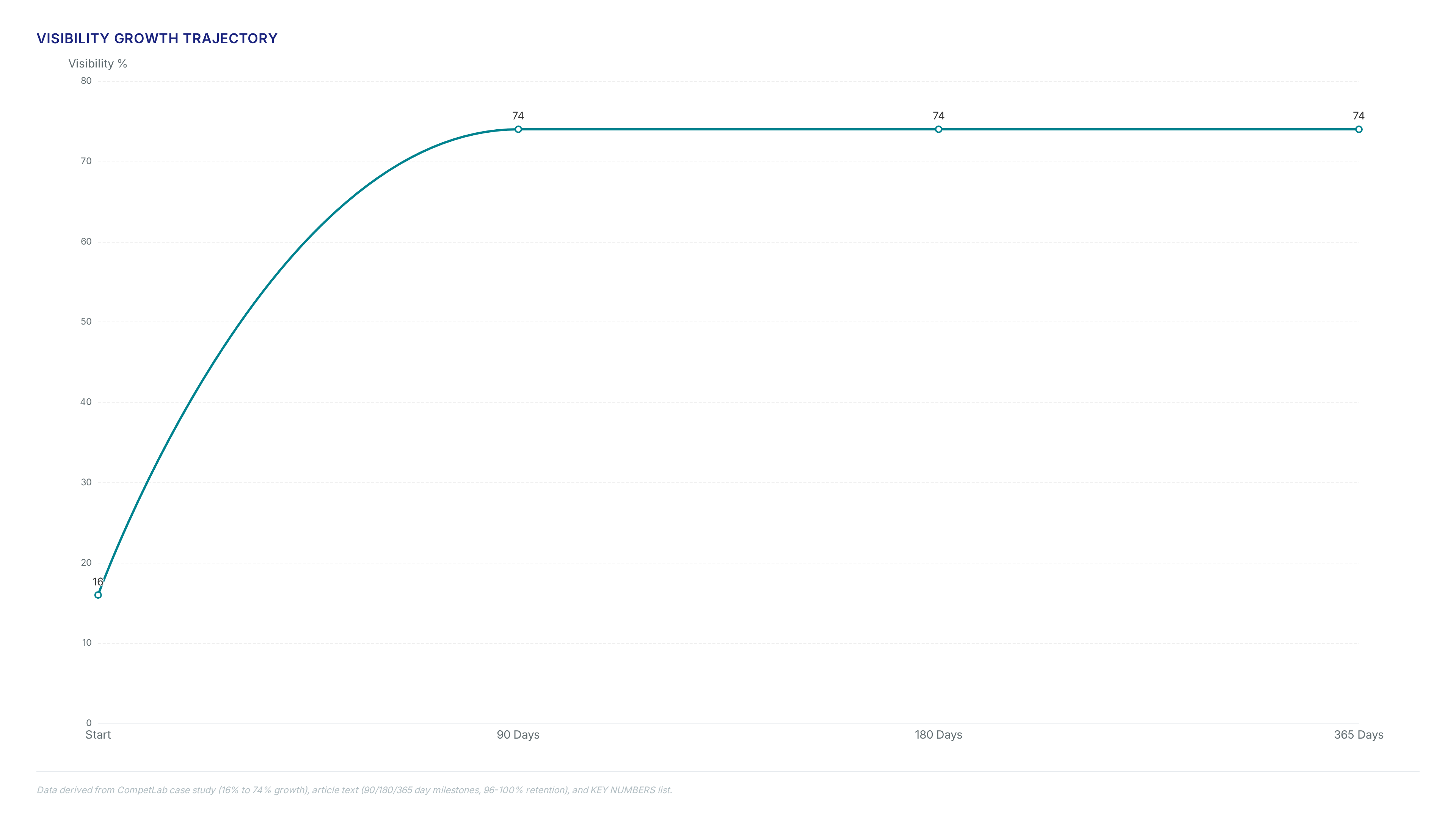
Foundation executes a four-stage operating system: research, create, distribute, and optimize. The workflow begins by using Profound to baseline citation share and map competitor gaps before content production starts. Technical implementation favors entity-level monitoring over keyword tracking because entities provide stable signals for category association. The second stage generates LLM-optimized articles, Reddit posts, and YouTube scripts derived directly from research data. Systems technically prefer sources with thorough FAQ pages and interconnected content clusters that demonstrate complete topical expertise. Distribution publishes these assets across identified channels, sequencing spend based on where citation share moves first.
Allocate budget dynamically by tracking which channel moves citation share first, rather than distributing spend equally across all platforms.
- Establish a citation baseline using Profound to measure current visibility before deploying new assets.
- Publish initial content clusters and monitor for the first statistically significant lift, which typically occurs inside 90 days.
- Shift majority spend to the specific channel driving early gains, often Reddit or YouTube, while holding other channels at maintenance levels.
- Re-evaluate the mix at 180 days to confirm a second channel is contributing before scaling investment.
This approach exploits the compounding nature of citation retention, where early assets continue earning visibility while new content layers on top. The risk lies in premature scaling; operators who increase spend on a channel before confirming pipeline influence often dilute their signal-to-noise ratio. Unlike traditional marketing mix modeling, this methodology requires waiting for the attribution moat to form over 365 days before declaring a channel dominant. Their citation share reached 11.7%, nearly double the nearest competitor, proving that concentrated channel sequencing outperforms broad distribution. Brands must resist the urge to chase visibility everywhere simultaneously.
Implementation: Validation Metrics for Response-Level Citation Rates
Establish a citation baseline immediately to measure owned content presence where it was previously absent. During the first 90 days, the program focuses on stabilizing these metrics before expecting significant volume lifts. A critical tension exists between tracking keywords and monitoring entities, as the latter provides stable signals for category association in AI synthesis. Technical implementation favors entity-level monitoring because entities anchor factual accuracy improved than volatile keyword rankings. Relying on keyword data alone often masks the fact that a competitor with weaker domain authority can out-cite a brand if they appear in trusted threads. If citation retention remains high, early assets continue earning visibility while new content layers on top. Teams must avoid the trap of measuring success solely by traffic, as the hidden selection phase determines shortlist inclusion before any click occurs. The ultimate validation is consistent appearance across query types, proving the brand has secured a position in the hidden selection economy.
About
Daniel Reyes serves as Head of Content Engineering at Enterium, where he architects production-grade AI content pipelines from ingestion to publication. His decade of experience in data and ML platform engineering uniquely positions him to dissect AI visibility, a phenomenon rooted in how LLMs retrieve and rank information rather than traditional SEO mechanics. By connecting daily work in vector stores and quality gates to buyer behavior, Reyes provides the technical clarity content leaders need to ensure their solutions appear when buyers query models like ChatGPT for vendor shortlists.
Conclusion
Scaling AI visibility breaks when teams chase broad distribution before securing entity-level dominance in specific threads. The operational cost of premature scaling is a diluted signal that fails to penetrate the attribution moat required for long-term retention. While traditional search volume faces a projected quarter decline by 2027, the real danger lies in measuring success by traffic rather than citation share. Brands must shift focus from keyword volatility to stabilizing response-level citation rates across platforms like Reddit and LinkedIn. This requires patience, as the compounding nature of citation retention means early assets continue generating value only if the fundamental entity signals are accurate.
Organizations should commit to a 90-day stabilization period focused exclusively on entity-level monitoring before expanding channel investment. This timeline allows the attribution moat to form without the noise of premature scaling. Do not declare a channel dominant until you have verified consistent appearance across diverse query types. Start this week by auditing your current citation baseline on owned domains against competitor presence in technical discussions. Identify the specific threads where your brand lacks entity anchor status and prioritize content creation for those gaps alone. This targeted approach ensures that when you do scale, your pipeline influence is strong enough to sustain visibility as the market shifts away from traditional search models.
Frequently Asked Questions
Brand domains capture only 2.2% of citations on unbranded discovery queries. This low rate means buyers primarily see third-party reviews and forums instead of your official content during vendor shortlisting.
Reddit, YouTube, and LinkedIn collectively drive a significant portion of AI citations. Brands must optimize presence on these specific channels since most influence originates from sources you do not own.
Perplexity cites sources in 94% of its generated responses, offering high transparency. This high citation rate allows brands to audit exactly where they appear compared to platforms with less consistent attribution behaviors.
Citation retention remains between 96% and 100% month over month for indexed content. This stability means early wins in AI visibility compound over time rather than requiring constant re-optimization efforts.
Gartner projected a 25% decline in traditional search volume specifically due to AI chatbot rise. Marketers must adapt now because relying solely on standard search metrics ignores this massive shift in buyer behavior.