AI Mode users ignore standard marketing fluff
AI Mode traffic converts 42% higher because these users have already decided what to buy. AI Mode delivers pre-qualified buyers who demand immediate task completion rather than persuasive fluff. While traditional searchers arrive with vague curiosity, Google data confirms that AI Mode users submit queries triple the length of standard keywords, signaling a shift from discovery to execution. This behavioral pivot forces a reevaluation of landing page architecture, which currently fails by assuming visitor ignorance instead of facilitating rapid action.
You will learn why planning-related queries are outpacing general AI Mode growth by 80%, creating a distinct user profile that ignores standard marketing funnels. Finally, the discussion turns to optimizing task-completion architectures that strip away unnecessary friction for these decisive agents.
Ignoring this shift is costly when agentic AI adoption accelerates despite only one in five companies having mature governance models, according to Deloitte. The query tells you who is coming; the question remains whether your infrastructure can handle visitors who have already made up their minds.
The Distinct Profile of AI Mode Visitors and Planning Queries
Defining the AI Mode Visitor Profile and Planning Queries
Traffic originating from AI Mode consists of users executing refined planning queries after triple-length input cycles, effectively bypassing traditional discovery funnels. These visitors arrive having compared options internally, rendering standard persuasion architectures obsolete for this specific segment. Data confirms One billion monthly active users now type queries triple the length of traditional searches, signaling a distinct shift from exploration to execution. Planning-related queries grow 80% faster than overall AI Mode volume, indicating users employ these tools to finalize decisions rather than brainstorm categories. This behavior demands task-completion surfaces that prioritize immediate action over feature exposition.
Failure to align page architecture with this planning query profile results in abandoned sessions from users who already selected a vendor. The website must assume knowledge, not ignorance.
Query Length as a Buying Funnel Indicator for AI Traffic
Triple-length queries function as definitive bottom-funnel signals, marking the transition from exploration to immediate execution. A standard three-word search implies broad category research, whereas a 30-word constraint-heavy prompt containing "same-day pickup" indicates a user ready to transact. This elongated syntax forces websites to abandon persuasion architectures in favor of direct task-completion surfaces. Visitors arriving with such specific parameters bounce quickly if forced to re-navigate a discovery funnel they already completed inside the AI interface. The content required to satisfy these complex, multi-constraint inputs demands significant depth. Top-performing pages optimized for this retrieval style average 1,447 words, ensuring authoritative coverage of niche scenarios. Ignoring this depth creates a mismatch where the site attempts to educate a user who has already decided. As Generative Engine Optimization overtakes traditional SEO by late 2027, static landing pages will fail to capture users planning actions rather than browsing categories.
| Query Type | Word Count | Funnel Stage | User Intent |
|---|---|---|---|
| Traditional Search | 3 words | Top | Discover options |
| AI Planning Query | 25+ words | Bottom | Execute specific task |
Operators must recognize that high bounce rates on AI traffic often stem from friction, not lack of interest. The visitor expects the page to validate their pre-formed decision instantly. Failure to surface pricing or booking tools within seconds confirms the site is built for awareness, not the planning queries driving 2026 growth.
AI Mode Visitors vs Traditional Organic Search Behavior
AI Mode visitors arrive having refined queries three times, bypassing discovery to execute pre-determined plans. This contrasts sharply with traditional organic traffic, where users often enter broad keywords to explore options. The decision-ready state of AI users renders standard persuasion architectures ineffective for this segment.
| Feature | Traditional Organic Search | AI Mode Traffic |
|---|---|---|
| User Intent | Discovery and comparison | Task execution |
| Query Length | Short, categorical | Triple the length, constraint-heavy |
| Funnel Stage | Top or middle | Bottom (pre-qualified) |
| Site Requirement | Persuasion and education | Immediate action surface |
Traditional searchers require convincing through feature lists and social proof, whereas AI Mode users demand direct access to transaction endpoints. The cost of ignoring this shift is measurable; retail traffic from AI sources converts 42% higher than non-AI traffic when sites enable immediate action. However, this premium vanishes if the landing page forces the visitor back into an awareness funnel they already completed inside the AI. Organizations must adapt their marketing attribution vendors to track these distinct behavioral paths accurately, as standard models often misclassify deep planning queries as mere browsing.
Aligning Page Architecture with Task Completion Over Persuasion
Landing pages must surface booking forms immediately because AI Mode visitors arrive ready to execute pre-determined plans. Standard architectures waste this intent by forcing pre-qualified buyers through awareness-stage persuasion funnels designed for cold traffic. Most sites delay action behind feature lists and testimonials, assuming the visitor needs convincing. This assumption fails when the user has already compared options inside the AI interface. The correction requires moving the task-completion surface to the viewport top, eliminating scroll depth for primary actions. Operators should audit referral paths from chat.openai.com to identify pages requiring this architectural shift.
| Architecture Element | Traditional Design | AI-Optimized Design |
|---|---|---|
| Primary Goal | Build awareness | Execute transaction |
| Above Fold | Hero image + value prop | Input form + price |
| Content Order | Problem → Solution | Action → Validation |
| Navigation | Multi-step exploration | Single-step completion |
Evidence suggests that flexible content insertion drives massive engagement lifts for retailers adapting to this behavior. While WineDeals saw triple-digit CTR growth, other sectors face different cost structures for similar digital transformations. The limitation lies in the adoption-execution gap where teams possess tools but lack workflow integration. A critical tension exists between maintaining brand storytelling and satisfying immediate action constraints. If a page requires navigation to a secondary URL to find pricing, it fails the 30-second completion test for AI arrivals. Enterium recommends stripping non-necessary narrative from high-traffic AI landing pages. The cost of retaining persuasion architecture is the loss of visitors who expect autonomous task fulfillment.
Information-Delivery Architecture vs. Task-Completion Design
Most websites deploy information-delivery architecture assuming visitors require education before action. This model fails AI Mode traffic that bypasses consideration entirely. Traditional pages list features and display trust badges to build confidence over multiple clicks. These elements create friction for users who have already selected a solution inside the AI interface. The visitor arrives at the "do the thing" stage, not the awareness phase. Forcing pre-qualified buyers through persuasion funnels causes immediate abandonment. Enterprises attempting to align backend systems often face high costs, where thorough enterprise digital marketing solutions can reach prohibitive monthly figures without guaranteeing frontend alignment. A modular approach combining small language models with retrieval mechanisms offers improved observability for tracking these distinct user paths. Operators must distinguish between platforms that spark interest versus those capturing conversion intent. The platform functionality distinction dictates that entry pages for AI traffic must skip discovery content entirely.
| Feature | Information-Delivery | Task-Completion |
|---|---|---|
| Visitor State | Uninformed | Pre-qualified |
| Primary Goal | Build trust | Execute action |
| Content Focus | Features and benefits | Pricing and booking |
| Navigation Depth | Multi-page process | Single-view finish |
Enterium recommends auditing landing pages to ensure the primary action appears above the fold without scrolling. Pages relying on long-form persuasion content will lose this high-intent segment to competitors offering direct task execution. The architectural mismatch between visitor intent and page design represents a critical revenue leak.
Optimizing Landing Pages for Immediate Task Completion
Application: Defining Information-Delivery vs Task-Completion Architecture
Pre-qualified buyers abandon sites that force them through awareness funnels they finished inside an AI model. Traditional pages deploy testimonials and feature lists to convince cold traffic, yet 94% of marketing teams use AI tools while only 19% use AI tools. This blindness creates an architectural mismatch causing immediate exits. Visitors arrive ready to transact rather than learn. Task-completion design inverts standard logic by surfacing booking forms or pricing tables before persuasive copy. Operators must prioritize immediate utility over narrative flow to capture value from high-intent sessions. Retrofitting legacy pages often incurs prohibitive costs, as thorough enterprise digital marketing solutions can exceed budget constraints for simple structural shifts. Friction from re-explaining product value drives away users whom the AI already validated.
Enterium recommends auditing top landing pages to ensure the primary action executes within 30 seconds of load time. Sites retaining persuasion-heavy hero sections for AI-referred traffic effectively reject the only segment ready to buy. Maintaining an information-delivery facade costs the total loss of the transaction the AI initiated.
Auditing Landing Pages for Chrome Auto-Browse Readiness
Chrome's auto-browse feature lands on Android phones in late June 2026, sending autonomous agents to complete tasks without human intervention. Operators must restructure high-traffic landing pages before this deadline to prevent agent failure. Google Analytics 4 tracks referrals from chat.openai.com com directly, allowing teams to isolate pages receiving pre-qualified traffic. These visitors bypass traditional persuasion funnels entirely. The average word.
Failure occurs when the primary call-to-action sits below three sections of social proof. Enterium recommends moving the task-completion surface to the viewport top immediately. Pages failing this audit force agents to scroll past explanatory content, triggering timeout errors or abandonment. Delay carries a measurable cost as planning queries continue expanding quicker than general AI Mode volume.
Narrative control diminishes for cold traffic segments under this approach. AI Mode users have already compared options and refined constraints inside the model. They arrive ready to execute, not to learn. Forcing these users through an awareness funnel creates unnecessary friction that reduces conversion potential. The Gemini 3.5 model further accelerates this behavior by enabling complex reasoning before the click. Operators must prioritize immediate action over storytelling to capture this demand.
The Persuasion Architecture Trap for Pre-Qualified Buyers
Forcing pre-qualified buyers through scrolling hero sections triggers immediate abandonment when task completion is blocked. Most websites deploy information-delivery architectures assuming visitors require education, yet AI Mode traffic arrives having already compared options and refined constraints inside the model. This architectural mismatch creates friction for users at the "do the thing" stage rather than the awareness phase. Abandonment becomes the measurable cost of this friction. Visitors do not need feature lists or trust badges; they require direct access to booking forms or pricing tables.
Enterium recommends auditing top referral pages from chat.openai.com to identify where persuasion content delays action. If a visitor must scroll past three sections of social proof to find the primary action, the page fails the 30-second completion test. The shift requires moving transactional elements above the fold, prioritizing immediate utility over narrative buildup.
Executing a Strategic Audit for AI-Referred Traffic Pages
Defining the AI Mode Audit Scope Using GA4 Referral Data
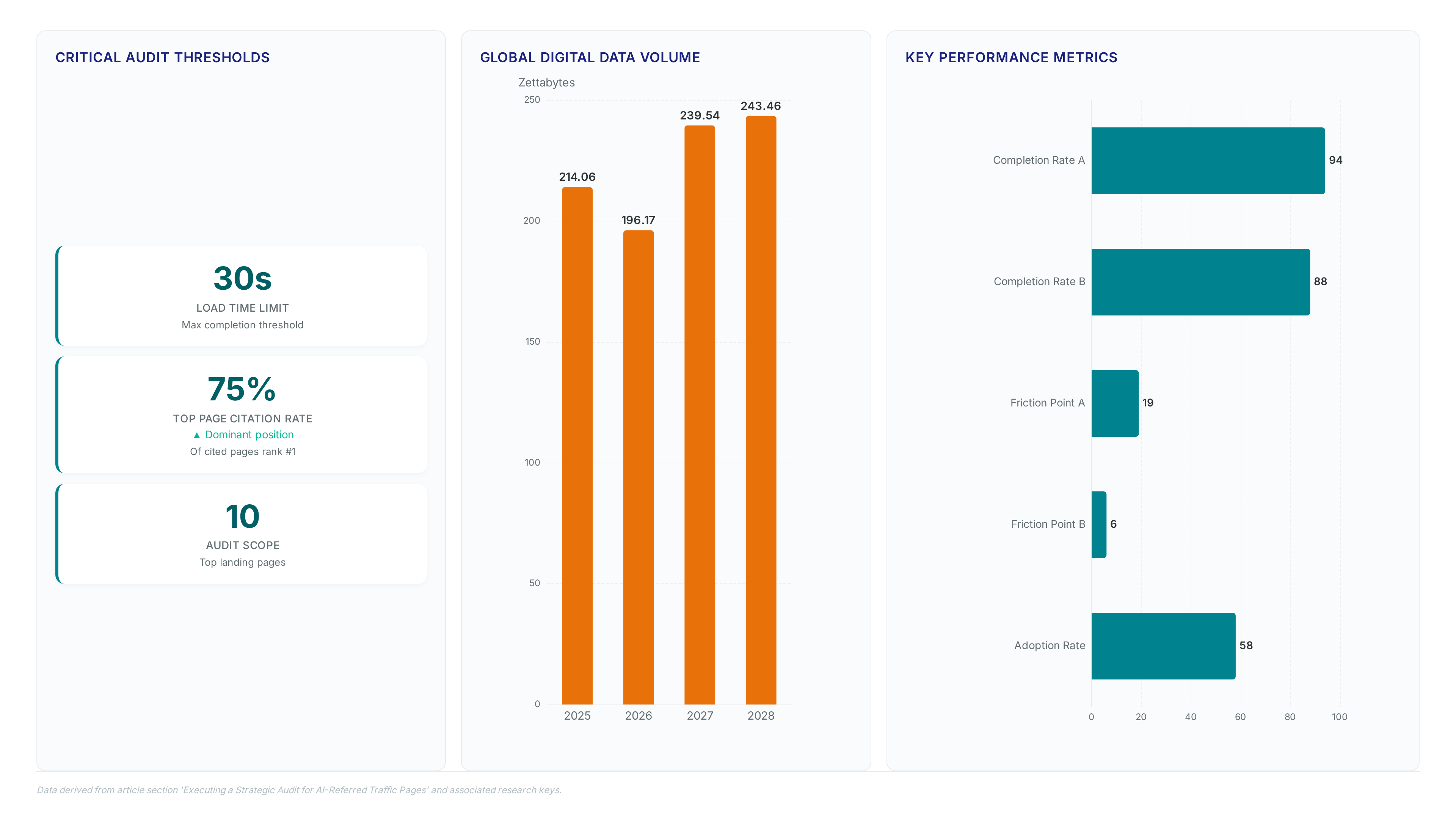
Isolate sessions from chat.openai.com and gemini.google.com in GA4 to establish the baseline for task-completion surfaces. This filtering separates planning-stage users from traditional organic traffic, revealing pages where persuasion architecture causes abandonment. Operators must pull the top 10 landing pages receiving these referrals to audit friction points.
- Filter GA4 reports by referral path to identify high-intent entry points.
- Verify page load time against the 30-second completion threshold for pre-qualified buyers.
- Map the click path to detect unnecessary navigation steps before action.
- Cross-reference cited URLs with AI Overviews citation logic to understand why specific pages rank outside the top 10 yet capture traffic.
Extract the top 10 landing pages receiving AI-referred traffic to evaluate task-completion surfaces against strict latency constraints.
- Filter GA4 reports for referrals from
chat.openai.comandgemini.google.comto isolate high-intent entry points. - Measure page depth against the average word count
- Verify that the primary action requires zero navigation steps beyond the initial load.
- Cross-reference target URLs with known AI Overviews citation logic to ensure the landing page matches the specific constraint set in the AI response.
The critical failure mode occurs when pre-qualified buyers encounter persuasion architecture designed for cold traffic. Unlike traditional visitors, these users have already compared options and refined constraints inside the model.
Chrome auto-browse agents launching on Android in June 2026 will fail task execution if landing pages bury actions beneath persuasive text layers. Legacy architectures force autonomous agents to parse unnecessary navigation steps, triggering immediate abandonment of the session. Only 19% of companies currently possesses a mature model for governing these autonomous AI agents, leaving most sites vulnerable to protocol mismatches. The friction arises when a page requires scrolling past feature lists instead of presenting a direct task-completion surface.
- Identify entry pages where the primary call-to-action sits below the fold.
- Remove intermediate navigation steps that require agents to resolve relative paths.
- Elevate booking forms or pricing tables to the immediate viewport top.
- Validate that no JavaScript blockers prevent headless browser interaction.
The cost of retaining persuasion-heavy layouts is the total loss of high-intent traffic to competitors offering direct action. Enterprises must shift from awareness-building to immediate utility to capture value from information agents expanding into local services. A simple configuration change in the template logic can expose the action element first. Operators implementing this structural prioritization through Enterium solutions mitigate the risk of agent failure. The window for optimizing these friction points closes as autonomous browsing becomes the default behavior for planning queries.
About
Sofia Marchetti is a B2B Content Strategist specializing in how automated content systems drive tangible pipeline growth. Her daily work involves dissecting the intersection of topical authority and GEO/SEO, making her uniquely qualified to analyze the shift toward AI Mode visitors. While traditional sites focus on persuasion, Sofia's experience building content pipelines at Enterium reveals that modern users arrive pre-qualified and task-oriented. At Enterium, a vendor-neutral resource for content engineers and marketing operations, she documents how teams scale production using LLMs without sacrificing strategic depth. This article connects her practical findings on agentic commerce to the reality that standard landing pages often fail these decisive users. By using data from Google Marketing Live 2026, Sofia bridges the gap between theoretical AI search trends and the revenue-focused content architectures required to capture them effectively.
Conclusion
The architectural break point arrives when legacy persuasion funnels collide with autonomous execution agents that refuse to scroll. As Chrome's auto-browse capabilities expand in 2026, sites burying actions beneath text layers will face immediate session abandonment, not due to lack of interest, but because of protocol mismatch. The operational cost shifts from customer acquisition to maintaining compatibility with headless browsers that demand direct task-completion surfaces. Firms continuing to prioritize narrative over utility will see their high-intent traffic volume evaporate silently, as these agents simply bypass friction rather than resolve.
Organizations must mandate a structural prioritization of action elements over persuasive copy by Q4 2027. This is not a design preference but a functional requirement for surviving the transition to agent-dominated traffic. Delaying this rearchitecture guarantees exclusion from the planning-query economy before most marketing teams even recognize the drop in conversion metrics. The window to govern these interactions closes as autonomous browsing becomes the default behavior for complex tasks.
Start by auditing your top ten entry pages this week to identify any primary call-to-action sitting below the fold. Implement a server-side detection rule immediately to serve a simplified, action-first view to any detected AI user-agent, ensuring your pricing or booking interface loads in the immediate viewport without requiring navigation resolution.
Frequently Asked Questions
AI Mode visitors convert 42% higher because they arrive pre-qualified after internal comparison. This premium exists because planning-related queries grow 80% faster, signaling users ready to execute specific tasks rather than browse options.
Planning-related queries grow 80% faster than overall volume, signaling a move to execution. These users type triple-length queries, proving they have already decided what to buy and need immediate task completion.
Comprehensive digital solutions now reach $50,000+ per month as firms rearchitect for performance. This investment targets the distinct profile of AI visitors who demand immediate action over standard persuasion architectures.
No, planning queries grow 80% faster while brainstorming only grew 30% faster. This gap proves most AI users are finalizing decisions with specific constraints rather than exploring broad categories or discovering new options.
Sites lose the 42% conversion premium by forcing pre-qualified buyers through awareness funnels. AI visitors skip discovery, so adding friction causes them to abandon sessions that should have been immediate completions.