AI marketing tools: why speed fails strategy
Seventy-one percent of marketers use AI tools weekly, yet strategy failures persist because speed does not equal success. AI marketing tools accelerate production without fixing broken fundamentals like audience definition or value propositions. Operational mechanics often degrade brand governance, creating a false equivalence between content volume and strategic growth. Implementing human override protocols remains the only viable path to maintaining brand integrity.
While Averi AI reports that content output volume increases by 77% within six months, this surge often masks a lack of strategic direction. Practical Ecommerce analysis confirms that generative AI has not altered core drivers such as segmentation or storytelling, noting that campaigns still fail due to pre-existing issues like muddy value props rather than the model used. The technology compresses the time between idea and execution, turning a 40-minute task into a four-minute one, but it cannot compensate for vague targeting.
Assuming that production cost reduction, which averages 42% according to Averi AI data, equates to improved performance is a dangerous accounting error. Without strict brand governance, automated pipelines produce mediocre outputs at scale, eroding tone consistency and confusing attribution models. True advantage comes not from the tool itself but from the discipline to apply human judgment to high-velocity workflows, ensuring that efficiency serves a coherent strategy rather than replacing it.
The Distinction Between AI Efficiency and Strategic Growth
Defining AI Efficiency Versus Strategic Growth Metrics
AI efficiency calculates how fast assets get built and how much each unit costs to produce. Strategic growth watches revenue lines and customer retention numbers instead. Generative algorithms shrink creation windows from hours down to minutes, letting two people plus a model do work that once demanded full production crews. AI tools are cutting content creation time by 60% on average for teams.
Do not mistake this throughput spike for business expansion. It is not. Teams frequently mix these separate metrics, treating higher output volumes as proof of growth. Data indicates that while many organizations deploy these tools, success depends heavily on strategic application. The limitation lies in input quality; ambiguous audience definitions yield mediocre variants regardless of generation speed. The cost of failure remains high when technology produces opposite organizational decisions based on flawed underlying strategy.
| Metric Category | Primary Focus | Key Indicator |
|---|---|---|
| Operational Efficiency | Speed and Cost | Time to launch |
| Strategic Growth | Value and Retention | Customer LTV |
Reporting frameworks address this gap by separating efficiency gains from performance outcomes in dashboards. Without this structural distinction, organizations risk optimizing for volume while stagnating on revenue. The fundamental drivers of marketing success remain unchanged despite the new tooling. Speed changed, but the necessity for clear segmentation and strong offers did not.
Applying AI to Accelerate A/B Test Variant Creation
Generative models compress A/B test variant production from a weekly cycle to an afternoon session. This shift transforms throughput velocity, allowing teams to generate numerous ad iterations in the time previously required for a single draft. Such acceleration lowers the marginal cost of content creation, effectively making draft generation free relative to manual labor costs. Teams using these workflows report efficiency gains that shift budget allocation from volume production to quality assurance and strategic oversight.
Speed increases existing strategic deficits. If the initial audience definition is vague, the system produces many mediocre ads quicker rather than one good one. This operational reality creates a tension where increased output volume makes quality control notably harder, not easier. Without a solid strategic brief, the technology scales mediocrity just as efficiently as it scales excellence.
| Metric Category | Pre-AI Baseline | AI-Enabled State |
|---|---|---|
| Production Time | 1 week per variant set | 4 hours per variant set |
| Primary Constraint | Writer availability | Strategic clarity |
| Cost Driver | Labor hours | Model tokens |
Automated content pipelines can quietly erode tone consistency over months if outputs go unwatched. Some organizations claim massive cost reductions. Cutting production costs means nothing if conversion rates remain static. True value emerges only when teams separate operational efficiency metrics from actual performance indicators like CAC and LTV. Strong governance frameworks are necessary to audit these strategic layers before scaling automated creation. Securing brand integrity while accelerating execution requires distinguishing between doing more and expanding more.
Risk of Blending Operational Efficiency with Actual Performance
Operational efficiency tracks unit cost reduction, while strategic growth measures revenue expansion and customer lifetime value. Production cost reduction averages across content formats when AI tools are operationalized correctly. This deflationary pressure on draft generation creates a dangerous accounting illusion where flat revenue appears as transformation. Teams often conflate the ability to produce assets quicker with the ability to convert audiences more effectively. The primary cost benefit cited is the conversion of hours of manual work per asset into minutes of production time, effectively lowering the marginal cost of content creation to near-zero for draft generation.
| Metric Category | Operational Efficiency Indicators | Strategic Growth Indicators |
|---|---|---|
| Focus | Cost per asset, time to launch | CAC, LTV, conversion rate |
| AI Impact | High volume, low marginal cost | Neutral without strategy |
| Risk | Scaling mediocre outputs | Stagnant revenue growth |
Cutting production costs means nothing to a CFO if conversion rates stay exactly where they were. The real danger lies in allocating saved budget to further tool acquisition rather than fixing the underlying strategic brief. When teams prioritize speed over audience definition, they increases poor positioning at machine scale. The "cost" of failure is highlighted by the fact that the same technology produces opposite organizational decisions depending on the underlying strategy. Smart operators separate these columns in reporting dashboards to prevent efficiency gains from masking performance plateaus. Effective management requires distinct oversight for volume increases versus strategic pivots to ensure technology increases success rather than failure.
Operational Mechanics of AI Content Production and Autonomous Bidding
Defining Brand Voice Drift in Automated Pipelines
Automated pipelines erode tone consistency over months when operators fail to monitor outputs, creating a phenomenon known as brand voice drift. This failure mode differs from simple style errors because the technology functions correctly while the aggregate result goes unwatched. Content output volume increases by 77% within six months of AI implementation, yet the lack of human governance allows subtle deviations to compound. Unlike a singular typo, drift represents a systemic shift where the model optimizes for fluency rather than brand alignment. Operational scaling creates the root cause. Teams often connect AI writing tools to CMS platforms without establishing feedback loops for tone. Production cost reduction averages 42% across content formats, so the temptation to remove human review gates increases.
| Failure Mode | Detection Timeline | Root Cause |
|---|---|---|
| Style Error | Immediate | Prompt ambiguity or model glitch |
| Voice Drift | Months | Absent human oversight layers |
Efficiency gains do not equal strategic growth for network operators and marketing leads. Entering 2026, voice-driven content and conversational search become integral to marketing strategies, making a distinct voice a competitive moat. High-volume pipelines will dilute brand equity without these protocols.
Operationalizing AI Content Production with Two-Person Teams
A full production team is no longer required to draft content when two people and a model work together, provided the strategic brief is solid. Generative systems execute drafting while humans define constraints, compressing labor. The mechanism shifts value from asset generation to strategic oversight.
| Workflow Stage | Traditional Team | AI-Operationalized Team |
|---|---|---|
| Drafting | Multiple writers | Model + 1 editor |
| Personalization | Manual segmentation | Automated variants |
| Review Focus | Grammar and facts | Brand alignment |
Teams focus resources on technical accuracy and search experience optimization by shifting budget allocation from volume production to quality assurance and strategic oversight. Production speed increases drastically. Manual approaches require hours of work per asset. AI-powered approaches reduce production time to minutes, offering a speed advantage of up to 50 times quicker personalization. This velocity increases operational discipline gaps. Vague target segment definitions cause the system to produce mediocre ads at scale rather than high-performing variants. Solutions address this by embedding governance gates directly into the generation pipeline so speed does not compromise brand integrity. The limitation of the two-person model is not technical capacity but the cognitive load of reviewing exponentially higher output volumes. Teams must separate efficiency metrics from growth metrics to avoid conflating cost savings with revenue impact. Takeaway: Deploy a governance framework to validate strategic briefs before model execution, ensuring the two-person team scales quality rather than just volume.
Attribution Errors from Murky AI Touchpoints
Increased channels and AI-assisted touchpoints create murky attribution that makes answering financial questions regarding spend difficult. These are not AI problems but operational discipline problems that AI happens to increases.
| Factor | Traditional Workflow | AI-Amplified Workflow |
|---|---|---|
| Touchpoint Density | Low, human-managed | High, autonomous |
| Spend Visibility | Clear per channel | Fragmented across variants |
| Error Source | Manual entry | Untracked model actions |
This efficiency obscures the financial signal. Teams cannot isolate which specific AI-generated variant drove revenue versus which merely consumed budget without strict governance. The result is a reporting blind spot where efficiency gains mask stagnant conversion rates. Organizations must shift budget allocation from volume production to quality assurance and strategic oversight to maintain clarity. Focusing on technical accuracy and search experience optimization helps teams improved manage the increased density of touchpoints. Operators must separate operational efficiency metrics from actual growth metrics to prevent flat revenue from appearing as transformation.
Implementing Human Override Protocols for Brand Governance
Defining Human Override Protocols for Autonomous Bidding

Autonomous bidding tools in platforms like DV360 and Advantage+ demand explicit human sign-off on spend thresholds to function safely. Governance now operates as a distinct layer in the marketing stack because automated systems expand the risk surface for brand safety and financial exposure. Algorithmic execution can rapidly deplete budgets on misaligned inventory before human teams detect the drift when boundaries remain undefined. Implementing effective override protocols requires a structured approach to constrain autonomous agents:
- Establish clear operational boundaries that require human validation before significant budget expansion occurs.
- Define affinity score minimums for creator-brand matching tools, requiring audits before allocating capital to new segments.
- Monitor performance data closely to identify anomalous velocity or cost-per-action spikes that deviate from historical baselines.
- Conduct regular governance reviews where human operators validate that automated decisions align with current strategic positioning.
Research indicates that while 23% of organizations are scaling agentic AI systems, the gap between autonomous capability and human control remains a significant vulnerability. Unmonitored automation costs more than the efficiency gains it provides when brand reputation suffers from unchecked algorithmic decisions. Operators must prioritize human governance structures that allow for immediate intervention regardless of the system's perceived confidence level.
Auditing Audience Segments Before AI Tool Stack Review
Validate that current audience segments possess sufficient definition to support high-volume generation before expanding tooling. Generating 50 ad variants quickly is ineffective if the target segment is mushy, resulting in 50 mediocre ads rather than scaled performance. Execute this pre-audit workflow to secure the strategic layer before expanding tooling:
- Review existing persona documents against actual conversion data to identify vague definitions.
- Separate efficiency metrics from growth metrics in all reporting dashboards.
- Require human sign-off on spend thresholds for any autonomous bidding agent.
The divergence in outcomes stems from strategy, not software access; the same technology produces opposite results in different companies based on the underlying strategic divergence present at deployment. Teams often conflate production speed with market fit, yet tool adoption alone is no longer a differentiator. A rigorous audit prevents the amplification of operational noise. Marketing leaders risk optimizing for volume while losing position without this distinction. The immediate next step is to validate that every segment has a unique value proposition clear enough to survive automated scaling.
Implementation: Checklist for Separating Efficiency Metrics from Growth Metrics
Isolate operational velocity from revenue impact in every quarterly report to prevent misleading performance narratives.
- Configure dashboards to display cost-per-asset separately from customer-acquisition-cost.
- Establish clear reporting distinctions between efficiency metrics and growth targets.
- Prioritize review for campaigns where output volume increases but conversion remains flat.
| Metric Category | Primary Indicator | Secondary Signal |
|---|---|---|
| Efficiency | Time-to-publish | Cost per variant |
| Growth | Lifetime value | Net retention rate |
This separation reveals a sharp tension: high-volume output frequently masks stagnant strategic positioning. Enterium recommends treating throughput gains as operational savings rather than proof of market fit. Leaders must recognize that quicker execution of a flawed strategy only accelerates failure. The immediate next step is to reconfigure your primary reporting view to hide efficiency stats until growth baselines are met.
Strategic Lessons for Balancing Creative Testing and Brand Integrity
Distinguishing Operational Efficiency from Actual Growth Gains
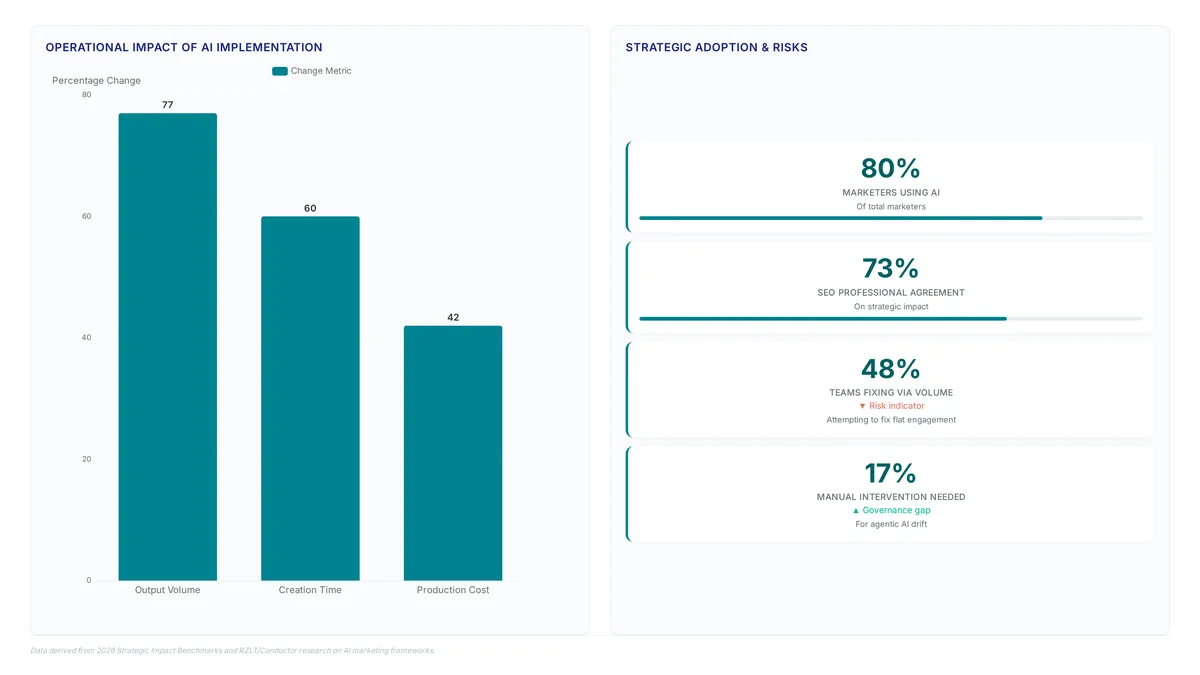
Speed metrics track how fast assets get made, while growth metrics track revenue changes. Generative algorithms shrink draft creation from hours into minutes, driving down the marginal cost of content production. Teams can now redirect budget from pure volume toward rigorous quality assurance. Confusing these velocity gains with real business results creates a dangerous illusion of forward motion. The main danger involves presenting flat revenue figures as a transformation just because asset throughput rose. Smart operators keep these data streams separate to prevent false positives in AI adoption reports. Benchmarking dashboards enforce a hard line between doing more work and actually expanding the business. Marketing leaders who skip this separation end up optimizing for cheap drafts instead of strong offers. Quicker production of weak strategic briefs only accelerates market irrelevance. True competitive advantage stays rooted in audience definition rather than generation speed.
Lessons: Implementing Override Protocols for Autonomous Bidding Systems
Organizations scaling agentic AI systems for multi-step tasks often still depend on manual intervention to fix drift. This gap creates a failure mode where execution speed outpaces governance controls. Marketing leaders must install override protocols that halt operations when brand voice metrics stray from baseline standards or when cost-per-acquisition limits breach set boundaries. Teams lacking these checkpoints frequently try to fix flat engagement after AI adoption by pumping up volume, which compounds the error instead of fixing the strategy. Human oversight stays mandatory for spend thresholds and regulatory compliance with bodies like the FTC. Algorithms might optimize for conversion while simultaneously eroding brand equity. A system could lower CAC by targeting irrelevant but cheap audiences, achieving technical success while failing strategically. Automated content pipelines can quietly erode tone consistency over months, a scenario where the technology functions perfectly while nobody watches the outputs. Skipping these gates costs money through wasted ad spend and reputational harm. Teams should audit their strategic layer before deploying autonomous agents to verify the underlying logic supports Actual Performance goals.
Validating Audience Positioning Before Tool Stack Audits
Skipping the strategic audit before tool adoption speeds up the production of fundamentally broken outputs. Leaders must define audience segments and clarify offers before reviewing any generative platform. This discipline separates strategic scaling from simple tool usage, making sure speed does not increases confusion. Teams bypassing this step often mistake high-volume draft generation for market fit. The outcome is a flood of content missing the mark on message differentiation. Human judgment remains the primary filter for strategic positioning. While 80% of marketers now apply AI tools, only a fraction achieve true adaptation to new search realities like AI Overviews. Technology cannot resolve ambiguous value propositions. Autonomous systems simply scale errors quicker than humans can correct them without this foundation. The operational takeaway is clear: audit the strategy first, then automate the execution.
About
Sofia Marchetti is a B2B content and demand-generation strategist who specializes in aligning automated content systems with revenue outcomes. Her decade of experience in B2B SaaS makes her uniquely qualified to analyze why AI marketing tools have accelerated production without altering core strategic fundamentals. In her daily work designing content pipelines, Marchetti observes that while generative models increase output velocity, they cannot compensate for weak positioning or unclear offers. This article reflects her operational reality at Enterium, where the focus remains on building reliable, vendor-neutral architectures for content automation rather than chasing tool hype. By documenting how modern teams scale content through rigorous quality gates and measurable workflows, Enterium reinforces the thesis that technology serves strategy, not the reverse. Marchetti's analysis provides the technical clarity needed by content leaders who must ship effective campaigns next week, proving that strategic discipline remains the ultimate competitive advantage in an AI-saturated environment.
Conclusion
Scaling AI marketing tools reveals a critical breaking point: velocity without verified positioning accelerates brand erosion rather than growth. While production timelines shrink dramatically, the operational cost of correcting misaligned messaging across thousands of AI-generated variants quickly outweighs initial efficiency gains. Organizations must recognize that strategic clarity is the non-negotiable prerequisite for automation, not a secondary optimization step. Leaders should mandate a full audit of audience segments and value propositions before expanding any agentic workflows this quarter. This approach prevents the common pitfall where teams mistake high-volume output for market fit, only to find their messaging differentiation diluted by algorithmic averaging.
The most effective immediate action is to pause all new autonomous agent deployments and manually validate the underlying logic of your top three performing content pillars against current audience positioning goals. Enterium helps organizations build these necessary strategic guardrails, ensuring that your technology stack amplifies a coherent brand voice rather than compounding strategic errors. True scalability arrives only when the system knows exactly what it is scaling.
Frequently Asked Questions
Faster creation does not fix broken strategy or vague audience definitions. While AI tools cut content creation time by 60%, teams still fail if their underlying value propositions remain unclear and untested.
Production costs drop significantly when teams operationalize automated workflows correctly. Data shows production cost reduction averages 42% across formats, but this savings means nothing if conversion rates stay flat due to poor strategic briefs.
Automated pipelines often erode tone consistency over time without strict human oversight. Although content output volume increases by 77% within six months, this surge frequently masks a dangerous lack of strategic direction and brand governance.
High volume often scales mediocrity if the initial audience definition is vague. Even with massive output gains, campaigns fail because speed cannot compensate for muddy value props or weak creative hooks in the strategy.
Teams must separate efficiency metrics from actual performance outcomes like revenue. Speed changes everything except the need for clear segmentation, so leaders must apply human judgment to high-velocity workflows to ensure strategic coherence.
References