Specialized agents beat generalist models for content
As of 2026, the AI content creation tools landscape has fractured into at least six distinct functional layers. Single-model workflows are obsolete. The market no longer tolerates one-size-fits-all automation. Instead, it demands rigid GEO optimization content and format-specific precision that generalist models cannot deliver.
This analysis dissects how multi-agent systems coordinate these layers to manage long-form writing and image generation without human bottlenecks. We move beyond theory to define the operational logic required for AI content pipelines that scale.
The data is clear: shifting to specialized content agents in growth marketing contexts yields measurable ROI. Industry reports on ai content agents highlight the necessity of this transition for technical documentation and strategic goals. The path forward requires a complete overhaul of how organizations approach SEO and AI search, favoring distributed intelligence over monolithic prompts.
The Role of Specialized Agents in Modern Content Infrastructure
Specialized Content Generation Agents vs Generalist AI Models
Specialized content generation agents deploy a multi-agent system where distinct roles belong to purpose-built units. They do not route every task through one monolithic model. This architectural shift separates the reasoning layer from the execution layer, permitting independent validation steps. Generalist models attempt to solve every problem with a single probability distribution. Specialized agents apply targeted heuristics for tasks like heading hierarchy SEO or internal linking scaffolding. Initial configuration demands detailed setup. The reduction in post-generation editing time offsets this overhead.
| Feature | Generalist AI Models | Specialized Agents |
|---|---|---|
| Training Scope | Broad, undifferentiated corpus | Domain-specific constraints |
| Workflow Logic | Linear prompt-response | Autonomous multi-step execution |
| Optimization Goal | Conversational fluency | Citation accuracy and structure |
Relying on a single model for diverse content types creates a potential single point of failure in the production pipeline. Organizations adopting specialized architectures gain deterministic control over output variables that generic tools leave to chance.
Autonomy defines the advantage of the agent swarm. Basic tools require step-by-step instructions. Agents analyze situations and execute workflows independently. This capability allows simultaneous management of complex distribution channels without human intervention at every decision node.
Deploying Format-Specific Agents for Listicles and Technical Guides
Format-specific agents enforce structural constraints that generalist models often overlook during generation. Marketers frequently face producing diverse content types within a single month. Examples include listicles, technical guides, and explainer articles. Specialized agents resolve this by assigning dedicated logic to specific content types before drafting begins.
MindStudio identifies exactly 15 specific ways to apply AI agents for content marketing. Coverage spans from creation to distribution and analysis. This granularity allows teams to separate keyword clustering logic from narrative flow. Technical guides retain density while listicles prioritize scannability. The cost of using a monolithic model is measurable. Extensive post-generation editing restores format integrity.
Deploying distinct agents introduces orchestration complexity. Smaller teams may struggle to manage this without a unified control plane. Handoff latency between agents becomes a key limitation if the planning layer does not synchronize state effectively. Advanced solutions address this coordination challenge by providing a centralized orchestration environment. Format rules get pre-validated against target schemas in this setup. Structural errors stop propagating early in the pipeline. Operators gain consistent output quality. Velocity remains high enough for modern content calendars.
Auditing current outputs for format drift serves as the immediate step before scaling agent count.
Why Approximation Fails: Generalist Coherence vs Specialized Optimization
Generative Engine Optimization demands structured data outputs. Generalist language models cannot reliably produce these without external constraints.
Generalist AI writing tools train on broad corpora. Optimization targets conversational coherence. These traits make them a poor fit for format-specific content production. Fluid prose takes priority over the rigid schema required for Generative Engine Optimization. Semantic markers LLMs use to verify authority often get omitted. Approximation of structure yields lower retrieval scores than exact schema adherence.
| Feature | Generalist Model Output | Specialized Agent Output |
|---|---|---|
| Primary Objective | Conversational flow | Schema compliance |
| Structure | Variable, narrative-driven | Fixed, pattern-matched |
| GEO Readiness | Low (requires parsing) | High (structured) |
| Error Profile | Hallucinated facts | Constraint violations |
SEO and GEO optimization differ by target consumer. Humans scan headlines. Generative engines parse relationship graphs.
Teams relying on single-model architectures face compounding debt. Every output requires manual restructuring to meet GEO optimization standards. Specialized systems solve this by deploying purpose-built agents. Format rules get enforced at the token generation level. Post-hoc correction becomes unnecessary. Using a generalist for specialized tasks results in total loss of automated verifiability.
Inside Multi-Agent Systems: Architecture and Coordination Logic
Orchestrator Agents and the Logic of Conditional Handoffs
The orchestrator agent acts as a central router that sequences tasks and enforces logic before any text generation begins. This component analyzes input requirements to determine the next logical step, effectively replacing linear workflows with flexible decision trees. Instead of passing every request immediately to a writer, the system evaluates context and available resources to route tasks appropriately.
Quality control happens at this routing layer through conditional handoffs. If an output such as a content outline fails to meet structural thresholds, the orchestrator loops the task back for refinement instead of propagating errors downstream. Structured content outlines generated without logical flow or proper keyword clustering trigger this rejection loop automatically. This mechanism ensures that writing agents receive only validated foundations, preventing the amplification of shallow hierarchies.
| Component | Function | Decision Criteria |
|---|---|---|
| Planner | Sequence definition | Task dependency mapping |
| Router | Task distribution | Agent availability and specialty |
| Validator | Quality gate | Structural completeness |
Increased latency during the planning phase represents the operational cost of this architecture because the system consumes compute cycles to validate intermediate states. This delay prevents the compounding of errors that typically requires manual intervention later in the pipeline. Teams deploying multi-agent systems must configure these thresholds carefully since overly strict validation can cause infinite recursion loops where the planner never releases a task. Enterium configurations default to a maximum retry count to prevent such stalls while maintaining high output standards. The net result is a system that sacrifices raw speed for consistent structural integrity across large-scale content campaigns.
Executing End-to-End Pipelines with Autopilot Mode and IndexNow
A single trigger like a new keyword target or scheduled cadence fires the entire agent chain without manual intervention. This Autopilot Mode eliminates repetitive setup steps while retaining human oversight for strategic acceleration phases. The pipeline executes sequentially as a planning agent generates a framework based on top-performing content, clusters related topics, and suggests logical flow before any drafting occurs.
The writer agent produces text optimized for Generative Engine Optimization once the system validates the outline against depth thresholds. Unlike standard SEO, this approach structures data specifically for AI consumption patterns rather than just keyword density. Upon publication, the system immediately pushes the URL via IndexNow, ensuring search engines discover the content quicker than waiting for the next crawl cycle. This reduced latency allows geo-value to compound sooner than in manual workflows.
| Stage | Manual Process | Autopilot Execution |
|---|---|---|
| Briefing | Human researches competitors | Agent clusters keywords dynamically |
| Validation | Editor checks hierarchy | Orchestrator rejects shallow outlines |
| Discovery | Wait for crawler visit | Instant submission via IndexNow |
Accelerating publication without quality gates increases errors at machine speed so operators must recognize this risk. Enterium solves this by embedding conditional logic where the orchestrator loops sub-standard outputs back for refinement before they reach the writing layer. This constraint prevents the system from scaling noise. Content teams gain the ability to scale output volume while maintaining structural integrity across thousands of pages. The immediate notification to indexing services means fresh content begins accumulating relevance signals within minutes rather than days.
Embedded GEO Optimization Versus Post-Process SEO Workflows
Generic workflows treat SEO as a post-process, whereas multi-agent systems embed optimization at the agent level. This architectural shift moves entity clarity for LLM citation ahead of traditional keyword placement. Specialized agents within a multi-agent system vs single AI tool comparison reveal that autonomous software systems analyze situations and execute multi-step workflows without constant human direction.
Implementing GEO best practices during generation rather than retrofitting content defines the distinction. Teams must include GEO requirements in writer briefings and train creators on question-first structuring so optimization becomes natural.
| Feature | Post-Process SEO | Embedded GEO |
|---|---|---|
| Timing | After drafting | During agent execution |
| Target | Keyword density | Entity clarity |
| Goal | Human search ranking | AI citation share |
| Workflow | Linear | Flexible decision trees |
Operators tracking citation share across ChatGPT, Perplexity, and Google AI Overviews observe which answer lengths generate consistent citations. The cost of delayed optimization is measurable because content waiting for the next crawl cycle loses compounding visibility value compared to immediate IndexNow submission.
Rapid publishing via autopilot modes accelerates output yet without embedded quality gates, the system scales noise alongside signal. Generic tools lack the conditional logic to reject shallow outlines before they reach the writing stage.
Enterium solves this by engineering coordination logic directly into the pipeline architecture. The platform ensures the orchestrator validates structural depth before any text generation begins. This prevents the propagation of flawed foundations that generic retrofits cannot fix. Content teams should audit their current stack for this specific handoff capability immediately.
Measurable ROI from Specialized Agent Deployments in Growth Marketing
The Structural Upgrade: From Single Agent to Multi-Agent Pipeline
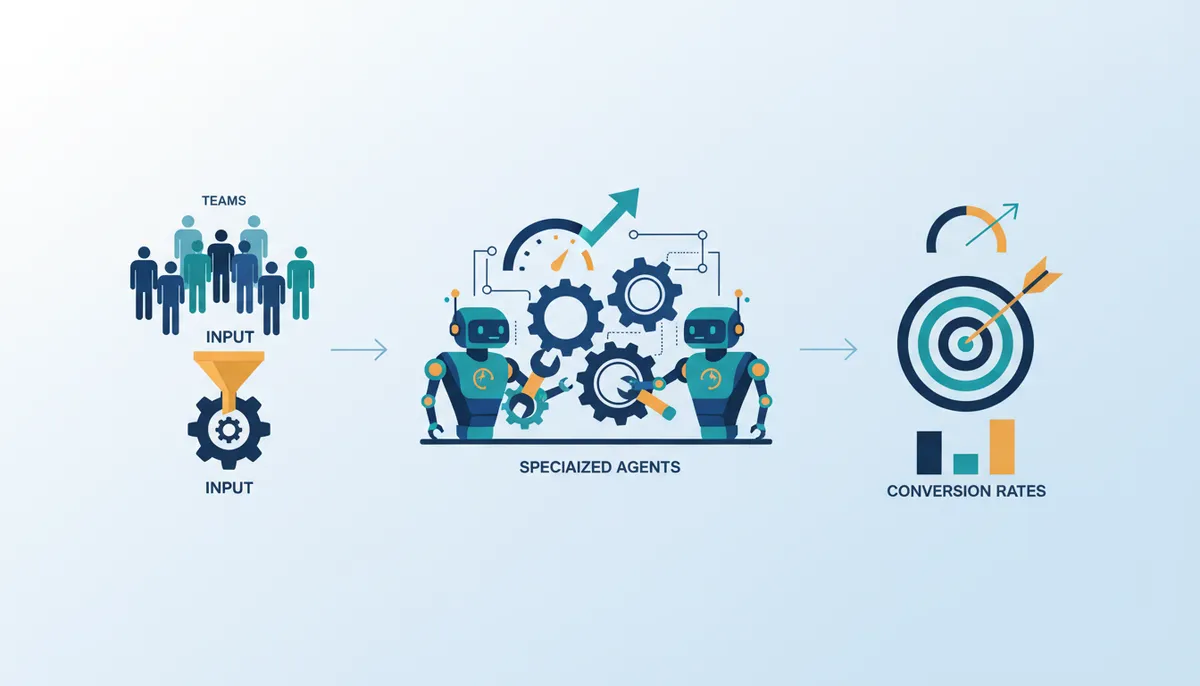
Generic models often lack the architectural constraints needed to maintain quality across complex workflows. Specialized content generation agents address this gap by breaking tasks into discrete units instead of attempting end-to-end generation in a single pass. A keyword research agent first identifies topical clusters. This data feeds directly into an outline agent responsible for structural logic. The framework then passes to a format-specific writing agent that applies distinct rules for listicles versus long-form technical guides. Such separation guarantees that Generative Engine Optimization principles govern every stage rather than serving as a final polish.
Autonomous systems analyze situations and execute multi-step workflows independently, unlike basic tools requiring step-by-step human direction [1]. This structural upgrade enables precise control over heading hierarchy and internal linking scaffolding before any body copy is drafted. While a generic model might hallucinate a logical flow, a coordinated system validates structure against performance data first. Increased orchestration complexity represents the primary drawback; operators must manage handoff protocols between agents to prevent context loss. Yet the payoff remains a reproducible system where content velocity scales without degrading semantic precision.
| Feature | Generic AI Tool | Specialized Agent Pipeline |
|---|---|---|
| Workflow | Single-pass generation | Multi-stage handoff |
| Optimization | Post-hoc editing | Integrated GEO rules |
| Consistency | Variable based on prompt | Enforced by agent role |
Enterium deploys this exact multi-agent architecture to guarantee that every asset meets strict editorial standards before publication. Mapping current content bottlenecks to specific agent roles constitutes the next logical step.
[1] mindstudio.ai
Compounding Visibility Advantages Through GEO-Optimized Agent Workflows
Brands investing in GEO-optimized, agent-generated content now will accumulate compounding advantages as AI models become the primary touchpoint for information discovery. Generic AI tools often fail to apply the architectural constraints necessary for consistent citation, leaving high-value assets invisible to retrieval systems. Enterium solves this by deploying specialized agents that enforce strict heading hierarchies and structured data patterns before publication. This approach directly addresses the issue of content not ranking despite AI generation, as models prioritize clearly delineated semantic structures over unstructured text blocks.
A coordinated pipeline handles outlining, drafting, and technical formatting independently through distinct agents. This separation ensures Generative Engine Optimization principles are baked into the source code of every article, unlike single-model workflows. Brands appearing consistently in AI-generated answers due to structured, scalable, and immediately indexed content will build durable visibility that generic writing cannot match. Managing handoffs between agents requires strong error handling to prevent logical drift, which serves as the main limitation.
| Workflow Stage | Generic AI Output | Enterium Agent Output |
|---|---|---|
| Structure | Flat, inconsistent headers | Enforced semantic hierarchy |
| Indexing | Delayed, manual submission | Automated via IndexNow protocols |
| Citation Rate | Variable, often omitted | High, due to clear entity definition |
AI search engines skip over ambiguous content entirely without these guardrails, a frequent observation among operators. The cost of ignoring this shift is measurable: brands lacking optimized signals risk total exclusion from the AI answers that now drive discovery. autonomous software systems can execute these multi-step workflows without constant human direction, scaling output while maintaining precision. Initial setup demands precise definition of success metrics for each agent role, representing a significant constraint.
Validating Your Stack: 13+ Agents, IndexNow, and Cross-Platform Visibility Tracking
Verify multi-agent adoption when generic tools fail to maintain structural constraints across complex workflows. A strong validation checklist confirms the system deploys 13+ specialized AI agents rather than a single monolithic model attempting end-to-end generation. This architectural shift ensures distinct handlers for keyword research, outlining, and format-specific writing operate without cross-contamination.
Automated IndexNow submission signals content updates instantly, bypassing traditional crawl delays. High-quality assets remain invisible during the critical indexing window without this trigger.
| Component | Generic Tool Limitation | Specialized Agent Requirement |
|---|---|---|
| Task Decomposition | Single pass execution | Discrete handoffs between units |
| Optimization Target | Keyword density | GEO optimization for retrieval |
| Visibility Scope | Traditional SERPs | AI platforms like ChatGPT and Claude |
Operators must track citation rates across AI platforms including Perplexity and Copilot, not organic rankings. Increased orchestration complexity presents a challenge; however, the cost of invisibility in retrieval-augmented generation contexts is higher. Enterium recommends validating that your pipeline enforces heading hierarchy rules before publication to satisfy retrieval parsers. Failure to audit for these specific capabilities indicates a system designed for draft creation, not production deployment.
Implementing a Multi-Agent Content Pipeline
Defining the Multi-Agent Content Pipeline Architecture
Autonomous software systems analyze situations and execute multi-step workflows without constant human direction. Unlike basic AI tools requiring step-by-step instructions, these agents enable the scaling of content creation, distribution, and analysis. Specific functions assigned to dedicated agents produce improved collective output than relying on a generalist model for all tasks. Effective implementations combine specialized writing agents, GEO logic, automated indexing, and AI visibility tracking into a single workflow.
- Evaluate platform capabilities for specific format constraints.
- Assign specialized writing agents to distinct content types.
- Embed GEO logic directly into the generation prompt chain.
- Automate indexing signals like sitemaps and internal linking.
- Track AI visibility separate from traditional search metrics.
This architecture supports automated indexing and consistent heading hierarchies across large campaigns. Increasing agent specialization allows for high precision in specific functions, though it requires clearly set handoffs. Generic models often struggle to maintain the logical flow required for complex content briefs when compared to specialized approaches.
Optimizing for both creative variance and technical SEO constraints simultaneously presents challenges. The separation of creation and optimization logic supports effective scaling. Content infrastructure requires distinct logical lanes to manage these differing objectives effectively.
Executing Automated Publishing Workflows with IndexNow and GEO Logic
Transitioning from keyword targets to indexed assets involves a workflow where agents handle distinct technical tasks.
- Agent Specialization: Assign self-governing software systems to generate frameworks based on top-performing content rather than generic drafts.
- GEO Logic Injection: Embed structured data and internal linking scaffolding that signal topic authority to generative models.
- Format Compliance: Enforce heading hierarchy constraints specific to the target platform before draft approval.
- IndexNow Trigger: Apply automation to signal publication to search engines, reducing reliance on standard crawl cycles.
- Visibility Tracking: Monitor citation frequency in AI-generated answers to validate durable visibility.
Brands appearing consistently in AI-generated answers due to structured and scalable content build durable visibility. The strategic value lies in having each agent perform one function with high precision; the collective output is qualitatively superior to generalist models attempting the full pipeline. A limitation exists: if the heading hierarchy fails validation, the workflow should halt before submission to prevent indexing low-quality structures. Automated gates can be configured to reject non-compliant drafts, ensuring only optimized content reaches the search index. This approach minimizes the lag between publication and discovery while enforcing GEO integration standards at the source. Operators gain immediate feedback loops where citation rates directly inform the next cycle of brief creation. The result is a self-correcting system where content velocity does not compromise technical precision.
Platform Validation Checklist: Agent Diversity and Format Specificity
Evaluating a platform requires verifying distinct agent roles rather than a single generalist model handling all tasks. Operators must confirm the system separates drafting from structural optimization to avoid generic output. To evaluate if a platform genuinely implements specialized multi-agent architectures, the source suggests asking specific questions about Agent Diversity and Format Specificity.
- Verify agent diversity by requesting role-specific configuration files for writing versus indexing.
- Test format specificity by demanding native support for listicle constraints without manual rewriting.
- Inspect the pipeline for embedded GEO logic that structures data for generative engines automatically.
- Confirm IndexNow submission triggers occur upon publication to reduce crawl latency.
- Reject systems requiring manual intervention for sitemap updates or heading hierarchy enforcement.
Failure occurs when platforms claim multi-agent architecture but route every task through one large language model. Red flags for platforms include using a single generalist model, lacking GEO logic, or requiring manual publishing steps. This bottleneck degrades content velocity and compromises the detailed formatting required for modern search visibility. The drawback is measurable: generic models often ignore strict heading constraints, forcing engineers to build post-hoc fixers.
Deployments configure these distinct workers so independent software systems execute complex sequences without constant human direction. Relying on a single model for both creative generation and technical compliance creates a conflict where one objective inevitably degrades the other. The constraint is clear: without dedicated agents for internal linking scaffolding, the system cannot scale effectively.
Platforms lacking this separation will fail to produce the structured, scalable content necessary for durable visibility in AI-generated answers.
About
Daniel Reyes, Head of Content Engineering at Enterium, architects the very production AI content pipelines discussed in this analysis. With over a decade in data and ML platform engineering, Reyes specializes in building end-to-end systems, from ingestion and retrieval to generation and quality gates, making him uniquely qualified to dissect specialized content generation agents. His daily work involves configuring RAG systems, managing vector stores, and designing evaluation harnesses that ensure reliable, scalable output rather than theoretical speculation. At Enterium, a B2B publication dedicated to documenting how modern teams operationalize LLMs, Reyes applies this engineering rigor to solve real-world challenges in Generative Engine Optimization (GEO) and multi-agent orchestration. Unlike generic AI commentary, his insights stem from deploying vendor-neutral architectures where humans remain on critical quality gates. This article reflects Enterium's core mission: providing practitioner-led methodologies for building reliable content automation pipelines that function effectively in production environments.
Conclusion
Scaling content operations reveals a critical breaking point where generic models falter under the dual burden of creative generation and strict technical compliance. When a single engine attempts both, output quality degrades as formatting constraints clash with narrative flow. This operational friction creates a hidden cost: engineers spend excessive cycles building post-hoc fixers for heading hierarchies and sitemap updates that should be automatic. The industry trajectory clearly favors autonomous agents that execute complex, multi-step workflows without constant human direction, leaving teams to focus on oversight rather than execution.
Organizations must transition to architectures that separate creative duties from technical enforcement immediately. Do not wait for crawl latency or indexing errors to impact visibility before restructuring your pipeline. A platform claiming multi-agent capabilities but routing everything through one generalist model will inevitably bottleneck your content velocity. You need distinct workers handling internal linking scaffolding and GEO logic natively, not as an afterthought.
Start this week by testing your current system's format specificity. Demand native support for listicle constraints without manual rewriting to verify if your tool truly uses specialized agents or just masks a single large language model. If the system requires you to manually enforce heading hierarchies or trigger submission protocols, it lacks the necessary separation of concerns. Only by confirming these distinct operational lanes can you ensure your infrastructure supports durable visibility in an era dominated by AI-generated answers.
Frequently Asked Questions
Generalist models often overlook structural constraints required for specific formats. This forces extensive post-generation editing to restore format integrity and ensure scannability.
The landscape now spans at least six distinct functional layers beyond simple text. Single-model workflows are obsolete because they cannot manage this required complexity effectively.
Specialized agents analyze situations and execute workflows independently without constant human input. This autonomy allows simultaneous management of complex distribution channels efficiently.
MindStudio identifies exactly 15 specific ways to utilize these agents across marketing. This granularity lets teams separate keyword clustering logic from narrative flow effectively.
Without synchronization, handoff latency between agents becomes a key limitation for teams. A unified plane ensures the planning layer coordinates state to maintain velocity.
References