State of AI 2026: Why Governance Lags Agents
Forty percent of professionals cite AI agents as their top trend, yet most organizations lack the governance to deploy them safely.
The 2026 State of AI for Business Report by SmarterX reveals a critical disconnect where enthusiasm for autonomous workflows clashes with severe resource constraints. This gap leaves enterprises vulnerable even as workers report feeling overwhelmed rather than confused by the technology.
Readers will examine the structural barriers preventing core integration, including the finding from SmarterX that 21% of respondents struggle primarily with the relentless pace of change. The discussion extends to the state of B2B adoption, where a lack of time to learn has become the primary blocker for advanced users. Finally, the article outlines frameworks for implementing safe experimentation policies that allow teams to use efficiency gains without compromising organizational stability or brand safety.
The State of B2B AI Adoption and Sentiment in 2026
Defining the AI Adoption Curve and Vibe Coding Gap
Individual practitioners are moving faster than enterprise governance can track. While 74% of professionals classify AI as necessary, organizational structures lag behind personal experimentation rates. This divergence creates a specific friction point: vibe coding. Here, non-technical staff generate functional logic through natural language prompts rather than syntax. Although 40% of respondents identify agents as their primary trend focus, only 13% of marketing leaders consider the technology core to operations.
Speed drives the individual; safety paralyzes the firm. Individuals pursue efficiency gains, with 28% citing productivity as their main driver, yet firms hesitate due to unresolved accuracy and reliability concerns. No-code AI platforms enable rapid prototyping, but this acceleration outpaces the deployment of necessary guardrails like ethics policies or AI councils. Professionals report lacking the bandwidth to learn new systems despite high motivation. Without dedicated hours for upskilling, vibe coding remains a shadow IT risk rather than a scalable asset. Enterprises must formalize these informal workflows to bridge the execution gap.
Real-World Scenarios of No-Code AI and Agent Deployment
Non-technical staff now construct functional logic via natural language, bypassing traditional syntax barriers. This shift allows individuals to reimagine workflows, yet organizational structures frequently lag behind personal experimentation rates. While 83% of companies prioritize AI in their strategy, only 20-30% of employees use it daily, indicating a massive execution gap. Fear of errors prevents full-scale deployment despite high strategic intent, creating an ownership gap.
Individual practitioners report building tools previously impossible without engineering support, driving a surge in localized productivity. However, this individual acceleration often outpaces governance, creating siloed solutions that lack enterprise validation. Without a roadmap or ethics policy, autonomous tools introduce compliance risks that halt broader scaling efforts.
| Dimension | Individual Operator | Organizational Strategy |
|---|---|---|
| Primary Driver | Efficiency and novelty | Risk mitigation and scale |
| Adoption Rate | High (daily usage) | Low (strategic integration) |
| Barrier | Time scarcity | Governance and safety |
Tool capability now exceeds operational readiness. The cost is not merely financial but structural, as uncoordinated agent deployment fragments data integrity. Enterium recommends pairing no-code experimentation with immediate policy formulation to bridge this divide. Only by aligning individual productivity gains with the guardrails can organizations convert isolated wins into compounding returns.
Brand Safety Blockers and Societal Anxiety in AI Integration
Brand safety fears prevent 60% of B2B marketing leaders from elevating AI from pilot to core operational status. This hesitation persists even as universal content creation usage confirms technical viability across the sector. The primary friction involves validating output quality at scale without manual review bottlenecks. Enterprises require deterministic evaluation layers to guarantee compliance before publication occurs.
Societal anxiety creates a parallel psychological barrier distinct from technical risk profiles. AI-forward knowledge workers share deep concerns about job displacement and societal impact with early adopters. This shared apprehension suggests that advanced technical proficiency does not inoculate professionals against ethical unease regarding automation.
| Concern Type | Primary Driver | Adoption Impact |
|---|---|---|
| Brand Safety | Quality control failure | Blocks core integration |
| Societal Anxiety | Job displacement fear | Slows strategic commitment |
| Governance Gaps | Missing ethics policies | Limits agent deployment |
Tools remain peripheral assistants rather than embedded infrastructure. Teams hesitate to deploy autonomous agents without explicit guardrails for brand voice and factual accuracy. This caution delays the realization of efficiency gains despite high strategic priority from leadership. Addressing these blockers requires more than improved models; it demands transparent governance frameworks that Enterium recommends implementing immediately. Organizations must establish clear quality gates to convert experimental usage into reliable production workflows. Only then can the execution gap between strategy and daily practice close effectively.
Structural Barriers Preventing Core AI Integration
Defining the Time Deficit and Pace of Change Barrier
Velocity, not technical illiteracy, drives the execution gap. Workers lack the bandwidth to absorb rapid tool evolution. These figures describe a single mechanical failure: operational throughput exceeds cognitive absorption rates. Unlike capital constraints, which affect only 25% of B2B marketers, the skills and expertise deficit creates a bottleneck approximately 2.4 times larger than budget limitations. This disparity forces teams into reactive cycles where they deploy tools without mastering underlying mechanics.
| Constraint Type | Prevalence | Impact on Ops |
|---|---|---|
| Skills Gap | High | Blocks integration |
| Budget Limits | Low | Delays scaling |
| Tool Complexity | Medium | Increases friction |
Organizations prioritize quick wins over sustainable architecture, compounding technical debt. The limitation is structural; adding more agents to an unprepared workflow accelerates chaos rather than resolution. A critical tension exists between the urge to automate immediately and the necessity of building core literacy first. Ignoring this flexible results in fragile systems that collapse under minor variance. For AI-forward organizations, a lack of time has become the top barrier to adoption across every function, becoming more pressing as the organization advances.
Operationalizing AI Agents Amidst Governance Gaps
Deploying autonomous agents safely is challenging when organizations lack the four structural pillars: a roadmap, an AI council, generative AI policies, and an ethics policy. A full third of organizations have none of these foundations. This ownership gap forces teams into a binary choice: halt innovation for compliance reviews or deploy unmonitored logic that risks brand integrity. Waiting for perfect policy locks organizations out of efficiency gains, yet rushing adoption without guardrails invites catastrophic hallucinations.
A practical approach involves pairing experimentation with a push for the basic policies that make autonomous tools safe to deploy. 1.
Capital allocation fails when organizations attempt to purchase solutions for a skills deficit that money cannot resolve. Research indicates that barrier priority focuses heavily on expertise gaps rather than financial limitations, creating a structural mismatch in remediation strategies. While budget concerns affect a minority of firms, the capability gap remains the dominant obstruction to scaling AI operations effectively.
| Constraint Factor | Prevalence | Strategic Implication |
|---|---|---|
| Skills & Expertise | High | Requires training investment |
| Budget Constraints | Low | Capital is available |
| Governance Foundations | Critical | Policies lag deployment |
Leadership often directs funds toward additional tools instead of workforce upskilling, exacerbating the disconnect between available technology and operational competency. This misalignment forces teams to rely on fragile, undocumented workflows built by isolated power users rather than standardized enterprise systems. Consequently, the organization accumulates technical debt in the form of unmaintainable automations that collapse under audit scrutiny.
Teams must prioritize establishing clear ownership models and ethical guidelines before expanding the autonomous agent footprint. Instead of simply seeking improved tools, managers should set aside time and space for teams to apply what they are already learning. Without this core stability, increased spending only accelerates the rate of operational failure and compliance risk exposure.
Implementing Safe AI Experimentation and Governance Policies
Defining the Four Basic AI Governance Foundations
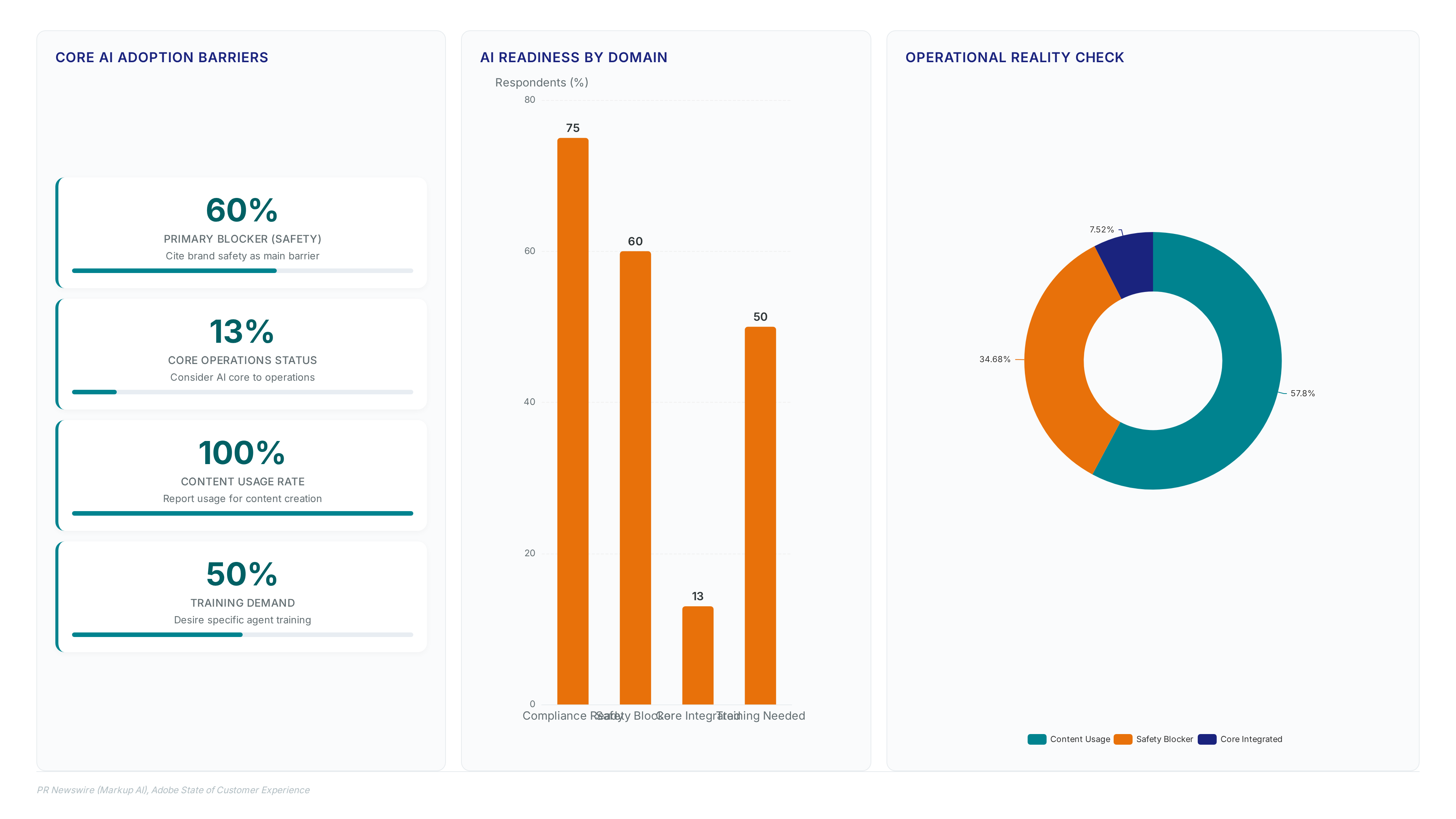
Safe AI experimentation requires four structural pillars: a roadmap, an AI council, generative AI policies, and an ethics policy. A significant portion of enterprises operate without these core controls in place. This absence creates a specific failure mode where teams deploy autonomous logic without set boundaries or accountability structures.
- Roadmap: Aligns AI initiatives with business outcomes rather than isolated technical experiments.
- AI Council: Provides cross-functional oversight to adjudicate use cases and resource allocation.
- Generative AI Policies: Establishes technical guardrails for data handling and output validation.
- Ethics Policy: Addresses societal impact and job displacement concerns shared by the workforce.
The challenge in learning and using AI agents safely is compounded by this governance gap. This gap blocks potential value creation when teams mistake tool availability for operational readiness, leading to brittle deployments that fail under audit.
The shift to Agentic AI demands higher fidelity controls than static chatbots. AI-forward teams should start experimenting with agents and no-code building while pushing for the basic policies that make autonomous tools safe to deploy.
Operationalizing Manager-Led Learning Time for Agent Experiments
Half of business professionals expressed a desire for training specifically on how to use AI agents, yet finding time remains a primary barrier. "Vibe coding," a term that barely existed a year ago, has emerged as a top trend response, signaling how fast the capability environment is shifting. This approach directly addresses the gap where individuals feel capable but lack the temporal space to practice.
- Set aside time and space for teams to apply what they are already learning.
- Define narrow scope constraints for each session to prevent aimless exploration.
3.
Unguided exploration risks replicating errors instead of building competence. While some argue that the training scales improved, self-directed blocks support the intuition needed for agentic solutions that simply reading documentation cannot provide. The trade-off is temporary output loss during the learning curve, which is necessary to close the execution gap. Without this dedicated time, organizations remain stuck in theoretical adoption cycles. Leaders should focus on creating space for honest conversation and experimentation to build confidence.
Checklist for Addressing Brand Safety and Quality Control Blockers
Many organizations lack this specific quality gate, forcing a choice between speed and safety that stalls operational scaling.
- Deploy content quality agents that score drafts against brand guidelines automatically.
- Establish ethics policies that define prohibited topics and tone constraints explicitly.
- Schedule manager-led review sessions to validate agent logic against societal concerns.
| Control Layer | Function | Deployment State |
|---|---|---|
| Automated Scoring | Detects tonal drift | Rarely implemented |
| Policy Guardrails | Blocks unsafe prompts | Partially deployed |
| Human Oversight | Validates nuance | Widely adopted |
Many firms feel prepared for compliance, yet most cannot scale without risking reputation. This false confidence creates a bottleneck where valid experiments die in review queues. Leaders must be open and empathetic to anxieties about what autonomous tools mean for colleagues and society. Ignoring these human factors while pushing technical guardrails increases resistance to adoption. This synchronization ensures that governance evolves alongside capability rather than lagging behind it. Teams should consult practical guidance from industry researchers to refine their validation protocols. Without this dual focus on technical controls and human context, brand safety remains a theoretical blocker rather than a solved engineering problem.
Strategic ROI from AI-Forward Teams Using Agents
Defining the AI-Forward Team Mindset Beyond Basic Usage
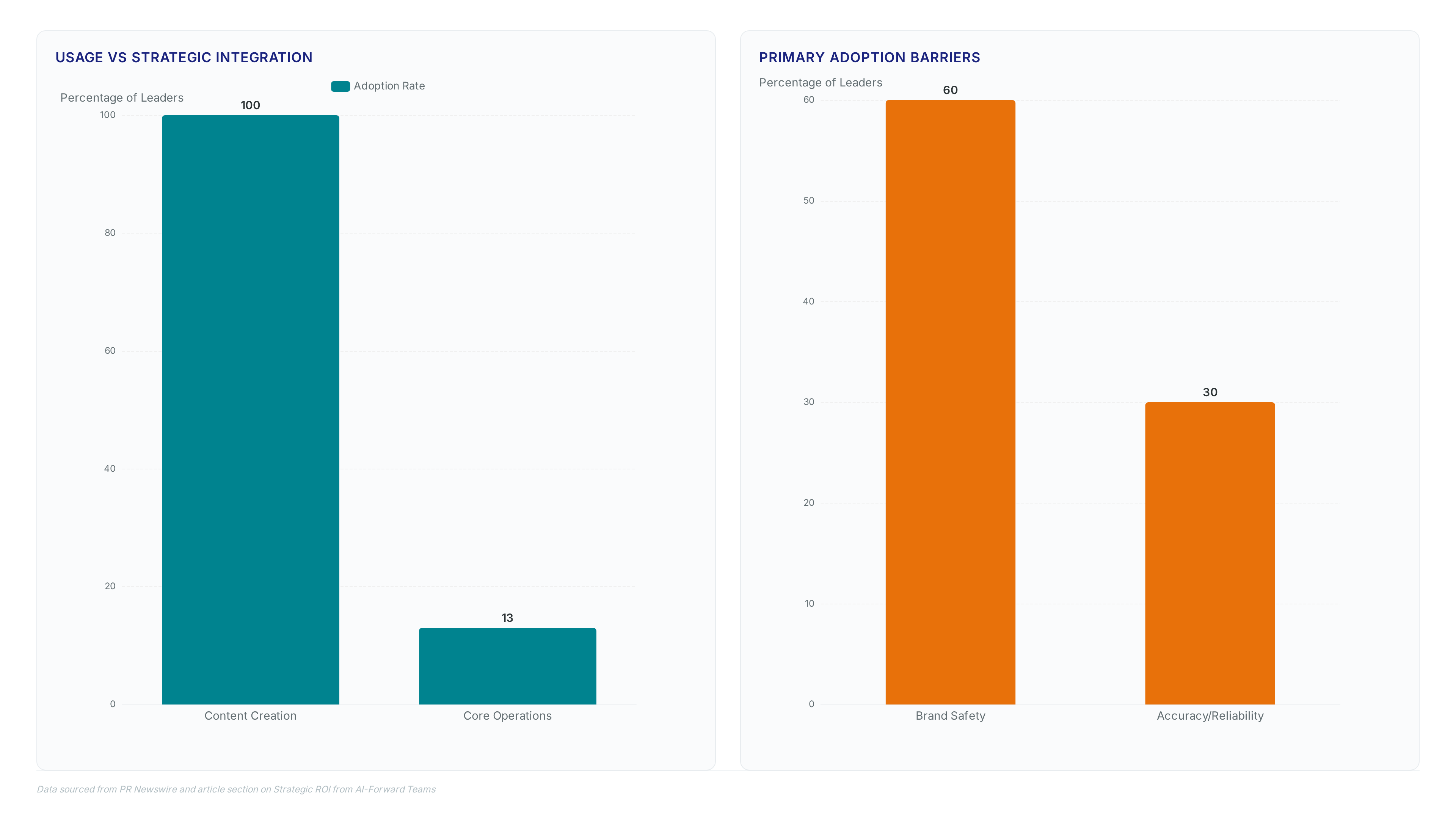
Casual usage stops at content generation, whereas an AI-forward team integrates autonomous agents into core workflows despite governance gaps. Many marketing leaders apply AI for creation, yet only a small fraction consider it an operational core because brand safety fears paralyze deployment. This distinction separates hobbyist prompting from structural transformation where professionals are increasingly building functional tools without traditional coding skills. Half of business professionals expressed a desire for training specifically on how to use AI agents. Friction arises when rapid experimentation clashes with necessary policy frameworks. Teams often lack the governance foundations required to scale, leading to a "shadow IT" environment where unvetted agents process sensitive data. Addressing this requires managers to allocate dedicated time for structured learning rather than demanding immediate productivity gains.
| Mindset Element | Casual User Approach | AI-Forward Team Strategy |
|---|---|---|
| Tool Interaction | Prompt-based queries | Agent orchestration |
| Risk Management | Reactive human review | Pre-deployment policy gates |
| Skill Development | Ad-hoc exploration | Scheduled experimentation blocks |
Establishing explicit ethical policies is critical before expanding agent autonomy to mitigate societal and reputational risks. Without these guardrails, the anxiety regarding job displacement and societal impact remains a latent drag on innovation velocity. Leaders must support empathy to navigate these concerns while pushing for technical competency. The operational cost of delay now exceeds the risk of controlled failure.
Application: Operationalizing Manager-Led Time for No-Code Agent Experiments
Data indicates that accuracy and reliability concerns act as a primary barrier to adoption, creating hesitation that only practical application can resolve. Teams should prioritize "vibe coding" trends, allowing staff to build no-code prototypes without immediate production pressure.
- Set aside dedicated time for teams to apply what they are already learning.
- Focus experimentation on agents and no-code building capabilities.
- Pair experimentation with a push for basic policies to make autonomous tools safe.
- Review outputs to identify where governance foundations like roadmaps or councils are missing.
Without this dedicated space, teams remain stuck in theoretical planning loops that never yield operational assets. Pairing these sessions with basic policy frameworks ensures safety during the build process. Leaders must be open and empathetic to concerns about what AI means for colleagues while providing the runway for mastery. This dual focus on time allocation and emotional intelligence drives the transition from casual usage to core integration.
| Session Element | Purpose | Outcome |
|---|---|---|
| Protected Time | Removes daily interruptions | Enables deep focus |
| No-Code Tools | Lowers technical barriers | Increases participation |
| Policy Guardrails | Ensures brand safety | Builds trust |
Operationalizing this practice requires shifting the metric of success from immediate ROI to competency growth.
Navigating Societal Anxiety and Job Impact Concerns in AI Deployment
Anxiety about societal impact persists among AI-forward workers despite high adoption rates. One respondent stated: "I believe society is fundamentally underestimating the impact of AI, is not building the mechanisms to deal with the change, and is fund." This sentiment creates a hidden friction point where technical capability outpaces cultural readiness. The cost of ignoring this tension is measurable: without empathetic leadership, teams struggle to move beyond manual processes due to unresolved fears. Addressing these fears requires more than policy documents; it demands open dialogue about what AI means for colleagues and the industry. Managers should explicitly create space for honest conversation regarding job impact concerns rather than focusing solely on productivity metrics. This approach transforms anxiety from a blocker into a governed variable. Without this human layer, even the most strong technical frameworks will struggle to achieve core operational status.
About
Daniel Reyes serves as Head of Content Engineering at Enterium, where he architects production-grade AI content pipelines from ingestion to publication. His decade of experience in data and ML platform engineering, specifically the last four years dedicated to building automated content systems, positions him to critically analyze the 2026 State of AI for Business Report. Unlike theoretical strategists, Reyes daily navigates the exact friction points identified in SmarterX's research: managing the overwhelming pace of change while enforcing strict quality gates. At Enterium, a brand focused on vendor-neutral content automation for B2B teams, he implements the very reliability measures and evaluation harnesses that practitioners cite as missing. This article translates raw sentiment data from over 2,100 professionals into actionable pipeline architecture, reflecting Reyes's commitment to reproducible, engineer-led solutions over hype. By connecting SmarterX's qualitative findings to real-world deployment challenges, he offers a grounded perspective on how modern teams can scale content operations without sacrificing accuracy or control.
Conclusion
Scaling AI agents reveals that technical readiness often masks a deeper cultural fragmentation. While strategy documents claim high priority, the disconnect between executive ambition and daily employee usage creates an operational ceiling that improved tools cannot fix. The real bottleneck is not code quality but the absence of psychological safety required for staff to transition from passive observers to active architects of automation. Without addressing the specific anxards around job displacement, organizations will continue to see pilot projects stagnate rather than scale into core infrastructure.
Leaders must explicitly decouple productivity metrics from the initial phases of agent deployment to allow competency growth to become the primary success indicator. I recommend establishing a mandatory governance sandbox within the next thirty days where teams can experiment with agents under strict policy guardrails but without performance pressure. This approach converts fear into a managed variable rather than a hidden drag on innovation. Start this week by scheduling protected time blocks specifically for non-production agent experimentation, ensuring these sessions include facilitated discussions on how roles will evolve rather than just how tasks will speed up. This deliberate pacing builds the trust necessary for agents to move from novelty to necessity.
Frequently Asked Questions
Brand safety fears prevent most leaders from full deployment. Specifically, 60% of B2B marketing leaders cite these quality control issues as their primary blocker to making AI central.
Workers lack the time required to learn new systems effectively. While 83% of companies prioritize AI strategy, only 20-30% of employees use it daily due to this execution gap.
Very few firms possess the required foundational policies for safe usage. Data shows only 13% of organizations have established all four essential governance components like an AI council.
AI agents are the dominant focus for industry professionals right now. Approximately 40% of respondents identify these autonomous tools as their primary trend to watch in 2026.
Most individuals seek tangible productivity improvements in their daily workflows. About 28% of professionals cite increased productivity as their main driver for pursuing these specific efficiency gains.