Optimize content for LLM citations with fresh data
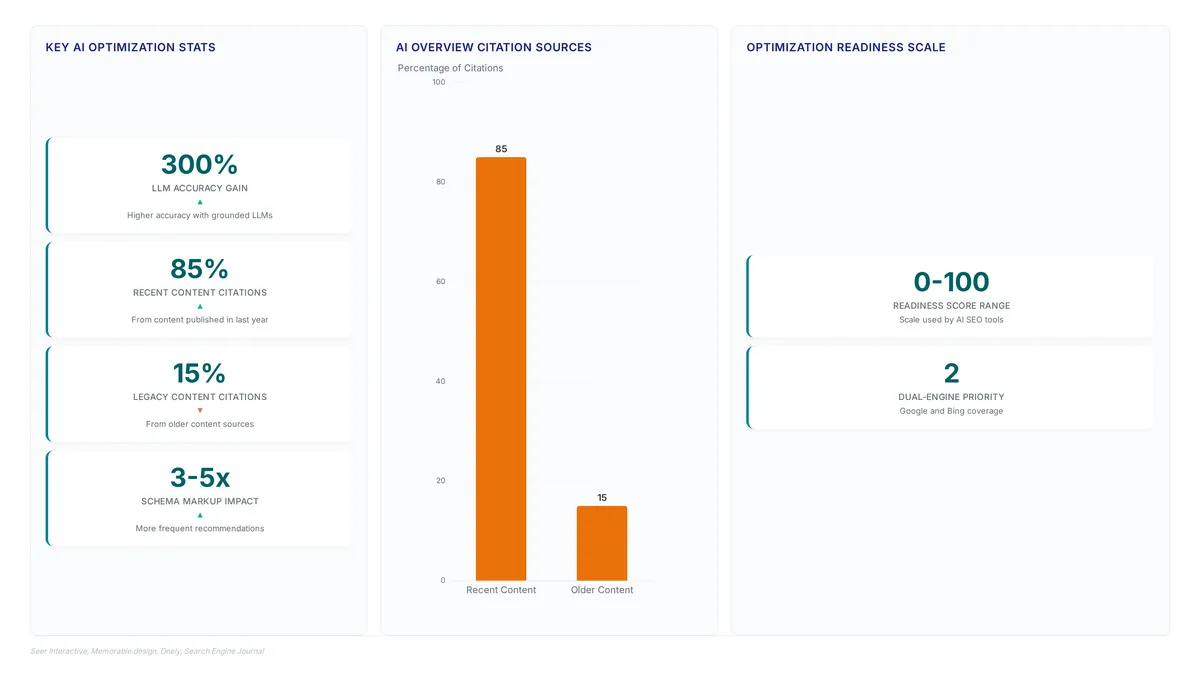
Fresh content drives visibility. Seer Interactive found 85% of AI Overview citations originate from material published in the last year. This data confirms that LLM citation rates depend heavily on recency rather than legacy domain authority alone. Surviving the shift to AI search optimization requires abandoning traditional SEO metrics in favor of semantic clarity and strict entity recognition.
Retrieval-augmented generation systems prioritize recent, structurally sound data over older, keyword-stuffed archives. A seven-step framework audits existing assets for AI readiness, ensuring your content cluster structure aligns with how models ingest information. We examine the mechanics behind topical authority in an era where internal linking serves as a primary signal for context rather than just PageRank distribution.
Theory gives way to application. You will learn to implement schema markup for AI and optimize FAQ sections to increase the probability of direct LLM citations. Ignoring these structural imperatives means your optimize content for LLMs efforts will fail as models increasingly ignore ambiguous or outdated sources. The window for passive visibility has closed. Only those who explicitly engineer for machine consumption have a path forward.
The Role of Retrieval-Augmented Generation in Modern AI Search Visibility
How LLM Citations Replace Blue Links in AI Search
LLM citations are definitive source attributions embedded within synthesized answers, replacing the traditional list of ten blue links with direct, verified references. Users no longer scroll; they ask. Large language models answer directly. This mechanism relies on Retrieval-Augmented Generation, where systems query external knowledge bases to ground responses in factual data rather than parametric memory alone.
Recency and semantic structure drive AI visibility. Research indicates that 85% of AI Overview citations come from content published in the last two years, signaling a heavy bias toward fresh, authoritative updates over static legacy pages.
Retrieval-Augmented Generation systems prioritize structured, semantically clear fragments over unstructured text blocks for citation. This alignment helps LLMs parse and retrieve definitive answers rather than inferring context from noise. Traditional keyword density no longer guarantees visibility in synthesized responses. The principles discussed draw from knowledge about how LLMs are trained and how retrieval-augmented generation (RAG) systems surface content, aligning with strong SEO fundamentals.
Here lies the friction: maximizing heading volume for machine readability often butchers narrative flow for human readers. Excessive fragmentation can degrade user experience even if it boosts machine scoring.
| Metric Category | Measurement Focus | Operational Goal |
|---|---|---|
| Structural Density | Heading volume | Increase parseable segments |
| Visual Ratio | Image-to-text balance | Enhance multimodal indexing |
| Semantic Clarity | Entity definition | Reduce hallucination risk |
Audit existing articles. Verify that H2 and H3 tags apply question-answer formats or clear statements. Content lacking clear hierarchies and structured data often struggles to be understood and cited by AI systems. Rigid structuring may oversimplify complex topics, potentially reducing the nuance required for high-level strategic analysis. Brands must balance strict formatting with sufficient depth to remain useful once cited.
Validating AI Readiness Scores and Freshness Signals
AI readiness assessments evaluate draft suitability for retrieval by measuring structural clarity for machine parsing. These models respond by citing sources they trust, making content structure critical for visibility. Topical authority now dictates inclusion in synthesized answers more than historical keyword density.
| Signal Type | Verification Method | Impact on Citation |
|---|---|---|
| Freshness | Content published within last 2 years | Strong correlation with inclusion |
| Schema | Thorough markup presence | Increased citation frequency |
| Clarity | Answer-first formatting | Improved extraction potential |
Optimization tools measure specific quantitative metrics including word counts, heading volume, and image ratios against top-ranking pages to ensure content meets density requirements for AI processing. Products with thorough schema markup appear in AI recommendations more frequently than those without.
Aggressive freshness updates often clash with deep semantic clarity. Rushing publication degrades the entity density required for high-confidence retrieval. The definition of topical authority shifts from backlink volume to verifiable data grounding. LLMs grounded in knowledge graphs achieve higher accuracy compared to unstructured data alone. However, relying solely on recency without structured data yields diminishing returns as systems filter for verifiable claims. Content creators must validate that freshness signals align with rigorous schema implementation to secure visibility.
Audit drafts against these criteria before publication. Treat readiness factors as a core dependency for pipeline progression, rather than a post-publish metric, to ensure content is positioned for synthesis.
How Semantic Clarity and Entity Recognition Drive LLM Citation Rates
How LLMs Build Knowledge Graphs from Entities
LLMs identify discrete facts and assess source credibility to assemble synthesized responses. These systems do not rank pages in isolation; instead, they prioritize structure, semantic clarity, and contextual completeness to determine which fragments of information are credible enough to be included in a generated answer. If content lacks clarity or consistent entity definitions, it risks being overlooked during the synthesis process. This fragmentation can dilute citation probability because the system struggles to aggregate authority signals across disconnected identifiers.
To structure articles for AI citations, authors should use clear hierarchies and answer-first formatting. Defining terms explicitly and maintaining terminology consistency helps AI tools understand content improved and map relational attributes accurately.
| Factor | Impact on Graph Construction |
|---|---|
| Entity Consistency | Helps merge concepts into a single high-authority cluster |
| Synonym Mapping | Prevents fragmentation of citation signals |
| Semantic Depth | Signals genuine expertise over keyword repetition |
Pages that repeat the same phrase without expanding the semantic environment signal optimization rather than authority, causing the model to deprioritize the content during retrieval. A definitive answer requires the text to cover the full scope of connected entities so the system can verify the claim against a dense local network of facts. FAQ sections perform double duty here by matching the specific question-answer format models extract for direct responses. Without structured, answer-first content and clear entity strength, visibility in AI-generated answers remains limited regardless of total word count. Auditing content for entity disambiguation is a critical step before attempting to expand topic coverage.
Structuring Content Clusters with Bidirectional Linking
A content cluster organizes one thorough pillar page around broad topics supported by specific satellite articles. This architecture mirrors how retrieval systems map topical authority through graph traversal rather than linear indexing. Implementing this requires strict bidirectional linking where supporting articles link back to the pillar, and the pillar distributes authority to satellites via descriptive anchor text. Internal linking is necessary for building topical authority and ensuring AI systems recognize the relationship between related pieces of content.
| Component | Function | Link Direction |
|---|---|---|
| Pillar Page | Covers broad topic comprehensively | Out to satellites |
| Satellite Articles | Address specific subtopics | In to pillar |
| Anchor Text | Defines semantic relationship | Bidirectional |
Operators must execute this in four steps:
- Define the core entity hierarchy for the primary topic.
- Draft the pillar page to encompass the full scope without duplicating satellite depth.
- Publish satellite articles that resolve specific queries while explicitly linking to the pillar.
- Update the pillar page to include contextual links to each new satellite piece.
Anchor text consistency determines success. Varying terminology across the cluster creates fragmented nodes that dilute citation probability. Unlike traditional keyword silos, this structure prioritizes semantic completeness for synthesis engines over simple crawl depth. A guide to building content clusters must account for the fact that missing return links prevent the aggregation of authority signals, leaving the pillar page unable to demonstrate full coverage to the model. Brands optimizing for this topology see citation rates increase as the system recognizes the complete entity map rather than isolated fragments. Auditing existing internal links to verify that every satellite piece explicitly references its parent pillar helps close the graph loop.
Technical Checklist for AI Crawler Discoverability
Content must be discoverable to be cited by generative systems. Operators begin by verifying robots.txt rules do not inadvertently block known AI user-agents while maintaining standard security postures. Submitting an updated XML sitemap ensures crawlers index the latest canonical URLs without relying on stochastic discovery paths. Integration with push protocols like IndexNow signals immediate content changes, reducing the latency between publication and potential inclusion in model training sets or retrieval indexes.
Structuring articles for AI citations requires explicit schema markup to define entity relationships clearly. Implementing Article and FAQPage schemas helps models extract definitive answers rather than inferring context from unstructured text. Technical issues kill visibility regardless of content quality if the rendering path fails Core Web Vitals thresholds.
| Check | Target State | Impact |
|---|---|---|
| Crawler Access | Allowed | Enables indexing |
| Schema Markup | Present | Defines entities |
| Load Performance | Pass CWV | Reduces timeout risk |
A frequent oversight involves assuming that human-readable HTML guarantees machine extractability; complex DOM structures can obscure the semantic clarity required for accurate tokenization. Unblocking AI crawlers is necessary but insufficient without clean structural data. Teams should audit their internal linking to ensure bidirectional flow between pillar pages and satellite articles, reinforcing topical authority graphs. Without this architecture, even high-quality text remains an isolated node with low retrieval probability.
Validate these configurations before scaling production output. Ensuring that flexible content renders correctly and within timeout limits of substantial indexing bots is a critical final step for maintaining AI visibility.
Executing a Seven-Step Framework to Audit and Optimize Content for AI Readiness
Defining the Three Content Buckets for LLM Audits
Categorize every page based on its current LLM readiness and structural integrity. This triage isolates assets requiring protection from those demanding structural overhaul before an audit completion.
- Optimization Candidates: Content here answers queries but lacks semantic clarity. Fix broken entity relationships and add definitive answers to secure visibility.
- Structural Overhaul Required: These assets fail entity recognition tests. Rewrite them to establish topical authority using clear hierarchies and question-answer formats.
Optimizing for semantic signals often conflicts with legacy keyword density strategies. While AI systems prioritize trusted sources, forcing unstructured text into rigid schemas without factual basis reduces credibility. The cost of neglecting this segmentation is invisible decay; content may rank in traditional engines while disappearing from AI-driven search results. Most teams ignore Bing Webmaster Tools, yet pages ranking in both Google and Bing achieve the broadest AI search visibility. Ignoring this dual-engine reality leaves citation-ready assets vulnerable to omission. Without distinct categories, audits produce generic advice rather than actionable engineering tickets.
Applying Definition-First Formatting and FAQ Blocks
LLMs favor content that directly and concisely answers specific questions using a definition-first format.
- Structure definitive answers: Write the opening sentence as a standalone fact, avoiding introductory fluff that delays the core assertion. This approach aligns with how retrieval systems extract semantic clarity from text blocks.
- Implement FAQ blocks: Append a dedicated question-and-answer section at the article terminus to create highly extractable formats.
- Enforce scannable density: Use concise paragraphs, lists, and clear hierarchies to maximize extraction probability.
Definition-first formatting trades narrative hook for machine extractability. While this structure boosts citation rates, it may reduce human dwell time if the surrounding context does not engage. Pages with thorough schema markup appear in recommendations 3-5x more frequently than those without.
Balancing conversational flow with rigid structural requirements is difficult. A page optimized strictly for extraction might feel stilted to human readers if the transition between the definitive answer and supporting analysis is abrupt. However, the 300% higher accuracy achieved by LLMs grounded in knowledge graphs justifies the structural rigidity. Teams should prioritize clarity over stylistic variance when targeting automated summarization systems.
| Feature | Impact on Extraction | Implementation Cost |
|---|---|---|
| Definition-First | High | Low |
| FAQ Schema | Very High | Medium |
| Narrative Lead | Low | None |
Focus on verifiable statements rather than speculative language to ensure the content serves as a reliable source node.
Implementation: Checklist for Trust Signals and Crawler Discoverability
Technical steps include reviewing robots.txt files to ensure AI crawlers are not blocked and submitting updated sitemaps promptly. Blocking user-agents intended for generative AI prevents retrieval systems from ingesting rendering even high-quality text invisible to citation engines.
- Review robots.txt directives for specific AI bot restrictions.
- Submit updated sitemaps to prompt immediate re-crawling of modified pages.
- Check IndexNow integration status for real-time update notification.
Submit an updated sitemap promptly after structural changes to ensure search engines detect modifications. Without this trigger, crawlers may rely on stale cache versions, delaying the reflection of corrected facts or new authority signals.
| Signal Type | Technical Requirement | Authority Impact |
|---|---|---|
| Crawler Access | Unblocked robots.txt | High |
| Freshness | Updated timestamps | Medium |
| Context | Clear sourcing and accuracy | High |
Include clear sourcing and factual accuracy on every article to satisfy trust requirements. LLMs weigh verifiable human expertise heavily when resolving conflicting information across multiple sources. Use Schema.org markups like HowTo schema for guides and FAQPage schema for Q&A sections. This markup transforms unstructured prose into machine-readable entities that retrieval systems prioritize for definitive answers.
Open access increases visibility but consumes bandwidth. Operators must balance granular allow-lists against the risk of total invisibility in emerging search interfaces. For a structured approach to these technical and authority markers, consult the AI Search Visibility Audit framework.
Measuring ROI and Iterating Strategy Based on AI Citation Performance
Defining the AI Visibility Score and Citation Cadence
An AI Visibility Score quantifies brand mention frequency and sentiment within generative answer engines. Teams should establish a regular cadence for tracking, suggested as weekly or biweekly, to detect shifts in retrieval probability before traffic impacts occur. An AI visibility platform like Sight AI can monitor this metric, capture brand mentions, and analyze sentiment across substantial models. Without structured measurement, operators cannot distinguish between a temporary model fluctuation and a systemic ranking decline. High citation volume with negative sentiment accelerates reputation damage. If you notice others including competitors getting mentioned more often, adjust your strategy to stay ahead via Adobe LLM Optimizer. Ignoring citation cadence allows competitors to cement topical authority while your content remains statically archived. The cost of irregular auditing is the loss of verifiable context during model updates.
| Metric | Function | Frequency |
|---|---|---|
| Visibility Score | Tracks mention volume | Weekly |
| Sentiment Analysis | Measures tone polarity | Biweekly |
| Prompt Tests | Validates retrieval logic | Weekly |
Operators must fix low AI visibility by aligning content updates with these measurement windows.
Applying Freshness Updates to Fix Low Citation Rates
Revisiting highest-priority pages every three to six months directly addresses low AI visibility by signaling active maintenance to retrieval systems. Operators must treat content freshness as a scheduled engineering task rather than an editorial afterthought to improve content citation rate. The mechanism involves updating factual claims, verifying linked resources, and refreshing the modified date metadata.
| Check Type | Action | Frequency |
|---|---|---|
| Timestamp | Update publish date | Quarterly |
| Data Verification | Validate stats/links | Quarterly |
| Schema | Refresh dateModified |
On edit |
Aggressive updating without substantive change can trigger quality filters that suppress visibility. Measurable engineering time gets diverted from new content creation. If the retrieval probability remains flat after two cycles, the content likely suffers from structural semantic issues rather than age. Teams should prioritize pages with high historical traffic but declining generative engine mentions. Ignoring this cadence risks permanent exclusion from model context windows as newer, verified sources accumulate preference.
Comparing Pre-Optimization and Post-Optimization Citation Frequency
Establish a citation baseline by capturing query-level retrieval counts across target answer engines before modifying content structure. This initial measurement isolates the impact of subsequent semantic adjustments from organic model drift. LLMs weight recent publication dates heavily. Pre-optimization baselines for stale content may reflect age penalties rather than quality deficits. Post-optimization analysis requires tracking the same query set to measure changes in citation frequency and answer inclusion. Use Adobe LLM Optimizer to observe visibility shifts over time rather than relying on single-point snapshots. A successful intervention shows increased mention rates alongside improved sentiment scores in generated responses.
| Metric | Pre-Optimization State | Post-Optimization Target |
|---|---|---|
| Retrieval Count | Low or zero for target queries | Consistent inclusion in top 3 answers |
| Competitor Gap | Competitors dominate specific entities | Parity or lead in entity coverage |
| Trust Signals | Missing schema or outdated claims | Verified facts with recent timestamps |
Monitoring competitor citations reveals structural gaps where rivals secure topical authority through deeper entity coverage. If competitors appear frequently while your content remains absent, the deficiency likely lies in semantic clarity or missing trust signals rather than keyword absence. Enterium recommends running systematic prompt tests weekly to validate these changes. Aggressive optimization for specific entities can sometimes reduce broader contextual relevance if not balanced with general informational depth.
About
Hannah Brooks, Marketing Operations Lead at Enterium, specializes in the architecture of reliable AI content pipelines. Her daily work involves rigorously evaluating tooling stacks and defining governance gates to ensure automated output meets strict quality standards. This operational focus makes her uniquely qualified to analyze AI search optimization, a discipline that demands precise content structuring rather than creative speculation. At Enterium, a B2B publication dedicated to vendor-neutral methodologies for scaling content with LLMs, Hannah translates complex visibility challenges into reproducible workflows. She connects the mechanics of LLM citations and schema markup directly to the engineering of content clusters that drive measurable ROI. By treating AI visibility as a systems problem, she provides practitioners with concrete steps to audit and optimize assets for citation readiness. Her analysis bridges the gap between theoretical AI potential and the practical reality of shipping content that performs in modern search environments.
Conclusion
Scaling semantic optimization reveals a harsh reality: high accuracy means nothing if the underlying content lacks the freshness required for model ingestion. While LLMs grounded in recent data achieve significantly improved results, the operational burden shifts from mere creation to rigorous, continuous lifecycle management. Content that fails to update its semantic structure and publication timestamps faces exclusion, not because it is wrong, but because it appears obsolete to the ranking algorithms. You must treat your existing library as a flexible asset that requires constant verification rather than a static archive.
Prioritize a structural overhaul of your top-performing legacy pieces before attempting to publish new material. If your content does not explicitly signal recency and entity clarity through updated schema and revised text, it will lose ground to competitors who maintain tighter citation frequency. Do not wait for traffic metrics to collapse before acting, as generative visibility often disappears silently before traditional analytics reflect the loss. Start by auditing your five most critical topic clusters this week to identify pieces older than twenty-four months that lack current trust signals. Refresh these specific assets with verified facts and clear entity definitions to immediately test their renewed inclusion in answer engines. This targeted approach ensures you secure topical authority based on verifiable quality rather than hoping for algorithmic favor.
Frequently Asked Questions
Recent publication dates are vital because 85% of citations come from new content. You must update archives immediately to avoid being excluded from the primary answer layer entirely.
Clear entity definitions reduce the risk of model hallucination significantly. Structured fragments allow systems to retrieve definitive answers rather than inferring context from unstructured noise blocks.
Traditional keyword density no longer guarantees visibility in synthesized responses. Systems now prioritize semantic clarity and structured data over simple term matching for accurate extraction.
Overly fragmented content satisfies machine parsers but often fails human readers. Excessive headings can degrade user experience even if the approach boosts machine scoring metrics.
Ignoring structural imperatives leads to measurable exclusion from the answer layer. Your optimization efforts will fail as models increasingly ignore ambiguous or outdated sources completely.
References