Digital asset management stops AI brand drift
With 93% of enterprises facing content challenges that rules-based automation cannot solve, digital asset management has become the necessary backbone for AI governance.
Legacy automation fails because AI systems struggle to adhere to rigid rules. We need hybrid workflows where humans retain final approval authority. Bynder's "State of DAM Report 2026" confirms the industry pivot: we are no longer celebrating raw creation speed. The focus has shifted to managing hallucinated outputs and brand inconsistency. Marketers now grapple with generative models that imagine requirements rather than following instructions.
Security concerns now top marketer priorities, surpassing legal compliance and workflow scaling. Modern governance frameworks integrate human judgment to validate assets before publication. Roughly 40% to 44% of automated tasks still undergo strict human review. We must examine the operational mechanics required to detect off-brand assets and manage complex metadata without creating new bottlenecks. DAM platforms now provide the necessary context for safe AI deployment.
The Critical Role of DAM in Modern AI Governance Frameworks
Why Static Storage Fails as the Single Source of Truth for AI
Simple file folders lack the semantic context generative models need to separate approved brand assets from outdated drafts. A Digital Asset Management (DAM) system acts as a governance engine. It supplies the organized content, consistent metadata, and explicit brand guidelines artificial intelligence requires for reliable function. Rigid automation struggles without this structured environment to address the variability of modern content demands.
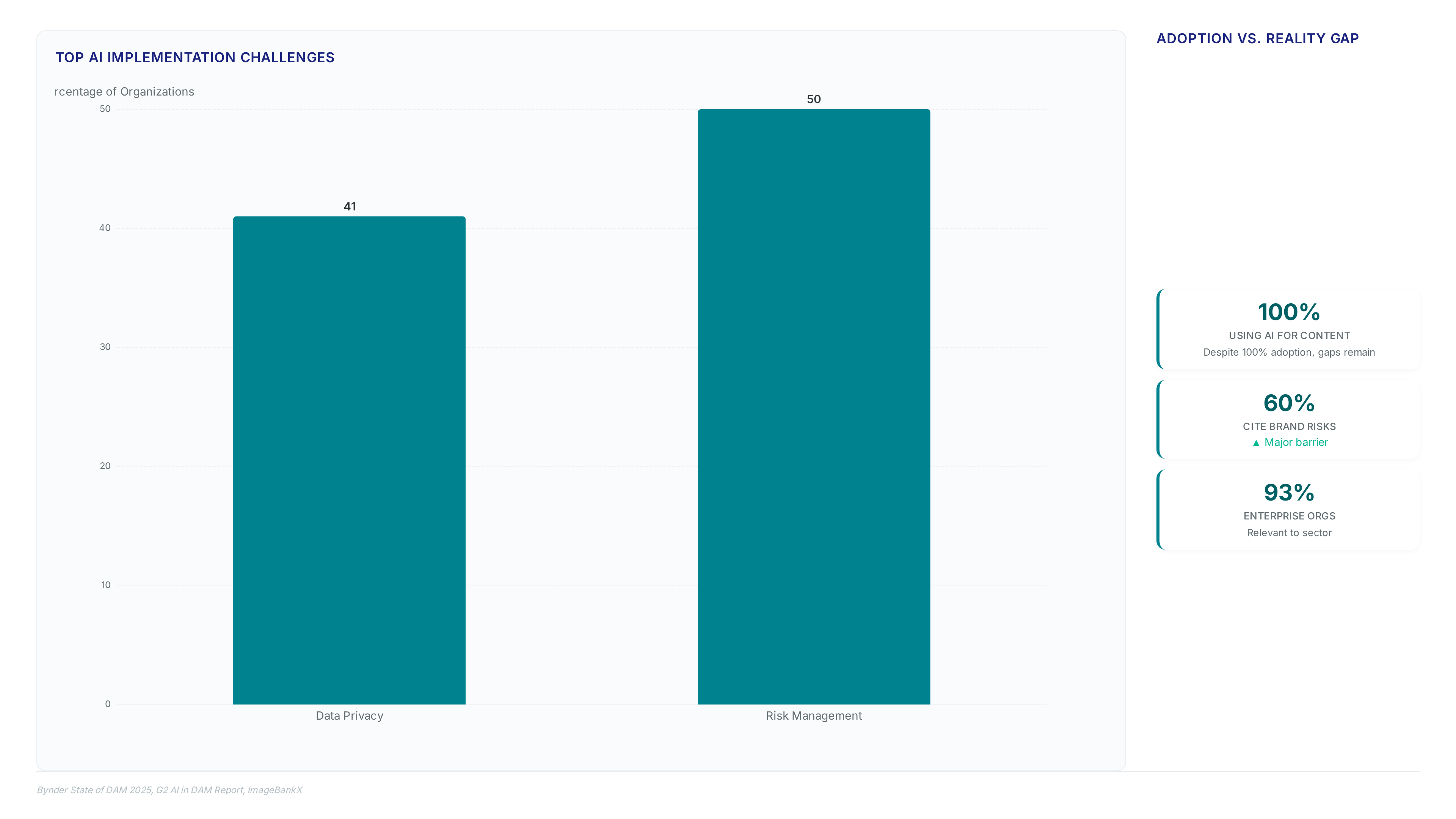
Data indicates that 93% of enterprises face content challenges that rigid automation cannot solve. Simple storage provides no mechanism for enforcing brand governance during generation. This limitation becomes severe when organizations attempt to scale.
Embedding Governance into Everyday Campaign Execution Workflows
Operational safety requires shifting AI governance from a final gate to an integrated component of daily campaign workflow. Security now dominates marketer concerns, superseding speed as the primary constraint on generative adoption. This urgency stems from the reality that 60% of marketing leaders cite brand safety and quality control as their main blocker to making AI core to operations.
Governance cannot remain a post-production audit when models generate variants at scale. It is becoming part of everyday campaign execution. The Digital Asset Stewardship platform evolves into this active enforcement layer. It serves as the place where AI accesses the rules, permissions, and context needed to support content creation. Unlike static storage, these systems provide the consistent metadata and clear guidelines sophisticated models require to function reliably. Without this structured context, even sophisticated AI has trouble making reliable decisions, leading to compliance failures.
| Traditional Automation | Agentic Governance |
|---|---|
| Rules-based execution | Context-aware decisioning |
| Fails on unanticipated inputs | Adapts via metadata signals |
| Human review at end | Human judgment at decision points |
Relying solely on human review after generation creates bottlenecks that negate speed advantages. The most common workflow combines AI with human approval, ensuring every output adheres to policy. Roughly 40% to 44% of respondents said automation performs the work while people make the final decision. This architectural shift means humans define the boundaries of acceptable risk while automation handles repetitive variation. The result is a system where governance scales linearly with content volume rather than collapsing under it.
Top Security and Compliance Blockers in AI-Driven Content Operations
Data privacy failures represent the primary obstacle for 41% of businesses deploying AI within digital repositories. Security has emerged as the top concern for marketers using AI in content operations, surpassing speed or volume metrics. Legal liability compounds these technical risks when models generate hallucinated outputs that violate copyright or regulatory standards. Without strict guardrails, organizations face "hefty license renewals" for legacy platforms that cannot enforce modern compliance policies dynamically.
The operational tension lies between rapid generation and verified accuracy. While 50% of organizations list risk management as a critical governance concern, many struggle to implement validation layers that do not stall production.
| Risk Factor | Operational Consequence |
|---|---|
| Data Privacy | Unauthorized model training on proprietary assets |
| Hallucination | Brand damage via factually incorrect public statements |
| Compliance Gaps | Regulatory fines from unvetted content distribution |
Scaling generative tools without creating workflow bottlenecks requires shifting governance from a final review step to an integrated component of daily execution. Most marketing organizations attempt to balance quicker content production with privacy requirements, yet few possess the metadata infrastructure to automate this safely. The Digital Asset Supervision system must evolve into an active enforcement layer rather than passive storage. Without this architectural shift, automation increases liability instead of reducing it. Organizations should audit current approval workflows to identify where human judgment remains non-negotiable before deploying autonomous agents.
Operational Mechanics of Hybrid Human-AI Content Workflows
Defining the Hybrid Human-AI Content Workflow Architecture
Algorithms now execute repetitive generation tasks while human operators retain judgment, governance, and accountability. This distribution marks a strategic pivot where AI agents manage complex, multi-step duties that rigid scripts cannot address. Separating execution from approval ensures machine speed does not compromise brand integrity.
| Component | Primary Function | Operator |
|---|---|---|
| Generative Engine | Drafts variants, tags assets, transcribes media | AI Agent |
| Governance Layer | Enforces permissions, validates metadata, checks compliance | Platform Policy |
| Decision Node | Approves final assets, resolves edge cases, sets strategy | Human Expert |
Unanticipated elements appear when AI operates without constraints. Rule-based automation functions well in anticipated scenarios but struggles when systems add unexpected components. Roughly 31% to 35% of organizations rely on mixed workflows that combine automation and manual review throughout the process to manage this variability. Sophisticated AI has trouble making reliable decisions without access to well-organized content and consistent metadata.
The Digital Asset Oversight system evolves from a passive repository into an active orchestration layer. Context meets control within this single source of truth. Governance becomes part of everyday campaign execution rather than a final review step. Marketers focus on judgment while AI handles repetitive work.
Operationalizing Metadata and Rules to Prevent AI Hallucinations
Clear brand guidelines and set approval processes prevent inaccurate or hallucinated outputs. AI tends to add elements based on what it imagines users want. Organizations move beyond simple rule-based constraints to address this behavior. Primary issues include detecting off-brand assets and governing AI-generated content rather than publishing speed.
Detecting off-brand assets remains a primary failure mode for pure automation workflows. Modern agents apply object recognition to flag visual inconsistencies before publication unlike simple rule-based systems. This shift addresses the inability of traditional workflows to reuse approved assets which drives up production costs. Operational demands must balance with copyright compliance brand governance and privacy requirements.
| Workflow Type | Detection Method | Limitation |
|---|---|---|
| Rule-Based | Exact string match | Fails on semantic nuance |
| Agentic AI | Contextual analysis | Requires high-quality training data |
Duplicate content creation inflates costs when organizations ignore these limits. Teams using agentic capabilities fulfill complex requests that break standard logic chains. Scaling AI without creating new workflow bottlenecks remains a key concern for marketing leaders. The operational takeaway treats the DAM platform as the foundation for AI governance. AI accesses the rules permissions and context needed to support content creation within this framework.
Risks of Scaling AI Without Integrated Brand Governance Checks
Expanding generative output without embedded governance creates immediate liability for inaccurate or hallucinated marketing materials. Models frequently invent elements that violate established brand guidelines because AI doesn't do well following rules. This behavior forces organizations to confront legal compliance gaps that rule-based scripts cannot anticipate or block. Security has emerged as the top concern for marketers using AI in content operations followed by legal and regulatory compliance.
Duplicate content and the inability to reuse approved assets effectively inflate production costs. Operational measurement often fails to capture these hidden inefficiencies until budget overruns occur. A majority of brands identify content quality control as a top area of concern regarding governance in the age of AI.
Marketing teams balance speed with strict copyright compliance and privacy requirements daily. Delegating repetitive work to algorithms while retaining human judgment for final accountability creates necessary tension. Scaling efforts merely accelerate the creation of unusable inventory without this hybrid approach. Industry focus shifts entirely to whether underlying infrastructure can support agentic AI while maintaining brand safety. This shift prevents bad data from entering the digital repository in the first instance.
Strategic Implementation of DAM for Secure AI Asset Management
Defining DAM as the Core Layer for AI Governance Rules
Digital Asset Governance platforms now function as the primary enforcement boundary where governance rules constrain generative output before publication. Without this structured context, even sophisticated AI struggles to make reliable decisions, often hallucinating brand elements or violating copyright protocols. Organizations treating DAM as mere storage miss the shift toward agentic governance, where systems actively validate permissions rather than passively holding files.
- Map approval workflows to specific asset types, ensuring high-risk categories trigger mandatory human review cycles.
- Embed brand guidelines directly into metadata schemas so models access visual constraints during the generation phase.
- Establish hybrid approval chains requiring mapping specific asset risks to mandatory human review gates within the DAM platform.
This architecture prevents hallucinated outputs from reaching public channels without oversight.
- Define risk tiers for asset categories, flagging high-visibility content for compulsory manual validation.
- Integrate structured content standards as the core power source for AI workflows to ensure reliable decision-making roboticsandautomationnews.com.
- Deploy approval workflows that pause generation upon detecting low-confidence metadata or off-brand elements.
The limitation of this approach is latency; adding human gates slows throughput compared to fully autonomous pipelines. However, this friction is the necessary cost of maintaining brand consistency when models inevitably drift from guidelines.
Operators face a tension between scaling volume and preserving trust. Without this human oversight, organizations risk publishing non-compliant materials that damage reputation. Teams deploying these systems should apply Enterium to orchestrate complex approval logic that balances speed with safety. The immediate next step is auditing current metadata schemas to ensure they support the granular permissions required for these hybrid workflows.
Checklist for Embedding Brand Guidelines and Preventing Hallucinations
Static rule sets fail to catch semantic drift when generative models invent brand elements. Operators must configure validation gates that cross-reference generated output against approved visual lexicons before distribution. Without these hard constraints, AI systems frequently hallucinate logos or misapply color palettes, creating immediate legal compliance exposure.
- Ingest brand guidelines as machine-readable metadata schemas rather than static PDF documents.
- Map approval workflows to asset risk tiers, forcing human review for high-visibility campaign materials.
- Deploy content quality agents to scan for off-brand semantics before assets enter the publication queue.
The limitation is that overly rigid schemas can stifle creative variance needed for personalization. Organizations ignoring this shift face compounding costs from duplicate content and reputational damage. Enterium recommends embedding these checks directly into the DAM platform to enforce consistency at scale. The consequence of delayed implementation is an unmanageable backlog of non-compliant assets requiring manual remediation.
Enterprise Risks and ROI of Centralized AI Content Governance
Defining the Shift from Final Review to Everyday Campaign Governance

Governance now functions as a continuous loop inside daily campaign execution instead of a static final checkpoint. This architectural shift answers a specific problem: AI often adds elements based on what it imagines users want, potentially violating established guidelines. Static rule-based workflows miss these semantic deviations because they lack the contextual awareness found in flexible systems. Enterprise organizations face content challenges that existing rules-based automation cannot solve, creating a need for real-time oversight mechanisms. The transition moves oversight from a binary gate to an ongoing orchestration layer.
Marketing teams are adopting agentic governance to handle complex, multi-step content workflows that traditional automation cannot address. The primary issues identified are not about publishing speed but include detecting off-brand assets and governing AI-generated content.
- Rule-based automation functions well in anticipated scenarios but struggles with the variability introduced by AI.
- Security has emerged as the top concern for marketers using AI in content operations.
- Governance is shifting from a final review step to part of everyday campaign execution.
- Inconsistent brand experiences arise when sophisticated AI lacks embedded context for reliable decisions.
Enterium positions the Digital Asset Stewardship platform as the active enforcement boundary where these risks get mitigated continuously. Without this embedded context, even sophisticated AI struggles to make reliable decisions, leading to inconsistent brand experiences. The operational imperative is clear: integrate governance into the creation loop to maintain fidelity at scale.
Real-World Scenarios of Off-Brand Asset Detection Failures
Generative models frequently hallucinate logo variants when lacking strict visual constraints, creating immediate brand fragmentation risks. Unlike static rule sets that fail against semantic drift, unmanaged AI systems invent color palettes and typography that violate established identity standards. This behavior occurs because AI tends to add things as it goes along, often prioritizing perceived user intent over rigid style guides. The result is a proliferation of off-brand assets that bypass traditional filters designed for file types rather than visual semantics.
Operators face significant hidden costs when scaling these unchecked outputs across global campaigns:
- Legal exposure from unauthorized use of copyrighted stylistic elements.
- Eroded consumer trust due to inconsistent visual communication.
- Increased manual labor to identify and remediate non-compliant assets post-generation.
- Wasted ad spend promoting visuals that damage long-term brand equity.
Data indicates that content quality control remains a primary concern for the majority of brands navigating this environment. Without a centralized governance layer, detection relies on sporadic human review, which cannot match the velocity of automated creation. The operational tension lies between maintaining high-velocity output and enforcing strict adherence to brand standards. Enterium addresses this gap by embedding validation gates directly into the asset lifecycle, ensuring every generated piece meets compliance before distribution. Organizations must treat their repository as the foundation for AI governance rather than passive storage to mitigate these detection failures effectively.
Legal Compliance Gaps and Data Privacy Breaches in Unmanaged AI
Unmanaged AI workflows expose organizations to immediate legal liability when generative models ingest sensitive data without access controls. While only a minority of marketing leaders consider AI core to operations, the remaining majority operate in a high-risk experimental zone where data privacy boundaries are frequently undefined. This gap creates a specific vulnerability: AI agents trained on uncurated repositories may inadvertently memorize and reproduce personally identifiable information (PII) in public-facing outputs. The cost of this oversight extends beyond brand reputation into tangible regulatory penalties.
Enterprises face significant challenges when lacking centralized governance:
- Copyright infringement claims from unverified training data sources.
- Violation of GDPR or CCPA mandates regarding data residency and consent.
- Remediation expenses for recalling non-compliant distributed assets.
- Loss of customer data trust requiring expensive public relations recovery efforts.
Decentralized experimentation might accelerate innovation speed, yet this approach ignores the compounding risk of hallucinated outputs containing inaccurate information. Rule-based systems fail silently on ambiguity, whereas generative models can produce plausible but unauthorized outputs. Governing AI-generated content requires more than post-hoc review; it demands pre-flight validation against compliance schemas. Consequently, firms must treat their content repository as the single source of truth for permissions. Enterium provides the necessary architecture to enforce these governance controls before generation occurs. Without embedding legal guardrails directly into the workflow, organizations invite catastrophic compliance failures that manual review cannot scale to catch.
About
Sofia Marchetti is a B2B Content Strategist specializing in how automated content systems drive pipeline through topical authority and durable distribution. With over a decade of experience in B2B SaaS demand generation, she is uniquely positioned to analyze why rules-based automation fails to address modern digital asset supervision (DAM) challenges. Her daily work involves architecting content pipelines where governance and brand consistency are critical, directly mirroring the article's focus on managing complex workflows and AI-generated content. At Enterium, a publication dedicated to documenting how teams build and scale content with LLMs, Sofia bridges the gap between theoretical strategy and production reality. She connects the limitations of static rules to the flexible needs of content operations, offering practitioner-led insights on integrating AI into existing DAM frameworks. This perspective ensures the analysis moves beyond hype to address the specific architectural and governance issues facing content leaders today.
Conclusion
Scaling generative AI without embedding governance directly into the asset repository creates a compounding liability where legal exposure grows quicker than content volume. The operational cost shifts from simple storage fees to expensive remediation of copyright infringement and data privacy breaches that manual review teams cannot catch at speed. Organizations must stop treating their content libraries as passive archives and instead activate them as enforcement layers that validate permissions before any model ingests data. This structural change prevents the silent failure of rule-based systems when facing ambiguous generative outputs.
Leaders should mandate that all AI workflows connect to a centralized governance architecture by the next fiscal planning cycle, ensuring every generated asset inherits verified compliance metadata. Do not allow experimental pilots to bypass these access controls, as the risk of reproducing personally identifiable information outweighs temporary speed gains. Start this week by mapping every active AI pilot against your current data residency policies to identify where uncurated repositories are feeding sensitive information to public models. This immediate inventory reveals the specific gaps where decentralized experimentation invites regulatory penalty. By securing the foundation now, enterprises change their content infrastructure from a liability into a controlled engine for safe innovation.
Frequently Asked Questions
Static storage lacks the semantic context AI needs to distinguish approved assets from drafts. This gap causes issues for 93% of enterprises facing content challenges that rigid automation cannot solve without structured governance.
Brand safety and quality control concerns block full operational integration for most marketing leaders. Specifically, 60% of these leaders cite these risks as their main obstacle despite already using creation tools.
Data privacy and security represent the leading hurdle for organizations deploying AI within digital asset management. Research shows 41% of businesses identify these security concerns as their primary obstacle during implementation phases.
Most teams combine AI generation with mandatory human approval to ensure policy adherence and accuracy. Roughly 40% to 44% of respondents stated automation performs the work while people make the final decision.
A lack of specific technical skills prevents many teams from scaling AI-driven digital asset management effectively. Current data indicates 36% of organizations list skill development as a primary barrier to expanding these capabilities.
References