Content automation: replacing manual triggers at scale
Over 204,008 marketers use AI Content Flow Builder tools to automate their digital output at scale. This isn't about swapping a keyboard for a prompt; it's about architectural shifts in how content gets built. We need to dissect the strategic necessity of content automation, tear down the bulk import systems that make it possible, and look at the actual ROI metrics multilingual deployment delivers.
Manual drafting is dead for high-volume operations.contentbot.ai reports serving a user base exceeding 204,008 marketers who rely on these features for daily operations. Winning in digital marketing now demands orchestrating complex sequences rather than writing isolated posts. The technology has matured beyond simple text generation into thorough workflow management.
We will examine the bulk import architecture capable of handling massive topic lists instantly. Then, we address the financial reality of automated content, moving past vanity metrics to focus on genuine search engine rankings and the output volume actual businesses require to survive in 2026.
The Role of AI Content Automation in Modern Digital Marketing
Defining AI Content Automation and the AI Blog Writer v4.0
Trigger-action workflows eliminate manual planning, forcing structured text to emerge from logic rather than whim.contentbot.ai has operated at the industry forefront since early 2021, serving over 204,008 marketers who rely on its Flow builder for scale. The platform's AI Blog Writer v4.0 defines modern generation by combining topic expansion with intelligent linking to build authority. Unlike basic generators, this tool supports content creation in over 110 distinct languages, enabling global reach from a single pipeline. Chaining triggers, actions, and filters produces daily or weekly posts automatically. Users retain full copyright of all generated assets, a necessary provision for commercial deployment that avoids hidden licensing costs. The platform uses GPT-3 technology by OpenAI as its primary engine for synthesizing human-like text from large datasets. This foundation allows for high-volume generation while the included Humanizer feature offers an option to create content that bypasses AI detection tools. Operators must configure these flows to balance speed with editorial oversight. The next step is mapping your current content calendar to specific trigger conditions within the flow builder.
Deploying AI Flows for SEO Specialists and Digital Marketers
SEO specialists deploy fine-tuned content flows to generate ranking assets that satisfy specific keyword constraints without manual drafting. Unlike chat interfaces designed for brainstorming, structured AI Flows execute recurring daily or weekly generation tasks, providing a distinct workflow advantage for sustained output. This architecture allows teams to import bulk topic lists and trigger automated content sequences that deliver finished drafts directly to CMS endpoints. Digital marketers use the Chrome extension and WordPress plugin to accelerate production velocity while maintaining editorial oversight. The AI Importer enables this by processing large datasets into varied copy formats, from landing pages to product descriptions, in minutes. The cost of entry sits at $29/month, a fixed variable that undercuts hourly freelance rates for equivalent volume. The platform includes a built-in plagiarism checker, adding value without requiring separate third-party subscriptions for basic verification. This prevents the propagation of hallucinated data points through high-volume pipelines. The strategic value lies not in replacing writers but in scaling the production of structured first drafts that require only human refinement.
Validating Cost Efficiency and Language Support Requirements
Validate cost efficiency by calculating volume thresholds against the Premium+ membership rate of approximately $0.16 per 1,000 words generated. This metric determines whether a prepaid model or subscription tier aligns with quarterly budget constraints for high-volume SEO campaigns. New users accessing the Prepaid plan receive an initial allocation of 10,000 words free of charge to stress-test output quality before financial commitment. Global teams must verify language coverage extends beyond substantial European dialects to include over 110 distinct languages supported by the underlying models. Enterium recommends integrating these validation steps into your procurement checklist to ensure the selected tool scales with both budget and geographic expansion requirements.
Inside ContentBot Flows and Bulk Import Architecture
ContentBot Flows: Linking Triggers, Actions, and Filters
A Flow functions as a series of triggers, actions, and filters that you can link together to create just about any type of content. This architecture links triggers, actions, and filters to construct repeatable content pipelines without manual intervention. The Flows feature was designed to save marketers hours by allowing users to go from Simple to Complex Flows in seconds. The system supports bulk operations, allowing practitioners to import lists containing up to 500 topics for parallel processing. Content marketers apply these structured workflows to manage large-scale projects, ensuring step-by-step completion of content calendars that chat-based interfaces cannot replicate. While conversational AI aids brainstorming, automated trigger-action sequences provide the consistency required for daily or weekly publication schedules.
| Component | Function | Operational Role |
|---|---|---|
| Trigger | Initiation | Starts the sequence based on time or input |
| Action | Execution | Generates text, images, or data variants |
| Filter | Logic | Refines output based on tone or length rules |
Predefined logic paths create a rigid structure that prevents ad-hoc deviation during execution. Users upload chosen files, select or create variables, and let the AI process the data. This constraint maintains brand consistency but requires upfront schema definition. Mapping variable schemas before configuring AI Content Flow Builder sequences helps prevent generation errors. Practitioners should validate filter logic against sample inputs to avoid cascading formatting failures in bulk runs.
Executing Bulk Imports with the AI Importer Feature
Practitioners execute mass generation by uploading data files to trigger the AI Importer for immediate variable mapping. This mechanism bypasses manual entry constraints, allowing operators to process large datasets where standard interfaces typically degrade in performance. The system accepts user-set files, maps specific columns to content variables, and executes preferred prompts across the entire dataset simultaneously. Outputs arrive as CSV files, documents, or direct emails within minutes, enabling rapid iteration on high-volume campaigns.
| Input Variable | Action Type | Output Format |
|---|---|---|
| Product SKUs | Description Generation | CSV Export |
| Blog Topics | Full Article Draft | Document File |
| Customer Lists | Personalized Email | Direct Inbox |
The platform introduced this capability to allow users to upload large amounts of data to achieve quicker results. Unlike chat-based interfaces that require sequential prompting, this architecture parallelizes the request load. Source data quality dictates the final output; garbage input yields garbage output regardless of processing speed. Operators must validate their source spreadsheets before upload to prevent propagating errors through the content pipeline. Integrating this bulk import logic into custom workflows helps guarantee that high-volume outputs maintain brand consistency without manual review bottlenecks. The practical implication is a shift from drafting content to auditing generated batches, fundamentally changing the editor's role from creator to quality controller.
Validating Flow Configurations for Daily and Weekly Automation
Verify trigger frequency settings to prevent duplicate generation during peak scheduling windows. The platform enables the creation of daily or weekly blog posts without manual planning.
Execute the following validation sequence prior to full-scale deployment:
- Inspect logical filters to ensure topic exclusions match current campaign constraints.
- Test the AI Importer with a small sample to verify variable mapping accuracy.
- Confirm output destinations, such as CSV exports or email delivery, are accessible.
| Configuration Element | Validation Method | Risk Mitigation |
|---|---|---|
| Trigger Schedule | Dry-run execution | Prevents spam |
| Variable Mapping | Sample import test | Avoids null values |
| Output Format | File type check | Ensures compatibility |
Neglecting the variable mapping step when importing large lists often results in malformed content across hundreds of assets. This cautious approach ensures that the efficiency gains from automation do not compromise content quality or brand voice consistency.
Measurable ROI from Automated Multilingual Content Workflows
Defining Measurable ROI in Automated Multilingual Workflows

Content output volume balanced against cost per word drives ROI calculations in this sector.contentbot.ai supports generation in over 110 distinct languages, enabling operators to target global audiences. The platform claims a 95% uniqueness rate for generated text, establishing a baseline for originality before humanization layers apply. Success metrics track how quickly automated flows produce publishable drafts across these languages versus manual creation timelines. This automation shifts the operator role from drafting to auditing, reducing the marginal cost of additional language variants. Effective configuration requires balancing speed with quality gates for tone and accuracy.
Case Study: Andres SEO Expert LLC View Growth Metrics
Andres SEO Expert LLC recorded 1,817 views on December 7 from a single article posted December 6. This immediate traffic surge demonstrates the velocity possible when automated posting executes correctly. The average time on page reached 1 minute and 06 seconds, indicating that high-volume generation does not inherently sacrifice reader retention. Operators seeking to generate multilingual content with AI often face a constraint between speed and structural consistency.contentbot.ai addresses this through "Flows," which function as trigger-action sequences to publish daily or weekly posts without manual planning. Structured flows enable this recurring automation, distinguishing the platform from chat-based interfaces that require constant human prompting.
| Performance Metric | Value | Context |
|---|---|---|
| Peak Daily Views | 1,817 | Day 1 post-publish |
| Engagement Duration | 1m 06s | Average time on page |
| Workflow Type | Trigger-based | Daily/Weekly automation |
Frequency and fidelity share a complex relationship within these systems. Many tools promise volume, yet the specific architecture of linking triggers to actions allows for sustained output that maintains topical relevance. SEO specialists use this capability to populate sites with fine-tuned content regularly. A drawback remains that such velocity requires rigorous upfront variable definition; without precise inputs, the output quality can degrade despite high view counts. Configuring these workflows with clear topic constraints helps sustain engagement metrics over time. The next step is mapping your current editorial calendar to a trigger-based schedule. This specific price differential establishes a clear break-even threshold for operators scaling output beyond sporadic bursts.
Executing Humanization and Detection Bypass Strategies
Defining the Humanizer Feature and Detection Bypass Mechanics
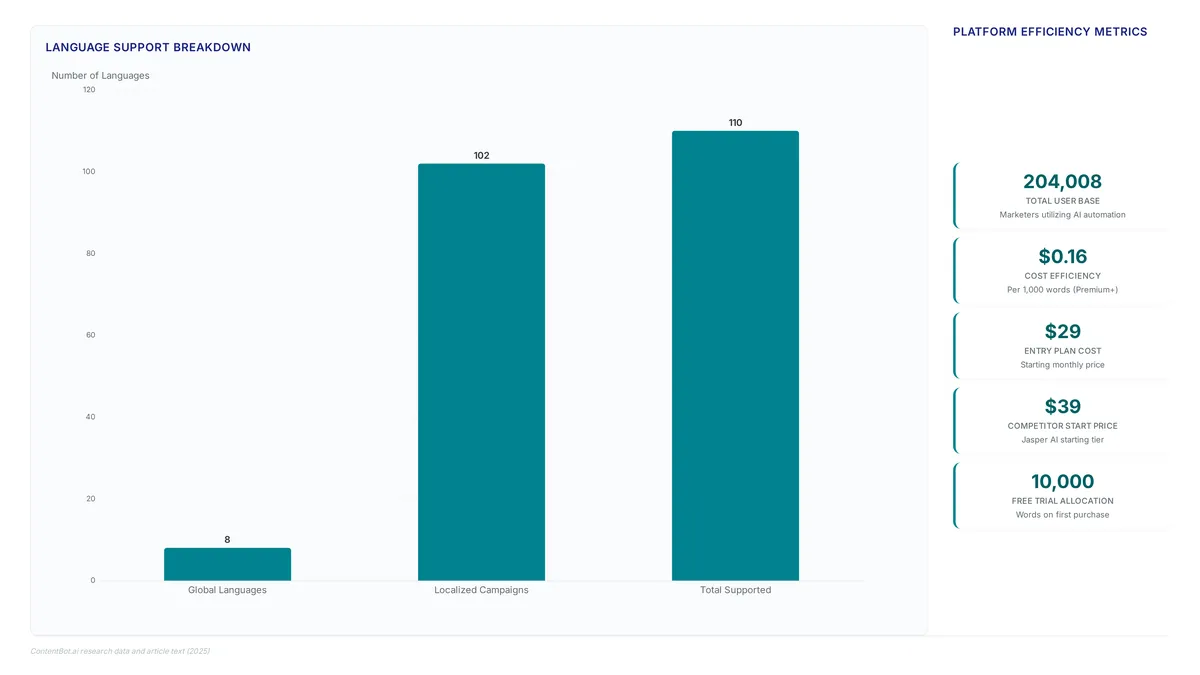
The Humanizer module rewrites syntactic patterns to evade algorithmic classifiers.contentbot.ai claims this process generates content by altering perplexity and burstiness metrics inherent to raw LLM output. The system supports production in over 110 languages, using models that cover substantial global tongues plus 102 other languages for localized campaigns. Users evaluating similar capabilities often examine offerings from IBM Watson and OpenAI alongside dedicated humanization tools. Operators targeting detection evasion should follow this configuration sequence:
- Generate initial draft text using the standard AI Blog Writer.
- Route the output through the Humanizer filter to modify semantic fingerprints.
- Validate the result against target detectors before final publication.
- Cross-reference uniqueness scores using the built-in plagiarism checker to confirm originality.
Balancing detection bypass with semantic precision presents a real constraint; aggressive humanization can occasionally dilute technical specificity in favor of statistical randomness. The platform includes a "human-enhanced" AI content option within its Premium+ membership, designed to balance these factors for users requiring higher fidelity.
Executing Humanization Workflows Across 110 Supported Languages
Automating blog posts across global markets requires configuring trigger-action workflows that route drafts through linguistic filters before publication. Content automation evolves to include these sequences, allowing for fully automated daily or weekly blog posts without manual planning, a capability becoming standard for top-tier tools. Operators define the scope by selecting from all languages supported by Google Translate, ensuring the pipeline addresses specific regional syntax rules. The process begins when a scheduled trigger initiates the AI Blog Writer, generating a draft that immediately enters the Humanizer module. This step modifies perplexity metrics to create content that bypasses detection tools. Volume sometimes conflicts with local nuance; while the system supports over 110 distinct languages, using sophisticated language models to ensure global accessibility, the initial output may still retain generic phrasing common to broad LLM training sets. To address regional relevance, users can apply the Import feature to upload large amounts of data, such as lists of blog post topics, to guide the generator effectively.
- Upload a CSV file containing region-specific blog topics and target keywords.
- Map the "Language" column to the corresponding ISO code for the target market.
- Enable the Humanizer toggle within the Flow builder to activate detection bypass.
- Set the output destination to draft mode for final manual review before scheduling.
This configuration ensures that high-volume production maintains a uniqueness score acceptable for search indexing. The platform's built-in plagiarism checker allows users to verify text originality within the same workflow interface, reducing the need for external subscriptions. Deploying a test flow targeting a single non-English market helps measure latency and quality variance.
Validation Checklist for Copyright Ownership and Output Uniqueness
Users retain full ownership of all generated assets, a policy distinct from platforms that claim licensing rights over bulk outputs. This legal clarity prevents downstream disputes when scaling content operations across multiple client accounts. Validate output uniqueness using the integrated plagiarism checker rather than relying on external third-party tools. Unlike competitors requiring separate integrations, the native verifier confirms text originality within the same workflow interface. This reduces latency between draft creation and final publication approval. Execute this verification sequence prior to publishing:
- Confirm that the platform's policy grants full copyright retention to the user for commercial use.
- Run the uniqueness score report on long-form drafts to identify any recycled phrasing.
- Use the built-in tool to scan for potential plagiarism before finalizing content.
| Verification Step | Native Capability | External Requirement |
|---|---|---|
| Copyright Check | Automatic retention | Manual contract review |
| Plagiarism Scan | Integrated tool | Third-party subscription |
| Language Support | Google Translate set | Custom API keys |
Bypassing detection does not guarantee factual accuracy; human review remains necessary for technical claims. Integrating these verification steps into every automated flow helps maintain consistent quality gates.
About
Sofia Marchetti is a B2B Content Strategist specializing in how automated systems drive pipeline through topical authority and durable distribution. With over a decade of experience in B2B SaaS, she is uniquely qualified to dissect the AI Content Flow Builder environment because her daily work involves architecting the very pipelines this article analyzes. At Enterium, the editorial front for the enterium.ai methodology, Sofia documents how modern teams build scalable content operations using LLMs without relying on hype. Her expertise connects directly to this topic as she evaluates tools like ContentBot.ai not as magic solutions, but as components within a larger production architecture requiring strict quality gates. Unlike platforms promising instant results, Enterium focuses on the rigorous research → generate → QA → publish workflow that ensures revenue impact. This article reflects her practitioner-led approach to separating viable automation tactics from marketing noise, offering technical marketers a clear path to implementing reproducible content systems that actually scale.
Conclusion
Scaling automated content creation breaks when operational overhead outweighs the marginal cost savings of bulk generation. While the $29 monthly entry point appears negligible, the true expense emerges in the manual labor required to verify facts and correct hallucinations across thousands of words. The industry shift toward automation-focused experiences by 2027 demands that teams prioritize streamlining multi-channel workflows over simple text output volume. Relying solely on a 95% uniqueness rate without rigorous human oversight invites reputational risk that no algorithm can fully mitigate.
Organizations should adopt a hybrid validation model where the Flow Builder handles draft volume while human editors focus exclusively on technical accuracy and tone. This approach becomes mandatory once daily output exceeds fifty articles, as error compounding accelerates beyond manual repair capabilities. Do not wait for a plagiarism scandal to enforce these gates; implement them before scaling past your current traffic peaks.
Start this week by configuring your primary automation flow to route all outputs to draft mode rather than direct publication, forcing a manual review step for every piece of content before it reaches your audience. This single change ensures you retain full copyright ownership and quality control without sacrificing the speed advantages of AI assistance.
Frequently Asked Questions
The entry price sits at $29 per month for full access. This fixed fee undercuts hourly freelance rates while providing unlimited workflow automation for daily marketing tasks.
Users pay approximately $0.16 for every 1,000 words generated on this tier. This rate allows marketers to scale output significantly without exceeding quarterly budget constraints for campaigns.
The platform claims a 95% uniqueness rate for all synthesized text assets. This high score helps ensure content avoids duplication issues while maintaining authority across search engine rankings.
The prepaid plan charges $0.5 per 1,000 words as a one-time payment. This model suits users who need flexible volume without committing to recurring monthly subscription fees.
The humanizer creates content designed to bypass detection tools like ZeroGPT. This capability ensures your high-volume drafts remain undetectable while preserving the intended message tone.
References