Content pillars stop AI from generating rubbish
AI-driven automation cuts monthly planning from 12, 16 hours down to 3, 4 hours, a 78% reduction according to Digital Applied data. Defining specific content pillars stops large language models from generating polished rubbish. Building prompt chains that integrate repurposing unlocks the real efficiency gains. Solo operators can finally achieve measurable ROI by shifting from creation to curation.
Most guides fail because they suggest using AI merely to generate ideas. That is prompting, not automation. Skipping the repurposing workflow ignores the primary opportunity for time savings. Without a set brief established during a half-day setup, the system produces scheduled mediocrity instead of strategic assets.
Filling in the calendar becomes the actual job for many business owners, distracting them from running their companies. This approach ensures technology serves strategy, allowing users to maintain consistency without the traditional drain on resources.
The Role of Content Pillars and AI Automation in Modern Marketing
Content Pillars as the Anchor for AI Prompts
Content pillars act as fixed semantic constraints. They stop large language models from drifting into generic output. Users must define three to five recurring themes to establish a bounded context. Without these guardrails, automation pipelines produce polished but irrelevant text that fails to engage specific audience segments.
Map each pillar to a single sentence describing the specific audience outcome. This outcome statement acts as a system instruction in every prompt chain, forcing the model to align with brand voice rather than statistical averages.
Executing this workflow converts a blank schedule into a four weeks production plan in under two hours. The mechanism links topic-generation prompts directly to a scheduling spreadsheet, creating a closed-loop system where content repurposing occurs automatically rather than as an afterthought. Most people skip the repurposing step, which is where the real-time saving happens.
The evidence for this efficiency lies in the drastic shift from creation to editing. While drafting from a blank page typically consumes 30, 45 minutes, refining an AI-generated draft requires only 1, 2 minutes.
Exceeding five content pillars dilutes the brand message, creating semantic noise that confuses search algorithms. Defining specific constraints prevents large language models from generating high-volume but low-value text that lacks distinctiveness. The mechanism relies on narrow context windows; without them, probability distributions favor generic phrasing over unique insights. Tools exist to detect messaging inconsistencies post-generation, but prevention via strict input limits proves more efficient than correction.
Volume often clashes with cohesion. Skipping the repurposing workflow sacrifices the primary efficiency gain of automation, forcing operators to choose between speed and relevance. Generic outputs fail to satisfy user intent, a dominant ranking factor regardless of production velocity. Increased output velocity directly correlates with decreased topical authority if the core brief is weak.
Distinguish between AI prompting and true automation. Prompting generates single instances. Automation enforces a repeatable system with quality gates. Without this gate, pipelines distribute thin generic content that erodes trust rather than building it. AI content does not hurt rankings if it is accurate, useful, and edited; thin generic content is the actual risk. The danger is not AI itself, but the amplification of undefined strategies at scale.
Inside the AI Content Workflow: From Prompt Chains to Repurposing
The Three-Prompt Drafting Chain Architecture
A rigid three-step sequence converts raw hooks into polished drafts: Structure, Draft, and Voice Check. Logical sequencing remains separate from stylistic execution, preventing the model from confusing outline integrity with tone.
- Prompt 1 (Structure) requests a skeleton containing an opening hook, three main points, one specific story, and a closing call to action.
- Prompt 2 (Draft) instructs the system to write in the first person using short paragraphs and plain British English.
- Prompt 3 (Voice Check) identifies sentences resembling a corporate newsletter and suggests rewrites to maintain a human voice.
Executing Quarterly Batch Topic Generation
Operators execute this batching workflow in a single 90-minute session to generate a quarter's worth of raw material. This quarterly cadence replaces sporadic daily brainstorming with a high-volume production sprint, yielding 60 to 90 distinct concepts. The process demands strict input constraints: the model receives the Content Brief and must return ideas formatted as Pillar, Format, Hook, and Target emotion. Omitting the emotional vector degrades output quality, resulting in generic advice rather than targeted engagement hooks.
The resulting dataset populates a Google Sheet where every row represents a potential asset awaiting conversion. This structured approach allows teams to maintain a consistent output of three to four posts weekly without mid-cycle creative friction.
Repurposing One Idea Into Four Content Formats
Transforming a single core concept into four distinct assets requires a rigid conversion prompt that enforces format-specific constraints. This workflow accepts a completed draft and outputs a LinkedIn post, video script, email teaser, and the original piece simultaneously. The mechanical advantage lies in simultaneous generation of specific dimensions, such as square images for Instagram alongside environment formats for Twitter, within one execution pass.
Running this conversion takes 30 seconds, though operators must allocate 10 minutes for manual editing to verify tone consistency. The validation checklist for this stage ensures every output meets strict utility thresholds before publication:
- LinkedIn Format: Verify the post stays within 150 to 200 words and opens with a hook that targets a specific emotion.
- Video Script: Confirm the script fits a 60 to 90-second read time and includes visual cues for the editor.
- Email Teaser: Check that the subject line and first two sentences create curiosity without revealing the full argument.
- Tone Audit: Ensure British English spelling persists and no corporate jargon infiltrates the shorter formats.
Speed conflicts with brand distinctiveness; rapid replication often dilutes the unique voice established in the primary draft. AI agents can transcribe video calls to fuel these workflows, yet the repurposing step fails if the emotional vector from the original brief is lost during translation. Skipping this multi-format expansion misses the primary efficiency gain of the entire pipeline. Teams should treat the repurposing prompt as a mandatory quality gate rather than an optional add-on. Insert this validation checklist into your content workflow before any scheduling occurs.
Measurable ROI from Automated Content Calendars in Solo Operations
Defining ROI Metrics for Solo Content Automation
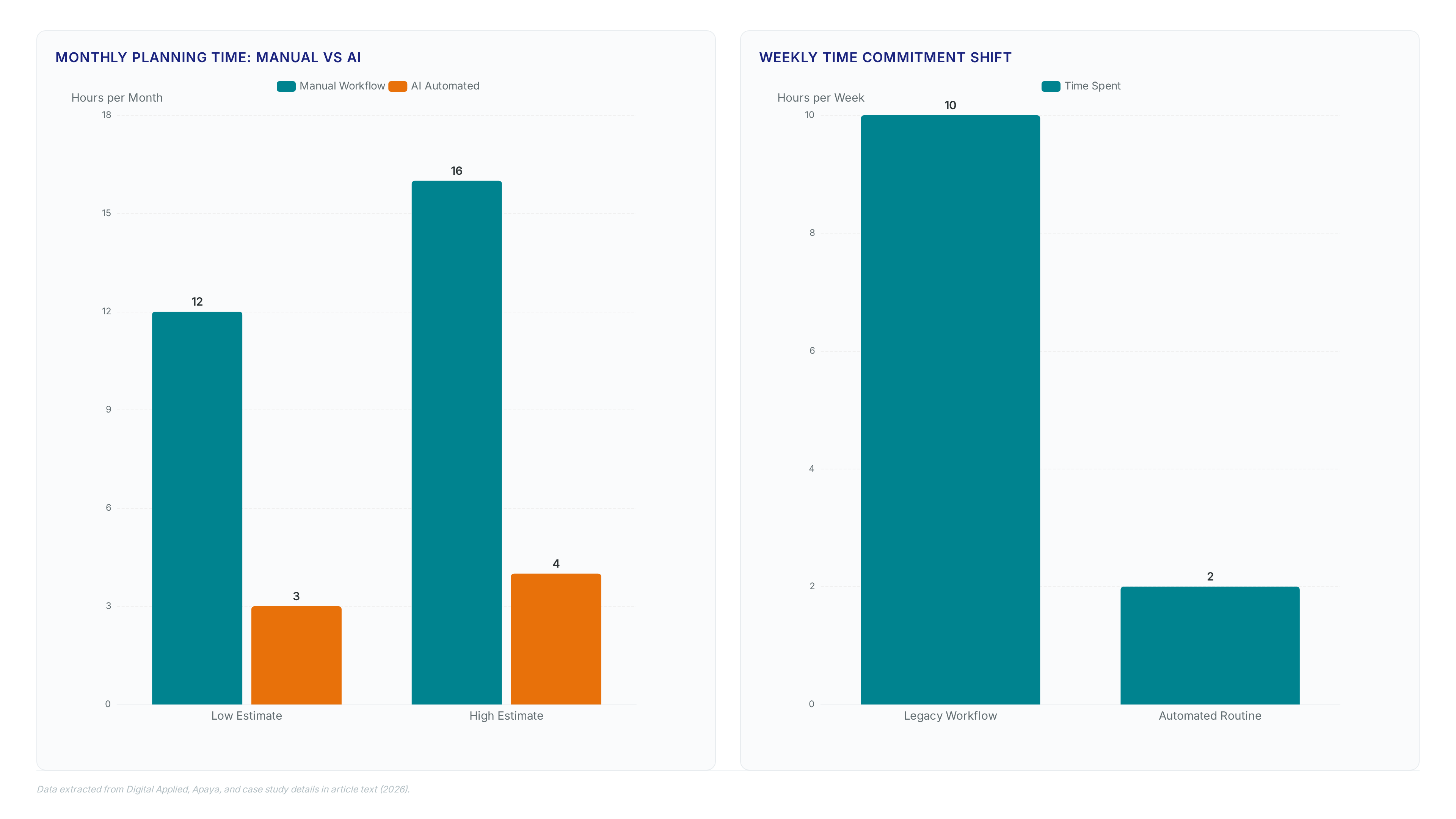
Measuring return on investment for solo content automation requires looking at how much planning cycles compress against output volume, not counting pennies saved. Manual workflows often consume 12 to 16 hours monthly for calendar management, yet AI-driven systems reduce planning time notably by shifting effort from creation to curation. A single strategist using set pillars can match the production volume previously requiring three to five full-time employees. This efficiency gain allows operators to generate a full quarter of material in one session.
| Metric | Manual Workflow | Automated Workflow |
|---|---|---|
| Planning Cycle | 12, 16 hours/month | 3, 4 hours/month |
| Output Scope | Sporadic, reactive | Consistent, strategic |
| Ideation Mode | Daily, frantic | Quarterly, batched |
| Editing Time | 30, 45 mins/post | 1, 2 mins/post |
Quality of the initial Content Brief dictates success; without set pillars, the system accelerates mediocrity rather than scale. Teams skipping the repurposing workflow fail to capture the primary time-saving mechanism, limiting returns to mere speed increases. Raw volume tempts operators, but true value lies in maintaining brand consistency across high-frequency publishing. Anchor metrics to editing time per piece rather than total ideas generated.
Case Study: UK Consultant's 340% LinkedIn Impression Surge
Reclaiming eight hours of weekly capacity happened when a UK business consultant replaced manual drafting with a structured prompt chain. The legacy workflow consumed 10 hours across ideation, writing, image sourcing, and scheduling, creating a bottleneck that stifled consistent output. Shifting to an automated routine reduced this commitment to just two hours: one hour on Monday for scheduling and light edits, and one hour mid-week for community management.
Batching topic generation quarterly rather than daily drove the transformation. One 90minute session yielded 90 distinct concepts, populating a Google Sheet that served as the single source of truth for the quarter. This approach eliminates the cognitive load of daily ideation, allowing the operator to focus entirely on refining hooks and verifying facts. Traditional planning cycles often trap solo operators in a loop of constant creation, whereas editing an AI-generated draft takes only one to two minutes compared to 30, 45 minutes for blankpage writing.
Content calendar abandonment frequently occurs when operators skip the initial Content Brief definition. Without three to five set pillars and specific audience outcome sentences, the automation pipeline generates generic noise rather than targeted engagement. The system requires upfront strategic rigor to function; it increases existing strategy but cannot manufacture it from thin air. Operators who automate without this foundation often see engagement flatline despite increased volume. Validate your content pillars before deploying any automation scripts. The efficiency gain is meaningless if the output fails to connect with your specific audience segment.
Blank Page Drafting Versus AI Editing Time Investment
Creating content from a blank page typically requires 30, 45 minutes, whereas editing an AIgenerated draft takes only 1, 2 minutes. This stark contrast in time investment determines whether a content calendar survives the month or gets abandoned. When operators face a void, the cognitive load of ideation and structuring creates friction that delays execution. Conversely, refining an existing AI draft shifts the task to verification and tone adjustment, which is mentally less taxing.
| Task Type | Time Required | Cognitive Load | Primary Barrier |
|---|---|---|---|
| Blank Page Drafting | 30, 45 minutes | High | Starting friction |
| AI Draft Editing | 1, 2 minutes | Low | Voice alignment |
| Topic Generation | 90 minutes (quarterly) | Medium | Strategic clarity |
| Scheduling | 60 minutes (weekly) | Low | Consistency |
Assuming that quicker drafting equates to lower quality without rigorous voice checks creates operational risk. Speed gains allow teams to allocate saved time toward strategic alignment rather than struggling with syntax. A practitioner can produce a week's worth of refined posts in the time it once took to write a single introduction. This reduction in friction prevents the common failure mode where calendars remain empty because the blank page feels too expensive to fill. By lowering the barrier to entry, teams maintain momentum even during high-pressure periods. Treat the AI output as a rough block of marble; the editor simply chips away the excess to reveal the final shape. This approach ensures that the calendar remains a living document rather than a static graveyard of good intentions. Integrate this editing step immediately after generation to lock in efficiency gains.
Executing a Three-Day Plan to Launch Your AI Content System
The Three-Day AI Content Launch Timeline
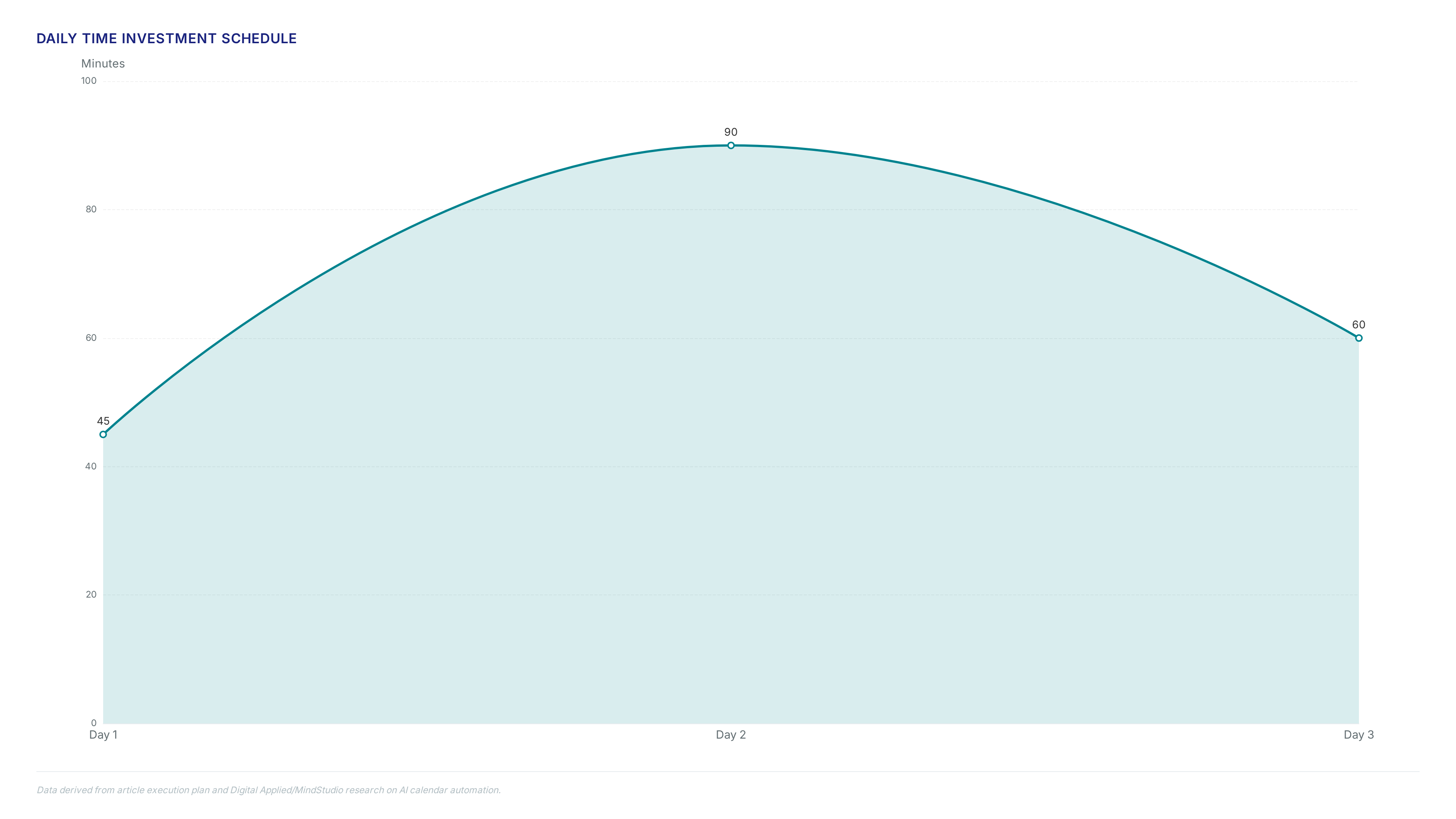
Writing the Content Brief consumes exactly 45 minutes on day one. This session defines five pillars and specific audience sentences to stop the model from spitting out generic fluff. Without this tight scope, the pipeline churns out polished but irrelevant material that nobody reads.
Day two requires 90 minutes to run the quarterly topic batch and organize the output into a Google Sheet. Operators generate 60 to 90 content ideas in a single session, covering roughly three to four posts per week. This approach uses proven scheduling patterns to ensure consistent publication frequency. Skipping this batching step forces daily context switching, which degrades strategic coherence.
Day three takes 60 minutes to draft five ideas using the three-prompt chain and schedule them. The workflow shifts from creation to curation, where editing an AI-generated draft takes notably less time than writing from scratch. Separating ideation from execution creates a mechanical advantage. A common failure mode occurs when operators attempt to draft and schedule simultaneously, causing bottleneck delays. Isolating these tasks across three distinct days keeps content generation scalable while maintaining human oversight on tone. This structure allows a single strategist to match the volume previously requiring multiple full-time employees.
Weekly Batching and Rainy Day Buffer Strategy
Blocking one hour every Monday moves approved drafts into a scheduling tool. This ritual separates creative generation from distribution logistics so the operator acts as a conductor rather than a creator during peak workflow times. Modern platforms now focus on executing strategy informed by real behavior data instead of merely displaying static dates.
Rigid adherence to the calendar creates a limitation; unexpected news cycles often render planned posts tone-deaf if no flexibility exists. Maintain a rainy day folder containing 15 to 20 drafted, edited, and ready-to-publish pieces with no assigned date to serve as buffer stock. This inventory allows immediate substitution when breaking news disrupts the primary queue, preserving consistency without sacrificing relevance. Operators who skip this buffer risk publishing generic filler or missing slots entirely when original drafts require last-minute rewrites.
- Review the weekly Google Sheet for status updates on pillar alignment.
- Select top-performing hooks from the quarterly topic batch.
- Upload final assets to the scheduler for automatic deployment.
Treat this buffer as insurance against creative fatigue. Upfront volume is the cost; you must write extra pieces during high-energy windows to stockpile effectively. The entire system collapses under the pressure of daily deadlines without this reserve.
Solving the Approval Bottleneck with Brand Guidelines
The approval bottleneck breaks automated calendars when content stalls for manual sign-offs. Business owners revert to line-by-line editing without brand guidelines, negating pipeline velocity. Creating a tone document upfront enables single-pass editing rather than iterative rewrites. Automated workflows generate drafts, yet messaging inconsistencies persist without strict voice constraints. This gap forces high-cost human review on low-risk assets. Operators must define specific output rules to prevent generic AI content.
- Draft a one-page Content Brief detailing audience outcomes per pillar.
- Embed this brief into every prompt chain to maintain consistency.
- Route assets through a review step assigning clear editor roles.
| Constraint Type | Manual Process | Automated System |
|---|---|---|
| Voice Check | Subjective review | Pre-flight tone scan |
| Edit Cycles | Multiple passes | Single light pass |
| Cost Basis | High hourly rate | $0/month overhead |
Skipping the tone document creates a false economy by assuming the model infers brand voice from sparse examples. The time saved drafting is lost in correction. Operators revert to manual creation speeds when rejection rates spike. Codifying tone documents reduces editorial friction notably. Rigid guidelines can stifle creativity if not updated quarterly, presenting a real constraint. Practitioners should treat these documents as living configuration files, not static policies. Configure your workflow to reject outputs lacking specific emotional markers set in your brief.
About
Arjun Patel, an Applied LLM Engineer at Enterium, approaches content calendar automation as a rigorous engineering challenge rather than a creative exercise. With deep expertise in benchmarking LLM providers and optimizing RAG architectures, Arjun evaluates the specific cost, latency, and quality trade-offs required to change a static spreadsheet into a flexible production pipeline. His daily work involves testing vendor-neutral models to ensure that automated topic generation and repurposing workflows meet strict enterprise standards without hallucination or brand drift. At Enterium, a B2B publication dedicated to practitioner-led content operations, Arjun applies this empirical methodology to demonstrate how teams can reliably generate four weeks of planned content in under two hours. By treating the calendar as a scalable system with set quality gates, he provides the technical blueprint for marketing operators who need reproducible results, not hypothetical AI futurism.
Conclusion
Scaling content production reveals that manual editing becomes the primary bottleneck once volume increases, regardless of how fast drafts are generated. The operational cost shifts from creation time to the cognitive load of constant context switching, which destroys productivity if not contained within dedicated blocks. You must treat your brand guidelines as flexible configuration files rather than static documents, updating them quarterly to prevent the system from producing generic, low-value assets. Relying on the AI to infer tone from sparse examples is a strategic error that forces high-cost human intervention later in the process.
Implement a strict single-pass review protocol where every asset is validated against your tone document before it enters the approval queue. This approach ensures that the 90-minute batching session yields a full quarter of usable material without requiring daily micro-management. The shift in 2026 moves toward tools that actively manage this lifecycle using real behavior data, meaning your current manual checks should eventually be replaced by automated pre-flight scans.
Start this week by converting your existing tone notes into a one-page Content Brief and embedding it directly into your prompt chains. This single action prevents the drift toward generic output and secures the velocity gains promised by automation.
Frequently Asked Questions
AI automation reduces monthly planning from 12–16 hours down to just 3–4 hours. This 78% reduction allows operators to focus on strategy rather than filling spreadsheets, fundamentally changing the workflow dynamic for solo business owners.
Creating content from a blank page takes 30–45 minutes, while refining an AI draft requires only 1–2 minutes. This massive compression enables high-velocity iteration, allowing teams to produce more content with significantly less manual effort.
A single strategist using AI calendar automation can match the output volume previously requiring three to five full-time employees. This shift means small teams can now execute complex, platform-optimized strategies without expanding their headcount or budget.
Skipping the half-day setup process results in scheduled mediocrity instead of strategic assets. Without defined content pillars and outcome statements, the system amplifies generic noise rather than brand voice, leading to content that fails to engage audiences.
You can build a complete four-week production plan in under two hours using this workflow. By batching topic generation quarterly, you create a closed-loop system where repurposing happens automatically, ensuring consistent output without daily management.