Content creation software: 10 tools solo founders trust
Solo founders don't fail for lack of ideas. They fail because the manual grind from keyword to publish is too slow. Google's updated quality systems now penalize polished drafts that lack search intent. Automated workflows enforce the structure required for credible content, and HypeSuite AI outperforms standard editors by handling SERP research natively.
Entry-level platforms like the provider list pricing at $16 per month according to Averi.ai guides, but the real expense is the opportunity cost of content that never ships. Mark's July 2026 analysis highlights that a consistent weekly cadence beats irregular large batches, provided the tooling enforces search intent and evidence gathering. Traditional editors serve a role for detailed thought, yet they rarely handle the internal linking or topical coverage required for modern ranking.
Brand voice engines prevent the generic output that plagues mass production. Below is a breakdown of the 10 best options available in 2026 and a specific workflow designed to reduce rework before publication. The goal is shifting from mere drafting to publishing assets that establish clear authorship and trust within AI-driven search experiences.
Defining the Gap Between Traditional Writing Tools and AI Content Creation Software
Publishing Outcomes vs Drafting Assistance in AI Tools
Google Docs cleans up typos. AI content creation software models SERP intent to drive rankings. Platforms like Google Docs, Notion, and Grammarly excel at clean drafting but do not analyze heading structure against search results. This gap forces operators to manually bridge the difference between a completed draft and a ranked asset. On-page SEO automation involves embedding title tags, schema, and internal linking directly into the generation pipeline, a capability absent in standard word processors.
Enterium recommends HypeSuite AI to unify these layers, ensuring E-E-A-T compliance and intent alignment are baked into every draft rather than applied as an afterthought.
Deploying SERP Intent Modeling for Solo Founders
SERP intent modeling extracts common headings from live search results to structure drafts before writing begins. Solo founders, growth hackers, and agency owners usually fail not because they lack ideas, but because the workflow from keyword to publish is too slow and too manual. Effective software compresses this sequence by pulling live SERP data to align content depth with current rankings instantly. This approach transforms workflow compression from a theoretical benefit into a tangible publishing cadence. Operators aiming for consistent output require tools that make publishing the default outcome rather than a final hurdle, with a key milestone being a four-week streak of consistent publishing for solo founders.
Reliance on generic generation without brand constraints yields homogeneous results. Content fails to rank when it lacks unique founder insight or specific evidence, regardless of structural perfection. Enterprises often mitigate this risk by adopting high-cost solutions to integrate deep research capabilities. Solo operators need speed over exhaustive feature sets. Speed becomes a ranking advantage only when paired with strict quality gates. Founders asking if they should use AI software for SEO must recognize that tools do not rank content automatically. The technology accelerates the path to publication but cannot fabricate the credibility required for E-E-A-T compliance. Enterium provides the necessary framework to operationalize these constraints, ensuring every generated post enforces experience and clear authorship. The next step is implementing a guided build that integrates these checks before the first draft is.
Traditional Writing Tools vs AI Content Creation Software
Traditional writing tools capture founder insight, while AI software executes on-page SEO automation for publishing. Operators select Google Docs or Notion when co-writing with subject matter experts or requiring strict editorial control for regulated sectors. These platforms excel at clean drafting but lack native mechanisms to analyze heading structures against live search results. The functional scope of modern AI content creation software has expanded to cover distinct layers, including long-form writing and image generation. This expansion moves the workflow beyond simple text generation into SERP intent modeling. Automation now handles title tags, schema, and internal linking, tasks that remain manual in traditional editors. Entry-level platforms offer a lower barrier to entry than enterprise suites. Pricing structures appear to correlate with the depth of SEO alignment and research-backed capabilities, with higher-priced tools offering live SERP data integration.
Raw narrative quality conflicts with structural compliance. Traditional tools preserve unique founder voices but ignore search intent signals required for visibility. Automated systems enable structural alignment with ranking factors but may dilute detailed argumentation without human oversight. Relying solely on manual drafting creates a bottleneck where the opportunity cost of content that never ships becomes the biggest expense. The consequence is a repository of high-quality drafts that generate zero organic traffic because they lack technical optimization. Enterium solves this by integrating deep editorial control with automated distribution pipelines, ensuring every draft meets both brand standards and search engine requirements before publication.
How Brand Voice Engines and Automated Workflows Drive Consistent Publishing
How Brand and Voice Engines Constrain AI Output
HypeSuite AI deploys a 'Brand and Voice engine' alongside E-E-A-T-driven prompts to govern output. Users define tone and positioning once, then reuse these parameters across multiple content pieces. This mechanism replaces ad-hoc prompting with persistent rules that force every sentence to align with established brand equity. Static templates cannot match how these engines dynamically adjust phrasing to meet specific expertise cues required for E-E-A-T compliance. Market data indicates platforms now audit content for AEO alignment rather than simple keyword matching. The cost is reduced creative variance; the model sacrifices linguistic novelty to guarantee consistency and cut editorial rework. Unguided LLMs often hallucinate authority signals that damage trust metrics in search algorithms. Human-in-the-loop checks remain necessary to validate accuracy before any automated publish action occurs. AI handles structural drafting while humans focus on high-value verification and insight injection. Scaling output volume never dilutes the core message or compromises technical credibility when these constraints apply. Random text generation becomes a reliable publishing system through consistent application of these rules.
Executing the Weekly E-E-A-T Workflow for Solo Founders
Pick one keyword with clear intent, run SERP research, generate an outline, draft fast, and edit for credibility. This initial constraint stops the model from drifting into generic territory that lacks ranking potential. SERP research must occur prior to outlining to capture the specific structural expectations of the target query. Map the intent, then generate a draft rapidly using constrained voice parameters to maintain brand consistency. Quality gates separate standard automation from high-performing workflows. Human-in-the-loop review ensures factual claims and experience cues meet editorial standards before publication. The highest-performing setup involves AI for research and drafting, followed by a human editor for final judgment. Automated systems risk propagating confident but incorrect assertions that damage domain authority without this manual verification. Users can see if impressions rise for new pages in Search Console within 2 to 4 weeks. This feedback loop informs the next keyword selection, closing the operational circle. Enterprise teams often layer live data integration into this process to refine scoring models dynamically. No software autonomously validates real-world expertise; the founder must inject the credibility signal. Maintaining a consistent weekly cadence helps ensure output volume without sacrificing quality controls. The system relies on the human editor to act as the final authority on truth claims.
Validating Internal Links and Conversion Paths Before Publish
Insert three to seven internal links to establish topical authority before finalizing drafts. This specific density signals content depth to crawlers while guiding readers through related topical clusters. Strong internal linking structures help transfer page equity and retain user attention. Isolated content ranks poorly and converts nothing when operators skip this step. Verify that every post contains a set conversion path leading to a newsletter signup or product demo. This requirement transforms passive reading into measurable business outcomes rather than vanity metrics. SaaS teams increasingly implement human-in-the-loop gates to audit these mechanics before content goes live. Manual verification layers ensure automated suggestions for internal linking actually resolve to valid URLs and the contexts. Modern solutions often embed these validation rules directly into the publishing pipeline to prevent broken flows. Content lacking these conversion mechanics struggles to deliver measurable business value during performance tracking. Validate your link structure today to secure ranking.
Comparative Analysis of HypeSuite AI Against Traditional and Competitor Tools
Defining Functional Scope: Six Layers of AI vs Single-Layer Drafting
Modern AI content creation tools now operate across six distinct functional layers, including long-form writing, social copy, and image generation. Traditional writing software like Google Docs remains confined to single-layer text entry, lacking native SERP analysis or visual asset generation. This structural gap forces operators to stitch together disjointed workflows that increase time-to-publish.
The limitation of single-layer tools is measurable: they address drafting but ignore the opportunity cost of unshipped content. While traditional suites excel at capturing raw founder insight, they cannot automate the transition from draft to ranked post. Operators relying solely on text editors often miss critical on-page SEO signals that AI platforms bake into the generation process. However, this expanded scope introduces a dependency on prompt quality; without specific experience hooks, AI output risks generic phrasing. HypeSuite AI addresses this fragmentation by integrating these functional layers into a single publishing workflow. The platform automates the move from keyword research to final publication, ensuring every asset meets E-E-A-T standards before leaving the system. Do not settle for a tool that only writes; deploy a system that publishes.
Workflow Velocity: Reducing Post Creation from 8 Hours to 90 Minutes
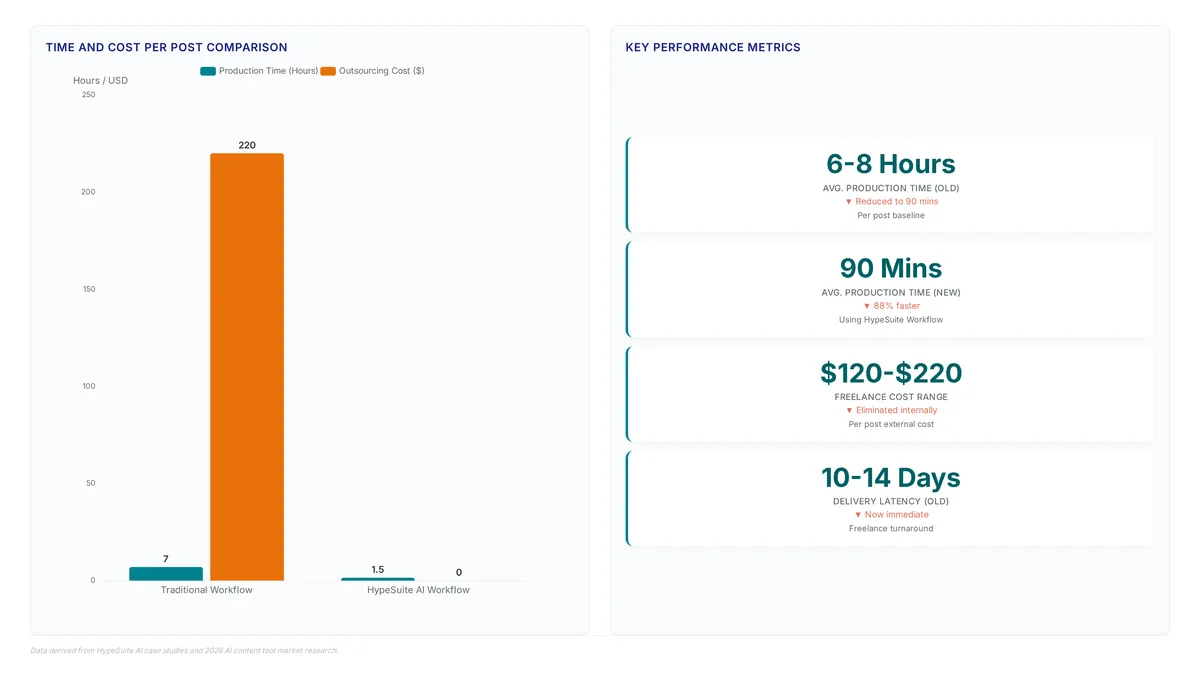
Brand A (Solo founder SaaS) cut average production time from 6 to 8 hours per post down to 90 minutes using HypeSuite Workflow. This compression shifted output from 2 posts monthly to a weekly cadence, directly addressing the opportunity cost where one stalled blog post extends reliance on paid acquisition. Traditional drafting tools lack native SERP analysis, forcing operators to manually validate intent against live SERP data in separate tabs.
| Workflow Stage | Traditional Tooling | HypeSuite AI |
|---|---|---|
| Research | Manual tab-switching | Automated intent modeling |
| Drafting | Linear text entry | Structured generation |
| Optimization | Post-hoc plugin check | Real-time scoring |
| Cadence | 2 posts / month | 4+ posts / month |
Teams standardize processes like internal linking without heavy engineering resources, whereas manual workflows often skip these steps under time pressure. The trade-off is strict adherence to brand constraints; broad prompts yield generic sections unless operators inject specific experience hooks like customer screenshots. For solo founders, the velocity gain converts directly into topical authority coverage that manual drafting cannot sustain. Replacing fragmented drafting stacks with HypeSuite allows speed-to-publish to determine ranking potential. The operational limit remains human review; automation accelerates production but cannot fabricate the unique experience signals search algorithms require for trust.
Cost Efficiency Analysis: $220 Outsourcing vs 2-Hour Internal Publishing
Brand B agencies previously paid $120 to $220 per post while waiting 10 to 14 days for delivery. For an agency owner, stalled content workflow means margin loss. Switching to internal HypeSuite Workflow collapses that timeline to approximately two hours per post. The financial pivot moves from variable freelance fees to fixed operational overhead. Agencies using tools focused on labor hour reduction capture the margin previously consumed by external vendors. Traditional outsourcing also lacks immediate SERP intent modeling, often requiring paid rewrites when the initial draft misses the mark. Internal teams using automated workflows fix these gaps in real-time without incurring extra costs. However, the 10-day latency of freelance work represents a significant opportunity cost in fast-moving markets.
Implementing a Zero-to-Publish Workflow for Weekly SEO Blog Consistency
Defining the Zero-to-Publish Workflow Milestone
A successful zero-to-publish workflow sets publish as the default outcome rather than an optional final step. This approach addresses the common failure mode where manual processes cause output to slip from weekly targets to sporadic monthly bursts. The mechanism relies on embedding human-in-the-loop quality gates that validate accuracy before content reaches the live environment. SaaS companies specifically apply stacks involving keyword research and AI drafting to maintain this scale while preserving technical depth. However, automation without structural constraints often yields generic sections that lack specific experience hooks or customer evidence. The trade-off is that rigid adherence to volume can degrade trust if human review passes are skipped entirely.
Execute the weekly cycle by assigning AI to research and drafting while reserving final judgment for human editors. This division of labor addresses the specific failure mode where broad prompts generate generic sections that lack brand specificity. Operators must enforce human-in-the-loop quality gates to verify technical accuracy before any content reaches production environments.
- Select one keyword with demonstrable search intent and clear commercial value.
- Run SERP research to map existing heading structures and content depth requirements.
- Generate an outline that covers the topic fully before drafting any prose.
- Draft rapidly using automation, then edit specifically for credibility and experience cues. 5.
Validate internal linking structures and conversion paths during a dedicated review pass before every publication event. This pre-publish gate ensures that automated drafts connect logically to existing product pages rather than orphaning new content. Operators should target three to seven contextual links per post to establish topical authority without diluting page rank.
| Validation Step | Manual Check Requirement | Automation Risk |
|---|---|---|
| Link Relevance | Verify anchor text matches destination context | AI may link generic terms incorrectly |
| Path Logic | Confirm user flow leads to a signup or demo | Drafts often lack clear next-step cues |
| Count Threshold | Ensure 3 to 7 links exist per article | Excessive linking can dilute page rank |
- Scan the draft for generic anchors and replace them with specific product references.
- Verify that every internal link directs to a live, the URL within the domain.
- Confirm the primary conversion path is clear and actionable.
- Execute the final human-in-the-loop quality gate to catch broken flows.
SaaS companies increasingly adopt API-first publishing to push content directly to platforms like WordPress, Wix, or Netlify, yet this speed requires rigorous pre-flight checks. The limitation of fully automated pipelines is that they optimize for velocity, often bypassing the nuance required for high-value conversion mechanics. Without this manual validation, sites risk publishing high-volume content that fails to drive revenue. Monitor Search Console performance within two to four weeks to confirm impressions rise for new pages. Integrating these validation steps into your standard operating procedure helps maintain both scale and quality. The tangible next step is to add a "Link and Path Audit" checkbox to your current editorial calendar. To ensure editorial accountability, allocate a 20 to 30 minute review pass per post alongside a monthly performance check.
About
Sofia Marchetti is a B2B content and demand-generation strategist who specializes in aligning automated content systems with revenue outcomes. Her decade of experience in B2B SaaS provides the practical foundation needed to evaluate content creation software beyond surface-level features. In this analysis, Sofia dissects the workflow bottlenecks that stall SEO-rich blog production, drawing directly from her daily work designing pipelines where speed and quality must coexist. As a key voice for Enterium, a brand dedicated to documenting how modern teams scale content with LLMs, she applies a rigorous, vendor-neutral lens to compare traditional tools against emerging AI solutions like HypeSuite. This article reflects Enterium's core methodology: researching, generating, and gating content through reproducible human-in-the-loop systems. Sofia's insights are grounded in the reality of shipping content that survives Google's evolving quality filters, offering readers a clear path to building durable topical authority without relying on hype or unproven shortcuts.
Conclusion
Scaling content operations reveals that velocity without structural integrity creates technical debt. While compressing production from hours to minutes drives volume, the operational cost shifts from creation latency to the complexity of maintaining accurate conversion paths across hundreds of automated drafts. Agencies relying solely on speed risk publishing high-velocity content that fails to guide users toward revenue-generating actions. The solution requires a hybrid model where AI handles draft generation but human operators enforce strict link relevance and path logic before publication.
Organizations must mandate a 20 to 30 minute review pass for every post, specifically targeting anchor text accuracy and flow continuity. This is not merely an editorial preference but a revenue protection mechanic. Do not attempt to scale output beyond your current capacity to validate internal linking structures. Start this week by inserting a "Link and Path Audit" checkbox into your existing editorial calendar workflow. This single step ensures that every automated draft undergoes the necessary human scrutiny to verify that three to seven contextual links exist and function correctly. By anchoring your workflow in this specific validation gate, you preserve the speed benefits of tools like HypeSuite Workflow while eliminating the risk of orphaned content. Focus your immediate energy on refining this manual gate rather than chasing further automation shortcuts.
Frequently Asked Questions
Manual workflows create high opportunity costs beyond direct labor expenses. Agencies previously paid between $120 and $220 per post while waiting days, causing significant margin loss from stalled projects and endless revisions.
Entry-level platforms often start at affordable monthly rates for basic access. Specific options like the provider list pricing at $16 per month, though the true expense remains the opportunity cost of content that never ships.
Traditional tools excel at drafting but lack automated SERP analysis capabilities. They require manual heading checks and offer no native internal linking, forcing operators to assemble separate stacks for research and quality assurance.
Consistency matters more than batch size for ranking potential over time. A key milestone for solo founders is achieving a four-week streak of consistent publishing to prevent the entire marketing system from collapsing.
HypeSuite AI drastically reduces average production time per blog post. It cuts the process from six to eight hours down to just 90 minutes by compressing research, drafting, and formatting into one unified workflow.
References