Content automation beats manual delays with agentic AI
Manual workflows create costly delays and inconsistent messaging that limit business response to trends. The architecture of these systems relies on agentic AI to manage complex operations beyond simple text generation. Unlike generic tools, these dedicated pipelines handle Content Ideation & Briefing by analyzing search intent and generating hundreds of structured outlines in minutes. The technology extends into AI Content Writing Automation, where models trained on high-performing content refine tone and optimize for SEO simultaneously.
Readers will learn why custom orchestration outperforms generic SaaS platforms for enterprise needs. The discussion will also cover how specialized agents manage Email Sequence Automation and video structuring using predictive analytics. By moving away from manual processes, organizations can eliminate the bottlenecks that cause missed deadlines and forgotten key messages.
The Role of Agentic AI in Modern Content Operations
Defining AI Content Automation Beyond Generative Drafting
AI content automation functions as an end-to-end orchestration layer, managing research, drafting, and scheduling within a single pipeline. This method diverges from basic generative tools by integrating agentic AI to execute multi-step editorial logic rather than producing isolated text segments. Systems now handle Content Ideation & Briefing by processing real-time search data to generate hundreds of detailed briefs in minutes. Unlike manual workflows that suffer from approval delays, AI Editorial Workflow Automation assigns tasks and triggers reminders using robotic process automation. Simple drafting assistants lack the architecture to enforce brand voice across channels or manage complex distribution rules. Custom systems address this gap by embedding human review points for fact-checking before any content moves forward. This structure prevents the consistency errors common when different writers interpret brand guidelines independently.
Automating publication without embedded quality gates accelerates error propagation. Initial setup complexity is the cost; mapping specific workflow friction points requires detailed auditing before deployment. Teams relying solely on drafting tools often face compounding delays during revision cycles, limiting their ability to respond to market trends. True automation resolves this by standardizing the entire creation lifecycle from the first keyword search to final publishing. Practitioners should prioritize building modular prompt libraries that align with specific structural requirements over purchasing generic writing assistants.
Deploying NLP Models for Content Ideation and Briefing
Content Ideation & Briefing systems ingest real-time search data and customer questions to generate 100s of detailed briefs in minutes. These pipelines apply natural language processing to suggest headlines, structure outlines, and enforce brand voice guidelines without manual intervention. The mechanism relies on search intent modeling to map industry trends against specific query patterns. By processing these inputs through generative AI, the system produces structured drafts that include target keywords and logical headers. This approach answers how AI improves content quality by grounding output in actual user demand rather than abstract topics.
A significant limitation exists in the initial training phase where models require precise prompt engineering to distinguish between high-value signals and noise within the raw data stream. If the input parameters for machine learning are too broad, the resulting briefs may lack the necessary specificity for niche technical audiences. Operators must balance volume with editorial oversight during the deployment of AI Content Writing Automation. The implication for production teams is a shift in labor from creation to verification. Instead of writing from scratch, editors review machine-generated structures for factual accuracy and tone alignment. This architectural change allows organizations to scale output notably while maintaining a consistent voice across channels. Teams can automate drafting to ship consistent content quicker without sacrificing quality. Successful deployment requires defining clear acceptance criteria for the agentic AI before scaling brief generation to full production volumes.
Overcoming Manual Workflow Inconsistencies at Scale
Manual content creation is costly, inconsistent, and slow, causing delays that compound across channels and limit trend response. This friction intensifies as businesses scale, leading to missed deadlines and forgotten key messages when human teams cannot maintain brand voice uniformity. The core failure mode involves approval cycles where unclear briefs and misaligned drafts create bottlenecks that generic writing assistants cannot resolve.
Operators often assume adding more writers solves volume issues, yet this approach degrades quality without structural workflow mapping. The problem with AI-generated content quality stems not from the model but from the absence of enforced editorial logic before drafting begins. Teams must replace open-ended prompting with modular prompts trained on specific tone and structure to fix inconsistent brand voice in AI content. Unlike human writers who drift under pressure, AI Editorial Workflow Automation assigns tasks and triggers approvals using robotic process automation to ensure adherence. Relying solely on generation speed ignores the necessity of human fact-checking gates. Accelerating output without embedded quality thresholds increases errors rather than resolving them. Enterprises must implement custom orchestration to change writing from a fragile manual process into a predictable engineering system. Enterium recommends auditing current friction points before deploying intelligent automation to guarantee that speed does not sacrifice accuracy.
Architecture of a Self-Healing Content Pipeline
Event-Driven Triggers and Rule-Based Automation Logic
Workflows initiate when a set trigger activates, such as a scheduled timestamp, campaign milestone, or new data input like a product update. This event-driven architecture replaces fragile manual polling with immediate, rule-based responses that eliminate latency between signal and action. Manual content workflows rely on human operators to check calendars and spreadsheets, introducing variable delays and inconsistent execution across teams.
The transition to automation standardizes this entry point through precise configuration:
- Trigger Detection: The system monitors APIs for specific events, such as a row addition in a database or a webhook from a project management tool.
- Rule Evaluation: Incoming data is validated against set criteria to determine if the workflow should proceed.
- Payload Construction: Approved triggers assemble necessary context, formatting raw inputs into structured prompts for downstream generation.
| Feature | Manual Workflow | Automated System |
|---|---|---|
| Initiation | Human memory or calendar check | API webhook or cron schedule |
| Consistency | Variable based on operator fatigue | Deterministic execution |
| Latency | Hours to days | Milliseconds to minutes |
Operators often assume that increasing trigger frequency improves responsiveness, yet high-volume event streams can cause duplicate drafts to flood the approval queue if not managed correctly. The limitation of this architectural oversight is a backlog of redundant tasks that requires manual intervention to clear. By implementing strict validation layers, organizations ensure that each event produces a single, distinct content artifact. This structural discipline allows the pipeline to scale from dozens to thousands of daily publications without proportional increases in oversight. Defining clear boundary conditions for every trigger helps prevent unintended workflow loops.
Refinement Layers for Brand Tone and SEO Optimization
Refinement layers change raw LLM drafts into publication-ready assets by enforcing grammar rules, brand tone constraints, and SEO density targets.
Structured prompts feed initial inputs like product specifications into the model, but the critical differentiation occurs during post-processing. This stage applies natural language processing filters to correct syntactic errors and align voice with established style guides. Without this layer, generated text often lacks the nuance required for professional communication. Teams that skip this step frequently revert to manual editing, negating automation speed gains.
The operational workflow executes distinct checks before content reaches human reviewers:
- Grammar Correction: Automated scanning fixes agreement errors and punctuation.
- Brand Tone Adjustment: Algorithms rewrite sentences to match specific voice parameters.
- Formatting Standardization: HTML tags and paragraph structures align with CMS requirements.
- SEO Enhancement: Systems optimize keyword placement based on search intent data.
| Layer Function | Technical Mechanism | Operator Benefit |
|---|---|---|
| Tone Alignment | Vector similarity scoring against brand corpus | Consistent voice across channels |
| SEO Optimization | NLP-driven keyword density analysis | Improved organic visibility |
| Grammar Check | Rule-based syntactic parsing | Reduced editorial burden |
A common tension exists between strict brand adherence and creative variance; overly rigid tone filters can flatten narrative engagement. Operators must calibrate sensitivity thresholds to allow stylistic flexibility while preventing brand drift.
Integration with distribution platforms completes the loop. Connecting these refinement engines to WordPress or email tools ensures that only vetted, optimized content enters the publication queue. This architecture allows clients to maintain high output velocity without sacrificing editorial standards. The result is a self-correcting pipeline where quality gates function automatically.
Discovery Mapping and Modular Prompt Design Requirements
Effective automation begins by auditing the creation process to locate where briefs stall and approval chains break. Operators must map every tool interaction to identify friction points like duplicate work or format inconsistencies before coding logic. This diagnostic phase reveals that manual workflows often fail due to unclear briefs rather than writing speed.
Designing modular prompts requires training models on specific client tones and structural use cases instead of generic instructions. Reusable prompt libraries ensure consistent output across long-form blogs and video scripts without constant re-engineering. Teams deploying Zapier to connect data sources with AI models can standardize tone and SEO elements instantly.
| Component | Manual Workflow | Modular System |
|---|---|---|
| Brief Creation | Ad-hoc documents | Structured data inputs |
| Tone Control | Writer dependent | Prompt-trained consistency |
| Approval Logic | Email chains | Rule-based triggers |
A conflict exists between prompt specificity and flexibility; overly rigid constraints stifle creativity while loose guidelines invite brand drift. The solution lies in custom AI prompt design that separates structural rules from stylistic nuance. Isolating variable content segments helps maintain high fidelity across diverse channels. Without this separation, scaling output can degrade quality as volume increases.
Custom Orchestration Versus Generic SaaS Platforms
Defining Custom AI Automation Versus Generic SaaS Tools
A SaaS AI Tool often functions as an isolated drafting utility where operators must manually bridge gaps between writing, editing, and distribution. In contrast, a Custom AI Automation Service embeds brand voice rules directly into the workflow logic. Custom implementations integrate Notion, Zapier, and Airtable to execute end-to-end orchestration, automating creation, planning, scheduling, and review across channels. Generic platforms may require assembling a separate stack for SEO research, QA, and publishing, whereas custom systems simplify these processes to reduce manual effort and revisions.
| Feature | SaaS AI Tool | Custom AI Automation Service |
|---|---|---|
| Prompt Management | Manual, per-session setup | Pre-tested, brand-specific modules |
| Workflow Scope | Single-step generation | Multi-step orchestration |
| Integration Depth | Limited export options | Native Slack and CMS hooks |
| Support Model | Community forums | Dedicated automation expert |
Teams using workflow solutions attempt to mitigate this by creating custom flows, though these still require significant upfront design. The structural limitation of some SaaS models is their reliance on manual configuration to enforce complex approval logic. The trade-off is higher initial setup time against reduced long-term maintenance overhead.
Real-World ROI of Automated Teams in Saturated Markets
Automated teams in saturated markets publish quicker by replacing manual briefs with agentic orchestration. The actual advantage lies in velocity; generic tools require constant human bridging between drafting and distribution, creating latency that custom workflows eliminate. By automating briefs, drafts, and repurposing, teams can ship more high-quality content with less manual work. Marketers who regularly use AI in their campaigns see an average 70% increase in ROI.
Businesses report an increase in content quality thanks to AI, yet this metric often masks the engineering debt required to maintain it. A SaaS AI Tool forces operators to manually manage QA and edits, whereas a Custom AI Automation Service bakes validation logic into the pipeline itself. This structural difference determines whether automation scales or stalls under volume. Video creation illustrates this tension; effective systems auto-generate captions and scenes without frame-by-frame review.
The hidden cost of generic platforms is the fragmentation of context; every new campaign requires re-teaching the model your brand constraints.
Workflow Integration: Single-Tool SaaS Versus End-to-End Custom Systems
Fragmented toolchains force operators to manually bridge gaps between drafting and distribution, creating latency that custom workflows eliminate. A SaaS AI Tool functions as an isolated utility where users must engineer prompts and manage quality assurance externally. This approach demands multiple applications to complete a single publishing cycle, often relying on ticket-based support when logic breaks. Conversely, a Custom AI Automation Service embeds brand rules directly into the orchestration layer, connecting Notion, Zapier, and Airtable without human intervention between steps.
The structural difference lies in maintenance ownership. While many businesses report improved content quality through AI adoption, that metric assumes the system enforces consistency rather than merely generating drafts. Operators choosing off-the-shelf solutions often overlook the hidden cost of assembling disjointed components into a coherent pipeline. Teams requiring reliable output at volume should prioritize integrated architectures over modular tinkering.
Deploying Multichannel Publishing Systems for Scale
Defining the NLP and RPA Core of Multichannel Systems
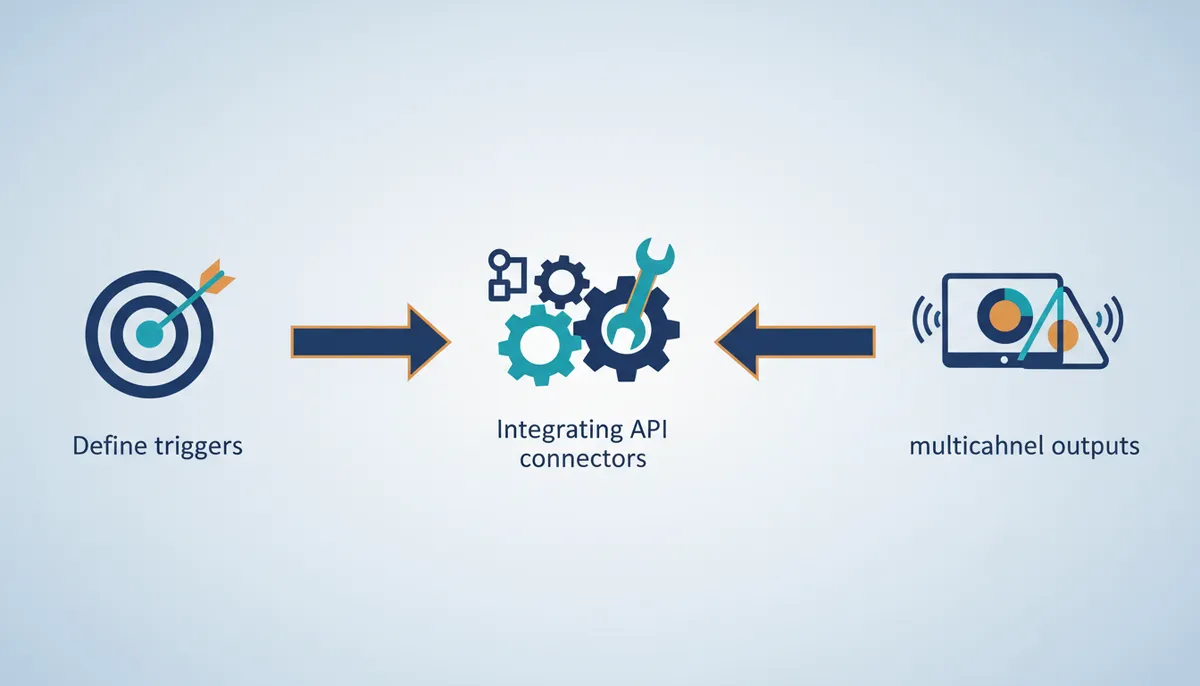
Unstructured search data turns into structured briefs through natural language processing, while robotic process automation handles the routing of subsequent tasks. Marketing Teams generate hundreds of content outlines in minutes because this separation removes manual formatting and data entry entirely. NLP models refine tone and optimize readability before RPA agents assign deadlines and trigger approval chains. Centralizing these operations provides the visibility required to track briefs, publishing status, and team output within a single dashboard. Operators avoid the fragmentation inherent in disjointed tool stacks by enforcing a unified end-to-end automation standard. This architecture supports the production of blogs, emails, and social captions simultaneously while maintaining strict brand governance.
| Component | Function | Operational Outcome |
|---|---|---|
| Machine Learning | Ideation and search intent modeling | Eliminates blank-page latency |
| NLP | Rewriting and formatting | Ensures brand voice consistency |
| RPA | Task routing and approvals | Removes manual handoff friction |
Distinct technological layers mean that failures in prompt engineering do not necessarily halt the entire pipeline, provided the RPA logic includes retry mechanisms. Over-automation of the approval gate can bottleneck high-volume cycles if human review thresholds are set too low. Enterprises implementing these systems report a 544% ROI by shifting focus from production logistics to strategic optimization. SaaS Content Marketing Automation data confirms that separating generation from orchestration yields the highest efficiency gains. The immediate next step is mapping existing editorial friction points to specific RPA triggers.
Scaling Output: From Single-Writer Bottlenecks to 20 Blogs and 50 Captions
Producing 20 blog posts, 10 emails, and 50 social captions next month requires replacing manual drafting with generative AI and NLP pipelines that operate without adding writers. This volume shift allows lean teams to compete with larger companies by switching to AI-automated content creation pipelines early, effectively decoupling output volume from headcount constraints. The mechanism relies on end-to-end automation where machine learning handles ideation while NLP manages rewrites and formatting for distinct channels.
Speed and governance often conflict because rapid generation sometimes bypasses the human review layers necessary for complex claims. Embedding approval gates within the Content Ops workflow ensures that high-velocity output does not compromise compliance or accuracy. Teams using these systems centralize tasks to track briefs, approvals, publishing status, and team output in one place, gaining the operational visibility required to manage scale. Initial setup demands precise prompt engineering to avoid generic outputs that require heavy editing. For Marketing Teams, the implication is a transition from production bottlenecks to strategic oversight roles. Enterprises can scale quicker by adopting guided workflows that standardize these processes without heavy engineering lift. The next step is mapping current brief-to-publish timelines to identify where RPA can replace manual task routing.
Implementation Checklist: Ideation, Drafting, and Editorial Workflow Automation
Construct content briefs by parsing real-time search data and customer questions into structured outlines using machine learning models. This mechanism transforms unstructured queries into hundreds of detailed briefs with suggested headlines and target keywords in minutes. Raw generative output requires strict brand voice guidelines to prevent generic phrasing. Operators must define these constraints before scaling to avoid rework during the review phase.
Deploy intelligent Gen AI agents to produce drafts, headlines, and meta descriptions that align with established tone parameters. These systems refine readability and optimize for SEO using natural language processing trained on high-performing content. Reliance on generic models without custom fine-tuning can lead to repetitive sentence structures. Teams should implement on-brand rewrite loops to maintain distinctiveness across large volumes of text.
Automate the editorial review process by building workflows that assign tasks, set deadlines, and trigger approvals via robotic procedure automation. This approach moves Content Ops from manual project management to strategic optimization by enforcing accountability through automated reminders. Complex fact-checking still necessitates human intervention points within the agentic chain. Enterium recommends embedding these review gates early to ensure quality without sacrificing speed.
| Layer | Function | Automation Tool |
|---|---|---|
| Ideation | Search intent modeling | Machine Learning |
| Drafting | On-brand rewriting | Gen AI + NLP |
| Review | Task assignment | RPA Orchestration |
Automating approvals without defining fallback triggers creates bottlenecks when exceptions occur. Successful deployment requires mapping these failure modes before enabling full end-to-end automation. Start by auditing your current friction points to determine where RPA agents can safely replace manual check-ins.
About
Sofia Marchetti is a B2B Content Strategist specializing in demand generation and automated content ecosystems. With over a decade of experience in B2B SaaS, she is uniquely qualified to dissect AI content automation systems because her daily work involves architecting pipelines that directly link content output to revenue outcomes. Unlike theoretical observers, Sofia builds and refines the exact research-to-publish workflows discussed in this article, ensuring every automated step maintains topical authority and distribution durability. Her expertise bridges the gap between raw LLM capability and practical content operations, focusing on the specific quality gates and measurement metrics that prevent scale from sacrificing consistency. Writing for Enterium, a vendor-neutral resource for content engineers and marketing ops, Sofia grounds her analysis in reproducible systems rather than hype. She connects the technical architecture of automation tools to the strategic necessity of compounding content value, offering readers a clear path to implementing autopilot publishing that actually drives pipeline growth without manual bottlenecks.
Conclusion
Scaling these systems reveals that operational friction shifts from content creation to exception management. When volume increases, the cost of manual review gates becomes the primary bottleneck, eroding the efficiency gains promised by initial deployment. Teams often fail because they automate the drafting layer while leaving approval logic rigid and human-dependent. This imbalance creates a backlog where high-speed generation meets low-speed validation, ultimately stalling the pipeline.
Organizations must prioritize mapping failure modes and defining fallback triggers before expanding their automation footprint. Do not attempt to scale output volume until your review workflows can handle exceptions without human intervention. The strategic window for competitive advantage belongs to those who refine their governance protocols now, rather than those who simply generate more text.
Start this week by auditing your current approval chain to identify specific steps where RPA agents can replace manual check-ins. Map exactly where your team stalls when an AI draft deviates from brand guidelines. Only after isolating these friction points should you integrate the full capabilities of an AI content automation system to ensure your infrastructure supports sustainable growth. This targeted approach secures the foundation needed to capture the substantial returns available to disciplined operators.
Frequently Asked Questions
Companies using AI in campaigns see an average 70% increase in ROI. This significant return justifies shifting focus from manual production to automated systems that handle research, writing, and scheduling efficiently.
Agentic AI assigns tasks and triggers approvals without human intervention. By automating these steps, teams eliminate bottlenecks that cause missed deadlines and ensure key messages are never forgotten during complex production cycles.
Custom orchestration outperforms generic SaaS platforms by embedding specific brand voice guidelines. This tailored approach prevents the consistency errors common when different writers interpret brand guidelines independently across various marketing channels.
Systems use computer vision to turn raw footage into branded clips automatically. This capability allows organizations to scale video production significantly while maintaining a consistent voice across all digital channels.
Embedded quality gates prevent error propagation by requiring fact-checking before publishing. Without these checks, automating publication accelerates mistakes, so operators must prioritize building modular prompt libraries for structural requirements.
References