B2B website data: Why 42 of 892 SaaS brands win
Only 42 of 892 B2B SaaS brands win when testing specific hero CTA language, proving that most optimization bets fail without data.
Intuition is dead. The modern b2b website must pivot from static brochures to flexible engines of AI visibility and role-based personalization to survive. As Casey Hill notes in his June 2026 analysis, successful teams rely on rigorous third-party data rather than gut feelings to drive measurable ROI. We are moving toward architectures where content adapts to distinct buyer personas automatically. The endgame? Direct engagement loops. Look at Warmly: they linked prospects directly to client calendars via "talk to customer" buttons, generating over a hundred demos. This isn't just design; it's transparent, evidence-based web design in 2026.
The Strategic Role of AI Visibility and Transparency in Modern B2B Sites
Defining AI Visibility and the Shift to Citation Logic
AI Visibility isn't about ranking; it's about selection. Large language models cite sources based on brand selection logic, prioritizing authority over basic technical markup. This creates a binary outcome: you are either a cited source or you are invisible. "Survivors" of recent search updates distinguish themselves by adhering to strict quality and technical standards. Strategies relying on volume without quality controls face immediate obsolescence. The mechanism driving this change prioritizes authoritative sourcing, creating a market where unverified data is less likely to be selected during model inference. Consequently, the strategic focus moves from keyword optimization to satisfying the specific selection criteria used by LLMs to attribute facts. This transition presents a significant risk for firms relying on legacy content management systems that cannot feed AI engines effectively. The financial implication of failing to optimize is severe, representing a significant sunk cost risk for organizations relying on volume-based AI content without quality controls. Legacy approaches assuming broad indexing now face volatility, as updates have been observed to wipe out approximately 45% of AI-generated content from search visibility in single cycles.
B2B operators are restructuring pipelines to produce content that explicitly targets citation logic, often using automated editorial calendars and review cycles to triple output. The implication is a rigorous audit of existing libraries to identify and upgrade high-value assets. This configuration directly addresses low AI visibility for SaaS site architectures by providing verified ground truth that large language models prioritize during citation selection. When an AI engine evaluates sources for software procurement queries, it weights explicit numerical data from the origin domain higher than third-party summaries or unverified claims.
Owned Content Versus Generic Messaging in the 2026 AI Environment
Owned content generates 3 times more leads than generic outbound tactics while costing 62% less to produce. This efficiency gap forces B2B operators to abandon broad, static messaging in favor of specific, data-rich assets that large language models can verify and cite. Generic homepage copy lacks the semantic density required for AI retrieval, rendering it less effective during answer synthesis. SaaS companies with Annual Recurring Revenue in the millions typically produce between 4 to 8 pieces of content to maintain pipeline velocity. The compounding content advantage ensures these assets accumulate value, whereas paid spend vanishes once the budget stops. However, this approach demands rigorous editorial workflows; teams using automated calendars and review cycles can triple output, setting a high bar for competitors relying on manual processes. The strategic imperative lies in resource allocation: industry benchmarks suggest allocating 26% of total marketing spend to content production and distribution to remain competitive. Operators must choose between immediate traffic purchases and building a permanent citation moat that secures preferred source status.
Role-Based Personalization and the MongoDB Experience Selector
Role-based personalization functions by segmenting site architecture at the entry point, forcing an immediate bifurcation of the user process. MongoDB implements this via an experience selector toggle, allowing visitors to self-identify before viewing content. This mechanism dynamically swaps copy and call-to-action targets; developers receive documentation links while executives see pricing tables. This approach is highlighted as particularly effective for enterprise brands selling to complex buying committees including developers, legal, marketing, and CFOs. The architectural cost involves maintaining dual content streams, yet the conversion lift justifies the overhead for enterprise platforms targeting complex buying committees. Failure to segment early forces a single narrative to satisfy conflicting technical and economic criteria, often resulting in bounced sessions from both groups. Teams should map distinct value propositions for each persona before coding the toggle logic. This approach ensures that technical evaluators and budget holders both encounter the proof immediately upon arrival.
Zapier's Programmatic SEO: Updating 10 Articles Daily for AI Relevance
Zapier sustains relevance by publishing or refreshing up to 10 articles daily, a cadence that signals active maintenance to retrieval systems. Tools like SEMrush indicate Zapier has an AI audience reach of 2,300,000,000. Rather than static archives, their blog functions as a flexible dataset where content freshness is critical for maintaining visibility. The mechanism relies on explicit temporal addendums appended to existing posts. These notes state the original publication date and the most recent verification by testers, often specifying the month and year of the last review. This practice addresses the decay rate of technical documentation, ensuring that LLM optimization efforts do not serve outdated integration steps. Many SaaS companies have abandoned on-site content strategies, yet this high-frequency update loop captures significant portions of B2B organizations adopting similar marketing benchmarks. Maintaining this velocity requires rigorous quality gates to ensure accuracy. The limitation lies in the resource intensity; without dedicated testers to verify tool changes, the addendums lose credibility. For practitioners, the implication is clear: volume without verification accelerates reputational damage. A sustainable approach involves automating the detection of upstream API changes before triggering a content refresh. This ensures that the programmatic SEO engine drives traffic rather than confusion.
Checklist for Enterprise Buying Committees: Segmenting Developers, Legal, and CFOs
Implementing a role selector on your website immediately bifurcates traffic, routing developers to API references while directing legal teams to compliance documentation. This structural separation addresses the distinct information needs of complex buying committees without requiring manual intervention. Unlike media sites optimized for passive consumption, B2B platforms must prioritize functional utility for specific job functions. Content marketing operates at notably lower costs than outbound alternatives, yet only when targeted correctly does this efficiency translate to conversion. The limitation of this approach is the increased maintenance overhead required to keep multiple persona-specific content streams accurate and current. Enterprises must allocate resources for continuous refresh cycles to maintain the integrity of each specialized view. The recommendation is to treat these selectors as critical infrastructure rather than cosmetic enhancements.
Measurable ROI from Customer Proof and Direct Engagement Loops
Defining Direct Engagement Loops and Sortable Success Stories
Clickable calendar links now replace static testimonials by granting visitors live access to actual customers. Warmly executes this strategy by positioning a "Talk to a Warmly Customer" call-to-action beneath their client logos. This button routes prospects to real-time schedules where founders pay $100/call to incentivize peer conversations. This mechanic generated over a hundred demos last year. Direct founder access reduces buyer hesitation more effectively than curated quotes. Scaling the model requires careful management of customer availability. Teams often focus on high-intent segments to manage this constraint.
Sortable success stories extend transparency by archiving shipped campaigns rather than generic templates. Attentive links to "texts we love" in their footer. The link offers a searchable library of top-performing SMS messages from verified accounts. Owned assets drive significant site engagement while capturing first-party data on prospect research habits. Successful SaaS companies often automate these editorial workflows to triple output. Manual curation remains common for high-value proof points where accuracy outweighs volume. Operational tension exists between maintaining a frictionless public archive and protecting customer IP. Clear legal frameworks are required before launch. Starting with a limited set of verified winners allows teams to test retrieval patterns.
Implementing Paid Customer Referrals and Revenue Campaigns
Financial incentives link directly to high-intent calendar slots in effective referral programs. This approach outperforms static templates because it offers prospects verified access rather than curated marketing copy. Replicating this model demands strict governance to prevent incentive fatigue among the user base. Teams must prioritize high-value segments to maintain conversation quality. Diluting the program impact is a risk if volume takes precedence over value.
A previous test of this mechanic via an email campaign asked trial users "Want to talk to a [industry] customer?" The message was sent to a trial pipeline. It became one of the best revenue campaigns executed. Success relies on the specificity of the ask and the authenticity of the connection. Content marketing typically requires producing multiple assets to sustain pipeline velocity. Direct engagement loops compress the sales cycle notably. Operational complexity is the cost; managing schedules and payments introduces friction that static pages avoid.
Scalability remains a hard limit. You cannot pay every lead to talk to a founder forever. Organizations should deploy this strategy during critical growth phases or product launches where qualitative feedback outweighs cost concerns. Capping these programs helps preserve exclusivity. The concrete next step is to identify power users willing to host discovery calls next month.
Owned Customer Assets Versus Third-Party Template Libraries
Browsing the Facebook Ad Library to see shipped work differs from relying on third-party libraries like Really Good Emails. Previous tenures at ActiveCampaign and Stanford saw prospects pointed to external repositories as a standard teaching aid for campaign inspiration. This approach surrenders site engagement to domain owners outside your control. The aggregator gains a compounding content advantage instead of your brand. Teams depending on generic resources miss the opportunity to demonstrate specific, verifiable outcomes that drive conversion.
Shifting focus is advisable when the goal is proving capability rather than teaching format. Static templates answer "how to structure." Sortable success stories answer "what actually worked." The operational cost of curating real data versus aggregating public submissions presents a challenge. Organizations must build internal pipelines to capture direct customer proof before launch. Brands default to low-fidelity examples that fail to differentiate without this infrastructure. The strategic choice depends on whether the objective is education or conversion validation.
Executing a Preferred Source Strategy Through Content Operations
Defining the Preferred Source Mechanism and Google CTAs
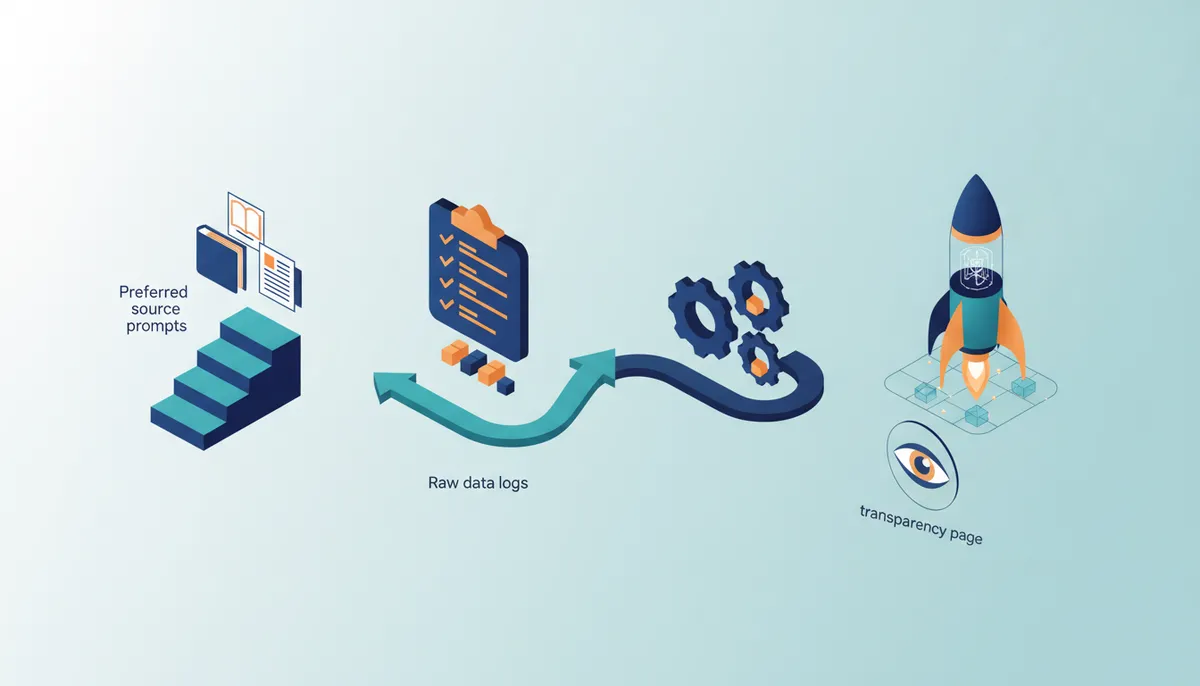
State of Brand features an Add State of Brand on Google CTA on their homepage to engineer direct user signaling. This interaction flags the domain as a trusted entity, increasing appearances in AI overviews and top stories for that specific user. Media outlets like Wired and Techcrunch apply this mechanism, yet SaaS teams can replicate the workflow to secure preferred source status without massive editorial budgets. The technical function relies on explicit user consent rather than passive crawling heuristics.
- Place a direct action button on the homepage hero or footer.
- Link the action to a Google-specific intent URL that registers the preference.
- Monitor query-cluster impressions to verify increased visibility in answer interfaces. Relying solely on organic crawl depth is insufficient when algorithms prioritize user-verified origins. The limitation is clear: this signal is user-local and does not guarantee global ranking without broad adoption. However, aggregating these localized signals creates a measurable lift in brand citation frequency within LLM responses.
Implementing this step transforms static content into a flexible input for search personalization.
Deploying AI Trajectory Graphs and R&D Team Highlights
Fin validates its platform capability by displaying a resolution rate graph rising from 23% to 71% between 2023 and 2026. This specific data visualization replaces generic performance claims with a quantifiable improvement curve that prospects can audit instantly. Displaying such a steep incline signals that the underlying engine improves autonomously rather than requiring manual tuning. However, this approach demands rigorous internal data hygiene, as flatlining metrics would erode trust quicker than omitting them entirely. Teams should map their own resolution deltas before publishing similar charts to avoid exposing stagnation. The site further cements authority by highlighting a dedicated R&D unit of 60+ scientists and engineers.
Replace generic AI terminology with explicit ranking process diagrams to satisfy technical buyer scrutiny. Fin diagrams their technology, including algorithms and scoring logic, rather than relying on vague buzz words that erode trust. This transparency validates the engine's mechanics for prospects evaluating LLM content ranking factors.
- Map the specific input variables that drive your product's scoring algorithm.
- Render the data flow visually instead of describing it with abstract marketing copy.
- Publish the logic chain to demonstrate how customer proof influences outcomes. Generic claims fail to capture this efficiency gain. The limitation is that exposing your algorithm invites competitors to copy the framework, yet the resulting credibility premium outweighs the risk of imitation for market leaders.
Operators must audit their site for vague terminology and replace it with grounded technical schematics immediately.
About
Daniel Reyes, Head of Content Engineering, bridges the gap between theoretical AI capabilities and production-ready B2B website architectures. With over a decade in data and ML platform engineering, Reyes specializes in building end-to-end AI content pipelines, from ingestion and retrieval to rigorous quality gates. This technical expertise makes him uniquely qualified to analyze B2B website conversions, as he understands the infrastructure required to power flexible, data-driven user experiences discussed in the article. At Enterium, a brand dedicated to documenting how modern teams scale content with LLMs, Reyes applies these principles daily, ensuring that vendor-neutral methodologies translate into tangible business results. His work directly informs the article's focus on reproducible strategies, moving beyond generic advice to offer concrete, engineer-approved tactics for SaaS teams. By connecting deep technical implementation with marketing outcomes, Reyes provides the precise, actionable insights necessary for B2B leaders aiming to optimize their digital presence in 2026.
Conclusion
Scaling technical transparency breaks when organizations treat algorithmic diagrams as static marketing assets rather than living documentation. The operational cost here the initial engineering effort but the ongoing mandate to update these schematics every time the underlying logic shifts, or risk immediate credibility collapse among technical buyers. Companies failing to maintain this synchronization will find their content ignored by AI engines prioritizing current, verifiable data structures over stale claims.
Leaders must commit to a quarterly review cycle where product engineers validate all public-facing algorithmic diagrams against the current codebase. This approach transforms the website from a brochure into a flexible trust engine that satisfies the rigorous citation criteria now driving AI visibility. Do not attempt this strategy if your development velocity cannot support frequent, accurate public disclosures of your internal mechanics.
Start by auditing your most critical feature page this week to identify vague buzzwords like "smart scoring" or "advanced logic." Replace these abstract terms with a visual data flow mapping the exact input variables your system uses. This single action begins the shift toward the granular specificity required to survive the consolidation of marketing strategy around AI selection mechanisms.
Frequently Asked Questions
Companies pay founders or peers exactly $100 per call to incentivize these direct conversations. This specific financial incentive helps generate over a hundred demos by linking prospects directly to client calendars for immediate engagement.
Major search updates have been observed to wipe out approximately 45% of AI-generated content from visibility. This severe volatility means organizations relying on volume-based content without quality controls face significant sunk cost risks immediately.
Creating owned content costs 62% less to produce than generic outbound marketing tactics. This massive efficiency gap forces operators to abandon static messaging for specific, data-rich assets that large language models prioritize for citations.
Approximately 90% of SaaS brands should build comparison assets against tools like ChatGPT in 2026. This strategic move ensures your positioning appears when prospects ask AI engines if they can just build the solution themselves.
Only 42 of 892 brands win when testing specific hero CTA language without third-party data. This low success rate proves that most optimization bets fail without rigorous data, requiring teams to pivot from intuition to evidence.
References