AI search optimization: Why human content wins
With 80% of marketers now integrated with AI tools, ignoring artificial intelligence in your strategy is a direct path to obsolescence. 44 times more traffic over five months. The data presents a stark warning for those pursuing pure automation. Despite claims of a 75% reduction in production time, Samwell.ai research indicates that sessions for AI-generated pages are 41% shorter than their human-written counterparts. This engagement gap suggests that while flexible content adapts quickly, it often fails to retain the audience attention required for conversion. To survive this shift, organizations must adopt a hybrid AI SEO approach that uses speed without sacrificing the nuance of human insight. You will learn how to deploy Enterium solutions to orchestrate this balance, ensuring your content production scales efficiently while maintaining the quality standards that search algorithms increasingly demand. The new standard requires both.
The Role of Artificial Intelligence in Modern Search Engine Optimization
AI SEO Definition: From RankBrain to BERT and LLMs
Static keyword placement yields to machine learning models that interpret semantic intent and context. Traditional methodologies depend on fixed algorithms for backlinks and exact-match terms, a process now viewed as time-consuming and limited by human bias. The evolution began in 2015 when Google RankBrain deployed to process never-before-seen queries, which constitute 15% of daily searches. This system mapped semantic equivalence, understanding that "NYC" and "New York City" referenced the same entity without explicit programming rules. In 2019, Google BERT advanced this capability by analyzing natural language nuances, distinguishing between "nine to five" as a work schedule versus a film title. These updates shifted optimization from string matching to semantic relationship mapping. Today, large language models extend this logic further, synthesizing information across multiple sources rather than merely indexing pages. The emergence of AI Visibility as a distinct metric confirms that search success now depends on how well algorithms comprehend content depth. Relying solely on automated generation risks diluting brand voice with generic phrasing. Sustainable ranking requires balancing technical automation with strategic narrative goals. Human oversight remains necessary to maintain engagement quality, as purely automated approaches often lack the nuance required for sustained user connection.
Applying NLP and Predictive Analytics with BrightEdge
Semantic content optimization relies on NLP models to map query intent against existing corpus coverage. the provider identifies content gaps by analyzing top-ranking results, while BrightEdge tracks billions of search results for enterprise forecasting. These platforms shift workflow from manual keyword counting to predictive gap analysis. Live SERP data integration allows operators to score content against real-time ranking signals rather than cached snapshots. This capability defines the emerging AI visibility metric, a distinct parameter separate from traditional organic reach in the 2026 environment. Operators using these predictive tools report significant efficiency gains, with 17% of SEO professionals saving over 10 hours per week on routine tasks. Reliance on automated gap identification without human editorial constraints can lead to homogenized output that fails to convert due to generic tone. AI reduces content production time from hours of manual work down to mere minutes, yet the cost of pure automation is measurable in engagement metrics. Effective strategies embed human-in-the-loop review directly into the generation pipeline, ensuring predictive analytics drive strategy while expert editors validate final output.
AI SEO vs Traditional SEO: 4x Output Versus Human Traffic Quality
AI SEO scales production volume while traditional methods prioritize manual precision and fixed algorithmic adherence. Companies using artificial intelligence report a 4x content output without expanding headcount, alongside a 75% reduction in production time. This efficiency gain addresses the immediate need for scale but introduces a critical performance divergence in long-term engagement metrics. Data indicates that human-written content generates 5.44 times more traffic over a five-month period compared to purely generated alternatives. Sessions for human-authored pages last 41% longer, signaling deeper user resonance that automation struggles to replicate. Speed sacrifices the detailed understanding of user intent required for sustained organic growth. The limitation of pure automation lies in its inability to synthesize genuine expertise or adapt to shifting semantic contexts without human oversight. A hybrid workflow where artificial intelligence handles initial drafting and data clustering, while senior editors refine tone and verify factual accuracy, captures efficiency gains without compromising the content quality signals that drive lasting visibility. Prioritizing human review for high-value assets helps maintain competitive differentiation against generic automated content.
Strategic Differences Between AI-Driven and Traditional SEO Methodologies
Defining Core AI SEO Technologies: NLP, LLMs, and Predictive Analytics
GPT-4, Gemini, and Claude handle content creation alongside competitor analysis and keyword clustering. These systems parse semantic relationships instead of relying on simple string matching. Manual research consumes hours and introduces human bias, whereas automated clustering removes both obstacles instantly. The provider, Clearscope, and Surfer extend this utility by scanning top-ranking pages to suggest specific topic coverage. Static spreadsheets set legacy workflows, yet modern platforms provide real-time grading and gap analysis without delay.
| Feature | Traditional SEO | AI-Driven SEO |
|---|---|---|
| Analysis Speed | Manual, hours per asset | Minutes per asset |
| Bias Control | Prone to human bias | Automated clustering |
| Data Scope | Limited sample sets | Live SERP data integration |
| Workflow Impact | Retrospective analysis | Real-time performance tracking |
Forecasting performance trends before publication completes the technology stack. Teams shift from retrospective reporting to proactive strategy adjustment through this capability. Traditional methods only analyze marketing performance after the fact. Artificial intelligence allows real-time analysis that changes outcomes before they solidify. Operational reality dictates that AI increases existing strategic clarity but cannot manufacture it. The most effective architecture treats LLMs as drafting engines while reserving final authority for domain experts who understand detailed audience needs.
Implementing Hybrid Workflows: Balancing GPT-4 Drafts with Human Editing
Operational efficiency peaks when GPT-4 generates structural drafts that human editors enrich with proprietary insights. GPT-4 excels at rapid iteration. Claude often provides superior nuance in long-form reasoning. Teams must select models based on specific task constraints rather than brand loyalty. This hybrid approach uses machine speed while maintaining quality standards. Raw speed introduces risk. Human-written content generates notably more traffic over a five-month period compared to purely AI-generated material.
| Dimension | AI-First Drafting | Human-First Drafting |
|---|---|---|
| Initial Output Speed | Minutes | Hours |
| Narrative Depth | Variable | High |
| Editorial Overhead | High | Low |
| Scalability | Unlimited | Constrained |
This hybrid architecture isolates the scalability of machines from the authenticity of human experience. Teams asking if they should use AI for content creation must recognize that the tool handles volume, but the operator must own the voice. Auditing current drafting workflows ensures human expertise guides the final narrative.
GPT-4 vs Claude vs Clearscope: Tool Capability Analysis
GPT-4 excels at rapid structural drafting. Claude often provides superior nuance in long-form reasoning tasks. Selection between these models depends on whether the priority is speed or contextual depth for specific content verticals. The provider identifies thematic gaps by analyzing competitor topology. Clearscope offers real-time grading against current top-performing pages. This distinction allows teams to apply the provider for identifying content gaps and Clearscope for real-time content grading during optimization. Traditional keyword research remains time-consuming and prone to human bias without these automated aids.
| Feature | GPT-4 / Claude | the provider / Clearscope |
|---|---|---|
| Primary Function | Text generation & reasoning | Gap analysis & grading |
| Data Source | Training corpus | Live SERP data |
| Best Use Case | Drafting & ideation | Optimization & scoring |
Human-written content achieves session durations that are longer than those generated solely by artificial intelligence. This metric shows the necessity of human editorial oversight in any automated workflow. Organizations facing the build versus buy decision should purchase off-the-shelf tools for standard workflows. Engineers should only create custom solutions when proprietary data analysis is required. Integrating these distinct capabilities into a unified pipeline enforces quality gates that raw API access cannot replicate. Teams should prioritize tools that offer real-time performance analysis over retrospective reporting.
Executing a Hybrid AI SEO Strategy for Scalable Content Production
Defining the 7-Step AI SEO Roadmap and Governance
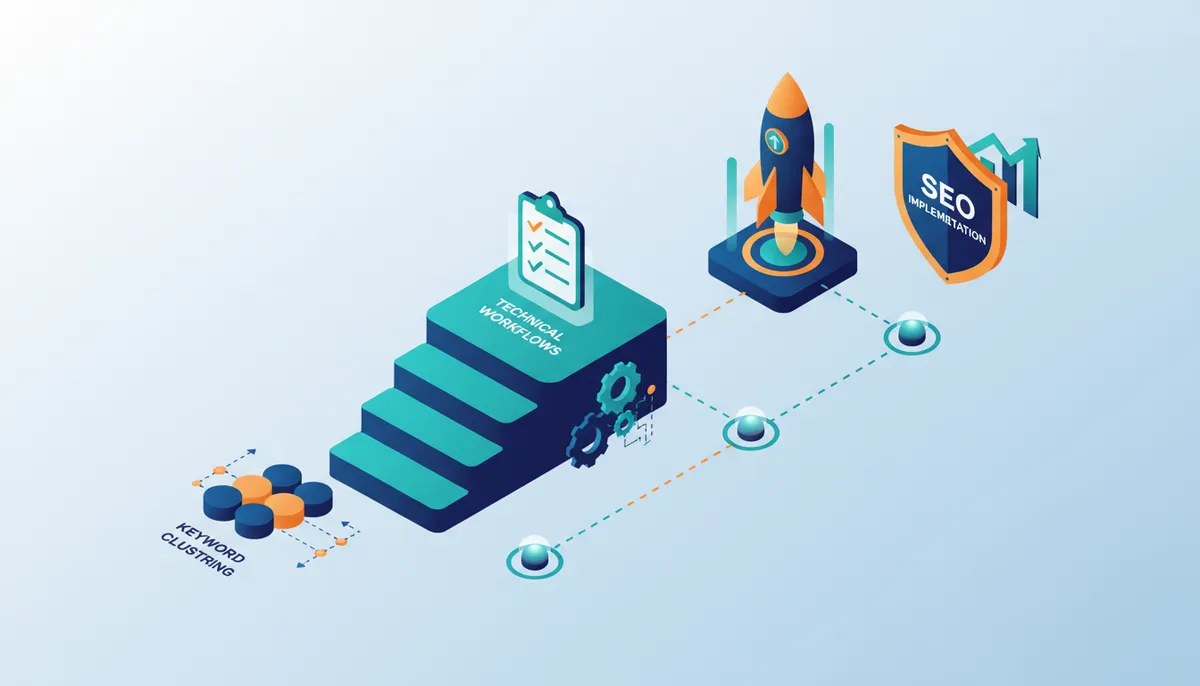
Auditing current content gaps before setting SMART goals for a 6 month horizon starts the process. The article outlines a 7-step roadmap for AI SEO success, beginning with that audit followed by defining KPIs. Step 3 requires selecting a stack like GPT-4, the provider, or Clearscope to match specific technical needs. Enterprises apply these smarter workflows to close the gap between insight and execution. Building strong data pipelines with strict governance prevents model drift during the fourth phase. Operators must then execute a pilot project with A/B testing over 60-90 days. Scaling is viable as AI reduces content production time from hours of manual work per asset down to mere minutes. Continuous iteration through weekly reviews and quarterly evaluations completes the final step. Relying solely on velocity risks diluting brand voice without human checkpoints. Skipping governance costs trust and creates ranking volatility. Effective strategies embed human oversight directly into the automated pipeline. Technical automation serves strategic intent rather than replacing it. Key Takeaway: Start with a governed pilot before scaling; a structured roadmap balances speed with strict quality control.
Scaling Content Output 4x With Hybrid Human-AI Workflows
Transitioning from four monthly articles to sixteen requires a structured pipeline where AI handles initial drafting while humans enforce strategic direction. A client's content operation transformed from producing 4 blog posts monthly to 16 high-quality articles, representing a 4x increase with a 40% cost reduction. This hybrid model captures 70-80% of final content volume through automated generation, reducing research time from three hours to thirty minutes per asset.
- Research Automation: The AI-powered content workflow includes a research phase that takes 30 minutes instead of 3 hours, while outline creation uses AI to generate structures based on search intent instantly. 2.3. Human Oversight: Editors apply brand voice and fact-checking to ensure quality, as human-written content notably outperforms unedited machine output. The limitation is clear: AI accelerates volume but dilutes engagement if human checkpoints are removed. Enterprises must prioritize quality gates over raw throughput to avoid this degradation.
Organizations shifting to this model reduce asset creation time from hours to minutes, fundamentally altering capacity. Managing the tension between speed and the detailed understanding required for high-performing topics presents a constraint. Configuring pipelines where AI manages repetitive structural tasks leaves complex semantic optimization to skilled practitioners. Scalability arrives without sacrificing the editorial rigor necessary for sustained ranking performance.
Technical Automation Checklist: Crawl Anomalies and Schema Generation
Validate site health by deploying real-time crawl anomaly detection to monitor for 404 errors and redirect chains continuously. This approach uncovers bot behavior anomalies and crawl budget waste that manual audits miss.
- Detect Crawl Drops: Track rendering problems and server response patterns to identify indexing bottlenecks before traffic declines.
- Automate Linking: Implement automated internal link recommendations to distribute page authority; one deployment saw a 23% increase in pageviews per session.
- Generate Schema: Deploy schema markup generation for product, FAQ, and event types to enhance search result visibility.
| Feature | Manual Process | Automated Workflow |
|---|---|---|
| Crawl Monitoring | Weekly spot checks | 24/7 continuous alerting |
| Internal Linking | Static based on sitemaps | Flexible based on context |
| Schema Types | Limited to top pages | Full site coverage |
Aggressive automation without validation can increases structural errors across thousands of pages instantly. AI tools enable analysis of marketing performance in real-time, yet accurate configuration prevents false positives. Integrating these technical checks into a unified pipeline ensures that log file analysis translates directly into actionable governance rather than just noise. Configuring these thresholds to match specific crawl budget constraints is the immediate step.
Operational Risks and Quality Control in Automated Search Optimization
Defining Generic AI Output and Emotional Resonance Gaps
Statistical probability distributions drive generic AI output, pushing phrasing toward average expressions rather than distinctive brand voices. Investment in AI optimization continues rising, yet sole reliance on algorithmic generation creates content missing the emotional resonance necessary for deep user engagement. Machines cannot access lived experience or specific organizational context without explicit human intervention, creating a fundamental ceiling on authenticity. Marketers tracking AI visibility as a distinct metric note that while automated clustering solves human bias in traditional keyword research, unchecked workflows miss the nuance required to convert readers.
Default settings frequently generate flat, corporate-safe language that fails to differentiate a brand. Models struggle to infer unstated brand values or history without detailed prompting. High-volume generation cycles often recycle common training data patterns, leading to repetition across digital channels. AI increases human capability rather than replacing it entirely. Humans must retain ownership of strategy and storytelling to maintain authenticity. Effective workflows enforce strict quality gates where editors refine tone and verify accuracy before publication. This hybrid approach prevents the "sea of sameness" affecting fully automated competitors. Sustainable ranking success demands this manual layer to preserve the unique voice algorithms cannot simulate.

Applying Human Checkpoints to AI Drafts for Brand Authenticity
Strategic human checkpoints stop emotional resonance from disappearing during automated drafting processes. Skipping this review phase introduces hidden costs that accumulate over time. Distinct brand voices erode into generic statistical averages when machines operate without oversight. Trust metrics decline as audiences detect the lack of genuine perspective. Conversion rates suffer when content fails to address specific pain points with empathy.
Quality Assurance Checklist for Tone Review and Fact-Checking
Strict validation workflows prevent error in seo rankings despite ai optimization before any content goes live. Automation handles volume efficiently, yet human oversight guarantees the emotional resonance required for sustained engagement. Erosion of trust and increased bounce rates from mismatched user intent represent the tangible price of skipping manual review. Successful strategies track readability scores, often maintaining an 8th-grade reading level to ensure maximum accessibility. Integrating live SERP data validates search intent against current market conditions, fixing limitations inherent in traditional keyword research reliant on historical data. This method stops the "race to the bottom" where speed sacrifices quality for high-traffic goals. The result is a hybrid workflow where AI scales production while humans safeguard strategic value.
About
Arjun Patel is an Applied LLM Engineer who specializes in benchmarking LLM providers, models, and RAG architectures for high-volume content workloads. His expertise is critical for understanding AI SEO, a field shifting from simple keyword matching to complex, context-aware search optimization. In his daily work, Arjun evaluates the trade-offs between cost, latency, and output quality across various inference engines, directly addressing the technical challenges of scaling content production without sacrificing relevance. This article connects those engineering realities to the strategic demands of modern search, where flexible content adaptation and real-time user segmentation are paramount. As a key voice behind Enterium, a B2B publication dedicated to content automation methodologies, Arjun documents how technical teams build reliable pipelines that integrate human quality gates with automated generation. The ongoing cost is not merely technical but reputational, as audiences disengage from material lacking genuine perspective. Organizations must shift their strategic focus from chasing search rankings to engineering content for extractability, ensuring their insights appear directly within AI-generated answers. This pivot requires a hybrid model where algorithms handle data synthesis while human editors enforce strict quality gates for tone and accuracy.
Teams should immediately implement a mandatory human review layer for all automated drafts before publication to preserve emotional resonance. This approach captures the efficiency gains of automation while preventing the erosion of trust that plagues fully synthetic content strategies. Start by auditing your current content pipeline this week to identify where human oversight has been removed, then reinstate manual checkpoints for tone and fact-checking on your highest-value pages. Success depends on balancing machine speed with human authenticity to ensure long-term viability in an extractive search environment. For deeper insights into maximizing these workflows, explore how ai seo tools can support your specific operational needs without compromising brand voice.
Frequently Asked Questions
Human-written content generates significantly more traffic than automated text alone.samwell.ai research shows sessions last 41% longer on human pages, requiring editors to refine AI drafts for maximum engagement.
Many experts report saving over ten hours weekly on routine optimization tasks. Data indicates 17% of SEO professionals achieve these efficiency gains, allowing teams to reallocate time toward high-level strategy instead of manual data entry.
Pure automation often creates generic output that fails to retain audience attention. Since sessions for AI pages are 41% shorter, you must integrate human oversight to ensure the nuance required for sustained user connection and conversion.
Organizations can achieve a fourfold increase in output without expanding their headcount. This hybrid model captures up to 80% of final volume through automation, though human insight remains vital for brand voice and quality control.
Modern systems process never-before-seen queries that constitute 15% of daily searches. Because these unique requests need semantic understanding rather than simple keyword matching, your strategy must leverage machine learning to interpret context effectively.
References